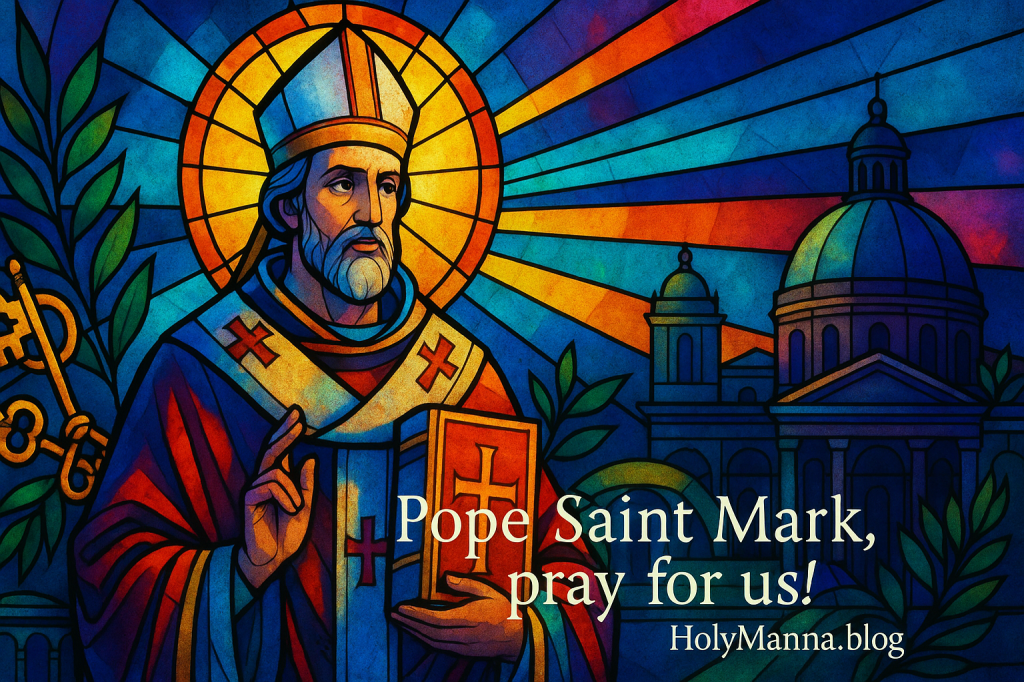
A Pontiff of Quiet Power and Enduring Unity
Pope Saint Mark’s pontificate lasted only from January 18 to October 7 in the year 336, yet his impact is remembered for consolidating the Church’s unity and strengthening the shape of Roman liturgical life. He is revered as a pastor who confirmed longstanding Roman customs, fostered prayer by founding churches, and steadied the Church in the stormy years after the Council of Nicaea. The Catechism of the Catholic Church teaches that the Pope, as successor of Saint Peter, serves the communion of the whole Church. “The Pope, Bishop of Rome and Peter’s successor, is the perpetual and visible source and foundation of the unity both of the bishops and of the whole company of the faithful.” (Catechism of the Catholic Church, 882). Pope Saint Mark embodied this service in a short but fruitful span.
Roman Roots, Apostolic Task
Tradition records that Mark was a Roman by birth, the son of a man named Priscus. Little is known about his early formation, which is common for many third and fourth century pastors whose sanctity was measured more by fidelity than by surviving writings. His election came at a moment when the Church in Rome needed a shepherd to maintain orthodoxy and order in the wake of intense theological conflict over the divinity of Christ. Mark’s life is remembered above all for confirming the custom that the Bishop of Ostia would be principal consecrator of a newly elected Bishop of Rome and for fostering the Church’s worship through the founding of churches. These acts reveal what he is most known for. He guarded apostolic succession, established clear rites around the papacy, and provided places where the faithful could gather to praise God. The Catechism reminds us that this continuity is not merely institutional, but sacramental. “In order that the mission entrusted to them might be continued after their death, the apostles consigned, by will and testament, as it were, to their immediate collaborators the duty of completing and consolidating the work they had begun.” (Catechism of the Catholic Church, 861).
Builders of Stones and of Communion
Pope Saint Mark is associated with the construction or dedication of two churches in Rome that anchored Christian life in the city. One stands in the heart of Rome and is today known as San Marco, a living place of prayer that preserves his memory. The other was a cemetery church near the Catacomb of Balbina along the Via Ardeatina, a solemn site where Christians honored their dead and professed faith in the Resurrection. These foundations show us the texture of his daily ministry. He was a pastor concerned with the unity of the Church at the altar. He was a bishop who ensured that the faithful had a calendar, a place, and a shepherd to guide their worship. In his brief time he confirmed the ancient Roman custom whereby the Bishop of Ostia presides at the consecration of a new pope, a sign that no man assumes the Petrine office by his own authority. Rather, the Church, through her bishops, receives a new successor of Peter for the sake of the flock. There are no reliably attested personal sayings of Pope Saint Mark that have come down to us. His legacy is written instead in the living practices of the Church. As the Catechism puts it, “The Roman Pontiff, by reason of his office as Vicar of Christ, has full, supreme, and universal power over the whole Church.” (Catechism of the Catholic Church, 882), a reality served and safeguarded by customs he confirmed.
Steadfast Under Pressure, Faithful to the End
Mark’s pontificate unfolded amid fierce debates surrounding the Nicene confession that the Son is consubstantial with the Father. While he did not die a martyr, his task required courage. He had to keep communion intact, to honor the council’s teaching, and to preserve the peace of the Roman Church in a time when doctrine and politics were deeply intertwined. He died of natural causes on October 7, 336, and was buried near the Catacomb of Balbina. His witness was not marked by dramatic confrontations. Instead, it was marked by a steady hand and a pastor’s heart. The Catechism reminds us that holiness is often quiet and constant. “By canonizing some of the faithful, the Church recognizes the power of the Spirit of holiness within her.” (Catechism of the Catholic Church, 828). Pope Saint Mark’s holiness shines through his care for unity and worship.
Venerated in Rome, Honored Through the Ages
After his death, the faithful continued to honor Pope Saint Mark, especially in the churches connected with his name. Over the centuries his relics were reverenced, and his memory was woven into the Roman Church’s liturgical and devotional life. While there are no securely documented miracle stories attached to him either during life or after death, the Church has long recognized that God often sanctifies his people through pastors whose work is institutional, liturgical, and pastoral rather than spectacular. The basilica of San Marco in Rome preserves his name and invites pilgrims to pray for the grace to imitate his fidelity. In this sense, his most enduring sign is the communion he helped to strengthen. The living continuity of apostolic succession, the reverence for the holy mysteries, and the filial devotion to the See of Peter are fruits that continue to bless the Church.
Lessons for Today: Unity, Worship, and Fidelity in Small Things
Pope Saint Mark speaks to anyone who serves quietly and faithfully. His life teaches that strengthening the Church’s common prayer is evangelical. He shows that guarding apostolic succession and honoring the Pope are not abstract ideas but concrete ways of loving Christ and his Mystical Body. You can live this today by praying daily for your bishop and your pastor. You can make Sunday Mass the immovable center of your week and prepare for it by reading the Scriptures in advance. You can foster unity by speaking well of others, by refusing to spread gossip, and by choosing reconciliation over resentment. Where is the Lord inviting you to build up communion rather than win an argument? How might you let the Church’s calendar, the readings, and the lives of the saints shape your schedule rather than the other way around? The Catechism summarizes it beautifully. “The college or body of bishops has no authority unless united with the Roman Pontiff, Peter’s successor, as its head.” (Catechism of the Catholic Church, 883). That unity is not a theory. It is a gift to be received and a discipline to be lived.
Engage with Us!
I would love to hear your thoughts and reflections in the comments below.
- What stands out to you most about Pope Saint Mark’s quiet but lasting impact on the Church’s unity?
- How can you honor the Church’s liturgical life more intentionally in the coming week?
- What concrete step could you take to pray for and support your bishop, your pastor, and the Pope?
- When has fidelity in small things, not dramatic moments, borne fruit in your spiritual life?
Be encouraged to live a life of faith, grounded in the Church that Christ founded, and to do everything with the love and mercy Jesus taught us.
Pope Saint Mark, pray for us!
Follow us on Instagram and Facebook for more insights and reflections on living a faith-filled life.

 Holy Manna!
Leave a comment