Memorial of Our Lady of the Rosary – Lectionary: 462
Choosing the Better Part
Today we slow down to sit at the feet of Jesus with Mary, so that our listening ripens into repentance and mercy. On the Memorial of Our Lady of the Rosary, the Church remembers how Christians turned to meditative prayer in a time of crisis and were strengthened to act. The Rosary is a school of contemplation that fixes our gaze on Christ through the mysteries of His life, passion, and glory, shaping our hearts for conversion and mission. The Catechism teaches that Marian devotion leads us to her Son and fosters true worship of Christ (CCC 971), and it commends meditative prayer that engages the mind, imagination, and desire, so that the truths of faith take root and bear fruit (CCC 2707 to 2708, CCC 2698). In Jonah 3, a single day of preaching opens a great city to grace, as Nineveh hears the word, fasts, and turns from violence, and God shows mercy. Psalm 130 gives language to the penitent heart that prays “Out of the depths I call to you, Lord” and hopes because “with the Lord is mercy, with him is plenteous redemption.” In Luke 10:38–42, Mary sits close and listens, while Martha is pulled in many directions, and Jesus reveals the path that anchors all Christian life: “There is need of only one thing.” The thread is clear. Contemplation at the feet of the Lord flowers into repentance and merciful action. The Rosary trains us in this rhythm of listening and turning, of receiving and responding, so that our prayer becomes the doorway to conversion for us and an invitation to mercy for the world. Where is the Lord inviting you to pause, to listen with Mary, and to let that listening reshape your actions today?
First Reading – Jonah 3
Opening the Floodgates of Mercy
In Jonah 3, we step into the heart of a pagan metropolis that is suddenly interrupted by the word of the Lord. Assyrian Nineveh was famed for power and violence, yet the prophet’s reluctant proclamation becomes the catalyst for communal conversion. In the ancient Near Eastern world, royal decrees, fasting, and sackcloth were public signs of contrition. Israel’s Scriptures repeatedly link such signs with genuine turning of heart, not mere performance. On the Memorial of Our Lady of the Rosary, this scene becomes a mirror. Marian contemplation trains us to hear God’s voice and then respond in concrete repentance, which is exactly what Nineveh does. The Rosary is not flight from the world. It is the school in which listening at the feet of Jesus becomes the decision to turn from sin and to seek God’s mercy. How is the Lord inviting you to let your prayer lead to real change today?
Jonah 3
New American Bible (Revised Edition)
Jonah’s Obedience and the Ninevites’ Repentance. 1 The word of the Lord came to Jonah a second time: 2 Set out for the great city of Nineveh, and announce to it the message that I will tell you. 3 So Jonah set out for Nineveh, in accord with the word of the Lord. Now Nineveh was an awesomely great city; it took three days to walk through it. 4 Jonah began his journey through the city, and when he had gone only a single day’s walk announcing, “Forty days more and Nineveh shall be overthrown,” 5 the people of Nineveh believed God; they proclaimed a fast and all of them, great and small, put on sackcloth.
6 When the news reached the king of Nineveh, he rose from his throne, laid aside his robe, covered himself with sackcloth, and sat in ashes. 7 Then he had this proclaimed throughout Nineveh: “By decree of the king and his nobles, no man or beast, no cattle or sheep, shall taste anything; they shall not eat, nor shall they drink water. 8 Man and beast alike must be covered with sackcloth and call loudly to God; they all must turn from their evil way and from the violence of their hands. 9 Who knows? God may again repent and turn from his blazing wrath, so that we will not perish.” 10 When God saw by their actions how they turned from their evil way, he repented of the evil he had threatened to do to them; he did not carry it out.
Detailed Exegesis
Verse 1 – “The word of the Lord came to Jonah a second time”
Jonah receives a renewed call. God’s mercy reaches not only sinners in Nineveh but also the hesitant prophet. The second summons reveals divine patience and the permanence of mission. God does not revoke His gifts.
Verse 2 – “Set out for the great city of Nineveh, and announce to it the message that I will tell you.”
The initiative is God’s. Jonah is to speak what he receives. Authentic preaching begins in listening. This pattern anticipates Marian discipleship. Mary listens, receives, and then magnifies the Word.
Verse 3 – “So Jonah set out for Nineveh, in accord with the word of the Lord. Now Nineveh was an awesomely great city; it took three days to walk through it.”
Jonah’s obedience unlocks grace. The detail about three days underscores the city’s scale and the daunting scope of the task. Grace meets human weakness when obedience begins.
Verse 4 – “Jonah began his journey through the city, and when he had gone only a single day’s walk announcing, ‘Forty days more and Nineveh shall be overthrown,’”
The message is stark and brief. Forty evokes biblical seasons of testing and transformation. The threat is medicinal. It exposes sin and summons hope. The word overthrown can imply either destruction or a turning over that becomes conversion. The ambiguity invites repentance.
Verse 5 – “The people of Nineveh believed God; they proclaimed a fast and all of them, great and small, put on sackcloth.”
Faith precedes reform. Believing God leads to fasting and visible signs of sorrow. The scope is total. From greatest to least, the city acts. True repentance is personal and communal.
Verse 6 – “When the news reached the king of Nineveh, he rose from his throne, laid aside his robe, covered himself with sackcloth, and sat in ashes.”
The king descends from royal height into humility. His posture embodies Psalm language of contrition. Leadership in penance matters. When the shepherd turns, the flock can follow.
Verse 7 – “Then he had this proclaimed throughout Nineveh: ‘By decree of the king and his nobles, no man or beast, no cattle or sheep, shall taste anything; they shall not eat, nor shall they drink water.’”
The fast is radical and comprehensive. Even the animals are included to dramatize the city’s total plea. The point is not spectacle. It is an appeal to God’s compassion from every corner of civic life.
Verse 8 – “Man and beast alike must be covered with sackcloth and call loudly to God; they all must turn from their evil way and from the violence of their hands.”
Prayer and ethics meet. Calling to God without turning from violence is hollow. Nineveh names its sin. Repentance is not vague remorse. It is concrete rejection of evil patterns.
Verse 9 – “Who knows? God may again repent and turn from his blazing wrath, so that we will not perish.”
Hope humbles itself before God’s freedom. The king does not presume on mercy. He asks. The Rosary forms this humble hope by leading us to contemplate Christ’s mercy again and again.
Verse 10 – “When God saw by their actions how they turned from their evil way, he repented of the evil he had threatened to do to them; he did not carry it out.”
God’s response confirms a biblical constant. Divine judgment aims at salvation. When sinners turn, God reveals the deeper will to forgive. Mercy has the last word.
Teachings
The Catechism describes the inner reality on display in Nineveh: “Interior repentance is a radical reorientation of our whole life, a return, a conversion to God with all our heart, an end of sin, a turning away from evil, with repugnance toward the evil actions we have committed.” (CCC 1431). It also situates our confession within God’s faithfulness: “God is rich in mercy… If we say we have no sin, we deceive ourselves, and the truth is not in us. If we confess our sins, he is faithful and just, and will forgive our sins and cleanse us from all unrighteousness.” (CCC 1847). Concerning meditative prayer, which the Rosary cultivates, The Catechism teaches: “Meditation engages thought, imagination, emotion, and desire. This mobilization of the faculties is necessary in order to deepen our convictions of faith, prompt the conversion of our heart, and strengthen our will to follow Christ.” (CCC 2708). It further notes the place of the Rosary in the Church’s prayer: “Medieval piety in the West developed the prayer of the Rosary, as a popular substitute for the Liturgy of the Hours.” (CCC 2678). Regarding Marian devotion and its Christ centered aim, The Catechism affirms: “The Church’s devotion to the Blessed Virgin is intrinsic to Christian worship.” It “differs essentially from the adoration which is given to the incarnate Word and equally to the Father and the Holy Spirit, and greatly fosters this adoration.” (CCC 971). Together these teachings illuminate Jonah 3: contemplation that listens to God’s word opens into concrete repentance, and God’s mercy responds.
Reflection
Nineveh shows that a single obedient word, heard and received, can transform an entire culture. The Rosary is our daily training in such obedience. As we ponder the mysteries of Christ with Mary, we learn to name our sins plainly, to turn from the violence of our hands, and to hope in God’s compassion. Begin with one small act of obedience today. Fast from a comfort that dulls your spiritual hearing. Make a sincere act of contrition and prepare for Confession. Repair a relationship where your words have wounded. Pray one decade slowly, listening for the Lord’s invitation to change one habit that blocks His mercy. Where is the Spirit highlighting a concrete step of turning in your life? What would it look like to let your prayer become action in your family, your workplace, or your city? Will you choose the better part today, and let that listening become mercy for others through you?
Responsorial Psalm – Psalm 130:1–4, 7–8
Hope in a God Who Listens
Psalm 130, long cherished in Israel’s worship and beloved in Christian prayer as the De Profundis, rises from the honest depths of human misery into the bright horizon of divine mercy. In Israel’s history this psalm gave voice to exiles, penitents, and mourners. In the Church it shapes the heart for contrition and confident hope. On the Memorial of Our Lady of the Rosary, this psalm becomes a pathway into Marian contemplation. Sitting with Mary at the feet of Jesus, our prayer learns to cry truthfully, to receive forgiveness, and to hope steadfastly. The Rosary trains this very movement. We descend into humility, we cling to the Lord’s mercy, and we rise with renewed courage to live differently. In this way Psalm 130 harmonizes with Jonah 3 and Luke 10:38–42: listening becomes repentance, and repentance flowers into merciful action.
Psalm 130:1-4
New American Bible (Revised Edition)
Prayer for Pardon and Mercy
1 A song of ascents.
Out of the depths I call to you, Lord;
2 Lord, hear my cry!
May your ears be attentive
to my cry for mercy.
3 If you, Lord, keep account of sins,
Lord, who can stand?
4 But with you is forgiveness
and so you are revered.
7 let Israel hope in the Lord,
For with the Lord is mercy,
with him is plenteous redemption,
8 And he will redeem Israel
from all its sins.
Detailed Exegesis
Verse 1 – “Out of the depths I call to you, Lord;”
The prayer begins in the abyss. The depths evoke waters of chaos, guilt, grief, and helplessness. True prayer does not mask the heart. It exposes the need before God. This honest cry stands at the threshold of conversion and anchors the Marian posture of humble listening.
Verse 2 – “Lord, hear my cry! May your ears be attentive to my cry for mercy.”
The petitioner begs for attentive hearing. The repetition of cry underscores urgency. Mercy is not demanded as a right but implored as a gift. This is the voice the Rosary forms in us as we repeatedly turn our eyes to Christ with Mary and consent to be heard and healed.
Verse 3 – “If you, Lord, keep account of sins, Lord, who can stand?”
Before God’s holiness no one can stand on personal merit. The verse disarms pride and invites contrition. It prepares the soul to receive forgiveness as sheer grace rather than achievement. This is the interior ground where repentance becomes possible.
Verse 4 – “But with you is forgiveness and so you are revered.”
The psalm links pardon with worship. Forgiveness reveals God’s beauty and inspires filial reverence. Awe does not spring from terror but from the wonder that God chooses to forgive. The fear of the Lord becomes grateful astonishment.
Verse 7 – “let Israel hope in the Lord, For with the Lord is mercy, with him is plenteous redemption,”
Personal lament expands into communal exhortation. Hope is commanded because God’s character warrants it. Plenteous redemption signals superabundance, not bare sufficiency. The psalmist calls the whole people to stake their future on the Lord’s steadfast love.
Verse 8 – “And he will redeem Israel from all its sins.”
The final note is promise. Redemption is not partial, nor is it theoretical. God acts to free His people from guilt’s burden and sin’s power. For the Christian who prays with Mary, this promise finds its center in Jesus whose Paschal Mystery we contemplate in the Sorrowful and Glorious Mysteries.
Teachings
The Catechism describes the interior stance of this psalm: “Prayer is the raising of one’s mind and heart to God. But when we pray, do we speak from the height of our pride and will, or ‘out of the depths’ of a humble and contrite heart? He who humbles himself will be exalted. Humility is the foundation of prayer; only when we humbly acknowledge that ‘we do not know how to pray as we ought,’ are we ready to receive freely the gift of prayer.” (CCC 2559). The grace we beg for is forgiveness, which The Catechism situates within God’s fathomless mercy: “God is rich in mercy and of great kindness. However, if we sin we do not despair, for ‘If we say we have no sin, we deceive ourselves, and the truth is not in us. If we confess our sins, he is faithful and just, and will forgive our sins and cleanse us from all unrighteousness.’” (CCC 1847). The hope that carries the psalmist is not vague optimism but a theological virtue. “Hope is the theological virtue by which we desire the kingdom of heaven and eternal life as our happiness, placing our trust in Christ’s promises and relying not on our own strength, but on the help of the grace of the Holy Spirit.” (CCC 1817). Concerning the contemplative school that shapes such prayer, The Catechism notes: “Meditation engages thought, imagination, emotion, and desire. This mobilization of the faculties is necessary in order to deepen our convictions of faith, prompt the conversion of our heart, and strengthen our will to follow Christ.” (CCC 2708). It also recalls the Church’s Marian pedagogy of prayer: “Medieval piety in the West developed the prayer of the Rosary, as a popular substitute for the Liturgy of the Hours.” (CCC 2678). Saint Teresa of Avila helps us hear the psalmist’s tone of intimacy: “Prayer is nothing else than an intimate sharing between friends. It means taking time frequently to be alone with Him who we know loves us.”
Reflection
Pray this psalm slowly as if it were the heartbeat of your Rosary today. Begin by naming your depths before God without pretense. Ask for attentive mercy. Confess where you have tried to stand on your own record and receive forgiveness as a gift. Then intercede for your family, parish, and city, inviting all to hope in the Lord who redeems. Choose one concrete act of hope that matches your prayer. Repair a strained relationship. Schedule Confession. Forgive someone by name. Give alms to break the cycle of self reliance. Pray one decade lingering on “with the Lord is mercy, with him is plenteous redemption.” From what depths do you need to cry today? How is the Lord inviting you to move from lament to hope? Where can your contemplative listening with Mary become a merciful action for someone else before the day ends?
Holy Gospel – Luke 10:38-42
Contemplative listening
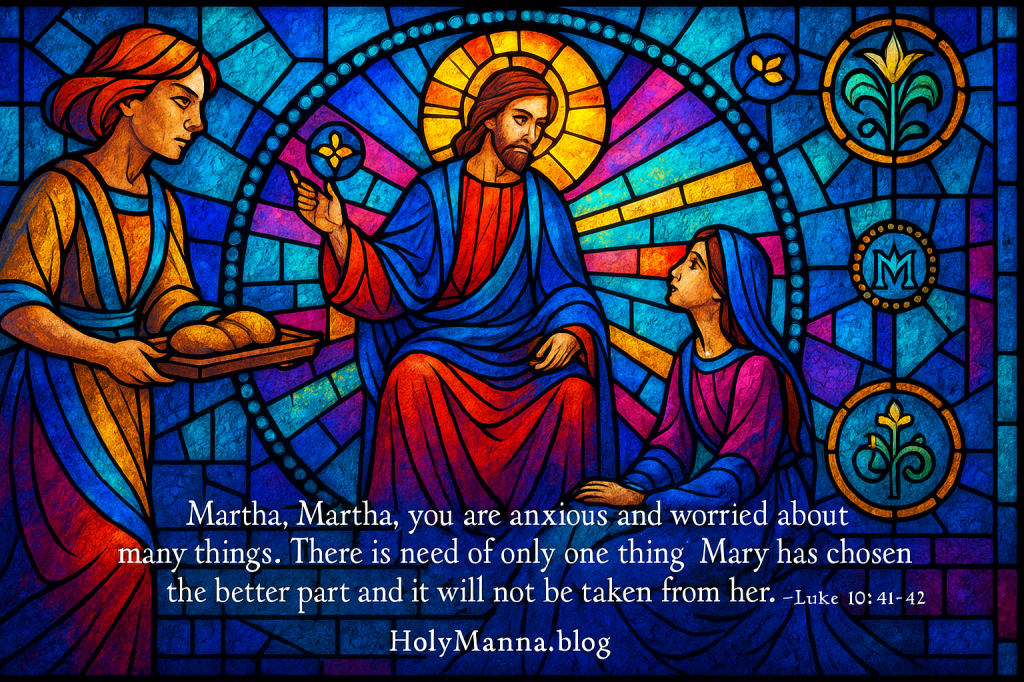
In Luke 10:38-42 we enter the travel narrative where Jesus moves toward Jerusalem, teaching what discipleship really means. In first century Jewish culture hospitality was a sacred duty, and Martha embodies that virtue by receiving the Lord into her home. Yet Luke highlights something even more striking. Mary takes the posture of a disciple who sits at a rabbi’s feet, which signals not passivity but active listening, learning, and surrender. Jesus does not reject service. He reorders it. He reveals that authentic action flows from contemplative attention to His word. On the Memorial of Our Lady of the Rosary, this scene becomes a living icon of Marian discipleship. Mary listens first, then love acts. The Rosary trains this rhythm of heart, where contemplation leads to conversion and mercy, the very pattern that unites Jonah 3 and Psalm 130 with today’s Gospel.
Luke 10:38-42
New American Bible (Revised Edition)
38 As they continued their journey he entered a village where a woman whose name was Martha welcomed him. 39 She had a sister named Mary [who] sat beside the Lord at his feet listening to him speak. 40 Martha, burdened with much serving, came to him and said, “Lord, do you not care that my sister has left me by myself to do the serving? Tell her to help me.” 41 The Lord said to her in reply, “Martha, Martha, you are anxious and worried about many things. 42 There is need of only one thing. Mary has chosen the better part and it will not be taken from her.”
Detailed Exegesis
Verse 38 – “As they continued their journey he entered a village where a woman whose name was Martha welcomed him.”
Martha’s welcome is real and good. Hospitality in Scripture is a concrete expression of love for God and neighbor. The Gospel begins by affirming the active life. Jesus enters the home and allows Himself to be served, which already dignifies Martha’s vocation.
Verse 39 – “She had a sister named Mary who sat beside the Lord at his feet listening to him speak.”
To sit at someone’s feet is the position of a disciple. Luke presents Mary as a true learner of the Word. Listening here is not idle. It is a chosen posture of receptivity that lets the Lord set the agenda. This anticipates the Rosary’s method of pondering Christ with Mary.
Verse 40 – “Martha, burdened with much serving, came to him and said, ‘Lord, do you not care that my sister has left me by myself to do the serving? Tell her to help me.’”
Martha’s service becomes heavy because it has been detached from the peace that comes from listening. Her complaint is familiar to all who try to love without first receiving love. Jesus invites her to bring even her frustration to Him, which is itself a kind of prayer.
Verse 41 – “The Lord said to her in reply, ‘Martha, Martha, you are anxious and worried about many things.’”
The double address is tender and personal. Jesus names anxiety and multiplicity. He does not condemn work, but He diagnoses the scattered heart. Distraction and interior noise suffocate charity at its source. The Lord calls Martha back to union with Himself.
Verse 42 – “There is need of only one thing. Mary has chosen the better part and it will not be taken from her.”
The one thing is communion with Jesus that orders every other thing. The better part is not a rejection of service. It is the wellspring that makes service free, joyful, and fruitful. What is chosen in contemplation cannot be stolen by circumstances. It abides.
Teachings
The Catechism describes contemplation in the simplest and most decisive terms: “Contemplation is a gaze of faith, fixed on Jesus.” (CCC 2715). It also explains how meditation prepares the heart for such a gaze: “Meditation engages thought, imagination, emotion, and desire. This mobilization of the faculties is necessary in order to deepen our convictions of faith, prompt the conversion of our heart, and strengthen our will to follow Christ.” (CCC 2708). The Rosary forms this Marian school of discipleship: “Medieval piety in the West developed the prayer of the Rosary, as a popular substitute for the Liturgy of the Hours.” (CCC 2678), and Marian devotion always leads us to her Son and fosters true worship of Him: “The Church’s devotion to the Blessed Virgin is intrinsic to Christian worship. It… greatly fosters this adoration.” (CCC 971). The Church also names our common struggle in prayer, which the Lord addresses in Martha: “The habitual difficulty in prayer is distraction.” (CCC 2729). Saint John Paul II draws the line from Mary of Bethany to the Rosary with luminous clarity in Rosarium Virginis Mariae: “To recite the Rosary is nothing other than to contemplate with Mary the face of Christ.”
Reflection
Begin today by choosing the one thing. Sit quietly for ten minutes and place yourself at the Lord’s feet. Pray one decade of the Rosary slowly, letting each mystery focus your attention on Jesus. Write down the top three anxieties that scatter your heart and surrender them to Christ by name. Then return to your responsibilities with renewed peace, serving like Martha but from Mary’s listening heart. What draws you away from the Lord’s feet most quickly? How can you build a daily habit of contemplative listening that anchors your work? Where is the Lord inviting you to transform restless activity into love that flows from His presence?
Praying the Rosary, Living Mercy
Today’s readings draw one golden thread. Sit at the feet of Jesus, listen like Mary, and let that listening become repentance that invites mercy. In Jonah 3 a reluctant prophet speaks and a violent city turns. God sees their actions and spares them. In Psalm 130 the penitent heart cries from the depths and learns to hope because “with the Lord is mercy, with him is plenteous redemption.” In Luke 10:38–42 Jesus names the center that orders everything else, “There is need of only one thing.” On the Memorial of Our Lady of the Rosary the Church hands us Marian contemplation as a daily way to choose that one thing. The Rosary is not an escape from the world. It is training in love that hears the Word, turns from sin, and becomes an instrument of mercy for others.
Here is the invitation. Pray the Rosary today with deliberate attention. Let each mystery guide you to a concrete act of conversion and charity. Examine your conscience and plan for Confession. Fast from a comfort that dulls your spiritual hearing. Reconcile with someone who has been hard to love. Offer a work of mercy for a person who suffers. Then return to your duties with Martha’s zeal, but from Mary’s peace. What is the one change the Lord is asking of you today? How will your contemplative prayer open a path of mercy for your family, parish, or city? Will you choose the better part and keep it by living it in love?
Engage with Us!
We would love to hear how the Lord is speaking to you. Please share your reflections in the comments below so we can pray and grow together.
- First Reading: Jonah 3. Where is God inviting you to a concrete turn of heart this week? How might your private repentance bear public fruit that brings mercy to others? What step of obedience could you take today that would open space for God to act in your home or city?
- Responsorial Psalm: Psalm 130:1-4, 7-8. From what depths do you need to cry out to the Lord with honesty and hope? How does remembering that “with the Lord is mercy, with him is plenteous redemption” change the way you approach Confession and daily prayer? Whom is the Holy Spirit urging you to encourage so that they will hope in the Lord as well?
- Holy Gospel: Luke 10:38-42. What practical habit will help you sit at Jesus’ feet each day before you serve? Where do worries and anxieties scatter your heart, and how can you surrender them to Christ so that you choose the better part? How will your contemplative listening shape the way you love your family, parish, and neighbors today?
May the peace of Christ guide your listening and your serving. Choose the better part, trust that “there is need of only one thing”, and do everything with the love and mercy Jesus taught us.
Sacred Heart of Jesus, we trust in You!
Immaculate Heart of Mary, pray for us!
Saint Michael the Archangel, defend us in battle!
Follow us on Instagram and Facebook for more insights and reflections on living a faith-filled life.

 Holy Manna!
Leave a comment