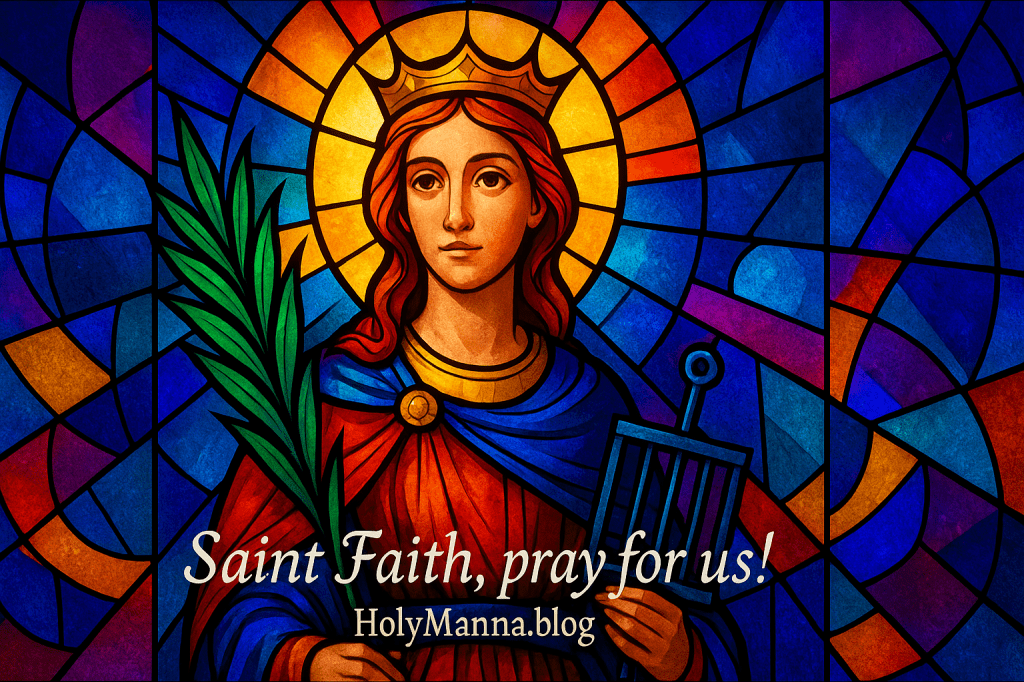
A Child’s Name, A Martyr’s Legacy
Saint Faith, or Fides in Latin and Sainte Foy in French, is a virgin martyr of Roman Gaul whose courageous witness ignited one of the most beloved pilgrimage traditions in medieval Europe. Celebrated on October 6, she is revered for her steadfast love of Jesus Christ, her purity of heart, and the extraordinary stream of miracles that came to be associated with her relics. Her story reminds the Church that holiness is not measured by length of life or number of accomplishments but by the depth of fidelity to Christ. “Martyrdom is the supreme witness given to the truth of the faith.” (Catechism of the Catholic Church, 2473).
Roots in Roman Gaul
Faith is traditionally said to have been born in Agen, an important town of Aquitania in southwest Roman Gaul. Ancient notices are brief, but they converge on a few points: she was young, she confessed Christ publicly, and she suffered for that confession. Some medieval traditions describe her as belonging to a respected family and being around twelve years old when officials required public sacrifice to the Roman gods. She refused and identified herself as a Christian. There are no authenticated writings of Saint Faith and no verifiable quotations preserved from her own lips. Later devotional texts sometimes place words of confession in her mouth, but the Church does not treat these as historically certain. What the Church does venerate with certainty is the radiant simplicity of her witness and the fruit it bore in the life of the faithful.
The Courage That Became Her Miracle
Unlike some saints, Faith is not remembered for a catalog of wonders during her lifetime. Her great sign was her unwavering fidelity to Jesus in the face of intimidation. Tradition holds that the prefect Dacian questioned her and ordered her to offer sacrifice. When she refused, she endured brutal torment. Some accounts add that her steadfastness inspired others in Agen, including Caprasius, to confess Christ. Faith’s importance lies in the clarity of her love. She shows Christians how to treasure the Lord above comfort, reputation, and even bodily safety. “We worship Christ as God’s Son; we love the martyrs as the Lord’s disciples and imitators.” (CCC 957). The very lack of self-concern in her witness is the miracle that calls believers in every age to a higher love.
Tested by Fire, Crowned in Glory
The oldest traditions agree that Faith was tortured and executed for her adherence to the Gospel. Later passions describe a red hot gridiron and, finally, beheading. While historians debate whether her death occurred under the Decian or the Diocletianic persecutions, all agree that she suffered in Agen and that her martyrdom quickly became a touchstone of Christian memory in the region. Her name appears among early martyr lists, and local devotion took root so firmly that her memory endured through centuries of upheaval. The Church sees in her story what it always proclaims about witnesses who shed their blood for Christ: “The martyr bears witness to Christ who died and rose, to whom he is united by charity.” (CCC 2473).
From Agen to Conques
Centuries after her death, the veneration of Saint Faith blossomed dramatically when her relics were translated to the abbey of Conques in the ninth century. Pilgrims traveling to Santiago de Compostela flocked to Conques to pray before her golden, jewel-encrusted reliquary statue. The monks recorded a cascade of favors: the restoration of sight to the blind, the healing of the sick, the liberation of captives, protection for the poor, and help for those facing injustice. A learned cleric named Bernard of Angers, initially skeptical, visited and gathered many of these accounts into what became known as The Book of Sainte Foy’s Miracles. The Church understands this veneration not as worship of an object but as love for the holy person it represents. “The honor rendered to an image passes to its prototype.” (CCC 2132). In the communion of saints, Faith’s intercession continues to bless the faithful. “Being more closely united to Christ, those who dwell in heaven… do not cease to intercede with the Father for us.” (CCC 956).
How Her Witness Reads Our Lives
Faith’s sanctity is disarmingly simple. She did not write treatises or found a great institution. She loved Christ and would not betray him. That purity of intention is a map for modern disciples. Ask her prayers for courage when the Gospel costs you popularity. Seek her help for those literally or spiritually imprisoned, for victims of oppression and injustice, and for the healing of blindness in body or soul. Let her childlike clarity reshape priorities. Begin the day with the Sign of the Cross and a short prayer of offering. Speak the name of Jesus with love when faced with pressure to compromise. Visit a church or chapel to pray before an image or relic of a saint, letting your heart be drawn to Christ. As the Catechism teaches of the saints, “Their intercession is their most exalted service to God’s plan.” (CCC 2683).
Engage with Us!
We would love to hear your thoughts and reflections in the comments below.
- Where is Christ inviting you to a bolder witness, even if it costs you comfort or reputation?
- How does venerating sacred images and relics, as the Church teaches, draw you closer to Jesus and the communion of saints?
- Which “prison” in your life needs Sainte Foy’s intercession—fear, resentment, a habit, or something else?
- What would childlike trust look like for you this week?
May Saint Faith of Agen pray that we live each day with courageous fidelity, and may we do everything with the love and mercy that Jesus taught us.
Saint Faith, pray for us!
Follow us on Instagram and Facebook for more insights and reflections on living a faith-filled life.

 Holy Manna!
Leave a comment