Monday of the Twenty-seventh Week in Ordinary Time – Lectionary: 461
Mercy That Pursues And Sends
Grace does not give up on us. It finds us in our flight, steadies us in the storm, and then sets us on the road to love. Today’s readings trace a single arc of conversion into mission: God’s mercy pursues the runaway heart so that it can become a merciful heart for others. In Jonah 1:1–2:11, the prophet tries to escape the divine call to preach in Nineveh, a famously violent Assyrian city. The Lord’s storm and the great fish are not punishments but instruments of rescue that draw Jonah into repentance and prayer. From the depths, Jonah discovers worship again, crying, “Out of my distress I called to the Lord, and he answered me.” (Jonah 2:3) The Responsorial Psalm drawn from Jonah 2:3–5, 8 echoes Israel’s temple spirituality, where even exile and Sheol are not beyond the reach of God’s presence. The Gospel situates us on the treacherous road from Jerusalem to Jericho in Luke 10:25–37, a setting known in antiquity for danger. Priests and Levites, representatives of Israel’s worship, pass by, while a Samaritan, a member of a community considered religiously compromised after the Assyrian exile, becomes the unlikely icon of covenant love. He sees, draws near, and spends himself. Jesus seals the teaching with the imperative of discipleship: “Go and do likewise.” (Luke 10:37) Read through the lens of The Catechism, the message is clear. Charity is the form of all the virtues and the path to eternal life (CCC 1822). The whole Law hangs upon love of God and love of neighbor (CCC 2055). The works of mercy are the concrete expression of that love in the wounds of the world (CCC 2447). The Lord who rescues Jonah is the same Lord who commands us to bind wounds on the roadside. Where is God’s mercy pursuing you today, and whom is He placing on your path to love?
First Reading – Jonah 1:1–2:1-2, 11
Runaway Prophet, Relentless Mercy
Nineveh stood as the feared heart of the Assyrian Empire, notorious in the ancient Near East for conquest and cruelty. God’s command to Jonah to preach there was not only a prophetic assignment but a shocking revelation of divine compassion toward enemies. Jonah fled toward Tarshish, a far western destination symbolizing escape to the edge of the known world, embarking from the port of Joppa. The Lord’s storm at sea, the casting of lots, and the prophet’s plunge into the deep reveal a God who disciplines in order to save, not to destroy. The pagan sailors move from fear to faith, offering sacrifice to the Lord, while Jonah descends into the belly of the great fish for three days and three nights, a descent that becomes a school of mercy. This reading prepares our hearts to recognize today’s theme. The God who pursues and rescues Jonah is the same God who will send us to bind the wounds of our neighbor. The movement from disobedience to repentance to renewed mission in Jonah 1–2 foreshadows the call to merciful action found in the Gospel and teaches us that grace does not abandon the runaway heart. It converts it and sends it.
Jonah 1:1–2:1-2, 11
New American Bible (Revised Edition)
Jonah’s Disobedience and Flight. 1:1 The word of the Lord came to Jonah, son of Amittai: 2 Set out for the great city of Nineveh, and preach against it; for their wickedness has come before me. 3 But Jonah made ready to flee to Tarshish, away from the Lord. He went down to Joppa, found a ship going to Tarshish, paid the fare, and went down in it to go with them to Tarshish, away from the Lord.
4 The Lord, however, hurled a great wind upon the sea, and the storm was so great that the ship was about to break up. 5 Then the sailors were afraid and each one cried to his god. To lighten the ship for themselves, they threw its cargo into the sea. Meanwhile, Jonah had gone down into the hold of the ship, and lay there fast asleep. 6 The captain approached him and said, “What are you doing asleep? Get up, call on your god! Perhaps this god will be mindful of us so that we will not perish.”
7 Then they said to one another, “Come, let us cast lots to discover on whose account this evil has come to us.” So they cast lots, and the lot fell on Jonah. 8 They said to him, “Tell us why this evil has come to us! What is your business? Where do you come from? What is your country, and to what people do you belong?” 9 “I am a Hebrew,” he replied; “I fear the Lord, the God of heaven, who made the sea and the dry land.”
10 Now the men were seized with great fear and said to him, “How could you do such a thing!”—They knew that he was fleeing from the Lord, because he had told them. 11 They asked, “What shall we do with you, that the sea may calm down for us?” For the sea was growing more and more stormy. 12 Jonah responded, “Pick me up and hurl me into the sea and then the sea will calm down for you. For I know that this great storm has come upon you because of me.”
13 Still the men rowed hard to return to dry land, but they could not, for the sea grew more and more stormy. 14 Then they cried to the Lord: “Please, O Lord, do not let us perish for taking this man’s life; do not charge us with shedding innocent blood, for you, Lord, have accomplished what you desired.” 15 Then they picked up Jonah and hurled him into the sea, and the sea stopped raging. 16 Seized with great fear of the Lord, the men offered sacrifice to the Lord and made vows.
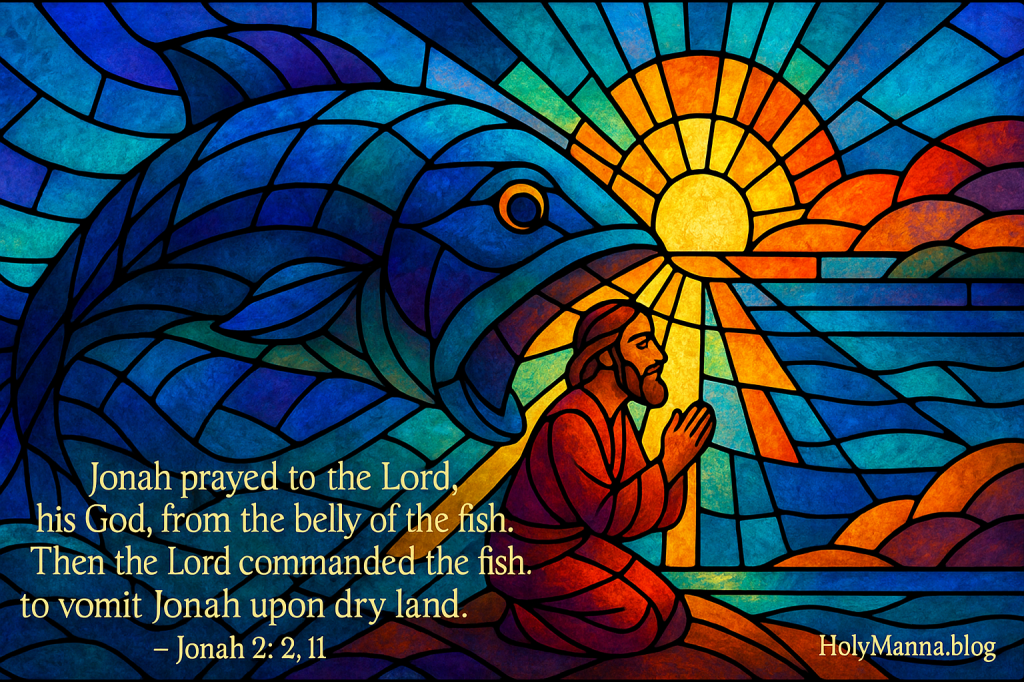
Jonah’s Prayer. 2:1 But the Lord sent a great fish to swallow Jonah, and he remained in the belly of the fish three days and three nights. 2 Jonah prayed to the Lord, his God, from the belly of the fish
11 Then the Lord commanded the fish to vomit Jonah upon dry land.
Detailed Exegesis
Verse 1:1 – “The word of the Lord came to Jonah, son of Amittai:”
God initiates mission. Prophecy begins not with human strategy but with the divine word. The identification of Jonah as son of Amittai roots him in Israel’s prophetic tradition and signals accountability to the covenant Lord.
Verse 2 – “Set out for the great city of Nineveh, and preach against it; for their wickedness has come before me.”
Nineveh’s greatness includes moral gravity. God’s justice sees human violence, yet His command to preach implies a will to save. The prophet’s message is a medicinal judgment ordered toward repentance.
Verse 3 – “But Jonah made ready to flee to Tarshish, away from the Lord. He went down to Joppa, found a ship going to Tarshish, paid the fare, and went down in it to go with them to Tarshish, away from the Lord.”
Jonah’s double descent signals spiritual decline. He attempts the impossible task of escaping God’s presence. Tarshish represents maximal distance, a refusal of mission rooted in fear or resentment toward God’s mercy for enemies.
Verse 4 – “The Lord, however, hurled a great wind upon the sea, and the storm was so great that the ship was about to break up.”
The Lord’s sovereign action is corrective, not capricious. The storm is a severe mercy meant to interrupt disobedience and rescue many lives, including Jonah’s.
Verse 5 – “Then the sailors were afraid and each one cried to his god. To lighten the ship for themselves, they threw its cargo into the sea. Meanwhile, Jonah had gone down into the hold of the ship, and lay there fast asleep.”
The pagan sailors display natural religiosity and practical prudence. Jonah’s sleep dramatizes spiritual stupor. He bears the word of life yet remains inactive while others perish.
Verse 6 – “The captain approached him and said, ‘What are you doing asleep? Get up, call on your god! Perhaps this god will be mindful of us so that we will not perish.’”
A pagan urges the prophet to pray. God can rebuke and awaken His servants through unexpected voices. Jonah’s vocation is recalled in the imperative to arise and call on God.
Verse 7 – “Then they said to one another, ‘Come, let us cast lots to discover on whose account this evil has come to us.’ So they cast lots, and the lot fell on Jonah.”
Casting lots reflects ancient discernment under divine providence. The lot reveals Jonah’s responsibility, not to humiliate him but to bring truth into the open as the necessary threshold of mercy.
Verse 8 – “They said to him, ‘Tell us why this evil has come to us! What is your business? Where do you come from? What is your country, and to what people do you belong?’”
The sailors press for identity. Sin is never merely private. Mission neglected endangers others. The interrogation invites Jonah to confess his vocation.
Verse 9 – “‘I am a Hebrew,’ he replied; ‘I fear the Lord, the God of heaven, who made the sea and the dry land.’”
Jonah’s creed is orthodox. He names the Creator who commands sea and land. Confession of true faith becomes the ground for repentance and hope.
Verse 10 – “Now the men were seized with great fear and said to him, ‘How could you do such a thing!’ They knew that he was fleeing from the Lord, because he had told them.”
The sailors grasp the incongruity of a believer fleeing the Lord of creation. Their fear begins to shift from superstition to genuine awe, edging toward wisdom.
Verse 11 – “They asked, ‘What shall we do with you, that the sea may calm down for us?’ For the sea was growing more and more stormy.”
Responsibility demands action. The question invites Jonah to accept sacrificial consequences rather than persist in denial.
Verse 12 – “Jonah responded, ‘Pick me up and hurl me into the sea and then the sea will calm down for you. For I know that this great storm has come upon you because of me.’”
Jonah finally owns his sin and offers himself for the life of others. Imperfect as it is, this is a movement toward self-gift that anticipates a greater saving sacrifice.
Verse 13 – “Still the men rowed hard to return to dry land, but they could not, for the sea grew more and more stormy.”
The sailors resist taking Jonah’s life. Their reluctance shows moral sensitivity already being purified by encounter with the true God.
Verse 14 – “Then they cried to the Lord: ‘Please, O Lord, do not let us perish for taking this man’s life; do not charge us with shedding innocent blood, for you, Lord, have accomplished what you desired.’”
They invoke the divine name and submit to God’s will. Their prayer reveals a conscience being formed by reverence and trust.
Verse 15 – “Then they picked up Jonah and hurled him into the sea, and the sea stopped raging.”
Obedience brings peace. Creation responds to the Creator’s order when human beings align with His will.
Verse 16 – “Seized with great fear of the Lord, the men offered sacrifice to the Lord and made vows.”
Conversion bears liturgical fruit. The sailors move from fear to worship, offering sacrifice and pledging fidelity.
Verse 2:1 – “But the Lord sent a great fish to swallow Jonah, and he remained in the belly of the fish three days and three nights.”
The descent becomes protection. The great fish is a vessel of mercy. The three days prefigure the mystery of burial and new life that God will unveil in fullness.
Verse 2 – “Jonah prayed to the Lord, his God, from the belly of the fish”
Mercy opens the mouth of prayer. Even in darkness, the covenant name summons hope. Jonah begins the return to mission through worship.
Verse 11 – “Then the Lord commanded the fish to vomit Jonah upon dry land.”
Deliverance follows repentance. The God who disciplines restores and recommissions. Dry land signals solid ground for obedience.
Teachings
The Catechism clarifies the arc on display in Jonah. The Catechism defines charity as the heart of Christian life. “Charity is the theological virtue by which we love God above all things for his own sake, and our neighbor as ourselves for the love of God.” (CCC 1822). It summarizes the law in love. “When asked which commandment in the Law is the greatest, Jesus answered: ‘You shall love the Lord your God with all your heart, and with all your soul, and with all your mind. This is the great and first commandment. And a second is like it: You shall love your neighbor as yourself. On these two commandments hang all the Law and the prophets.’” (CCC 2055). The works of mercy give that love tangible shape. “The works of mercy are charitable actions by which we come to the aid of our neighbor in his spiritual and bodily necessities.” (CCC 2447). God’s mercy calls us to ongoing conversion. “Christ’s call to conversion continues to resound in the lives of Christians.” (CCC 1428). Receiving mercy requires truth about sin. “To receive his mercy, we must admit our faults.” (CCC 1847). The sacramental life keeps us on this path of return and mission. “The Church has always understood that she is entrusted with the power of the keys of the kingdom… reconciliation with God by the sacrament of Penance.” (CCC 1446).
The saints illuminate mercy’s shape. St. Thomas Aquinas describes mercy as a movement of the heart that acts. “Mercy signifies heartfelt sympathy for another’s distress, impelling us to succor him if we can.” (St. Thomas Aquinas, Summa Theologiae II–II, q.30, a.1). St. Augustine reminds us of grace and human response. “God created us without us, but he did not will to save us without us.” (St. Augustine, quoted in The Catechism, CCC 1847). In Jonah, God’s prevenient mercy stirs the pagan sailors to worship and the runaway prophet to prayer, so that both may participate freely in God’s saving plan.
Reflection
God’s mercy does not coddle our flight. It intercepts it and turns it into a path of mission. If you feel far from God, remember that storms can be mercies that awaken prayer and bring you to solid ground again. Begin with truthful confession before the Lord. Ask for the grace to accept responsibility without despair, to pray in the depths, and to rise when God sets you back on shore. Then look for the neighbor on your path who needs your compassion today. Practice one concrete work of mercy for a person in distress, offer a sincere prayer for someone you struggle to love, and make reconciliation a habit rather than a last resort. Where have you been asleep to God’s call, and what would it look like to arise and pray today? What step of obedience is God asking of you that will bring peace to others as well as to your own heart? Whom is the Lord inviting you to serve so that your renewed love for Him becomes visible mercy for your neighbor?
Responsorial Psalm – Jonah 2:3–5, 8
From The Depths To The Temple
Jonah’s prayer rises from the belly of the great fish and from the symbolic brink of Sheol, the realm of the dead. In Israel’s worship, the temple represented the meeting place of heaven and earth, the locus of God’s presence and mercy. Even far from Zion and sunk beneath the waves, Jonah orients his heart toward that holy presence and discovers that no exile can silence covenant love. This psalm of distress and remembrance fits our theme perfectly. The God who pursues the runaway prophet also hears the voice that calls from the deep. Mercy lifts the penitent from chaos into renewed worship so that mission can begin again. The descent becomes a doorway to trust, and the memory of God becomes the path back to obedience.
Jonah 2:3-5, 8
New American Bible (Revised Edition)
3 Out of my distress I called to the Lord,
and he answered me;
From the womb of Sheol I cried for help,
and you heard my voice.
4 You cast me into the deep, into the heart of the sea,
and the flood enveloped me;
All your breakers and your billows
passed over me.
5 Then I said, “I am banished from your sight!
How will I again look upon your holy temple?”
8 When I became faint,
I remembered the Lord;
My prayer came to you
in your holy temple.
Detailed Exegesis
Verse 3 – “Out of my distress I called to the Lord, and he answered me; From the womb of Sheol I cried for help, and you heard my voice.”
Jonah names both his peril and God’s response. “Sheol” evokes radical separation and helplessness, yet the Lord hears. Prayer is not a last resort but the first confession of faith. Even in the place of death, God’s covenant fidelity remains near. This anticipates Christian hope that no depth can separate us from God’s mercy, which seeks the lost and answers the cry of repentance.
Verse 4 – “You cast me into the deep, into the heart of the sea, and the flood enveloped me; All your breakers and your billows passed over me.”
The language echoes creation themes in which the Lord commands the waters. Jonah recognizes divine sovereignty at work through the storm. The sea becomes a severe mercy that unmasks disobedience and prepares salvation. What looks like punishment can be purifying love that returns the sinner to truth.
Verse 5 – “Then I said, ‘I am banished from your sight! How will I again look upon your holy temple?’”
Jonah voices the ache of alienation. Yet the question about the temple signals faith that worship and reconciliation remain possible. To face the temple is to turn the heart toward God’s presence. Repentance begins when we ask how to return to worship and fidelity.
Verse 8 – “When I became faint, I remembered the Lord; My prayer came to you in your holy temple.”
Remembering God is the hinge of conversion. As strength fades, memory becomes adoration, and adoration becomes access. The temple is not a geographic limit for grace. It is the sign that God receives the contrite and renews their mission. Prayer travels where the body cannot, and God answers with rescuing mercy.
Teachings
Prayer is God’s initiative meeting our response. “God calls man first.” (CCC 2567). Jonah’s remembrance in the depths shows how grace awakens the heart to call upon the Name. The Church sees in Israel’s prayers a school for all believers. “The Psalms constitute the masterwork of prayer in the Old Testament.” (CCC 2589). Jonah’s psalm teaches that authentic prayer dares to bring fear, guilt, and hope before the Lord who saves. The restless cry of the human heart is answered by the God who is near. “You have made us for yourself, and our heart is restless until it rests in you.” (St. Augustine, Confessions I, 1). Jonah’s movement from despair to temple-faced trust also models the inner shape of repentance. “Christ’s call to conversion continues to resound in the lives of Christians.” (CCC 1428). Adoration focuses this conversion by placing God first. “To adore God is to acknowledge, in respect and absolute submission, the ‘nothingness of the creature’ who would not exist but for God.” (CCC 2097). In this psalm, adoration and petition fuse. The penitent remembers, turns, and is heard, and thus becomes ready to be sent.
Reflection
When the waters rise, begin with remembrance. Speak to God with honesty about your distress and your sin, and face the temple by turning your heart to the Lord in prayer. Make a simple plan today. Offer a sincere act of contrition. Return to the Sacrament of Reconciliation if it has been a while. Set times of prayer morning and evening, even if brief, and let your first words be thanksgiving for mercy. Ask God to show you the next step of obedience that will lead from prayer to concrete love for a neighbor in need. Where do you feel most “far” from God, and will you remember the Lord there today? What specific habit could you surrender so that your heart looks again toward the holy temple? Whom can you serve this week as the first fruit of the mercy you have received?
Holy Gospel – Luke 10:25–37
Love That Crosses The Road
On the steep and perilous road from Jerusalem to Jericho, Jesus tells a story that reframes the question of eternal life in terms of concrete mercy. The figures are familiar to first century Israel. A priest and a Levite, ministers of temple worship, meet a wounded man and pass by. A Samaritan arrives, a member of a people viewed with suspicion after centuries of religious and ethnic hostility, and he becomes the model of covenant fidelity. The road itself was notorious for danger, which makes the Samaritan’s lingering care costly and risky. Jesus places this parable within a dialogue about the heart of the Law. The scholar of the Law rightly cites the two great commandments, and Jesus unveils their measure. To love God truly is to love the neighbor who bleeds on our path. This Gospel fulfills today’s theme. The God who pursued Jonah and heard his cry now commands us to imitate divine mercy by drawing near, binding wounds, and spending ourselves for the good of another.
Luke 10:25-37
New American Bible (Revised Edition)
25 There was a scholar of the law who stood up to test him and said, “Teacher, what must I do to inherit eternal life?” 26 Jesus said to him, “What is written in the law? How do you read it?” 27 He said in reply, “You shall love the Lord, your God, with all your heart, with all your being, with all your strength, and with all your mind, and your neighbor as yourself.” 28 He replied to him, “You have answered correctly; do this and you will live.”
The Parable of the Good Samaritan. 29 But because he wished to justify himself, he said to Jesus, “And who is my neighbor?” 30 Jesus replied, “A man fell victim to robbers as he went down from Jerusalem to Jericho. They stripped and beat him and went off leaving him half-dead. 31 A priest happened to be going down that road, but when he saw him, he passed by on the opposite side. 32 Likewise a Levite came to the place, and when he saw him, he passed by on the opposite side. 33 But a Samaritan traveler who came upon him was moved with compassion at the sight. 34 He approached the victim, poured oil and wine over his wounds and bandaged them. Then he lifted him up on his own animal, took him to an inn and cared for him. 35 The next day he took out two silver coins and gave them to the innkeeper with the instruction, ‘Take care of him. If you spend more than what I have given you, I shall repay you on my way back.’ 36 Which of these three, in your opinion, was neighbor to the robbers’ victim?” 37 He answered, “The one who treated him with mercy.” Jesus said to him, “Go and do likewise.”
Detailed Exegesis
Verse 25 – “There was a scholar of the law who stood up to test him and said, ‘Teacher, what must I do to inherit eternal life?’”
A sincere question is mixed with a testing motive. The issue is eternal life, not mere legal correctness. Jesus will move the conversation from speculation to discipleship.
Verse 26 – “Jesus said to him, ‘What is written in the law? How do you read it?’”
Jesus honors the Law and invites personal appropriation. The second question presses the scholar beyond memory to interpretation and obedience.
Verse 27 – “He said in reply, ‘You shall love the Lord, your God, with all your heart, with all your being, with all your strength, and with all your mind, and your neighbor as yourself.’”
The scholar rightly unites Deuteronomy 6:5 with Leviticus 19:18. The whole person is summoned to love. Neighbor love flows from love of God and is its visible proof.
Verse 28 – “He replied to him, ‘You have answered correctly; do this and you will live.’”
Jesus confirms the summary but insists on action. The path to life is not only knowing the commandment but doing it.
Verse 29 – “But because he wished to justify himself, he said to Jesus, ‘And who is my neighbor?’”
Self-justification narrows the circle of responsibility. The scholar seeks limits. Jesus will answer by expanding vision and obligation.
Verse 30 – “Jesus replied, ‘A man fell victim to robbers as he went down from Jerusalem to Jericho. They stripped and beat him and went off leaving him half dead.’”
The wounded man is deliberately anonymous. His need, not his identity, defines the urgency. Violence strips him of markers that might invite tribal compassion.
Verse 31 – “A priest happened to be going down that road, but when he saw him, he passed by on the opposite side.”
The priest sees yet avoids. Concerns about ritual purity or danger may explain his distance, but the effect is failure to love. Sacred office does not excuse neglect of mercy.
Verse 32 – “Likewise a Levite came to the place, and when he saw him, he passed by on the opposite side.”
Repetition underlines the scandal. Two representatives of worship see and pass by. Seeing without compassion hardens the heart.
Verse 33 – “But a Samaritan traveler who came upon him was moved with compassion at the sight.”
The enemy becomes exemplar. Compassion moves from sight to sympathy and prepares for costly action. The heart of mercy beats in those we least expect.
Verse 34 – “He approached the victim, poured oil and wine over his wounds and bandaged them. Then he lifted him up on his own animal, took him to an inn and cared for him.”
Approach replaces avoidance. Oil and wine signify cleansing and soothing. The Samaritan sacrifices comfort and time. Mercy is practical, embodied, and attentive.
Verse 35 – “The next day he took out two silver coins and gave them to the innkeeper with the instruction, ‘Take care of him. If you spend more than what I have given you, I shall repay you on my way back.’”
Mercy plans for tomorrow. The Samaritan pledges ongoing responsibility. Charity is not a moment but a commitment.
Verse 36 – “Which of these three, in your opinion, was neighbor to the robbers’ victim?”
Jesus shifts the question. Neighbor is not primarily the one I choose to include. Neighbor is the identity I take on through merciful action.
Verse 37 – “He answered, ‘The one who treated him with mercy.’ Jesus said to him, ‘Go and do likewise.’”
The scholar must admit the truth. Jesus issues a command that sends every disciple onto the road of compassion. The final imperative echoes through Christian life.
Teachings
Charity is the soul of the moral life. “Charity is the theological virtue by which we love God above all things for his own sake, and our neighbor as ourselves for the love of God.” (CCC 1822). Jesus binds the Law to love. “When asked which commandment in the Law is the greatest, Jesus answered: ‘You shall love the Lord your God with all your heart, and with all your soul, and with all your mind. This is the great and first commandment. And a second is like it: You shall love your neighbor as yourself. On these two commandments hang all the Law and the prophets.’” (CCC 2055). The Church names the works of mercy as love in action. “The works of mercy are charitable actions by which we come to the aid of our neighbor in his spiritual and bodily necessities.” (CCC 2447). Mercy is not sentiment but movement toward the suffering. St. Thomas Aquinas explains its dynamism. “Mercy signifies heartfelt sympathy for another’s distress, impelling us to succor him if we can.” (St. Thomas Aquinas, Summa Theologiae II–II, q.30, a.1). The parable also exposes the temptation to limit love to our group. The Catechism teaches that the commandment of charity is universal and concrete. “This commandment is summed up in the Golden Rule: ‘Whatever you wish that men would do to you, do so to them.’” (CCC 1970). The neighbor is anyone in need whom God places on our path, and discipleship means becoming a neighbor through merciful deeds.
Reflection
Ask the Lord to train your eyes to see as the Samaritan saw and your feet to move as his feet moved. Begin where you are. Offer to help the person whose need you routinely pass by. Set aside time and resources each week for a work of mercy that costs you something, such as visiting the sick, feeding the hungry, or accompanying someone in distress. Return to prayer whenever compassion feels inconvenient, and ask for a heart that perseveres beyond a single moment. Whom have you avoided because it felt safer to cross the road, and what would it look like to draw near today? Where is the Lord inviting you to spend yourself generously, not only once but with committed care? How will you practice love of God this week by becoming a true neighbor to the wounded on your path?
Found By Mercy, Sent For Mercy
Today’s Word reveals one seamless movement of grace. In Jonah 1:1–2:2, 11, the runaway prophet is pursued, awakened, and restored so that he can be sent again. In the psalm from Jonah 2:3–5, 8, the cry from the deep becomes worship that faces the holy temple and trusts that God hears. In the Gospel, Luke 10:25–37 shows that the love of God reaches its full measure in concrete mercy toward the wounded neighbor. The same Lord who calms the sea and lifts Jonah from the depths now commands us to draw near, bind wounds, and persevere in compassionate care. Read with The Catechism, the path is clear. Charity is the heart of Christian life as taught in CCC 1822. The whole Law hangs upon love of God and love of neighbor as taught in CCC 2055. Works of mercy are love made visible as taught in CCC 2447. Receive mercy, remember the Lord, and then go and do mercy. Begin with honest prayer and a renewed confession of faith. Ask for a heart that sees need and a courage that crosses the road. Choose one deliberate work of mercy today. Visit someone who is ill, feed someone who is hungry, or reconcile with someone you have avoided. Let your worship become service, and your service become a living witness to the God who first loved you. “Go and do likewise.” (Luke 10:37) Where is God inviting you to remember Him in the depths today? Whom is He placing on your path so that your love for Him becomes care for them? What single step will you take now to let His mercy in you become mercy through you?
Engage with Us!
Share your reflections in the comments below so we can pray, learn, and grow together as one family in Christ.
- First Reading, Jonah 1:1–2:2, 11: Where might you be avoiding a hard call from the Lord, and what single act of obedience could you take today? How does Jonah’s descent and prayer help you interpret a present storm as a mercy that invites repentance and renewal?
- Responsorial Psalm, Jonah 2:3–5, 8: When you feel overwhelmed, what helps you remember the Lord and turn your heart toward worship? How will you face the “holy temple” today through honest prayer, thanksgiving, or reconciliation?
- Holy Gospel, Luke 10:25–37: Who is the wounded neighbor on your road right now, and how will you draw near with concrete mercy? What time, resource, or comfort are you willing to spend so your love of God becomes visible care for another?
Go forth with courage. Receive the mercy of God, remember His goodness, and let your worship overflow into a life of compassionate service. Live your faith with the love and mercy Jesus taught us, and let His grace make you a true neighbor to everyone you meet.
Sacred Heart of Jesus, we trust in You!
Immaculate Heart of Mary, pray for us!
Saint Michael the Archangel, defend us in battle!
Follow us on Instagram and Facebook for more insights and reflections on living a faith-filled life.

 Holy Manna!
Leave a comment