A Witness from the Black Sea
In the early fourth century, when Diocletian’s Great Persecution raged across the Roman Empire, a young Christian from Amisus in Pontus shone with a steady, uncompromising light. Charitina is revered as a virgin martyr whose life unites purity, courage, and a quiet zeal for evangelization. The Church honors her on October 5 and remembers her not for public achievements or writings, but for a steadfast fidelity that glorified Christ when it was most costly. Her story is a living catechesis on discipleship, chastity for love of Jesus, and the serene boldness that springs from hope in the Resurrection. The Catechism of the Catholic Church teaches, “Martyrdom is the supreme witness given to the truth of the faith.” (Catechism of the Catholic Church, 2473). In Charitina, that supreme witness is radiant and simple.
Formed by Grace in a Household of Faith
Charitina’s home was Amisus, a bustling Black Sea port in the province of Pontus, in what is now modern Samsun, Turkey. Orphaned at an early age, she was adopted by a Christian named Claudius, who raised her as his own daughter. In this domestic church, she learned the Scriptures, the discipline of prayer and fasting, and an affection for the poor. Tradition remembers her as gentle and sensible, a young woman who consecrated her virginity to Christ and set her heart on the kingdom of God. Some ancient accounts suggest she had not yet received sacramental Baptism when she was arrested, which is why later Christians saw in her witness a profound example of what the Church calls “baptism of blood.” The Catechism explains, “This Baptism of blood, like the desire for Baptism, brings about the fruits of Baptism without being a sacrament.” (Catechism of the Catholic Church, 1258). She is best known for steadfast charity and a quiet apostolate that drew others to Jesus by the force of a holy life.
Hidden Fire That Evangelizes
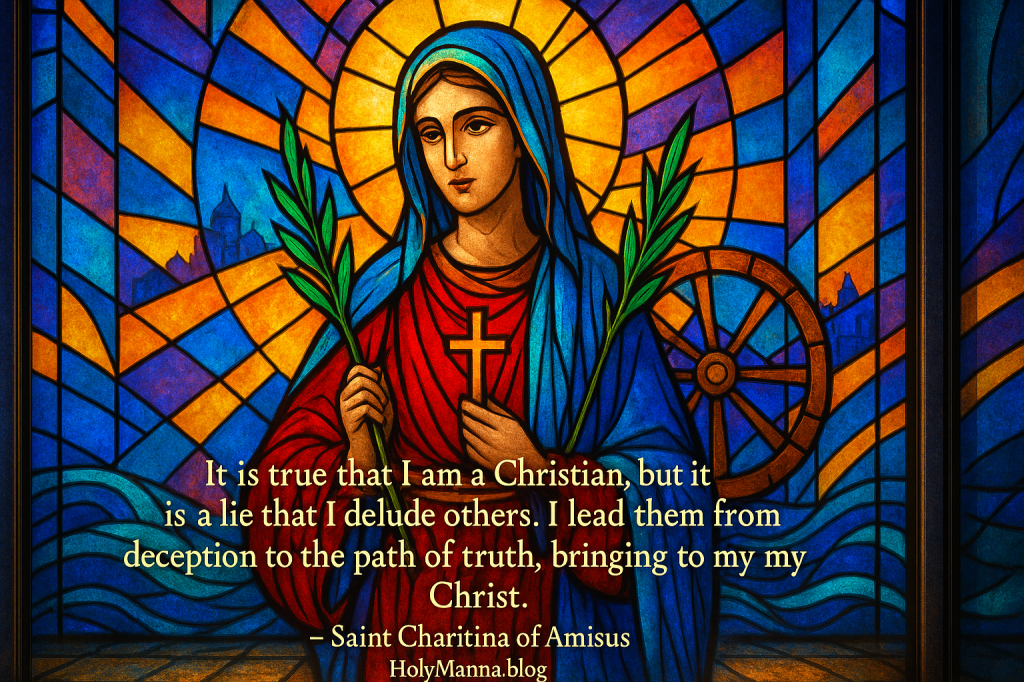
Charitina did not preach from pulpits. She evangelized by transparent holiness. Her prayer, fasting, modesty, and work of mercy became a quiet school of discipleship that attracted neighbors and acquaintances. When the local governor, Dometius, heard that converts were multiplying through her influence, he summoned her for interrogation. The ancient passion narratives remember her clear confession. According to the traditional account she declared, “It is true that I am a Christian, but it is a lie that I delude others. I lead them from deception to the path of truth, bringing them to my Christ.” There are no surviving personal writings from Charitina, and what we possess are hagiographical testimonies preserved in the Church’s memory. Even so, her attributed words illuminate the heart of her mission: she did not argue people into the Church, she loved them into the truth. Her daily fidelity is a reminder that the most persuasive apologetics often begin on one’s knees.
Baptized in Blood
The governor’s threats could not shake her peace. Traditional accounts describe a sequence of torments intended to humiliate and break her resolve. Her hair, a symbol of her consecration, was shorn in public mockery, then is said to have been miraculously restored to shame her accusers. Burning coals were heaped upon her head and vinegar poured over her wounds. With a stone tied to her, she was thrown into the sea. As the waves closed, the tradition preserves a brief cry of faith: “This is my Baptism.” God preserved her life and she reached the shore unharmed. She was then bound to a wheel set over burning coals, yet an angel is said to have halted the mechanism. Finally, when lawless men were sent to violate her, Charitina prayed that the Lord would receive her soul before she could be defiled. She died in prayer, a spotless offering to Christ, and thus received the martyr’s crown. Her passion is not a sensational tale; it is a sacrament-like sign that the Crucified and Risen Lord stands with his servants in the hour of trial.
Signs and Consolations During Her Suffering
The same tradition that recounts her tortures also records moments of divine consolation. The restoration of her hair, the extinguishing or reversal of devices meant to burn her, and her preservation from drowning were received by early Christians as assurances that Christ had not abandoned his handmaid. These are not spectacles for their own sake. They are reminders of what the Church teaches about God’s providence within suffering. Charitina’s endurance showed that grace can steady the heart even when the body is assaulted. Her confident invocation of Christ and her refusal to return malice for malice made her very life a living homily on purity of heart.
The Church Remembers
After her death, Christians reverently buried Charitina’s body, and devotion to her spread along the Black Sea coast and throughout the wider Church. Her name entered the calendars of East and West, and her witness was preserved in synaxaria and martyrologies. Over the centuries, Christians sought her intercession in trials that strike at human dignity, especially threats against purity and faith. While specific posthumous miracles are less detailed in surviving sources than those reported during her passion, the continuity of her cult and the enduring confidence of the faithful stand as a testimony to the fruitfulness of her intercession. In every generation, martyrs like Charitina become luminous signposts, assuring the Church that love is stronger than death.
Reading Charitina with the Church
Charitina’s consecrated virginity, her clarity in confession, and her meek courage echo the Church’s perennial teaching on chastity and witness. The Catechism exhorts all of us, “All the baptized are called to chastity.” (Catechism of the Catholic Church, 2348). Chastity is not a sterility of love but its purification and strength. In Charitina, chastity becomes apostolic. It frees the heart for undivided love of Christ and magnifies a person’s capacity to love others with reverence. Her martyrdom also draws us to the heart of Christian hope. The truth for which she died is not an idea but a Person. Because she belonged to Jesus, her final breath was a prayer, not a protest. The Church sees in her a daughter who loved the Bridegroom unto death, and in her story a summons to each of us to make our whole life a yes to God.
How Her Life Speaks to Us Today
Charitina teaches that holiness matures in hidden places. The disciplines that formed her soul were simple and accessible: daily prayer, fasting that made room for charity, modest speech, and humble service. Her witness invites us to begin again where we are. Speak the name of Jesus with clarity and gentleness. Practice chastity according to your state in life and let it become an evangelizing love. Fast from whatever weakens your freedom and give the savings to someone in need. When you face ridicule or pressure to compromise, remember the gentle firmness of this young saint from the Black Sea. The Lord may not spare you every hardship, but he will never leave you within it. If you feel unworthy or half converted, take heart. Charitina’s story assures us that God completes in love what we begin in faith.
Engage with Us!
We would love to hear your thoughts and prayer intentions in the comments below.
- Where is Christ inviting you to witness with clarity and gentleness this week?
- What concrete practice of chastity, fasting, or prayer can you adopt to let your love for Jesus grow hidden and strong like Charitina’s?
- Have you ever sensed God’s help in a moment of trial? How did that strengthen your faith?
- Whom might God be asking you to lead “from deception to the path of truth” by patient love and example?
- How does the Church’s teaching on the “baptism of blood” deepen your trust in God’s mercy?
Go in peace, live boldly in faith, and do everything with the love and mercy Jesus taught us.
Saint Charitina of Amisus, pray for us!
Follow us on Instagram and Facebook for more insights and reflections on living a faith-filled life.

 Holy Manna!
Leave a comment