Twenty-seventh Sunday in Ordinary Time – Lectionary: 141
Mustard-Seed Faith in God’s Timing
Come in close and breathe for a moment, because today’s Word invites a quiet courage that waits on God’s timing, listens to His voice, guards the gift, and serves without seeking applause. In Habakkuk 1:2–3; 2:2–4, a prophet cries out at the sight of violence and delay, yet God commands him to write the vision and to wait, promising that “it will surely come, it will not be late”, and that “the just one who is righteous because of faith shall live.” Psalm 95:1–2, 6–9 turns our waiting into worship and warns the heart against the wilderness sins of Meribah and Massah, urging, “Oh, that today you would hear his voice: do not harden your hearts.” In 2 Timothy 1:6–8, 13–14, an aging apostle in chains urges his spiritual son to rekindle grace with apostolic courage, “for God did not give us a spirit of cowardice but of power and love and self-control.” Finally, in Luke 17:5–10, Jesus answers the apostles’ plea for more faith with the image of a mustard seed and a servant who fulfills his duty, teaching that even the smallest faith, “the size of a mustard seed,” can accomplish the impossible, while humility keeps our hearts aligned with God as we say, “We are unprofitable servants; we have done what we were obliged to do.”
The central thread is persevering, obedient faith that trusts God’s appointed time, stays soft to His voice, guards the apostolic deposit, and expresses itself in humble service. Historically, Habakkuk voices Israel’s anguish as empires rise and injustice seems unrestrained, a setting that sharpens the call to trust the vision God sets before His people. Psalm 95 reaches back to the Exodus, when Israel tested the Lord at Meribah and Massah, reminding the Church that worship without obedience becomes hollow. Second Timothy likely comes from Paul’s final imprisonment, a sober moment in which the early Church needed courage to safeguard sound teaching under pressure. Luke 17 sits within Jesus’ journey to Jerusalem, where the way of the cross reframes greatness as faithful service. The Church teaches that faith is a theological virtue by which we believe in God and all He has revealed, it works through charity, it perseveres in trial, and it bears fruit in obedience and humble merit that is always God’s gift first and last, see CCC 162, CCC 1814–1816, and CCC 2006–2011. Where is God inviting you to wait trustingly, to listen today without a hard heart, to kindle your gift with courage, and to serve quietly for His glory?
First Reading – Habakkuk 1:2–3; 2:2–4
Waiting well when God seems silent
Habakkuk prophesies in a turbulent age when injustice festers within Judah and imperial threat looms from without. The prophet stands at the watchtower of history and cries out about violence in the streets, corruption in the courts, and anxiety in the hearts of God’s people. Into that ache, the Lord does not offer an instant fix. He commands a faithful posture. Write the vision. Wait for the appointed time. Live by faith. This passage anchors today’s theme of persevering, obedient faith. The just do not calculate God’s goodness by the speed of His interventions. They entrust themselves to His timing and they embody fidelity in the meantime. In canonical context, Habakkuk’s confession becomes a seed-text for the New Testament proclamation that righteousness is received and lived by faith, see Romans 1:17, Galatians 3:11, and Hebrews 10:38. In liturgical context, the Church hears this reading as a summons to keep listening, to keep worshiping, and to keep serving with humble confidence even when outcomes are delayed.
Habakkuk 1:2-3; 2:2-4
New American Bible (Revised Edition)
Habakkuk’s First Complaint
1:2 How long, O Lord, must I cry for help
and you do not listen?
Or cry out to you, “Violence!”
and you do not intervene?
3 Why do you let me see iniquity?
why do you simply gaze at evil?
Destruction and violence are before me;
there is strife and discord.
God’s Response
2:2 Then the Lord answered me and said:
Write down the vision;
Make it plain upon tablets,
so that the one who reads it may run.
3 For the vision is a witness for the appointed time,
a testimony to the end; it will not disappoint.
If it delays, wait for it,
it will surely come, it will not be late.
4 See, the rash have no integrity;
but the just one who is righteous because of faith shall live.
Detailed Exegesis
Verse 1:2: “How long, O Lord, must I cry for help and you do not listen? Or cry out to you, ‘Violence!’ and you do not intervene?”
Habakkuk speaks the ancient prayer of lament that faithful Israel knows by heart. The question “How long” does not accuse God of indifference. It dares to bring real anguish into covenant dialogue. The prophet names violence without euphemism and teaches the Church to pray honestly when God’s response seems deferred. Lament, in Scripture, is itself an act of trust because it keeps speaking to God rather than turning away.
Verse 3: “Why do you let me see iniquity? why do you simply gaze at evil? Destruction and violence are before me; there is strife and discord.”
The piling up of terms mirrors the piling up of injustices. The prophet feels implicated by what he sees. This verse exposes a perennial temptation to harden one’s heart when evil appears unchecked. The remedy, which the Lord will soon reveal, is not cynicism but faith that perseveres in righteousness even when public life is crooked.
Verse 2:2: “Then the Lord answered me and said: Write down the vision; Make it plain upon tablets, so that the one who reads it may run.”
God’s answer begins with inscription. Revelation is to be made public, legible, and actionable. To “make it plain” means the message must be taught and handed on with clarity. The command “so that the one who reads it may run” suggests urgency in obedience and mission. The Church sees here a pattern for apostolic proclamation. What God reveals is not for private hoarding but for the people’s conversion and perseverance.
Verse 3: “For the vision is a witness for the appointed time, a testimony to the end; it will not disappoint. If it delays, wait for it, it will surely come, it will not be late.”
God re-centers time around His promise. The “appointed time” belongs to Him. Waiting is not passive. It is the active fidelity of hope. This verse is a medicine against despair and against manipulative haste. It forms in us the steady confidence that God’s purposes arrive precisely when they should, neither prematurely nor too late.
Verse 4: “See, the rash have no integrity; but the just one who is righteous because of faith shall live.”
Two ways are set before us. Pride makes a person swollen and unstable. Faith renders a person upright and alive. This is not a call to mere optimism. It is a covenant claim that true life comes from trusting God and walking in His ways. The New Testament will cite this line to announce that God justifies and sustains the believer through faith, which then bears fruit in a life of obedience, see Romans 1:17, Galatians 3:11, and Hebrews 10:38.
Teachings
Habakkuk’s dialogue with God discloses the grammar of biblical faith. It prays honestly, receives revelation humbly, and perseveres obediently. The Church articulates this in the theological virtue of faith. The Catechism teaches, “Faith is the theological virtue by which we believe in God and believe all that he has said and revealed to us, and that Holy Church proposes for our belief, because he is truth itself.” CCC 1814. Because faith often matures in seasons of obscurity, the Catechism also teaches, “Believing is possible only by grace and the interior helps of the Holy Spirit.” CCC 154. It further acknowledges the darkness that can accompany fidelity, “Now, however, we walk by faith, not by sight; we perceive God as in a mirror, dimly, and only in part. Even though enlightened by him in whom it believes, faith is often lived in darkness and can be put to the test.” CCC 164. The prophetic command to “write the vision” resonates with the Church’s apostolic duty to hand on, guard, and proclaim the deposit of faith with clarity in every age, see 2 Timothy 1:13–14.
Saints echo Habakkuk’s wisdom about trusting God’s timing. Saint Augustine counsels, “Do not seek to understand in order to believe, but believe that you may understand.” This is not an anti-intellectual slogan. It is a recognition that trust opens the mind to God’s light. Saint John Paul II situates faithful waiting within a larger horizon of truth, writing in Fides et Ratio, “Faith and reason are like two wings on which the human spirit rises to the contemplation of truth.” As for the patience demanded by 2:3, Saint Pio of Pietrelcina offers a simple school of holiness that fits Habakkuk’s counsel: “Pray, hope, and do not worry.”
Historically, Habakkuk likely prophesied as Babylon ascended and Judah’s internal injustices multiplied. The Lord’s reply does not first disclose geopolitical outcomes. It forges a people capable of living righteously whatever the headlines may be. That formation remains the Church’s task in every age.
Reflection
When outcomes stall, the soul can either grow brittle or become refined. Habakkuk invites us to choose refinement. Bring your “How long” to the Lord with candor. Make His vision plain in your home and parish by studying and sharing the Word. Practice the disciplined hope of waiting without surrendering to despair or to shortcuts. Choose integrity over rashness in small choices today. Ask the Holy Spirit to deepen trust where you feel most anxious. Where have you been tempted to measure God’s faithfulness by the speed of His answers rather than by the certainty of His promise? What one concrete act of fidelity can you write down and live today while you wait for the appointed time? How might you make the vision plain for someone else through a word of encouragement, a work of mercy, or a moment of witness?
Responsorial Psalm – Psalm 95:1–2, 6–9
Worship that softens the heart and steadies the will
This psalm was likely used in Israel’s temple liturgy as a processional call to enter God’s presence with praise and to renew covenant fidelity. It intertwines joy and warning. The first movement invites exuberant worship of the Creator and Shepherd. The second recalls the wilderness failures at Meribah and Massah, when Israel tested the Lord despite His mighty works in the Exodus. Heard alongside Habakkuk 1:2–3; 2:2–4, 2 Timothy 1:6–8, 13–14, and Luke 17:5–10, Psalm 95 teaches that persevering, obedient faith begins in adoration and continues in docility. True worship softens the heart so that it can wait on God’s timing, guard the gift, and serve humbly without entitlement.
Psalm 95:1-2
New American Bible (Revised Edition)
A Call to Praise and Obedience
1 Come, let us sing joyfully to the Lord;
cry out to the rock of our salvation.
2 Let us come before him with a song of praise,
joyfully sing out our psalms.
6 Enter, let us bow down in worship;
let us kneel before the Lord who made us.
7 For he is our God,
we are the people he shepherds,
the sheep in his hands.
Oh, that today you would hear his voice:
8 Do not harden your hearts as at Meribah,
as on the day of Massah in the desert.
9 There your ancestors tested me;
they tried me though they had seen my works.
Detailed Exegesis
Verse 1: “Come, let us sing joyfully to the Lord; cry out to the rock of our salvation.”
The psalm opens with a summons that moves God’s people from private sentiment to communal praise. Calling the Lord the “rock” evokes stability and covenant faithfulness. Praise is not escapism. It is spiritual alignment that acknowledges God as the source and security of our salvation.
Verse 2: “Let us come before him with a song of praise, joyfully sing out our psalms.”
Approach is liturgical and relational. Israel draws near with thanksgiving because worship is a response to grace already received. Joyful singing is not optional flourish. It is fitting acknowledgment of who God is and what He has done.
Verse 6: “Enter, let us bow down in worship; let us kneel before the Lord who made us.”
Bowing and kneeling embody interior adoration. The Creator-creature distinction is confessed with the body so that the heart may be schooled in humility. The posture prepares the soul to receive instruction and correction.
Verse 7: “For he is our God, we are the people he shepherds, the sheep in his hands. Oh, that today you would hear his voice:”
Covenant identity grounds obedience. We belong to a Shepherd whose hands both form and protect. The urgent “today” makes worship a living encounter, not nostalgia. Hearing God’s voice implies consent and action, not mere acoustic reception.
Verse 8: “Do not harden your hearts as at Meribah, as on the day of Massah in the desert.”
Meribah and Massah name episodes where thirst and fear prompted grumbling and distrust, see Exodus 17 and Numbers 20. The warning is pastoral. Hardness begins subtly when memory of God’s works fades and self-protection becomes our reflex. The psalm calls for supple hearts that remain teachable.
Verse 9: “There your ancestors tested me; they tried me though they had seen my works.”
Testing God reverses the proper order. Creatures put the Creator in the dock despite abundant evidence of His care. The text exposes a spiritual amnesia that fuels disobedience. Remembering God’s deeds is therefore a moral act that sustains fidelity.
Teachings
The psalm’s movement from adoration to obedience mirrors the Church’s understanding of worship and faith. The Catechism teaches, “Adoration is the first act of the virtue of religion. To adore God is to acknowledge him as God, as the Creator and Savior, the Lord and Master of everything that exists, as infinite and merciful Love.” CCC 2096. Faith responds to that revelation with total surrender. The Catechism states, “By faith, man completely submits his intellect and his will to God. With his whole being man gives his assent to God the revealer.” CCC 143. Psalm 95’s “today” is taken up in the Church’s exhortation to perseverance. Hebrews 3:7–8 applies this psalm to the Christian life with the living word, “Today, if you hear his voice, do not harden your hearts.”
The saints echo this union of adoration and docility. Saint Augustine confesses in Confessions, “You have made us for yourself, O Lord, and our hearts are restless until they rest in you.” Restful worship becomes obedient love in daily choices. Saint Benedict teaches in his Rule, “Prefer nothing whatever to the love of Christ.” These voices illumine the psalm’s claim that genuine praise flowers into steadfast trust rather than testing God when trials come.
Historically, the memory of Meribah and Massah functioned as a national examen for Israel. Even after miracles, the human heart can drift toward suspicion. The liturgy therefore trains memory. By rehearsing God’s works and bowing before the Creator, the community resists the spiral of grumbling and remains ready to receive instruction and correction.
Reflection
Let your worship today be the school of your obedience. Begin with thanksgiving for concrete mercies and name them aloud, because gratitude tills the soil of the heart. Choose one bodily act of adoration, such as kneeling with attention, to let your posture catechize your soul. Practice remembrance by recounting how God has shepherded you through specific deserts, since memory heals distrust. When fear rises, refuse the reflex to test God with ultimatums. Pray instead, “Speak, Lord, your servant is listening,” and act on the next faithful step before you. Where is the Lord inviting you to move from grumbling to gratitude so your heart stays soft today? What act of humble adoration can you offer that will shape your willingness to obey His voice? How will you remember and retell one work of God this week so that testing gives way to trusting?
Second Reading – 2 Timothy 1:6–8, 13–14
Kindle the gift, carry the Cross, guard the deposit
Paul writes to Timothy from imprisonment near the end of his apostolic race, likely during a time when Rome’s suspicion of Christians was growing and the Church in Ephesus faced internal pressures and external hostility. In this cultural world shaped by honor and shame, public allegiance to a crucified Lord could cost one’s reputation, livelihood, and life. Paul therefore speaks with paternal urgency. He reminds Timothy of the grace conferred through the laying on of hands, calls him to courageous witness without embarrassment, and charges him to guard the apostolic teaching with the aid of the Holy Spirit. This reading fits today’s theme by showing that persevering faith is not passive waiting. It is a continual rekindling of grace that empowers humble service and steadfast fidelity to the Gospel’s content.
2 Timothy 1:6-8, 13-14
New American Bible (Revised Edition)
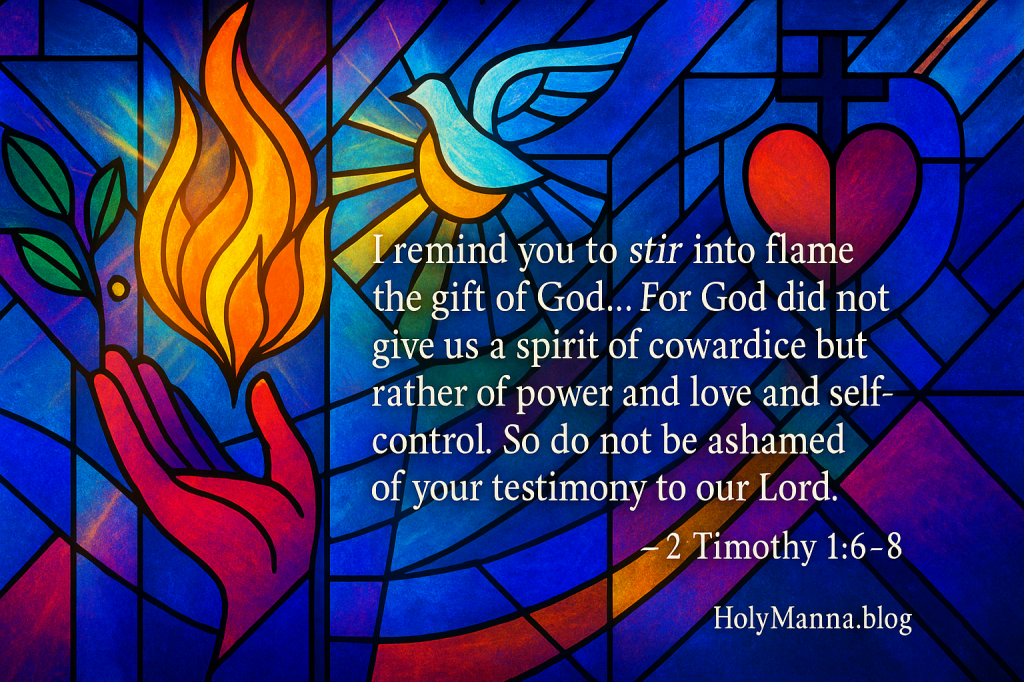
The Gifts Timothy Has Received. 6 For this reason, I remind you to stir into flame the gift of God that you have through the imposition of my hands. 7 For God did not give us a spirit of cowardice but rather of power and love and self-control. 8 So do not be ashamed of your testimony to our Lord, nor of me, a prisoner for his sake; but bear your share of hardship for the gospel with the strength that comes from God.
13 Take as your norm the sound words that you heard from me, in the faith and love that are in Christ Jesus. 14 Guard this rich trust with the help of the holy Spirit that dwells within us.
Detailed Exegesis
Verse 6: “For this reason, I remind you to stir into flame the gift of God that you have through the imposition of my hands.”
Paul evokes the sacramental and charismatic reality of Timothy’s ministry. The “imposition of my hands” points to the conferral of a grace for service, which Timothy must actively rekindle. Grace does not negate effort. It empowers it. To “stir into flame” suggests that gifts can lie dormant if not exercised through prayer, preaching, and pastoral charity.
Verse 7: “For God did not give us a spirit of cowardice but rather of power and love and self-control.”
The source of Christian courage is God’s own gift, not bravado. “Power” names the divine strength that enables witness. “Love” keeps ministry ordered to persons rather than to performance. “Self-control” (sound mind and disciplined will) guards the heart from panic and pride. Together they form the spiritual temperament of a shepherd who perseveres in trial.
Verse 8: “So do not be ashamed of your testimony to our Lord, nor of me, a prisoner for his sake; but bear your share of hardship for the gospel with the strength that comes from God.”
Shame in the ancient world policed behavior. Paul counters it with the honor of the cross. The apostle invites Timothy to accept the portion of suffering that accompanies authentic witness, not by gritting his teeth but by receiving strength from God. Solidarity with a chained apostle is solidarity with Christ himself.
Verse 13: “Take as your norm the sound words that you heard from me, in the faith and love that are in Christ Jesus.”
Doctrine and discipleship interpenetrate. Timothy must hold to a pattern of healthy teaching, yet do so “in faith and love,” which prevents orthodoxy from hardening into polemics. Truth is lived as well as taught.
Verse 14: “Guard this rich trust with the help of the Holy Spirit that dwells within us.”
The “rich trust” is the apostolic deposit. Guarding it is not a defensive retreat but a Spirit enabled stewardship that preserves, proclaims, and hands on the Gospel whole and entire. Fidelity to content is a work of love for the flock’s salvation.
Teachings
The Catechism describes faith, cooperation with grace, and the stewardship of the apostolic deposit with clarity. “Faith is the theological virtue by which we believe in God and believe all that he has said and revealed to us, and that Holy Church proposes for our belief, because he is truth itself.” CCC 1814. “Faith is an entirely free gift that God makes to man. We can lose this priceless gift. To live, grow, and persevere in the faith to the end we must nourish it with the word of God; we must beg the Lord to increase our faith; it must be ‘working through charity,’ abounding in hope, and rooted in the faith of the Church.” CCC 162. “In faith, the human intellect and will cooperate with divine grace.” CCC 155.
Regarding the “rich trust,” the Church teaches, “The apostles entrusted the ‘sacred deposit’ of the faith (the ‘depositum fidei’), contained in Sacred Scripture and Tradition, to the whole of the Church.” CCC 84. “Sacred Tradition and Sacred Scripture make up a single sacred deposit of the Word of God, which is entrusted to the Church.” CCC 97. The grace given “through the imposition of my hands” resonates with Holy Orders. “With the imposition of hands and the prayer of consecration, the grace of the Holy Spirit is given and a sacred character is impressed in such a way that bishops and priests are configured to Christ as Head and Shepherd and deacons to Christ as servant of all.” CCC 1538–1539 summarized in one sentence that expresses their core teaching. The humility that keeps ministry pure is safeguarded by the Church’s teaching on merit. “With regard to God, there is no strict right to any merit on the part of man.” CCC 2007. “The merit of man before God in the Christian life arises from the fact that God has freely chosen to associate man with the work of his grace.” CCC 2008. “Since the initiative belongs to God in the order of grace, no one can merit the initial grace of forgiveness and justification, at the beginning of conversion.” CCC 2010. “The charity of Christ is the source in us of all our merits before God.” CCC 2011.
The saints echo Paul’s charge. Saint John Paul II writes, “Faith and reason are like two wings on which the human spirit rises to the contemplation of truth.” Fides et Ratio. Saint Augustine counsels, “Do not seek to understand in order to believe, but believe that you may understand.” These voices underline that guarding the deposit is an act of trusting love animated by the Spirit.
Reflection
Ask the Lord to kindle the grace you have already received. Set a simple plan to pray daily with Scripture so that the Word keeps your heart courageous, loving, and disciplined. Name one place where shame or fear has muted your witness, and take one small step to speak of Jesus with charity and clarity. Review the pattern of sound teaching you have received, and choose one practice to guard it, such as studying the Creed, the sacraments, or a paragraph of The Catechism each day. Encourage a priest, deacon, or catechist this week, since their hands were once laid on for your salvation. Where do you need to ask for God’s strength to bear your share of hardship for the Gospel? What gift lies dormant that the Holy Spirit is prompting you to stir into flame today? How can you guard the rich trust in your home and parish through prayer, study, and humble witness?
Holy Gospel – Luke 17:5–10
Small faith, steadfast obedience, and the humility that keeps grace flowing
Luke places this scene within Jesus’ journey to Jerusalem, where he forms his disciples in the shape of the cross. The apostles ask for more faith because they sense the demands of discipleship and the scandal of the cross ahead. Jesus answers with two images from first century life. The first is the mustard seed, a tiny seed used proverbially for smallness, which he weds to a bold command about uprooting a hardy mulberry tree and planting it in the sea. The second is the ordinary household world of field labor and table service, where a servant fulfills duty before sitting to eat. Heard with Habakkuk 1:2–3; 2:2–4 and Psalm 95:1–2, 6–9, the Gospel teaches that the power of faith is not measured by size but by real trust that acts in humble obedience. In the economy of grace, God’s initiative comes first, our cooperation follows, and humility safeguards communion so that our service remains love rather than self-display.
Luke 17:5-10
New American Bible (Revised Edition)
Saying of Faith. 5 And the apostles said to the Lord, “Increase our faith.” 6 The Lord replied, “If you have faith the size of a mustard seed, you would say to [this] mulberry tree, ‘Be uprooted and planted in the sea,’ and it would obey you.
Attitude of a Servant. 7 “Who among you would say to your servant who has just come in from plowing or tending sheep in the field, ‘Come here immediately and take your place at table’? 8 Would he not rather say to him, ‘Prepare something for me to eat. Put on your apron and wait on me while I eat and drink. You may eat and drink when I am finished’? 9 Is he grateful to that servant because he did what was commanded? 10 So should it be with you. When you have done all you have been commanded, say, ‘We are unprofitable servants; we have done what we were obliged to do.’”
Detailed Exegesis
Verse 5: “And the apostles said to the Lord, ‘Increase our faith.’”
The apostles pray a perfect prayer for every disciple. They do not manufacture faith by effort alone. They ask the Lord to give what only he can give. This aligns with the Church’s confession that faith is God’s gift, even as we freely cooperate with it.
Verse 6: “The Lord replied, ‘If you have faith the size of a mustard seed, you would say to [this] mulberry tree, “Be uprooted and planted in the sea,” and it would obey you.’”
Jesus reframes quantity. Authentic faith, though small, participates in God’s authority. The mulberry tree is deep rooted and resilient, which heightens the image. Planting it in the sea is impossible on human terms, which underscores that grace, not technique, accomplishes what faith commands. The point is not spectacle. It is confidence in God’s power exercised in obedience to his will.
Verse 7: “Who among you would say to your servant who has just come in from plowing or tending sheep in the field, ‘Come here immediately and take your place at table’?”
Jesus shifts from power to posture. In a familiar household setting, hearers would expect duty before dinner. The question exposes our tendency to spiritual entitlement. Faith’s power must be yoked to a servant’s heart.
Verse 8: “Would he not rather say to him, ‘Prepare something for me to eat. Put on your apron and wait on me while I eat and drink. You may eat and drink when I am finished’?”
The image is provocative to modern ears, yet its moral is clear. Disciples serve God first. Spiritual gifts and labors remain ordered to his glory. Only then do servants share the joy of their master. The sequence protects us from using religious work to serve ourselves.
Verse 9: “Is he grateful to that servant because he did what was commanded?”
In the parable’s world, doing one’s duty does not create a claim on the master. Jesus is not discouraging gratitude or denying God’s tenderness. He is correcting the calculus of merit that would turn obedience into leverage. Grace always remains gift.
Verse 10: “So should it be with you. When you have done all you have been commanded, say, ‘We are unprofitable servants; we have done what we were obliged to do.’”
The Lord seals the teaching with the language of humble service. “Unprofitable” does not mean worthless. It means we cannot put God in our debt. Humility keeps faith pure. It frees us to serve because we love God, not because we seek spiritual credit.
Teachings
The Catechism describes faith and our cooperation with divine initiative with precision. It teaches, “Faith is the theological virtue by which we believe in God and believe all that he has said and revealed to us, and that Holy Church proposes for our belief, because he is truth itself.” CCC 1814. Faith is God’s gift that must be nourished and asked for daily. The Catechism states, “Faith is an entirely free gift that God makes to man. We can lose this priceless gift. To live, grow, and persevere in the faith to the end we must nourish it with the word of God; we must beg the Lord to increase our faith; it must be ‘working through charity,’ abounding in hope, and rooted in the faith of the Church.” CCC 162. Our response is real cooperation. The Catechism teaches, “In faith, the human intellect and will cooperate with divine grace.” CCC 155.
The servant parable illumines Christian humility and merit. God’s grace precedes, accompanies, and follows our action. Therefore, “With regard to God, there is no strict right to any merit on the part of man.” CCC 2007. Yet the Father dignifies our cooperation. “The merit of man before God in the Christian life arises from the fact that God has freely chosen to associate man with the work of his grace.” CCC 2008. All begins with God’s initiative. “Since the initiative belongs to God in the order of grace, no one can merit the initial grace of forgiveness and justification, at the beginning of conversion.” CCC 2010. The very source of any true merit is charity infused by Christ. “The charity of Christ is the source in us of all our merits before God.” CCC 2011. These teachings protect the Gospel’s balance. Even mustard seed faith can do the impossible because God acts. And even great labors do not put God in our debt because we remain beloved servants whose very capacity to serve is grace.
The wider scriptural witness clarifies the nature of faith’s power. “Faith is the realization of what is hoped for and evidence of things not seen.” Hebrews 11:1. Jesus’ teaching on humble service resonates with his self description, “The Son of Man did not come to be served but to serve and to give his life as a ransom for many.” Matthew 20:28. The Church therefore reads Luke 17:5–10 as a school of trust and a school of love, where power flows through obedient hearts that make themselves servants after the Heart of Christ.
Reflection
Ask for faith today with the same simplicity as the apostles. Name your need before the Lord and receive faith as gift. Then act on it in small obedience. Speak one mustard seed command against sin or fear in your life, and take one concrete step of trust that aligns with God’s will. Choose the servant posture in hidden ways. Serve someone without announcing it, and offer the labor to God alone. When you complete a duty, resist the urge to tally spiritual credit. Thank God for the grace to have served at all. Where is Jesus inviting you to move from wishing for greater faith to exercising the mustard seed you already have? What duty before you today can become an offering of love that keeps you lowly and free? How might you let humility guard your prayer, your ministry, and your relationships so that all your service remains for the glory of God?
Today, If You Hear His Voice
Today’s Word gathers into a single call: trust God’s timing, keep your heart soft to His voice, guard the grace you have received, and serve with humble love. In Habakkuk 1:2–3; 2:2–4, the Lord teaches waiting that is active and courageous, promising, “If it delays, wait for it, it will surely come, it will not be late,” and sealing it with the covenant heartbeat, “the just one who is righteous because of faith shall live.” Psalm 95:1–2, 6–9 turns that faith into worship that listens, “Oh, that today you would hear his voice: do not harden your hearts.” 2 Timothy 1:6–8, 13–14 commands us to rekindle grace and to keep the deposit whole, “for God did not give us a spirit of cowardice but of power and love and self-control.” Luke 17:5–10 crowns the message with a disciple’s posture before the Master, where even tiny faith moves the impossible while humility keeps us free, “We are unprofitable servants; we have done what we were obliged to do.”
Let this be your path today. Ask like the apostles, “Increase our faith,” then act on the mustard seed you already have. Write God’s vision into your habits, your calendar, and your conversations so that others may run toward Him. Enter prayer with praise, kneel with attention, and keep your heart tender to correction. Guard the gift of the Gospel with fidelity that is strong, gentle, and self controlled. Serve in hidden ways for the Father’s eyes alone, and give Him thanks for the grace to have served at all. The Church teaches that faith believes, trusts, and obeys, see CCC 1814–1816, and that perseverance often grows in darkness, see CCC 164, while every true merit springs from grace and charity, see CCC 2008–2011. Where is the Lord inviting you to wait trustingly for His appointed time? What concrete act of obedience will you offer today so that your worship becomes life? Whom will you serve quietly, letting humility keep your love pure?
Engage with Us!
We would love to hear your reflections in the comments below. Share how the Lord is speaking to you through today’s Scriptures and how you plan to respond in faith.
- First Reading – Habakkuk 1:2–3; 2:2–4: Where are you praying “How long, O Lord” and what concrete act of trust will you take while you wait for God’s appointed time? How will you “write the vision” in your life so that you and others may run with it in fidelity to God’s promise?
- Responsorial Psalm – Psalm 95:1–2, 6–9: What specific act of adoration will keep your heart soft so that you can respond to “Today, if you hear his voice” with obedience? Where have you slipped toward Meribah and Massah patterns of grumbling, and how will you replace them with grateful remembrance of God’s works?
- Second Reading – 2 Timothy 1:6–8, 13–14: Which grace will you “stir into flame” this week through prayer, study, and service, trusting that “God did not give us a spirit of cowardice but of power and love and self-control”? How will you guard the deposit of faith in your home and parish with the help of the Holy Spirit who dwells within you?
- Holy Gospel – Luke 17:5–10: Where will you exercise mustard seed faith today by taking one small step of obedient trust that you have been postponing? What hidden act of service will you offer for the glory of God alone, echoing “We are unprofitable servants; we have done what we were obliged to do.”?
May the Lord bless you with persevering faith, a tender listening heart, and the courage to serve with humility. Live a life of faith and do everything with the love and mercy Jesus taught us.
Sacred Heart of Jesus, we trust in You!
Immaculate Heart of Mary, pray for us!
Saint Michael the Archangel, defend us in battle!
Follow us on Instagram and Facebook for more insights and reflections on living a faith-filled life.

 Holy Manna!
Leave a comment