A Shepherd Who Rebuilt a City
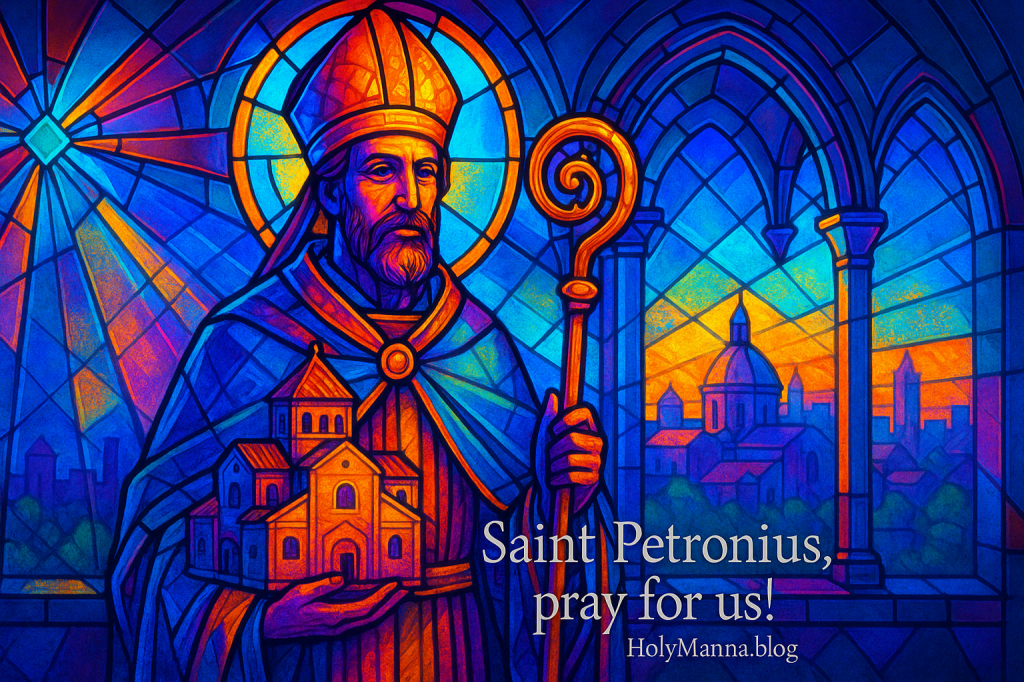
Saint Petronius, fifth century bishop and patron of Bologna, stands as a model of pastoral courage in a world that was coming apart. He guided his flock during the slow collapse of the Western Roman Empire and gave his people a visible way to contemplate the mysteries of Christ by shaping a sacred landscape right in their city. His feast is kept on October 4 in Bologna, and he is often depicted holding a small model of the city he loved and served. Petronius is remembered for steady government, tender care of the poor, and a theological imagination that turned stone and street into catechesis.
From Roman Nobility to Holy Pastor
Ancient witnesses describe Petronius as a man from a noble Roman family who was formed in Christian devotion and public responsibility. Traditions speak of his familiarity with travel and with the Christian East. These experiences likely deepened his love for the Holy Land and for monastic devotion. Around the year 432 he became bishop of Bologna. The call was not to a quiet office but to a demanding service in a city shaken by political insecurity and social need. Petronius took that moment as a summons to evangelize by example. He lived simply, fostered ascetical life, and dedicated himself to rebuilding churches as he rebuilt hearts.
The Pastor Who Built a Little Jerusalem
Petronius is best known for initiating the Santo Stefano complex in Bologna. The ensemble was conceived as a local echo of Jerusalem. Within one precinct the faithful encountered chapels that recalled the Passion and the Holy Sepulchre, along with spaces that invited meditation on the trial of Jesus and the hill of Calvary. Petronius turned architecture into a living homily. He taught his clergy and people that the Church prays with her feet and her eyes as well as with her lips. Walking from court to chapel and from chapel to tomb trained the heart to enter the Paschal Mystery. In a time without easy pilgrimage, he gave his city a path to the Lord’s own city.
Holiness in Action More Than in Anecdote
Unlike later medieval saints, Petronius left no catalog of spectacular miracle tales from his lifetime. His sanctity is measured by the endurance of what he built and by the conversion it inspired. The Church reminds us that canonization points to God’s work within the members of Christ. “By canonizing some of the faithful, the Church recognizes the power of the Spirit of holiness within her.” The Catechism of the Catholic Church (CCC 828). Petronius’s daily faithfulness, his defense of sound doctrine, and his care for the poor were the signs that mattered most. He made holiness credible by forming a community that prayed, learned, and served together.
Burdens Carried With the Heart of a Shepherd
Petronius did not die a martyr. His trials were the slow pressures of a fractured age. He faced civic instability, poverty, and the fear that follows borderland incursions. He shouldered the tasks of reconciling factions, strengthening discipline among clergy, and consoling the wounded. The Church’s teaching on the pastoral office reads like a portrait of his ministry. “The good shepherd lays down his life for the sheep.” The Gospel of John 10:11. Petronius poured out his life in patient leadership and died around the middle of the fifth century, very likely before the year 450, leaving behind a city more rooted in Christ than when he had found it.
When a City Keeps Loving a Saint
After his death the veneration of Petronius grew. In the twelfth century his relics were discovered and solemnly honored, and devotion to him became a defining feature of Bologna’s identity. Centuries later the city began the great Basilica di San Petronio on Piazza Maggiore. Although it is not the cathedral, the basilica became a civic and devotional heart, a constant reminder that holy pastors shape not only liturgy but also culture. Pilgrims continue to visit Santo Stefano and San Petronio, praying before the saint who turned the memory of Jerusalem into a school of hope.
Why Saint Petronius Still Matters
Petronius teaches that Christian leadership unites contemplation and construction. He prayed like a monk and planned like a builder. He knew that beauty leads to belief and that a church well ordered and well loved becomes a pulsing center of charity. His memory urges us to be what Scripture calls us to be. “Like living stones be built into a spiritual house.” The First Letter of Peter 2:5. In times of fatigue and fracture, Petronius points to a path of patient rebuilding, where sacraments, catechesis, and works of mercy reinforce one another for the salvation of souls.
Practicing Petronius Today
Begin with the foundations that shaped him. Pray daily with Scripture. Confess frequently so that you can build on mercy rather than on pride. Love the Eucharist, since Christ present in the Sacrament is the center of any true renewal. Support your parish’s sacred spaces through time, talent, and treasure, because beautiful churches teach hearts to hope. Welcome the stranger and the poor, since a city is rebuilt through charity as surely as through brick. Study the faith in communion with the Church. The bishops are charged to teach, sanctify, and govern for our good, and our docility to sound teaching strengthens the whole body of Christ (CCC 894–896). Petronius would insist that holiness takes on the shape of the place where you live and that grace can make any neighborhood a pilgrimage to Christ. “Let your light shine before others.” The Gospel of Matthew 5:16.
Engage with Us!
We would love to hear how Saint Petronius speaks into your life. Share your reflections below.
- Where is God asking you to “rebuild” a space in your life or community so that others can encounter Christ?
- How can you make your home or parish reflect the mysteries of Jerusalem, especially the Cross and the Empty Tomb?
- What practical step will you take this week to unite prayer, sound teaching, and concrete service in your city?
- Which saint-built church or local shrine has strengthened your faith, and why?
- How might Petronius’s steady fidelity encourage you to persevere through present trials?
Go in confidence. Live your faith with courage and tenderness. Do everything with the love and mercy Jesus taught us.
Saint Petronius, pray for us!
Follow us on Instagram and Facebook for more insights and reflections on living a faith-filled life.

 Holy Manna!
Leave a comment