Memorial of Saint Francis of Assisi – Lectionary: 460
The Childlike Poverty That Rebuilds
Today’s liturgy invites us to trade the loneliness of exile for the joy of belonging by returning to God with the heart of a child. In Baruch 4:5-12, 27-29, Jerusalem speaks like a grieving mother, naming Israel’s sin and yet urging hope in mercy, “Take courage, my children; call out to God… turn now ten times the more to seek him”. Psalm 69:33-37 picks up this cry and promises restoration to the lowly, proclaiming, “The Lord hears the poor”, while God rescues Zion and rebuilds her cities. In Luke 10:17-24, the seventy-two disciples return elated at their power over evil, but Jesus redirects their joy to its true source, “rejoice because your names are written in heaven”, and praises the Father for revealing the Kingdom to the childlike. Historically, these texts echo Israel’s diaspora wounds and God’s covenant fidelity, the Church’s mission to the nations, and the decisive fall of Satan as the Gospel advances. Religiously and culturally, the childlike are not naïve but radically receptive, the anawim whose poverty of spirit becomes the doorway to divine wisdom, as taught in The Catechism (CCC 544, 2546). This is why the Memorial of Saint Francis of Assisi is providential today. In thirteenth century Italy, Francis embraced literal and spiritual poverty, heard Christ’s call to “rebuild my Church,” and became a living sign of Zion’s promised restoration. His joyful penance and humble praise embody what our readings proclaim. Will we let the Father make us small enough to receive everything, courageous enough to return, and joyful enough to be rebuilt in Christ for the sake of the world?
First Reading – Baruch 4:5-12, 27-29
Courage in Exile, Joy in Return
In the wake of Jerusalem’s devastation and the Babylonian exile, Baruch speaks with the voice of a grieving mother who refuses to surrender hope. Historically, this text emerges from Israel’s diaspora consciousness where sin has real social consequences, yet covenant mercy remains the final word. Culturally and religiously, the passage confronts idolatry as the root of collapse and calls God’s people to a penitential homecoming. Today’s theme, “From Exile to Joy,” finds here its beating heart: authentic sorrow for sin that opens into a childlike trust. The promise of restoration in Baruch anticipates the consolation of Psalm 69 and the Gospel’s heavenly joy. In the Memorial of Saint Francis of Assisi, we encounter this path embodied. Francis turned from worldly vanities to radical poverty, allowing Christ to rebuild his heart and, through him, to rebuild the Church. The same invitation presses on us now. God’s justice exposes our idols, and God’s mercy draws us back, so that our names may be written in heaven and our lives may become praise.
Psalm 69:33-37
New American Bible (Revised Edition)
33 “See, you lowly ones, and be glad;
you who seek God, take heart!
34 For the Lord hears the poor,
and does not spurn those in bondage.
35 Let the heaven and the earth praise him,
the seas and whatever moves in them!”
36 For God will rescue Zion,
and rebuild the cities of Judah.
They will dwell there and possess it;
37 the descendants of God’s servants will inherit it;
those who love God’s name will dwell in it.
Detailed Exegesis
Verse 5 – “Take courage, my people! Remember, O Israel,”
This summons restores identity before it commands action. Israel is reminded of who they are before what they must do. Remembrance heals spiritual amnesia by recalling God’s covenant fidelity. In the arc of salvation, courage is not bravado but grace-enabled perseverance that begins with memory.
Verse 6 – “You were sold to the nations not for destruction; It was because you angered God that you were handed over to your foes.”
Exile is interpreted theologically, not merely politically. The text reads history through the covenant lens of moral cause and effect. Yet the phrase “not for destruction” signals medicinal judgment aimed at conversion rather than annihilation. Divine discipline is ordered to life.
Verse 7 – “For you provoked your Maker with sacrifices to demons and not to God;”
Idolatry is unmasked as communion with what is unworthy of worship. It is not neutral error but a rupture in filial trust. The verse frames false worship as the decisive betrayal that unravels society.
Verse 8 – “You forgot the eternal God who nourished you, and you grieved Jerusalem who nurtured you.”
Forgetting God starves the soul and wounds the community. The mother-city motif personifies the Church’s sorrow when her children stray. Apostasy is never private. It grieves the whole people.
Verse 9 – “She indeed saw coming upon you the wrath of God; and she said: ‘Hear, you neighbors of Zion! God has brought great mourning upon me,”
Jerusalem’s lament becomes prophetic testimony to the nations. Wrath here is not divine caprice but God’s holy opposition to sin. Mourning acknowledges truth and thereby becomes the threshold of hope.
Verse 10 – “For I have seen the captivity that the Eternal One has brought upon my sons and daughters.”
Captivity is permitted, not preferred, by God. The maternal voice confesses a hard providence without despair. Naming the captivity is the first step toward release from it.
Verse 11 – “With joy I nurtured them; but with mourning and lament I sent them away.”
The contrast between joy and lament traces the tragedy of unfaithfulness. Yet even the sending away bears a medicinal character. Exile becomes a severe mercy designed to awaken desire for God.
Verse 12 – “Let no one gloat over me, a widow, bereft of many; For the sins of my children I am left desolate, because they turned from the law of God,”
Mockery from outsiders is rejected. The desolation is explained plainly as a consequence of turning from God’s law. Truthful confession clears space for real consolation.
Verse 27 – “Take courage, my children; call out to God! The one who brought this upon you will remember you.”
The maternal voice shifts from lament to exhortation. Divine remembrance is covenant language. God’s memory restores what our forgetfulness destroyed.
Verse 28 – “As your hearts have been disposed to stray from God, so turn now ten times the more to seek him;”
The remedy for straying is intensified seeking. The hyperbole “ten times the more” calls for zealous conversion of heart, not half measures. Desire must exceed the old disordered loves.
Verse 29 – “For the one who has brought disaster upon you will, in saving you, bring you eternal joy.”
Judgment yields to salvation. The telos of God’s action is not exile but joy. The promise reaches beyond a political return to an eschatological consolation that the Gospel names heaven.
Teachings
The Catechism clarifies the nature of true conversion. “Interior repentance is a radical reorientation of our whole life, a return, a conversion to God with all our heart, an end of sin, a turning away from evil” (The Catechism, CCC 1431). On idolatry, the Church is frank. “Idolatry not only refers to false pagan worship. It remains a constant temptation. Idolatry consists in divinizing what is not God.” (The Catechism, CCC 2113). Prayer fuels this return because it lifts us beyond ourselves. “Prayer is the raising of one’s mind and heart to God or the requesting of good things from God.” (The Catechism, CCC 2559, quoting Saint John Damascene). God’s preferential love for the poor in spirit illuminates the path out of exile. “The Kingdom of heaven belongs to the poor and lowly, which means those who have accepted it with humble hearts.” (The Catechism, CCC 544).
The saints echo Baruch’s summons. Saint Augustine confesses the restlessness of the heart apart from God. “You have made us for yourself, O Lord, and our heart is restless until it rests in you.” Confessions I.1. Saint Francis of Assisi models the zeal of verse 28. “Let us begin again, for up to now we have done nothing.” His holy poverty is a living protest against idolatry and a living catechesis in trust. Historically, Israel’s exile and promised restoration prefigure the Church’s mission to restore worship in spirit and truth by calling every heart from idols to the living God.
Reflection
Exile today can look like distraction, addiction, cynicism, and the slow forgetfulness that replaces worship with lesser loves. God’s word does not shame us. It invites us home. Choose one concrete act of return that is “ten times the more.” Begin with contrition and confession if needed. Add a daily habit of Scripture and quiet prayer. Practice a small but real poverty, such as fasting from one comfort, and give the savings to someone in need. Restore a relationship through forgiveness. Where have you forgotten the God who nourishes you? How will you call out to Him today with the courage of a child? What idol will you renounce so that your heart can rejoice in the God who writes your name in heaven?
Responsorial Psalm – Psalm 69:33-37
Praise From The Lowly That Rebuilds Zion
Composed as a lament that opens into thanksgiving, Psalm 69 gives voice to the anawim, the poor and humble who entrust themselves to God when everything else fails. Historically, this psalm resonates with Israel’s experience of humiliation and exile, yet it insists that God’s mercy has the final word. Culturally and religiously, it shapes the community to pray from the underside of power, teaching that praise is born from dependence rather than self-sufficiency. Within today’s theme of returning from exile to joy, these verses summarize the trajectory from sorrow to restoration. God hears the poor, rescues Zion, and settles His people again in a place of praise. The Memorial of Saint Francis of Assisi amplifies this movement. Francis embraced voluntary poverty and turned all creation into a choir of thanksgiving, echoing the psalm’s cosmic summons to praise with his Canticle of the Creatures, where he sings, “Praised be You, my Lord, with all Your creatures”.
Psalm 69:33-37
New American Bible (Revised Edition)
33 “See, you lowly ones, and be glad;
you who seek God, take heart!
34 For the Lord hears the poor,
and does not spurn those in bondage.
35 Let the heaven and the earth praise him,
the seas and whatever moves in them!”
36 For God will rescue Zion,
and rebuild the cities of Judah.
They will dwell there and possess it;
37 the descendants of God’s servants will inherit it;
those who love God’s name will dwell in it.
Detailed Exegesis
Verse 33 – “See, you lowly ones, and be glad; you who seek God, take heart!”
The psalm calls the lowly to joy because their seeking is not in vain. Gladness arises not from changing circumstances but from God’s nearness to those who depend on Him. This verse frames poverty of spirit as the doorway to consolation that Jesus praises in the Gospel.
Verse 34 – “For the Lord hears the poor, and does not spurn those in bondage.”
Hearing is covenant language. God binds Himself to the cry of the afflicted and refuses to reject those chained by oppression or sin. This assurance grounds a childlike trust that replaces fear with hope.
Verse 35 – “Let the heaven and the earth praise him, the seas and whatever moves in them!”
Praise expands from the poor to the entire cosmos. Creation becomes liturgy. The verse anticipates the Church’s catholic praise that gathers every voice into thanksgiving. Saint Francis stands in this stream by calling even Brother Sun and Sister Water to bless the Lord.
Verse 36 – “For God will rescue Zion, and rebuild the cities of Judah. They will dwell there and possess it;”
Rescue flows into rebuilding. Divine salvation is not abstract. It restores a people, a place, and a way of life. The promise answers Baruch’s lamentation with concrete hope of habitation and peace.
Verse 37 – “the descendants of God’s servants will inherit it; those who love God’s name will dwell in it.”
Inheritance seals the promise. Those who love the Name receive stability and belonging. Love of the Name signals worship purified of idols, the very healing our readings urge.
Teachings
The Catechism situates praise at the center of Christian prayer: “Praise is the form of prayer which recognizes most immediately that God is God.” (The Catechism, CCC 2639). The Psalms tutor the Church’s voice: “The Psalter is the book in which the Word of God becomes man’s prayer.” (The Catechism, CCC 2587). God’s Kingdom belongs to the humble: “The Kingdom of heaven belongs to the poor and lowly, which means those who have accepted it with humble hearts.” (The Catechism, CCC 544). Charity toward the afflicted flows from this worship: “God blesses those who come to the aid of the poor and rebukes those who turn away from them.” (The Catechism, CCC 2443). The Church recognizes every form of misery as a summons to merciful love in Christ: “In its various forms material deprivation, unjust oppression, physical and psychological illness and death, human misery in general is the obvious sign of the inherited condition of frailty and need for salvation in which man finds himself as a consequence of original sin. This is why Christ the Savior was particularly close to the poor.” (The Catechism, CCC 2448). Saint Francis’s hymn of praise aligns perfectly with verse 35, as he prays in his Canticle: “Most High, all-powerful, good Lord, Yours are the praises, the glory, and the honor, and all blessing.”
Reflection
God hears you when you are small, unseen, or tired. Begin prayer today by taking the psalmist’s posture of the lowly. Offer God one concrete poverty and one concrete praise. Set aside simple alms for someone in need as a sign that you believe He rebuilds lives. Pray a short doxology each hour to let praise reframe your day. Where do you feel in bondage and need to cry out again with trust? How can you let your home become a little Zion where praise is spoken aloud? What habit of daily thanksgiving will train your heart to love the Name and dwell in the joy that God promises?
Holy Gospel – Luke 10:17-24
Heaven’s Joy, Childlike Hearts, And The Fall Of The Enemy
Luke situates this scene during Jesus’s Galilean ministry as the seventy or seventy-two disciples return from a mission that prefigures the Church’s worldwide evangelization. In the Jewish imagination there were seventy nations in Genesis 10, so this sending signals a universal scope. Religiously and culturally, authority over demons testifies that the Kingdom of God is breaking into history. Yet Jesus redirects the disciples from triumphalism to humility. He celebrates the Father’s gracious revelation to the childlike and blesses the privilege of the disciples who see and hear what Israel longed to behold. Within today’s theme, the Gospel moves us from the exile of pride to the joy of belonging. The ultimate reason for rejoicing is not power but communion. Saint Francis of Assisi embodied this Gospel by choosing radical poverty, delighting to be small before the Father, and rejoicing that his name was written in heaven rather than in earthly acclaim.
Luke 10:17-24
New American Bible (Revised Edition)
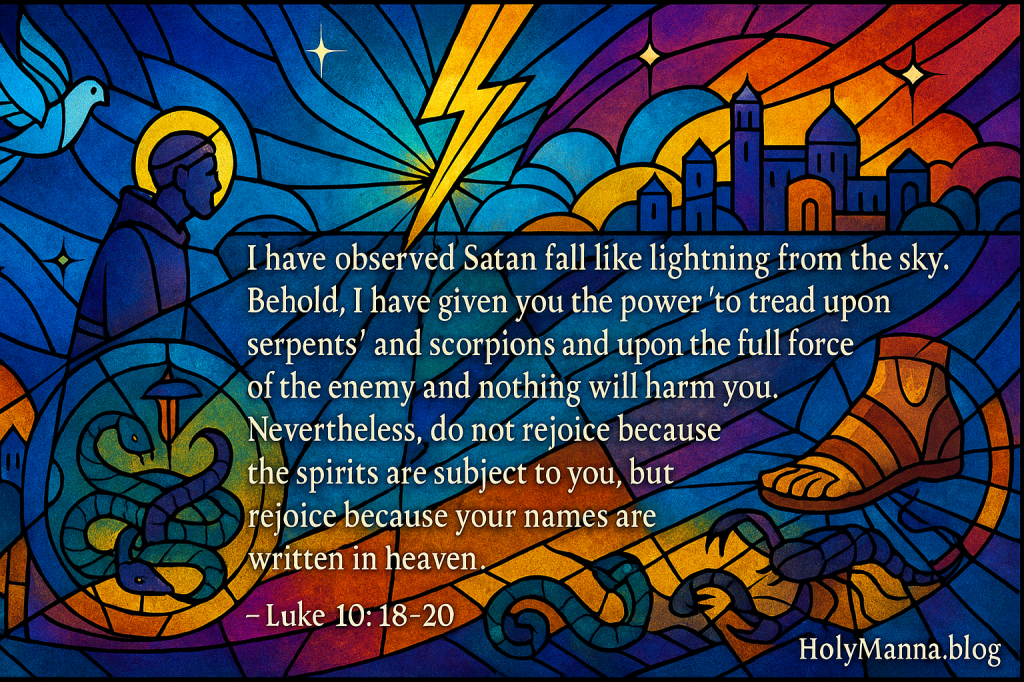
Return of the Seventy-two. 17 The seventy[-two] returned rejoicing, and said, “Lord, even the demons are subject to us because of your name.” 18 Jesus said, “I have observed Satan fall like lightning from the sky. 19 Behold, I have given you the power ‘to tread upon serpents’ and scorpions and upon the full force of the enemy and nothing will harm you. 20 Nevertheless, do not rejoice because the spirits are subject to you, but rejoice because your names are written in heaven.”
Praise of the Father. 21 At that very moment he rejoiced [in] the holy Spirit and said, “I give you praise, Father, Lord of heaven and earth, for although you have hidden these things from the wise and the learned you have revealed them to the childlike. Yes, Father, such has been your gracious will. 22 All things have been handed over to me by my Father. No one knows who the Son is except the Father, and who the Father is except the Son and anyone to whom the Son wishes to reveal him.”
The Privileges of Discipleship. 23 Turning to the disciples in private he said, “Blessed are the eyes that see what you see. 24 For I say to you, many prophets and kings desired to see what you see, but did not see it, and to hear what you hear, but did not hear it.”
Detailed Exegesis
Verse 17 – “The seventy[-two] returned rejoicing, and said, ‘Lord, even the demons are subject to us because of your name.’”
The mission bears visible fruit. Demons yield to the authority of Jesus’s name, which signifies His person and saving presence. Joy is good, but it risks becoming self-referential if it rests in visible success rather than in covenant relationship.
Verse 18 – “Jesus said, ‘I have observed Satan fall like lightning from the sky.’”
Jesus interprets their experience within a cosmic horizon. Satan’s fall signals the inbreaking of the Kingdom. The image evokes sudden, decisive defeat. What the disciples tasted locally participates in Christ’s universal victory.
Verse 19 – “‘Behold, I have given you the power ‘to tread upon serpents’ and scorpions and upon the full force of the enemy and nothing will harm you.’”
Serpents and scorpions symbolize demonic forces and deadly snares, echoing Psalm 91:13. The gift is mediated authority, not autonomous power. Protection does not promise an easy life but a share in Christ’s triumph.
Verse 20 – “‘Nevertheless, do not rejoice because the spirits are subject to you, but rejoice because your names are written in heaven.’”
Jesus recalibrates joy from outcomes to identity. The deepest cause of gladness is belonging to God, inscribed in the Book of Life. Childlike poverty of spirit delights more in adoption than in achievement.
Verse 21 – “At that very moment he rejoiced [in] the holy Spirit and said, ‘I give you praise, Father, Lord of heaven and earth, for although you have hidden these things from the wise and the learned you have revealed them to the childlike. Yes, Father, such has been your gracious will.’”
Jesus’s own joy is Trinitarian, springing from the Holy Spirit and addressed to the Father. Revelation is a gift to the childlike, the anawim who receive rather than grasp. Divine pedagogy overturns worldly hierarchies of status and learning.
Verse 22 – “‘All things have been handed over to me by my Father. No one knows who the Son is except the Father, and who the Father is except the Son and anyone to whom the Son wishes to reveal him.’”
Jesus discloses the reciprocity of knowledge within the Trinity and His unique mediatorship. Access to the Father is through the Son’s free self-revelation. Discipleship is grace before it is task.
Verse 23 – “Turning to the disciples in private he said, ‘Blessed are the eyes that see what you see.’”
A beatitude crowns their vocation. To witness the Kingdom’s arrival is sheer privilege. Vision here is not mere sight but faith-perception.
Verse 24 – “‘For I say to you, many prophets and kings desired to see what you see, but did not see it, and to hear what you hear, but did not hear it.’”
Jesus situates the moment in salvation history. The longings of Israel’s greatest figures converge in Him. The disciples stand within fulfilled promise, which should evoke gratitude and responsibility.
Teachings
The Catechism explains Christ’s victory over the demonic as integral to the Kingdom: “The coming of God’s kingdom means the defeat of Satan’s: ‘If it is by the Spirit of God that I cast out demons, then the kingdom of God has come upon you.’ Jesus’ exorcisms liberate men from the domination of demons. They anticipate Jesus’ great victory over ‘the ruler of this world.’ The kingdom of God will be definitively established through Christ’s cross: ‘God reigned from the wood.’” (The Catechism, CCC 550). The humble are the privileged recipients of revelation: “The Kingdom of heaven belongs to the poor and lowly, which means those who have accepted it with humble hearts. Jesus is sent to ‘bring good news to the poor’; he declares them blessed, for ‘theirs is the kingdom of heaven.’ To them the Father is pleased to reveal what remains hidden from the wise and the clever.” (The Catechism, CCC 544). Prayer expresses this filial joy and simplicity. “Prayer is the raising of one’s mind and heart to God or the requesting of good things from God.” (The Catechism, CCC 2559, quoting Saint John Damascene).
The saints witness to childlike joy. Saint Francis prays, “Most High, all-powerful, good Lord, Yours are the praises, the glory, and the honor, and all blessing.” Canticle of the Creatures. He exhorts continual conversion that rejoices in heaven more than in works: “Let us desire nothing else, let us wish for nothing else, let nothing else please us and cause us delight except our Creator and Redeemer and Savior, the only true God.” Earlier Rule, 23.
Reflection
To live this Gospel, cultivate joy that cannot be stolen because it rests in heaven. Begin each day by renewing your baptismal identity with a simple act of praise to the Father in the Spirit through Jesus. When God works through you, give thanks, then quietly return the glory to Him. Practice small acts of hidden charity that no one notices. Choose poverty of spirit by surrendering outcomes in prayer and accepting obscurity with peace. What success are you tempted to clutch instead of placing it back into the Father’s hands? How will you become more childlike so that the Son may reveal the Father to you today? Where can you rejoice, not because spirits submit, but because your name is written in heaven?

 Holy Manna!
Leave a comment