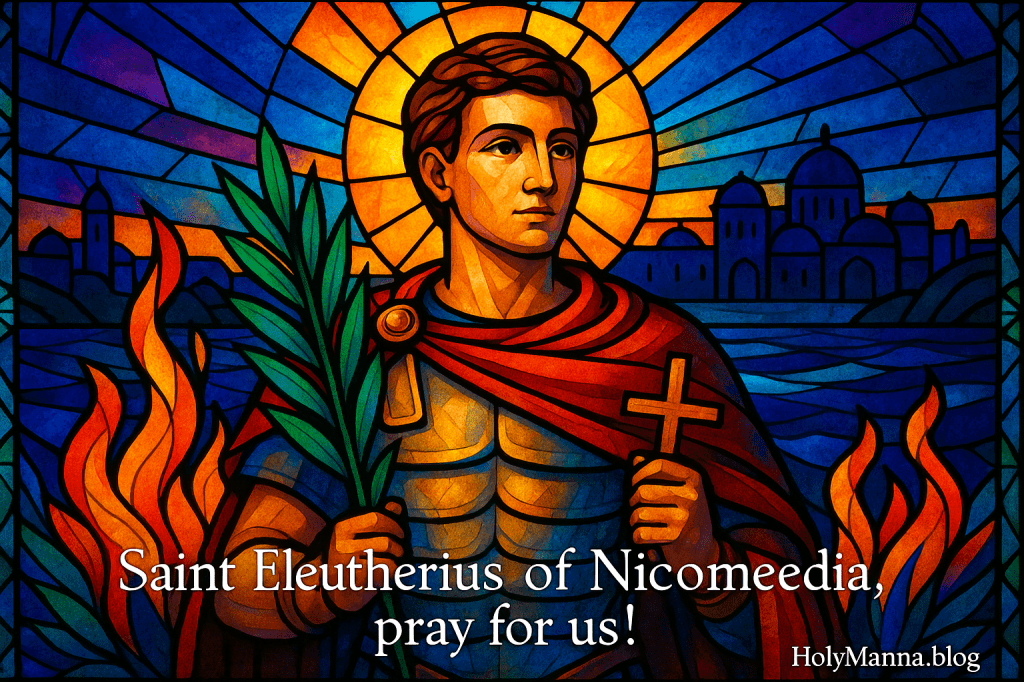
A Witness Tempered in Fire
Saint Eleutherius of Nicomedia is remembered in the Church as a steadfast soldier of Christ during the opening months of the Great Persecution under Emperor Diocletian. The Roman Martyrology commemorates him on October 2 and situates his martyrdom at Nicomedia, a principal imperial residence in Bithynia, where Diocletian spent significant time. Eleutherius is honored not for public writings or a long episcopal career, but for unflinching fidelity to Jesus when fear, suspicion, and violence swept through the capital. His name is linked with a large company of unnamed Christians who suffered the same fate, which is a reminder that sanctity often unfolds far from the spotlight yet shines with the same Gospel light.
From Garrison to Gospel
Specifics of Eleutherius’ family and youth have not survived, which is common for early martyrs whose memory reached us primarily through liturgical lists and brief notes. What the Church preserves with certainty is that he served as a soldier in Nicomedia at the very time imperial policy turned aggressively against the Christian community. In late February of the year 303, the church of Nicomedia was destroyed, sacred books were burned, and new edicts targeted Christians’ assemblies and property. Against that ominous backdrop, Eleutherius’ conversion is best understood as a total adhesion to Christ that defined his identity more than military rank ever could. He is known most of all as a confessor who became a martyr, a disciple whose allegiance to Jesus outlasted every threat.
Holiness in Plain Sight
The early sources do not record extraordinary signs worked by Eleutherius during his lifetime. Instead, they bear witness to something the Church calls the supreme sign: the willing surrender of life rather than betrayal of the Lord. The Catechism of the Catholic Church affirms, “Martyrdom is the supreme witness given to the truth of the faith: it means bearing witness even unto death.” It continues, “The martyr bears witness to Christ who died and rose, to whom he is united by charity.” This is the pattern we see in Eleutherius. His courage was not a flash of human bravado but the quiet strength of grace. If you seek a line that might be placed beside his name, let it be the wisdom of Scripture that the tradition applies to martyrs: “As gold in the furnace he tried them.” Wisdom 3:6.
The Trial by Flame
In the tense weeks after the first anti-Christian edict, fires broke out at the imperial palace in Nicomedia. Christians were blamed. The Roman Martyrology states plainly that Eleutherius, a soldier, was falsely accused along with numberless others and that groups of Christians were executed by sword, by fire, and by drowning. The tradition identifies Eleutherius as a principal victim who suffered severe tortures and was finally burned alive. These events unfolded within a broader wave of arrests and executions that also claimed well-known figures in Nicomedia, such as palace officials and the city’s bishop. The cruelty of the punishments reflects an empire unsettled by a faith it could neither absorb nor ignore. Eleutherius’ endurance shows that Christian courage is not the absence of pain, but the refusal to let pain speak the last word.
Memory That Heals
There are no specific, authenticated posthumous miracle stories that the Church attaches to Saint Eleutherius by name. What endures is the miracle of memory that strengthens faith. His commemoration on October 2, the day the Church also celebrates the Holy Guardian Angels, has become a providential catechesis. The calendar itself pairs angelic guardianship with the courage of a martyr, inviting believers to see that God’s providence does not abandon the faithful in trial. The presence of Eleutherius in the Roman Martyrology is the Church’s official act of remembrance, a liturgical veneration that unites us to his intercession. As with many early martyrs whose earthly details are few, the Church’s cult focuses less on a shrine with spectacular cures and more on the spiritual healing that flows from contemplating a life totally given to Christ.
Lessons from a Hidden Hero
Saint Eleutherius teaches that fidelity is formed long before the decisive hour. The habits you cultivate in prayer, in the sacraments, and in charity prepare your soul to say yes when saying yes costs something. The Catechism reminds us that martyrs are united to Christ by love, which means their strength is not self-manufactured. It is received. Ask daily for that grace. Consider setting a regular time for Scripture, frequent Confession, and intentional acts of mercy that move you beyond comfort. When reputation is threatened, answer with truth and humility. When fear presses in, stand your ground with the peace of Christ. Let Eleutherius’ silence about himself become a school of humility for you. He left no words, yet his life still speaks clearly: Jesus is worth everything.
Engage with Us!
Share your thoughts and reflections in the comments below.
- How does Eleutherius’ quiet fidelity challenge the way you think about success and recognition in your own life?
- Where is Christ inviting you to choose truth and charity over comfort or approval this week?
- When you face misunderstanding or blame, how can you respond with the courage and gentleness of a Christian witness?
- What concrete practice—Scripture, Confession, the Rosary, Adoration—will you adopt to strengthen your daily witness?
Be encouraged to live your faith with courage, compassion, and joy. Do everything with the love and mercy Jesus taught us.
Saint Eleutherius of Nicomedia, pray for us!
Follow us on Instagram and Facebook for more insights and reflections on living a faith-filled life.

 Holy Manna!
Leave a comment