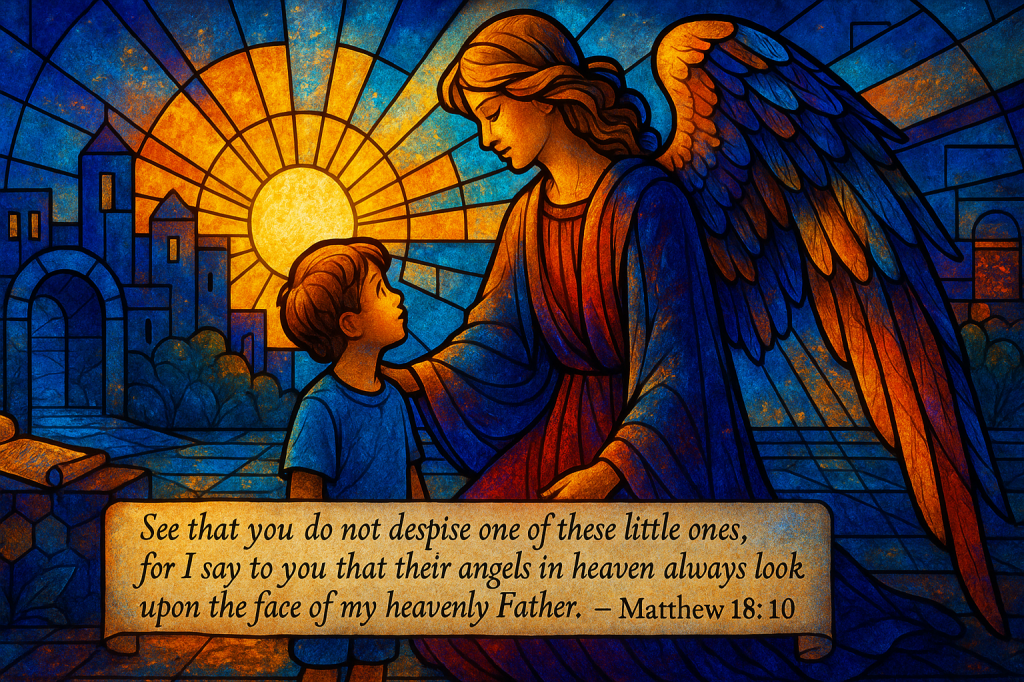
Memorial of the Holy Guardian Angels – Lectionary: 458/650
Small Enough to Hear: The Law, the Little Ones, and Their Angels
The thread that binds today’s readings with the Memorial of the Holy Guardian Angels is childlike docility to God’s Word, received with joy and safeguarded by heaven’s watchful care. In Nehemiah 8, a newly restored people gathers at the Water Gate to hear the Torah proclaimed after exile, and the leaders tell them to celebrate because “rejoicing in the Lord is your strength”. This is more than a moment of remembrance. It is a renewal of identity as a people formed by revelation, a scene that anticipates our own liturgical listening when the Scriptures are read and explained so that all can understand. Psalm 19 sings the same melody from within the heart, declaring that “The law of the Lord is perfect, refreshing the soul” and that God’s commands are sweeter than honey. Then Matthew 18:1-5, 10 completes the picture as Jesus places a child at the center and teaches that greatness begins with humility, “Unless you turn and become like children”, while reminding us that the little ones have angels who always behold the face of the Father. The Church sets this Gospel beside the memorial because, as The Catechism teaches in CCC 336, “Beside each believer stands an angel as protector and shepherd leading him to life.” Today we approach the Word as Israel did, we let its sweetness shape our minds and hearts, and we entrust our steps to the guardians who guide us along the path of holiness. How is the Lord inviting you to receive his Word with a child’s trust under your angel’s care today?
First Reading – Nehemiah 8:1-12
How the Word Rebuilds a People
Fresh from return and rebuilding after exile, Israel gathers at the Water Gate for a covenant renewal that will define their identity. The first day of the seventh month situates the assembly in a sacred season of remembrance and joy in God’s mercy, a moment that later Jewish tradition associates with a solemn new beginning. Ezra and the Levites do more than read. They interpret so that everyone can understand, which mirrors the Church’s Liturgy of the Word in which Scripture is proclaimed and opened for the faithful. The people’s tears give way to a commanded joy and a shared feast, signaling that God’s Word restores, reforms, and sends a people outward in mercy. This fits today’s theme of childlike docility guarded by heaven’s care. The community listens as one, receives instruction with humility, and learns that holy celebration includes sharing with those who have nothing prepared. Our Guardian Angels, who “always look upon the face of the Father,” remind us that heaven attends our hearing of the Word and helps us persevere in obedient joy as the “little ones” of God, just as Matthew 18:1-5, 10 teaches and as CCC 336 affirms.
Nehemiah 8:1-12
New American Bible (Revised Edition)
Ezra Reads the Law. 1 Now when the seventh month came, the whole people gathered as one in the square in front of the Water Gate, and they called upon Ezra the scribe to bring forth the book of the law of Moses which the Lord had commanded for Israel. 2 On the first day of the seventh month, therefore, Ezra the priest brought the law before the assembly, which consisted of men, women, and those children old enough to understand. 3 In the square in front of the Water Gate, Ezra read out of the book from daybreak till midday, in the presence of the men, the women, and those children old enough to understand; and all the people listened attentively to the book of the law. 4 Ezra the scribe stood on a wooden platform that had been made for the occasion; at his right side stood Mattithiah, Shema, Anaiah, Uriah, Hilkiah, and Maaseiah, and on his left Pedaiah, Mishael, Malchijah, Hashum, Hashbaddanah, Zechariah, Meshullam. 5 Ezra opened the scroll so that all the people might see it, for he was standing higher than any of the people. When he opened it, all the people stood. 6 Ezra blessed the Lord, the great God, and all the people, their hands raised high, answered, “Amen, amen!” Then they knelt down and bowed before the Lord, their faces to the ground. 7 The Levites Jeshua, Bani, Sherebiah, Jamin, Akkub, Shabbethai, Hodiah, Maaseiah, Kelita, Azariah, Jozabad, Hanan, and Pelaiah explained the law to the people, who remained in their places. 8 Ezra read clearly from the book of the law of God, interpreting it so that all could understand what was read. 9 Then Nehemiah, that is, the governor, and Ezra the priest-scribe, and the Levites who were instructing the people said to all the people: “Today is holy to the Lord your God. Do not lament, do not weep!”—for all the people were weeping as they heard the words of the law. 10 He continued: “Go, eat rich foods and drink sweet drinks, and allot portions to those who had nothing prepared; for today is holy to our Lord. Do not be saddened this day, for rejoicing in the Lord is your strength!” 11 And the Levites quieted all the people, saying, “Silence! Today is holy, do not be saddened.” 12 Then all the people began to eat and drink, to distribute portions, and to celebrate with great joy, for they understood the words that had been explained to them.
Detailed Exegesis
Verse 1 – “Now when the seventh month came, the whole people gathered as one in the square in front of the Water Gate, and they called upon Ezra the scribe to bring forth the book of the law of Moses which the Lord had commanded for Israel.”
The restored community stands “as one,” which underscores covenant solidarity. The Water Gate evokes cleansing and life, a fitting place to be washed by the Word. Asking for the Law signals a people eager to let God speak first. True renewal begins when we request God’s Word and submit to it.
Verse 2 – “On the first day of the seventh month, therefore, Ezra the priest brought the law before the assembly, which consisted of men, women, and those children old enough to understand.”
All who can “understand” are included. The Word is not a private possession. It is proclaimed to a whole people. The mention of understanding anticipates the ministry of explanation. This openness prepares the heart for the humility of spiritual childhood in Matthew 18.
Verse 3 – “In the square in front of the Water Gate, Ezra read out of the book from daybreak till midday, in the presence of the men, the women, and those children old enough to understand; and all the people listened attentively to the book of the law.”
Attentive listening over many hours reveals reverence and hunger. The length of the reading highlights that God’s Word deserves our best focus. This models liturgical patience and the childlike posture that receives rather than controls.
Verse 4 – “Ezra the scribe stood on a wooden platform that had been made for the occasion; at his right side stood Mattithiah, Shema, Anaiah, Uriah, Hilkiah, and Maaseiah, and on his left Pedaiah, Mishael, Malchijah, Hashum, Hashbaddanah, Zechariah, Meshullam.”
The platform makes the proclamation visible and audible. The named attendants witness that this is not a solitary act but an ecclesial service. The Word is mediated through ordered ministry, a pattern the Church mirrors in lectors, deacons, and priests.
Verse 5 – “Ezra opened the scroll so that all the people might see it, for he was standing higher than any of the people. When he opened it, all the people stood.”
The people stand in honor of the Word. Their bodies catechize their hearts. Posture expresses faith. In many parishes, standing for the Gospel reflects this same conviction that God himself addresses his people.
Verse 6 – “Ezra blessed the Lord, the great God, and all the people, their hands raised high, answered, ‘Amen, amen!’ Then they knelt down and bowed before the Lord, their faces to the ground.”
Blessing, acclamation, raised hands, kneeling, and prostration form a choreography of worship. The double “Amen” seals communal assent. The sequence anticipates the Church’s liturgical dialogue and the interior acts of adoration that the angels model unceasingly before God.
Verse 7 – “The Levites Jeshua, Bani, Sherebiah, Jamin, Akkub, Shabbethai, Hodiah, Maaseiah, Kelita, Azariah, Jozabad, Hanan, and Pelaiah explained the law to the people, who remained in their places.”
Explanation follows proclamation. Understanding matters. The Levites’ teaching is pastoral and patient, meeting people where they are. This is the biblical root of the homily, which opens the Word for conversion.
Verse 8 – “Ezra read clearly from the book of the law of God, interpreting it so that all could understand what was read.”
Clarity in reading and faithful interpretation serve the people’s grasp of God’s will. The text is not left opaque. The Church continues this mission in preaching, catechesis, and spiritual direction so that the Word forms conscience and life.
Verse 9 – “Then Nehemiah, that is, the governor, and Ezra the priest-scribe, and the Levites who were instructing the people said to all the people: ‘Today is holy to the Lord your God. Do not lament, do not weep!’ For all the people were weeping as they heard the words of the law.”
Conviction pierces hearts, and tears come. Yet the leaders command joy because holiness and mercy frame the day. God’s Word wounds to heal, then calls to rejoicing. The movement from sorrow to joy anticipates Gospel consolation and the protective encouragement of our Guardian Angels.
Verse 10 – “He continued: ‘Go, eat rich foods and drink sweet drinks, and allot portions to those who had nothing prepared; for today is holy to our Lord. Do not be saddened this day, for rejoicing in the Lord is your strength!’”
Feasting and almsgiving are mandated. Joy in God becomes strength, and sharing becomes the sign of true reception. The Word always sends us outward. Mercy to the unprepared mirrors God’s mercy to us.
Verse 11 – “And the Levites quieted all the people, saying, ‘Silence! Today is holy, do not be saddened.’”
Sacred silence stabilizes joy. The day’s holiness is sustained by reverent calm. This is the silence where angels worship and where our hearts learn to rest in God.
Verse 12 – “Then all the people began to eat and drink, to distribute portions, and to celebrate with great joy, for they understood the words that had been explained to them.”
Understanding births charity and festal joy. Right doctrine flowers in right practice. The narrative completes a liturgical arc: proclamation, understanding, conversion, and mission.
Teachings
The Church teaches that angelic help accompanies the entire life of the faithful, including our hearing of the Word. CCC 334 states, “In the meantime, the whole life of the Church benefits from the mysterious and powerful help of angels.” CCC 336 adds, “Beside each believer stands an angel as protector and shepherd leading him to life.” The people’s reverent posture and joyful obedience in Nehemiah 8 reflect how heaven attends earthly worship. The liturgical instinct of Israel also prefigures the Church’s veneration of Scripture. Saint Jerome insists on Scripture’s centrality with his famous line, “Ignorance of the Scriptures is ignorance of Christ.” This reading also models the Liturgy of the Word’s purpose. God’s revelation is proclaimed, interpreted, and received so that a people is formed for charity. The command to share portions with those who lack anticipates the moral demand of the Gospel. It shows that genuine understanding always bears fruit in mercy.
Reflection
When the Word is opened before us, God rebuilds us from the inside out. Approach the readings at Mass with a child’s trust and ask your Guardian Angel to help you listen attentively, to understand, and to act. Make time today to read the passage slowly, to kneel or bow in simple adoration, and to share something concrete with someone in need as a sign that the Word has taken root. What part of this reading moves you to deeper humility and joy today? Where is the Lord asking you to trade tears for rejoicing in concrete acts of mercy? How might you invite your Guardian Angel to guard your attention and guide you from hearing to holy action this week?
Responsorial Psalm – Psalm 19:8-11
The Word That Makes Us Little and Wise
Psalm 19:8-11 is a Torah hymn that celebrates God’s revealed instruction as perfect, trustworthy, and joy giving. In Israel’s worship this psalm trains the heart to love the Law not as a burden but as a gift that restores and enlightens. Its ancient images of precious gold and honey evoke the cultural markers of wealth and delight, reminding us that divine wisdom outshines every treasure and sweetens every bitterness. Within today’s theme of childlike docility guarded by heaven’s care, the psalm teaches us to receive God’s Word the way a little one receives nourishment. It forms in us the simplicity praised by Jesus in Matthew 18:1-5, 10 and attunes us to the vigilant assistance of the Holy Guardian Angels who help us walk in the clarity of God’s commands as taught by CCC 336.
Psalm 19:8-11
New American Bible (Revised Edition)
8 The law of the Lord is perfect,
refreshing the soul.
The decree of the Lord is trustworthy,
giving wisdom to the simple.
9 The precepts of the Lord are right,
rejoicing the heart.
The command of the Lord is clear,
enlightening the eye.
10 The fear of the Lord is pure,
enduring forever.
The statutes of the Lord are true,
all of them just;
11 More desirable than gold,
than a hoard of purest gold,
Sweeter also than honey
or drippings from the comb.
Detailed Exegesis
Verse 8 – “The law of the Lord is perfect, refreshing the soul. The decree of the Lord is trustworthy, giving wisdom to the simple.”
The “law” or Torah is comprehensive instruction that heals interior fatigue and returns the person to right relationship. Perfection here means wholeness and sufficiency. God’s Word does not only inform. It reforms. The promise of wisdom to the “simple” aligns with Jesus’ call to become like children in Matthew 18:3. The Guardian Angels assist this humble receptivity by guarding our steps toward the truth.
Verse 9 – “The precepts of the Lord are right, rejoicing the heart. The command of the Lord is clear, enlightening the eye.”
God’s precepts straighten the path and gladden the interior life. Clarity “enlightens the eye,” a biblical way of saying that God’s will makes reality intelligible. Angels, who behold the Father’s face in Matthew 18:10, delight in this light and prompt us to walk without compromise.
Verse 10 – “The fear of the Lord is pure, enduring forever. The statutes of the Lord are true, all of them just.”
“Fear of the Lord” means reverent awe that cleanses the heart and endures because it rests in the eternal God. Truth and justice describe both God and his standards. To love the statutes is to love the God who gives them. Our guardians strengthen holy reverence, preserving us from the pride that darkens judgment.
Verse 11 – “More desirable than gold, than a hoard of purest gold, Sweeter also than honey or drippings from the comb.”
The psalm contrasts ultimate value and ultimate pleasure with the surpassing worth of God’s Word. In the ancient world gold was wealth and honey was rare sweetness. The psalm dares us to prefer revelation over riches and consolation. This is the taste of spiritual childhood. We learn to crave what nourishes eternal life.
Teachings
The Catechism of the Catholic Church situates this psalm within the Church’s living reception of revelation. CCC 1785 teaches, “In the formation of conscience the Word of God is the light for our path; we must assimilate it in faith and prayer and put it into practice. We must also examine our conscience before the Lord’s Cross. We are assisted by the gifts of the Holy Spirit, aided by the witness or advice of others and guided by the authoritative teaching of the Church.” This is the logic of Psalm 19: the Word enlightens and reforms. CCC 336 reminds us of heaven’s nearness as we receive this light, “Beside each believer stands an angel as protector and shepherd leading him to life.” The Council’s Dei Verbum beautifully describes what happens when we take this psalm to heart, “For in the sacred books, the Father who is in heaven meets his children with great love and speaks with them.” Saint Jerome underscores the same priority with his famous dictum, “Ignorance of the Scriptures is ignorance of Christ.” When Psalm 19 says that God’s commands are sweeter than honey, it echoes the Church’s conviction that Scripture is not merely instructive but life giving. The Law fulfilled in Christ and opened by the Spirit forms our conscience, orders our loves, and gladdens our hearts.
Reflection
Ask your Guardian Angel to help you love the Word the way a child loves what is good. Set aside time today to pray slowly with Psalm 19:8-11. Read each verse aloud and after each one ask for the corresponding grace: refreshment of soul, joy of heart, enlightened eyes, and a new taste for God’s will. Choose one concrete practice that expresses preference for the Word over convenience, such as memorizing one line or acting on a small nudge toward mercy. What truth from this psalm do you desire to taste as sweetness today? Where might the Lord be inviting you to trade a “gold” of earthly comfort for the joy that only obedience brings? How can you invite your Guardian Angel to protect your attention so that Scripture becomes your daily light?
Holy Gospel – Matthew 18:1-5, 10
Spiritual Childhood Under Angelic Care
In Matthew 18 Jesus inaugurates the community teaching that will shape life inside the Church. Disciples in a culture that prized honor and status ask about greatness. Jesus answers by placing a child at the center. In the first century a child had no legal standing and depended entirely on others. Jesus makes this littleness the doorway to the Kingdom and the measure of true authority. He then unveils heaven’s nearness by revealing the ministry of angels who behold the Father’s face. This Gospel crowns today’s theme of childlike docility to the Word and the Memorial of the Holy Guardian Angels. The Lord invites us to receive revelation like the little ones and to trust that angelic guardians accompany our path into humble love.
Matthew 18:1-5, 10
New American Bible (Revised Edition)
The Greatest in the Kingdom. 1 At that time the disciples approached Jesus and said, “Who is the greatest in the kingdom of heaven?” 2 He called a child over, placed it in their midst, 3 and said, “Amen, I say to you, unless you turn and become like children, you will not enter the kingdom of heaven. 4 Whoever humbles himself like this child is the greatest in the kingdom of heaven. 5 And whoever receives one child such as this in my name receives me.
10 “See that you do not despise one of these little ones, for I say to you that their angels in heaven always look upon the face of my heavenly Father.
Detailed Exegesis
Verse 1 – “At that time the disciples approached Jesus and said, ‘Who is the greatest in the kingdom of heaven?’”
The question exposes an ambition that can live even in religious hearts. Jesus will reframe greatness from status to surrender. In the community discourse of Matthew 18, the Lord defines ecclesial life by humility, care for the vulnerable, and vigilance against scandal.
Verse 2 – “He called a child over, placed it in their midst,”
Jesus makes a child the living parable. In a world where children symbolized dependence, he relocates the center of the community to those who cannot rely on themselves. The gesture is sacramental. It teaches with a sign before it teaches with words.
Verse 3 – “and said, ‘Amen, I say to you, unless you turn and become like children, you will not enter the kingdom of heaven.’”
Conversion is required. To “turn and become” means a decisive reorientation toward trust. Entry into the Kingdom depends on this transformation, not on achievement. The Catechism explains the same mystery in CCC 526, “To become a child in relation to God is the condition for entering the kingdom.”
Verse 4 – “Whoever humbles himself like this child is the greatest in the kingdom of heaven.”
Greatness equals humility. The pattern of Christ, who is “gentle and humble of heart,” becomes the Christian measure. The Kingdom belongs to those who accept it with lowly hearts. CCC 544 teaches, “The Kingdom of heaven belongs to the poor and lowly, which means those who have accepted it with humble hearts.”
Verse 5 – “And whoever receives one child such as this in my name receives me.”
To welcome the little ones is to welcome Jesus himself. The Church’s pastoral care is therefore Christocentric and concrete. Holiness is measured by hospitality to those who cannot repay. The angels, whose ministry serves the heirs of salvation, rejoice when we honor Christ’s presence in the least.
Verse 10 – “See that you do not despise one of these little ones, for I say to you that their angels in heaven always look upon the face of my heavenly Father.”
Despising the little ones dishonors heaven. Their guardians stand before the Father in the light of his presence. The Gospel reveals angelic advocacy and invites reverence for every vulnerable person. CCC 336 affirms this intimate help, “Beside each believer stands an angel as protector and shepherd leading him to life.”
Teachings
This passage discloses the core grammar of Christian life. Spiritual childhood is not immaturity. It is the theological virtue of trust. CCC 526 states, “To become a child in relation to God is the condition for entering the kingdom.” Humility is the doorway to true greatness because it conforms us to Christ who emptied himself. The Kingdom is given to the lowly. CCC 544 teaches, “The Kingdom of heaven belongs to the poor and lowly, which means those who have accepted it with humble hearts.” The Lord also reveals the nearness of heaven through the angels. CCC 336 declares, “Beside each believer stands an angel as protector and shepherd leading him to life.” The saints echo this Gospel. Saint Thérèse of Lisieux describes the little way: “It is to recognize our nothingness, to expect everything from God as a little child expects everything from its father.” In the life of the Church this teaching shaped concrete charity, devotional acknowledgment of Guardian Angels, and a consistent preference for the small and the poor. Whenever Christians receive the least in Jesus’ name, they receive the Lord and honor the worship of the angels who always behold the Father.
Reflection
Ask your Guardian Angel to help you choose the low place today. Make one decision that places another’s good before your own recognition. Welcome someone who is overlooked and treat that person as you would treat Christ. Pray with this Gospel by imagining yourself as the child Jesus places in the midst and let him speak to your fears. Where is Jesus inviting you to turn and become small so that you may enter the Kingdom with freedom and joy? Whom can you receive today in his name so that you may receive him anew? How can you cooperate with your Guardian Angel to guard your heart from pride and to guide your steps toward humble love?
Walk with the Word, Walk with Your Angel
Today we heard a people rebuilt by the proclamation of God’s Law in Nehemiah 8:1-12, a heart taught to love that Law in Psalm 19:8-11, and a Savior who crowns humility as true greatness in Matthew 18:1-5, 10. The arc is simple and saving. God speaks, the little ones listen, and heaven guards their way. Israel gathers as one to hear the Torah and discovers that “rejoicing in the Lord is your strength”. The psalm teaches that the Lord’s commands are sweeter than honey and more desirable than gold. Jesus places a child in the center and promises that those who become small will enter the Kingdom, reminding us that the little ones have angels who always behold the Father’s face. The Catechism confirms this nearness of heaven in CCC 336: “Beside each believer stands an angel as protector and shepherd leading him to life.”
Let the Word rebuild your identity. Ask for the grace to become small and teachable. Invite your Guardian Angel to guard your attention, guide your choices, and keep you in joyful obedience. Choose one concrete act of mercy today by sharing with someone who has “nothing prepared,” as the people did when they understood the Law. Set aside time to pray with Psalm 19 and to meditate on Jesus’ call to spiritual childhood. End your day by thanking your Guardian Angel for hidden help and by renewing your desire to rejoice in the Lord. What step of humble trust can you take right now to receive God’s Word more fully? How will you cooperate with your Guardian Angel to walk in holiness with a child’s joy this week?
Engage with Us!
Share your reflections in the comments below so we can pray and grow together as a community.
- Nehemiah 8:1-12: How is the Lord inviting you to listen attentively to his Word today, and what can you do to prepare your heart before you hear it proclaimed? Where might he be calling you to move from sorrow to rejoicing through obedience and mercy? What concrete portion can you share with someone who has nothing prepared as a sign that the Word has taken root in you?
- Psalm 19:8-11: Which line of this psalm do you most want to taste as sweetness in your soul today, and why? Where is the Lord asking you to prefer his wisdom over something that feels like gold in your life? How can you invite your Guardian Angel to help you guard your attention so that God’s commands enlighten your eyes each day?
- Matthew 18:1-5, 10: What step can you take to turn and become like a child before God in a real situation this week? Who is the “little one” you can receive in Jesus’ name today, and how will you welcome Christ in that person? How will you cooperate with your Guardian Angel to protect your heart from pride and to guide your steps toward humble love?
May the Lord strengthen you to live a life of faith, to rejoice in his Word, and to do everything with the love and mercy that Jesus taught us.
Sacred Heart of Jesus, we trust in You!
Immaculate Heart of Mary, pray for us!
Saint Michael the Archangel, defend us in battle!
Follow us on Instagram and Facebook for more insights and reflections on living a faith-filled life.

 Holy Manna!
Leave a comment