Little Flower, Doctor of Love
Saint Thérèse of the Child Jesus, also called Thérèse of Lisieux and known affectionately as the Little Flower, is one of the most widely loved saints of the modern era. Hidden within the cloister of the Carmel of Lisieux, she opened an immense path to holiness for ordinary people through her Little Way of spiritual childhood, which is complete trust in the Father and doing small things with great love. In 1997 the Church recognized the depth and universality of her teaching by naming her a Doctor of the Church through the apostolic letter Divini Amoris Scientia. Thérèse’s spirituality is not complicated or reserved for experts. It is the Gospel lived with simplicity, humility, and burning charity. As she wrote, “For me, prayer is a surge of the heart. It is a simple look turned toward heaven, it is a cry of recognition and of love, embracing both trial and joy.” Her life shows that sanctity is possible in the hidden, daily faithfulness of one who trusts the Heart of Jesus.
A Home of Saints, A Christmas of Grace
Marie-Françoise-Thérèse Martin was born on January 2, 1873, in Alençon, France, the youngest of nine children of Louis and Zélie Martin, whom the Church canonized together in 2015. After Zélie’s death from breast cancer, the family moved to Lisieux, where Thérèse grew up surrounded by the faith of her father and older sisters, several of whom would also enter religious life. Sensitive and precocious, Thérèse suffered a serious childhood illness and received a sudden healing that she attributed to the maternal smile of the Blessed Virgin, whom she later honored under the title Our Lady of the Smile. The turning point of her spiritual life came on Christmas night in 1886. She described this grace as an interior strengthening that freed her from fragile self-love and ignited a desire to live entirely for Jesus. In 1887, during a pilgrimage to Rome, the fourteen-year-old Thérèse asked Pope Leo XIII for permission to enter the Carmelite monastery at fifteen. She entered the Carmel of Lisieux on April 9, 1888, received the religious name “of the Child Jesus and the Holy Face,” and made her profession on September 8, 1890. She is most known for articulating and living the Little Way, for her autobiographical manuscript Story of a Soul, and for her profound love of the missions. “I understood that love comprised all vocations. My vocation is love. In the heart of the Church, my Mother, I will be love.”
The Little Way in a Small Cloister
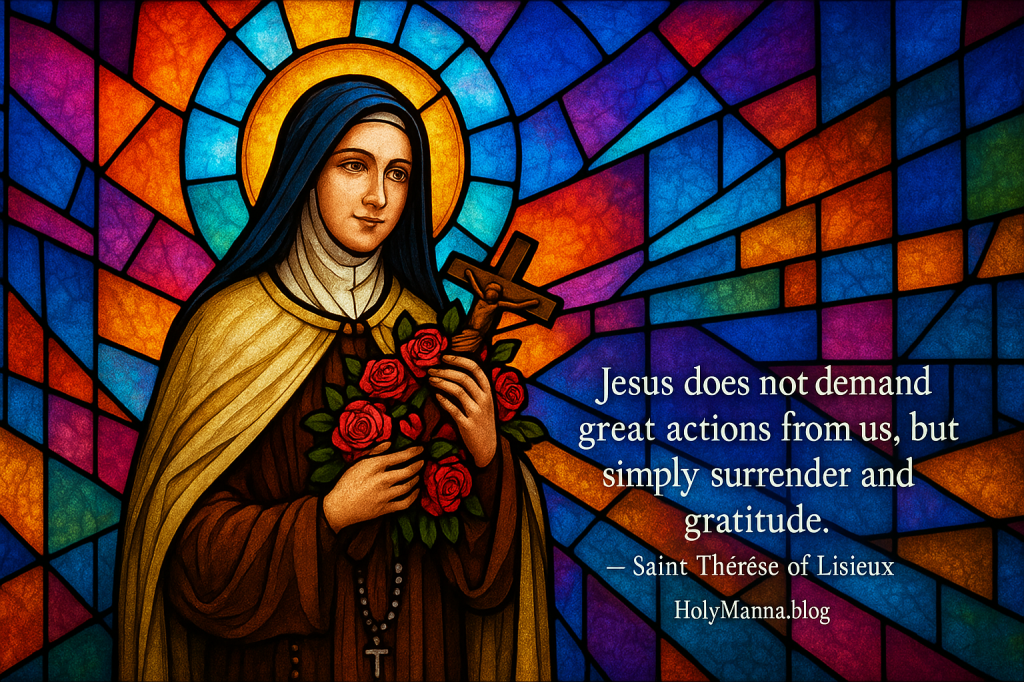
Thérèse’s daily life in Carmel was marked by ordinary tasks carried out with extraordinary love. She embraced community life, prayer in dryness and consolation, fidelity to the Rule, service in the laundry and sacristy, and patient charity toward sisters who were difficult for her temperament. She was entrusted with the formation of novices, guiding them not by severity but by example, tenderness, and clarity about the demands of love. In Story of a Soul she distilled her path: holiness is not about great deeds, but about humble fidelity and trust. “Jesus does not demand great actions from us, but simply surrender and gratitude.” She loved to speak of herself as a little child before God and described her confidence in vivid imagery: “It is your arms, O Jesus, which are the elevator to carry me to Heaven.” She offered every small act as a hidden martyrdom of love. One famous grace during her life concerned the condemned criminal Henri Pranzini. Thérèse prayed fervently for his conversion and implored a visible sign. On the scaffold he seized the crucifix and kissed it three times. For Thérèse this was a confirmation that love and intercession in the hidden life bear fruit for souls.
Trials Without Bitterness
The path of the Little Way ran through real suffering. Thérèse endured misunderstandings in community, long periods of aridity in prayer, and a dark trial against faith near the end of her life that she offered for those who do not believe. Tuberculosis slowly consumed her, causing intense physical pain and suffocating weakness. She made of each moment a loving offering for priests, missionaries, and sinners. There was no public martyrdom, yet her heart burned with the desire to shed her blood for Christ, and she spoke of a “martyrdom of love” in which every breath could become an act of self-giving. She died on September 30, 1897, at age twenty-four, gazing at the crucifix and whispering her final act of love. “I am not dying. I am entering life.” “I will spend my heaven doing good on earth.” Her serenity at death flowed from a lifelong confidence in divine mercy. “Everything is grace.”
A Shower of Roses
After Thérèse’s death, favors multiplied with startling rapidity and reached every continent. The Church examined many healings and conversions attributed to her intercession as part of the processes that led to her beatification in 1923 and canonization by Pope Pius XI on May 17, 1925. Among the best-known cures was that of the Belgian pilgrim Maria Pellemans, who recovered after invoking Thérèse, and that of the seminarian Charles Anne, who experienced an instantaneous healing after being given a relic of the Little Flower. The phrase “shower of roses,” which Thérèse herself had promised, became a lived reality for countless petitioners who reported receiving roses in connection with answered prayers. In 1927, Pope Pius XI named her Patroness of the Missions together with Saint Francis Xavier, affirming that missionary fruitfulness springs from prayer and love. Pilgrims travel to the Basilica of Sainte-Thérèse in Lisieux and to the Carmel where her relics are venerated, and her relics have traveled the world inspiring conversions, healings, and renewed vocations. Her life continues to teach that sanctity is accessible to all who dare to trust the merciful Heart of Jesus with childlike abandon.
Walking the Little Way Today
Thérèse offers a concrete roadmap for everyday holiness. Begin where you are, with the people in front of you and the duties you already have. Offer small acts of service with a smile. Accept daily contradictions without complaint. Pray simply and honestly. Trust the Father even when you feel nothing. If you fall, begin again with confidence, because the Lord delights in the heart that returns to Him. Let your vocation be love in the heart of the Church. “To pick up a pin for love can convert a soul.” “I have always wanted to be a saint, but I have always felt, when I compared myself with the saints, that I am as far removed from them as is the grain of sand trampled underfoot from the mountain whose summit is lost in the clouds. Instead of being discouraged, I said to myself: God would not make me wish for something impossible, so in spite of my littleness I can aim at being a saint.” Her Little Way does not shrink our desires. It enlarges them by rooting them in trust and charity. If you want to evangelize, begin with prayer, hidden sacrifice, and a heart that surrenders to Jesus. If you want to persevere in a busy life, choose small, repeatable habits of love. Let every breath become an act of confidence: Jesus, I trust in Your merciful love.
Engage with Us!
Share your thoughts and reflections in the comments below.
- Where is God inviting you to become “small” so that His grace can be great?
- What “little” duty today can you do with great love for Jesus and for someone in need?
- How does Thérèse’s trust in prayer challenge your own approach to interceding for others?
- Which line from Story of a Soul speaks most to your heart, and why?
Be encouraged. Walk the Little Way. Do everything with the love and mercy Jesus taught us.
Saint Thérèse of Lisieux, pray for us!
Follow us on Instagram and Facebook for more insights and reflections on living a faith-filled life.

 Holy Manna!
Leave a comment