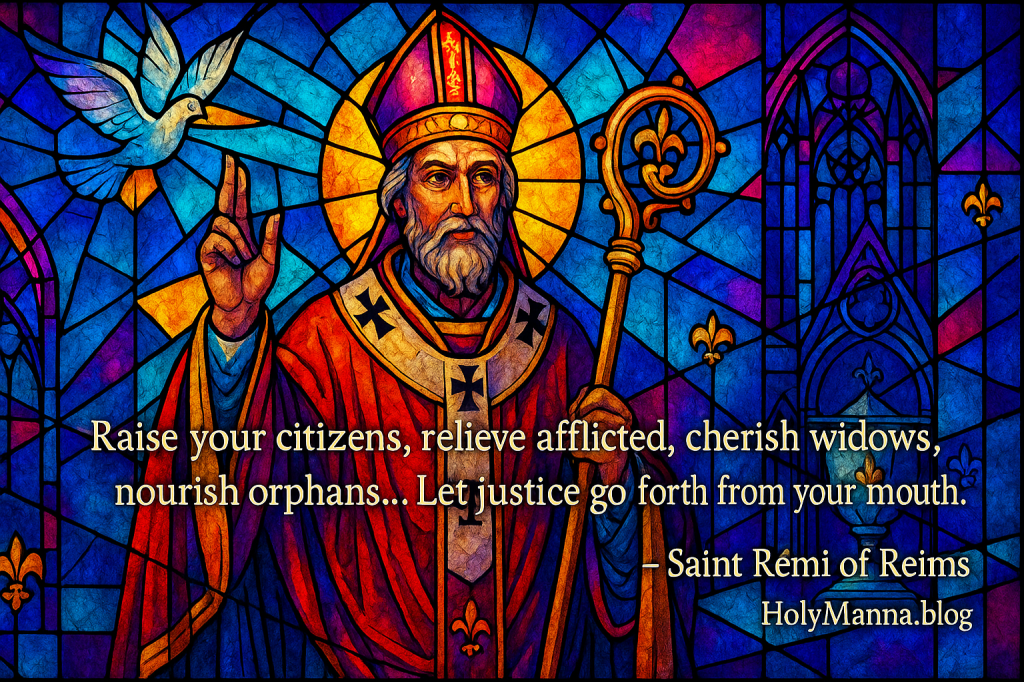
A Bishop Who Turned a People to Christ
Few saints redirected the course of a nation like Saint Remigius. History remembers him as the Apostle of the Franks because his pastoral friendship with King Clovis I culminated in the king’s baptism at Reims and the baptism of thousands of his warriors. By bringing a rising Frankish kingdom into full communion with the Catholic Church, Remigius helped anchor Western Europe in the Gospel. For nearly three quarters of a century he exercised the bishop’s threefold office with unusual steadiness. He taught with clarity, sanctified through the sacraments, and governed a complex flock in the violent transition from late Roman Gaul to a newly Christianized realm. For centuries his memory lingered not only in the parish and monastery but even in royal ritual, where the anointing of kings would recall his sacramental ministry.
From Gallo Roman Scholar to Shepherd of Reims
Remigius was born around 437 at Cerny en Laonnois in northern Gaul to a distinguished Gallo Roman family. Tradition names his father Emilius, Count of Laon, and his mother Saint Cilinia. His brother Principius became bishop of Soissons, a sign of the family’s deep Christian roots. Remarkably, the clergy and faithful of Reims chose Remigius as their bishop while he was still quite young, about twenty two, a choice prompted by his learning, his eloquence, and his reputation for holiness. The call did not merely elevate a gifted scholar. It placed upon him the full weight of apostolic responsibility, and he embraced it with prayer, fasting, and tireless preaching.
Providence soon knit his life to that of Clovis, the formidable Frankish ruler. The steadfast witness of Queen Clotilda combined with Remigius’s counsel to prepare the king’s heart. After a crucial battlefield victory, Clovis consented to catechesis and sought baptism. On Christmas, commonly dated to the year 496, Remigius received Clovis at the font in Reims. Tradition preserves the bishop’s striking exhortation to the king as he approached baptism, “Bow your head, proud Sicambrian. Adore what you have burned. Burn what you have adored.” In the wake of the king’s conversion, a great number of his warriors also entered the Church. Remigius’s stature as pastor and father of a people was sealed in that liturgy.
Planting the Church
The conversion of a king was the beginning, not the end, of Remigius’s work. He organized ecclesial life across northern Gaul, strengthening existing dioceses and fostering new ones at places such as Tournai, Cambrai, Arras, Terouanne, and Laon. He formed clergy, corrected abuses, defended orthodoxy against Arian teaching, and fostered harmony among newly baptized warriors who had not yet learned the habits of Christian charity. His letters and judgments reveal a pastor who could be both firm and merciful, correcting without crushing and always aiming at the healing of the Body of Christ.
Hagiographic memory associates his ministry with particular signs that pointed to the power of the sacraments. One beloved account tells that when oil for baptism was lacking, two empty vials set upon the altar were found miraculously filled, one with the oil of catechumens and one with chrism. Another current of tradition links Remigius to the Holy Ampulla that would later be used to anoint French kings, a sign that the grace poured out at Clovis’s baptism continued to shape the nation’s life. In addition to these sacramental marvels, early vitae speak of healings and deliverance from evil that accompanied the bishop’s preaching and visits, the quiet wonders that so often attend pastoral zeal.
Trials of a Pastor
Remigius did not shed his blood for Christ, but he knew the hidden martyrdom of a shepherd who spends himself day after day for the flock. He contended with Arian influence circulating among some clergy and nobles. He navigated the tensions that come when a warrior culture first learns the Gospel’s demands. He intervened in disciplinary cases with a firm preference for repentance and restoration, sometimes drawing criticism from fellow bishops until his reasoning won them over. His steadfastness preserved unity, guarded right teaching, and kept newly planted communities from splitting along ethnic or political lines. The cross he carried was governance marked by prayer, patience, and a father’s love.
Relics, Pilgrimage, and a Nation’s Memory
Saint Remigius died on January 13, 533, and the Church kept his memory with reverence. His relics were first preserved at the cathedral in Reims, then solemnly translated in 1099 to the great Abbey of Saint Remi, beside the basilica that bears his name. Through centuries of upheaval, pilgrims sought his intercession at that shrine and reported healings and favors won at his tomb. The Holy Ampulla associated with his legacy became a cherished symbol in the coronation of French kings, a reminder that Christian kingship must be shaped by the chrism of Christ. In the liturgical calendar his feast has been celebrated on October 1 in many places, while January 13 marks the day of his death in local observances. Wherever his name is kept, the heart of his legacy remains the same. A people encountered Christ through a bishop’s fidelity to the Gospel and the sacraments.
Evangelization Rooted in Baptism
Saint Remigius’s life is a living commentary on the Church’s teaching in the Catechism of the Catholic Church. The Catechism calls baptism “the basis of the whole Christian life” and the “gateway to life in the Spirit” (CCC 1213). It also teaches that the Church is missionary by her very nature, since she receives from Christ the mandate to go to all nations (CCC 849 to 852). Finally, it reminds us that bishops, as successors of the apostles, are charged to teach, sanctify, and govern the People of God (CCC 888 to 896). Remigius embodies these truths. He welcomed a king into the font, he evangelized a nation with patience, and he guarded the unity of the Church with a father’s heart.
What does that mean for us? Renew your baptismal identity by making a heartfelt act of faith and by returning often to the sacraments, especially Reconciliation and the Eucharist. Share the Gospel in ordinary conversations with clarity and kindness. Pray daily for your bishop and pastors that they may shepherd with wisdom and courage. Let Remigius’s exhortation to Clovis become a daily examen. “Bow your head, proud Sicambrian. Adore what you have burned. Burn what you have adored.” Ask where you still cling to old idols and what needs to be burned away so that Christ may reign. If a nation could begin to change through one bishop’s fidelity to baptismal grace, then our families, parishes, and cities can change through our fidelity to the same grace.
Engage with Us!
Share your thoughts and your prayer intentions in the comments below. Which moment from Saint Remigius’s life stirs your heart, and why?
- Where do you sense God inviting you to be an instrument of someone else’s conversion, as Remigius was for Clovis?
- How can you strengthen your baptismal identity this week through concrete practices of prayer, penance, and charity?
- What challenges in your community require a Remigius-like balance of truth and mercy, and how will you respond?
Go in peace and live your faith boldly. Do everything with the love and mercy Jesus taught us.
Saint Rémi of Reims, pray for us!
Follow us on Instagram and Facebook for more insights and reflections on living a faith-filled life.

 Holy Manna!
Leave a comment