Memorial of Saint Thérèse of the Child Jesus, Virgin and Doctor of the Church – Lectionary: 457
Hand to the Plow, Heart in Jerusalem
Come close and listen for the quiet tug of homesickness that will not let your soul settle. Have you felt that holy ache that longs for God’s city while calling you to act here and now? Today’s readings reveal a single path that runs from holy longing to wholehearted surrender, and the Memorial of Saint Thérèse of the Child Jesus shows us how to walk it with childlike trust.
In Nehemiah 2:1–8, we meet a servant whose sorrow for Jerusalem becomes courageous availability. Nehemiah prays briefly, speaks boldly, and receives favor to rebuild the ruins under Artaxerxes in the month of Nisan, likely in 445 B.C., a moment shaped by the Persian policy that often allowed exiles to return and restore sacred sites. Psalm 137 preserves the interior music of this era. Israel sits by Babylon’s rivers and refuses to forget Zion. Their lament is fidelity in exile. It is the decision to keep God’s dwelling as first delight, even when the harp feels heavy on the poplars. Then Luke 9:57–62 places us on the road of discipleship where the Lord makes the cost plain. To follow Jesus is to accept insecurity for love’s sake, to let the call of the Kingdom cut through every delay and every backward glance. Jesus says, “No one who sets a hand to the plow and looks to what was left behind is fit for the kingdom of God.” Luke 9:62.
Saint Thérèse, Virgin and Doctor of the Church, embodies the synthesis. Her Little Way is the daily choice to rebuild the ruined places of love with small, hidden acts done immediately and for God alone. She teaches that spiritual childhood is not passivity. It is prompt obedience, confident prayer, and radical preference for God’s will in the ordinary. In the light of The Catechism, the summons is universal. “All Christians in any state or walk of life are called to the fullness of Christian life and to the perfection of charity.” CCC 2013. Detachment clears the heart for this love, as we learn that the disciple willingly lets go of created consolations for the joy of Christ, in harmony with CCC 2544 and the hope-infused urgency of CCC 1817–1821. Prayer becomes the humble door through which grace enters the moment, as CCC 2559 reminds us, so that our longing for the heavenly Jerusalem becomes concrete charity before nightfall.
Nehemiah’s brief prayer, Israel’s steadfast memory, and the Lord’s uncompromising call find their living commentary in Thérèse’s simplicity. Today we remember that authentic discipleship begins with longing for God’s city and matures into the immediate gift of ourselves. What small act of trust and love will you put into God’s hands today, without looking back?
First Reading – Nehemiah 2:1–8
Rebuilding What Love Remembers
Nehemiah speaks from the heart of Israel’s exile after the Babylonian destruction of Jerusalem, in the era when Persia ruled a vast empire and often permitted subject peoples to restore their cult and cities. As cupbearer to King Artaxerxes I, Nehemiah holds a trusted post in the royal court, a setting where sorrow must be masked and protocol obeyed. Yet the memory of Zion burns within him. The month of Nisan marks spring and new beginnings, which frames this moment as a providential turning point. Nehemiah’s brief prayer and bold request reveal a faith that trusts God’s hidden governance while navigating earthly authority. Within today’s theme of holy longing turning into wholehearted surrender, this passage shows the Little Way in action. A quiet, courageous act of fidelity becomes the spark that rebuilds a city. Saint Thérèse’s spiritual childhood is present here as a pattern. Love remembers Jerusalem, asks at once, and moves forward without looking back.
Nehemiah 2:1-8
New American Bible (Revised Edition)
Appointment by the King. 1 In the month Nisan of the twentieth year of King Artaxerxes, when the wine was in my charge, I took some and offered it to the king. Because I had never before been sad in his presence, 2 the king asked me, “Why do you look sad? If you are not sick, you must be sad at heart.” Though I was seized with great fear, 3 I answered the king: “May the king live forever! How could I not look sad when the city where my ancestors are buried lies in ruins, and its gates consumed by fire?” 4 The king asked me, “What is it, then, that you wish?” I prayed to the God of heaven 5 and then answered the king: “If it please the king, and if your servant is deserving of your favor, send me to Judah, to the city where my ancestors are buried, that I may rebuild it.” 6 Then the king, with the queen seated beside him, asked me, “How long will your journey take and when will you return?” My answer was acceptable to the king and he agreed to let me go; I set a date for my return.
7 I asked the king further: “If it please the king, let letters be given to me for the governors of West-of-Euphrates, that they may give me safe-conduct till I arrive in Judah; 8 also a letter for Asaph, the keeper of the royal woods, that he may give me timber to make beams for the gates of the temple citadel, for the city wall and the house that I will occupy.” Since I enjoyed the good favor of my God, the king granted my requests.
Detailed Exegesis
Verse 1 – “In the month Nisan of the twentieth year of King Artaxerxes, when the wine was in my charge, I took some and offered it to the king.”
Nehemiah situates the scene in courtly routine. Nisan is the first month of the Hebrew calendar, often linked with Passover and deliverance. As cupbearer, Nehemiah is close to power yet inwardly bound to God’s people. The setting underscores how God works through ordinary duties to launch extraordinary missions.
Verse 2 – “The king asked me, ‘Why do you look sad? If you are not sick, you must be sad at heart.’ Though I was seized with great fear,”
Sorrow is risky in a royal presence, which explains Nehemiah’s fear. Yet the king’s concern opens a door for truth. Providence uses human compassion and political structures to accomplish divine purposes. Fear does not paralyze him. It becomes the threshold of obedience.
Verse 3 – “I answered the king: ‘May the king live forever! How could I not look sad when the city where my ancestors are buried lies in ruins, and its gates consumed by fire?’”
Nehemiah honors the king while naming the wound. He appeals to ancestral graves, a profound cultural marker of identity and piety. Love for Jerusalem is not nostalgia. It is covenant fidelity. His grief is intercessory, not self-pitying.
Verse 4 – “The king asked me, ‘What is it, then, that you wish?’ I prayed to the God of heaven”
Before speaking further, Nehemiah prays. The pause is decisive. It exemplifies the union of action and contemplation. Prayer precedes petition, aligning his will with God’s will.
Verse 5 – “and then answered the king: ‘If it please the king, and if your servant is deserving of your favor, send me to Judah, to the city where my ancestors are buried, that I may rebuild it.’”
The request is precise and sacrificial. He asks to be sent, not merely to be granted resources. True love offers oneself. Rebuilding is both physical and spiritual. It is the restoration of worship and identity.
Verse 6 – “Then the king, with the queen seated beside him, asked me, ‘How long will your journey take and when will you return?’ My answer was acceptable to the king and he agreed to let me go; I set a date for my return.”
The queen’s presence hints at a favorable context. The king engages practical details, which signals genuine support. God’s grace works through candid planning and responsible timelines. Faith welcomes accountability.
Verse 7 – “I asked the king further: ‘If it please the king, let letters be given to me for the governors of West-of-Euphrates, that they may give me safe-conduct till I arrive in Judah;”
Nehemiah anticipates obstacles and secures lawful protection. Prudence complements zeal. The mission is not improvised heroism. It is ordered charity that honors legitimate authority.
Verse 8 – “also a letter for Asaph, the keeper of the royal woods, that he may give me timber to make beams for the gates of the temple citadel, for the city wall and the house that I will occupy.’ Since I enjoyed the good favor of my God, the king granted my requests.”
Resources for temple, city, and dwelling are all included. Worship, community, and vocation must be rebuilt together. The final line names the true source: God’s favor. Human consent cooperates with divine providence to restore the things that love remembers.
Teachings
Nehemiah models the seamless movement from prayer to action that marks mature discipleship. The Church teaches the universal call to holiness, which includes the sanctification of daily work in ways that rebuild communion. “All Christians in any state or walk of life are called to the fullness of Christian life and to the perfection of charity.” CCC 2013. Nehemiah’s swift, humble prayer exemplifies what The Catechism calls the heart of prayer. “Prayer is the raising of one’s mind and heart to God or the requesting of good things from God.” CCC 2559. In the same living tradition, Saint Thérèse of the Child Jesus describes prayer with luminous simplicity that fits this moment exactly. “For me, prayer is a surge of the heart. It is a simple look turned toward heaven. It is a cry of recognition and of love, embracing both trial and joy.” CCC 2558. Finally, the radical preference for God that energizes Nehemiah’s request aligns with evangelical detachment. “Jesus enjoins his disciples to prefer him to everything and everyone.” CCC 2544. In Nehemiah we see holy desire become courageous planning, respectful collaboration with civil authority, and concrete rebuilding that serves worship and the common good.
Reflection
Nehemiah teaches us to let longing turn into loving initiative. Pray first, speak clearly, ask concretely, plan prudently, and give God the glory. Small, prompt acts of fidelity rebuild families, parishes, and neighborhoods. Saint Thérèse reminds us that hidden sacrifices can restore broken gates more surely than grand gestures without love. Where is God asking you to rebuild today, beginning with a brief prayer and a concrete step before sunset? What permission do you need to seek, and what resources should you request, so that worship, community, and your vocation are strengthened together? Will you choose to remember your Jerusalem and move without looking back?
Responsorial Psalm – Psalm 137:1-6
Songs We Refuse To Forget
This lament rises from Israel’s exile after the fall of Jerusalem, when many Judeans were carried to Babylon and settled along its canals. Musicians who once led worship at the Temple now hang their harps on trees, because the holy songs belong to the Lord’s house in Zion, not to the courts of their captors. The psalm preserves a sacred memory that refuses assimilation. It is the interior resistance of a people who will not let grief erase covenant identity. Within today’s theme, this is the heart’s homesickness that becomes fidelity in the present. Nehemiah’s rebuilding begins here, in love that remembers Jerusalem. Saint Thérèse of the Child Jesus embodies the same interior resolve in her Little Way. She keeps her gaze on heaven while offering every small act to God. Psalm 137 teaches us to protect holy desire so that our surrender to Christ in Luke 9:57-62 is immediate and undivided.
Psalm 137:1-6
New American Bible (Revised Edition)
Sorrow and Hope in Exile
1 By the rivers of Babylon
there we sat weeping
when we remembered Zion.
2 On the poplars in its midst
we hung up our harps.
3 For there our captors asked us
for the words of a song;
Our tormentors, for joy:
“Sing for us a song of Zion!”
4 But how could we sing a song of the Lord
in a foreign land?
5 If I forget you, Jerusalem,
may my right hand forget.
6 May my tongue stick to my palate
if I do not remember you,
If I do not exalt Jerusalem
beyond all my delights.
Detailed Exegesis
Verse 1 – “By the rivers of Babylon there we sat weeping when we remembered Zion.”
The scene is communal sorrow beside irrigation canals that sustained Babylon’s wealth. Memory ignites tears. The people do not numb themselves to loss. They sanctify it by remembering Zion. True worship begins when we let God teach our hearts to mourn rightly.
Verse 2 – “On the poplars in its midst we hung up our harps.”
Harps are symbols of Temple praise. Hanging them signals reverent restraint. Israel will not trivialize sacred music by performing it as entertainment for foreign masters. Holiness includes knowing when to be silent, so that desire for God is not cheapened.
Verse 3 – “For there our captors asked us for the words of a song; Our tormentors, for joy: ‘Sing for us a song of Zion!’”
The demand turns prayer into spectacle. Exiles resist because liturgical song is covenant speech. To sing for mockers would be to betray the God to whom the song belongs. The verse exposes every pressure to commodify the sacred.
Verse 4 – “But how could we sing a song of the Lord in a foreign land?”
This question is a confession of faith. The “song of the Lord” is not portable entertainment. It is the voice of a people gathered in God’s presence. Israel discerns that worship requires right place, right heart, and right relation to the Holy One.
Verse 5 – “If I forget you, Jerusalem, may my right hand forget.”
The right hand is the seat of strength and skill. The psalmist vows that self-impairment is preferable to infidelity. Better to lose dexterity than to lose the memory that anchors identity in God’s promises.
Verse 6 – “May my tongue stick to my palate if I do not remember you, If I do not exalt Jerusalem beyond all my delights.”
The tongue is for praise and proclamation. The psalmist would rather fall silent than sing anything that demotes God’s dwelling. Jerusalem stands for God’s saving presence. To exalt it “beyond all delights” is to place God above every comfort and convenience.
Teachings
At the core of the psalm is the logic of worship that protects the primacy of God. The Church teaches that prayer begins with the humble heart that remembers God before all else. “Prayer is the raising of one’s mind and heart to God or the requesting of good things from God.” CCC 2559. This posture fuels hope that endures exile. “Hope is the theological virtue by which we desire the kingdom of heaven and eternal life as our happiness, placing our trust in Christ’s promises and relying not on our own strength, but on the help of the grace of the Holy Spirit.” CCC 1817. Saint Thérèse of the Child Jesus describes this interior movement with luminous clarity. “For me, prayer is a surge of the heart, it is a simple look turned toward heaven, it is a cry of recognition and of love, embracing both trial and joy.” Saint Thérèse of the Child Jesus, quoted in CCC 2558. The psalm’s holy refusal to sing for spectacle also reflects evangelical detachment, the preference for God over every lesser delight. “Jesus enjoins his disciples to prefer him to everything and everyone.” CCC 2544. Historically, the Babylonian exile purified Israel’s worship and deepened longing for restoration. Spiritually, this purification prepares the disciple to answer Christ’s call without delay in Luke 9:57-62, and to begin rebuilding, as in Nehemiah 2:1-8, through fidelity that starts in the heart’s remembrance.
Reflection
Let this psalm teach you to guard holy desire. Begin your day by remembering the true Jerusalem, which is communion with God. Choose one small act that says yes to God and no to the commodification of your soul. When faith is mocked, keep your harp on the tree until you can sing for God alone. Offer a brief prayer before each decision, and let your speech serve praise rather than performance. What delight tends to displace God in your daily choices, and how will you set it beneath the love of Christ today? Where are you tempted to turn prayer into mere display, and how will you reclaim silence for worship? What is one concrete way you will remember and exalt God’s presence before nightfall, so that your heart, your right hand, and your tongue belong to Him alone?
Holy Gospel – Luke 9:57-62
The Cost Of Not Looking Back
On the road toward Jerusalem, Jesus confronts would-be disciples with the real terms of following Him. First century Galilee and Judea were worlds where kinship duties, honorable burial, and village ties defined a person’s identity. To place the Kingdom above home, property, and public expectations was shocking. Yet Jesus reveals that the nearness of God’s reign demands decisive love now. Within today’s theme, this Gospel moves us from holy longing to wholehearted surrender. It is the same immediacy that animated Nehemiah’s rebuilding and Israel’s faithful memory, and it is the spirituality Saint Thérèse of the Child Jesus lived as her Little Way: prompt, trusting obedience in small, costly yeses that do not look back.
Luke 9:57-62
New American Bible (Revised Edition)
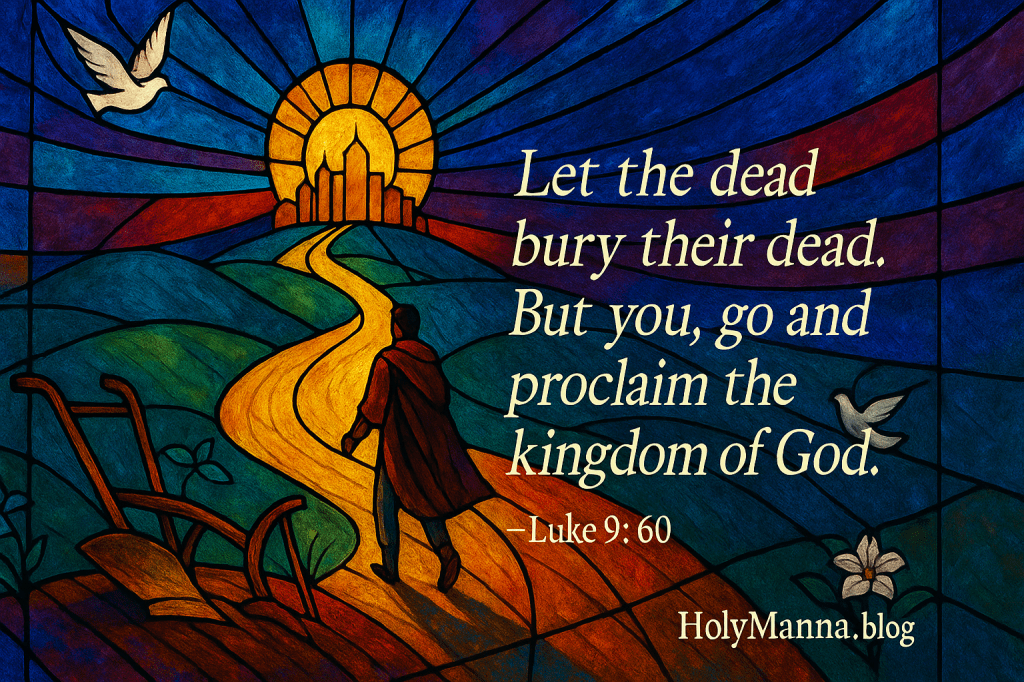
57 As they were proceeding on their journey someone said to him, “I will follow you wherever you go.” 58 Jesus answered him, “Foxes have dens and birds of the sky have nests, but the Son of Man has nowhere to rest his head.” 59 And to another he said, “Follow me.” But he replied, “[Lord,] let me go first and bury my father.” 60 But he answered him, “Let the dead bury their dead. But you, go and proclaim the kingdom of God.” 61 And another said, “I will follow you, Lord, but first let me say farewell to my family at home.” 62 [To him] Jesus said, “No one who sets a hand to the plow and looks to what was left behind is fit for the kingdom of God.”
Detailed Exegesis
Verse 57 – “As they were proceeding on their journey someone said to him, ‘I will follow you wherever you go.’”
The journey frames discipleship as movement toward the cross. The volunteer’s enthusiasm is sincere but untested. The scene warns against romanticizing the path. Following Jesus is not a self-designed project. It is consent to His way.
Verse 58 – “Jesus answered him, ‘Foxes have dens and birds of the sky have nests, but the Son of Man has nowhere to rest his head.’”
Jesus names His chosen poverty. The title Son of Man echoes Daniel 7 while revealing humble solidarity with us. The disciple must share the Lord’s insecurity for love’s sake. Detachment is not contempt for good things. It is freedom for the Kingdom.
Verse 59 – “And to another he said, ‘Follow me.’ But he replied, ‘[Lord,] let me go first and bury my father.’”
Jesus takes the initiative. The request to bury a father reflects a sacred duty in Jewish life. The man calls Jesus “Lord”, yet inserts “first”. The tension exposes how even good obligations can delay obedience when the Kingdom calls.
Verse 60 – “But he answered him, ‘Let the dead bury their dead. But you, go and proclaim the kingdom of God.’”
The Lord speaks with semitic hyperbole to reveal urgency. Life with Him is the truest life. Those spiritually “dead” can fulfill routine tasks. The disciple is commissioned to announce God’s reign now. The priority is proclamation that gives life.
Verse 61 – “And another said, ‘I will follow you, Lord, but first let me say farewell to my family at home.’”
This echoes 1 Kings 19:19-21, where Elisha seeks a goodbye before following Elijah. Jesus is greater than Elijah. The word “first” returns. The heart wants to hold both directions. The Gospel tests our preferences and exposes our hesitations.
Verse 62 – “Jesus said, ‘No one who sets a hand to the plow and looks to what was left behind is fit for the kingdom of God.’”
Plowing requires straight focus. Looking back ruins the furrow. The image translates into interior resolution. The Kingdom is incompatible with divided attention. The disciple’s yes must be present tense and persevering.
Teachings
The Church names the radical preference for Christ that this passage demands. “Jesus enjoins his disciples to prefer him to everything and everyone, and bids them ‘renounce all that [they have]’ for his sake and that of the Gospel. Shortly before his passion he gave them the example of the poor widow of Jerusalem who, out of her poverty, gave all that she had to live on.” CCC 2544. This preference flows from the universal call to holiness that reaches every state of life. “All Christians in any state or walk of life are called to the fullness of Christian life and to the perfection of charity.” CCC 2013. Discipleship must be confessing and missionary, not merely private resolve. “The disciple of Christ must not only keep the faith and live on it, but also profess it, confidently bear witness to it, and spread it.” CCC 1816. The tension with family obligations is real, yet the Gospel reorders loves toward God’s call. “Family ties are important but not absolute. Just as the child grows to maturity and human and spiritual autonomy, so his unique vocation which comes from God asserts itself more clearly and forcefully. Parents should respect this call and encourage their children to follow it.” CCC 2232. Saint Thérèse of the Child Jesus offers a lived commentary on this passage through spiritual childhood. Quoted by The Catechism, she teaches the posture that makes immediate obedience possible. “For me, prayer is a surge of the heart, it is a simple look turned toward heaven, it is a cry of recognition and of love, embracing both trial and joy.” CCC 2558. Prayer like this becomes the engine of ready surrender, letting love act without delay.
Reflection
The Lord asks for a yes that does not hedge. Begin each day with a simple prayer of availability. Name one attachment that usually says “first” and set it beneath Christ’s call. Choose one act of proclamation today, perhaps a word of encouragement that points to God, an intercession for someone far from faith, or a concrete service done quietly for love. When anxieties about security arise, remember that the Son of Man had nowhere to lay His head and yet lacked nothing essential. What is the “first” you tend to place before Jesus, and how will you release it today? Where do you feel torn between good duties and the Kingdom’s call, and how can you reorder those loves in prayer? How will you keep your hand on the plow without looking back before nightfall, in a small, faithful act that only God may see?
Little Way, Steady Plow
Today’s Word traces a single movement of grace. Nehemiah 2:1-8 shows love that remembers Jerusalem and prays first, then acts to rebuild. Psalm 137:1-6 guards that love with a vow never to forget God’s dwelling, even when the harp is silent in a foreign land. Luke 9:57-62 brings the decision to its edge, where Jesus teaches that the Kingdom asks for an undivided yes that does not look back. The Memorial of Saint Thérèse of the Child Jesus gathers these threads in her Little Way, where trust becomes prompt obedience in small, hidden acts. In the light of The Catechism, this is the universal call to holiness that restores worship, community, and the heart itself, as CCC 2013 and CCC 2544 remind us. The disciple prays with simplicity, receives grace with humility, and loves with immediacy, in harmony with CCC 2558-2559.
Let your longing for God’s city become concrete today. Remember Jerusalem by turning your heart to the Eucharist and to the Church. Offer a brief prayer before decisions. Ask for the grace to place Christ first in every preference. Choose one small work of mercy that rebuilds what love remembers. If you are tempted to delay, hear again the Lord’s word: “No one who sets a hand to the plow and looks to what was left behind is fit for the kingdom of God.” Luke 9:62. What small act of trust and love will you begin before nightfall, without looking back? May Saint Thérèse intercede for us, so that our hands stay on the plow, our hearts stay in Jerusalem, and our steps keep time with the quiet courage of the Gospel.
Engage with Us!
We would love to hear your heart. Please share your reflections in the comments below so we can pray with you and encourage one another.
- Nehemiah 2:1-8: Where is God inviting you to rebuild something broken through a brief prayer and a concrete step today, and how will you ask for the help and resources you need with humility and trust?
- Psalm 137:1-6: What practice will help you remember Jerusalem in your daily routine so that worship remains for God alone and not for performance, especially when you feel like hanging up your harp?
- Luke 9:57-62: What good thing usually says “first” in your life, and how will you keep your hand on the plow by placing Jesus before every preference without looking back?
Go in peace and live a life of faith. Do everything with the love and mercy Jesus taught us, and may your small acts of trust and charity become bright windows for His light today.
Sacred Heart of Jesus, we trust in You!
Immaculate Heart of Mary, pray for us!
Saint Michael the Archangel, defend us in battle!
Follow us on Instagram and Facebook for more insights and reflections on living a faith-filled life.

 Holy Manna!
Leave a comment