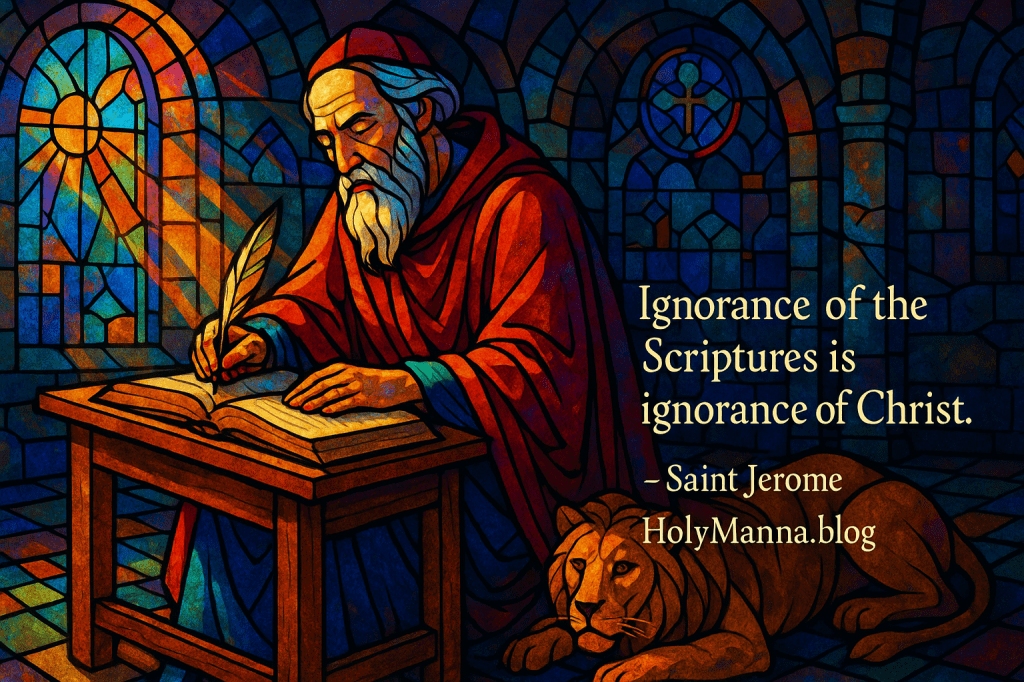
Doctor of Holy Scripture
Jerome of Stridon (c. 347 to 420) is the Church’s great lover of the Word, best known for translating the Bible into Latin, the Vulgate. He is honored as a Doctor of the Church because his life welded scholarship to sanctity. He prayed with the text, lived among monks, guided lay disciples, wrote vigorous defenses of doctrine, and spent himself to bring God’s Word to ordinary Christians. His rallying cry, “Ignorance of the Scriptures is ignorance of Christ.”, names the heart of his mission and remains a guiding star for the Church’s life with the Bible, a call echoed in the Catechism, which urges all the faithful to read Scripture prayerfully and often.
From Rome’s Schools to the Desert
Jerome was born in Stridon on the Dalmatian and Pannonian frontier, in a family able to send him to Rome for classical studies. Under the grammarian Aelius Donatus he mastered Latin style and rhetoric, gifts that would later make his biblical commentaries sharp and clear. He was baptized in Rome around 360 and began a pattern of study and travel that shaped his vocation. Time in Trier and Aquileia nourished his attraction to the ascetic life. In the Syrian desert of Chalcis, he embraced solitude, fasting, and memorization of Scripture with a ferocity that marked him for life. He was ordained a presbyter at Antioch, deepened his theology in Constantinople under Saint Gregory of Nazianzus, and then moved to Rome. There Pope Damasus asked him to revise the Latin Gospels, a commission that widened into a lifelong project of revising and translating the biblical text. After Damasus’s death, Jerome settled in Bethlehem, where with the holy women Paula and Eustochium he established a monastic school of prayer, study, and charity. There he learned Hebrew from Jewish teachers, compared manuscripts, and worked with scribes so that his translations would rest on the most reliable sources available.
The Workshop of the Word
Jerome’s Bethlehem years were a relentless labor of love. He produced critical revisions of the Gospels and then much of the Old Testament directly from the Hebrew, a choice he called Hebraica veritas because he wanted the Church to hear the Old Testament with Israel’s own voice. Alongside the Vulgate, he wrote prefaces that teach how to read each book and a library of commentaries, especially on Isaiah, Jeremiah, Ezekiel, and the Minor Prophets. He also authored De viris illustribus (On Illustrious Men), short biographies of Christian writers that helped the early Church remember its teachers. His treatises Against Helvidius and Against Jovinianus defended the perpetual virginity of Mary and the evangelical value of consecrated chastity within the larger beauty of Christian marriage. He guided an extraordinary circle of Roman noblewomen, especially Paula and her daughter Eustochium, into a life of Scripture, prayer, and service. Jerome did not love Scripture in the abstract. He prayed it, preached it, copied it, and insisted that it reorder our days. In a famous letter of spiritual direction, Letter 53, he urged a disciple to live with the Bible open, to let prayer and reading answer each other, and to make Scripture the first counsel in every decision. “Let sleep find you holding the Scripture, and let the sacred page receive your drooping head.”
Grace before Wonders
Unlike many saints, Jerome’s life is not stocked with documented, episodic miracles of healing or bilocation. The beloved story of a lion tamed by a thorn removed from its paw arose in medieval devotion as a symbol of his courageous charity. The real marvel in Jerome’s life is the conversion that Scripture produced in him and through him. His pen saved the Western Church from a fractured scriptural inheritance by supplying a unified biblical text. His translations and notes became the table where generations of Christians have found daily bread. His letters converted hearts to prayer, reconciliation, and a serious pursuit of holiness. If you seek a miracle in his lifetime, look at minds enkindled, vocations born, communities founded, and the Church’s worship enriched by a faithful text.
Anvils and Fires
Jerome’s zeal brought trials. He could write with cutting clarity, and his uncompromising teaching drew enemies. After Pope Damasus died, court intrigues and rumors in Rome pushed Jerome to leave the city he had just served so fruitfully. In Palestine he faced the Pelagian controversy, and in the early fifth century rioters attacked the Bethlehem monasteries, burning buildings and threatening lives. Jerome took shelter and kept writing. He polemicized when he had to, but he also repented of harshness, asked forgiveness when he judged that he went too far, and never stopped teaching the faithful. He was not a martyr, but he lived a real white martyrdom of exile, calumny, danger, and relentless labor for the Gospel until his death at Bethlehem on September 30, 420.
After the Scribe Fell Silent
Jerome was buried near the Cave of the Nativity in Bethlehem. Over the centuries his relics were associated with Bethlehem and with the Basilica of Saint Mary Major in Rome, where Christians venerate him among the guardians of the mystery of the Incarnation. Pilgrims who visit the Bethlehem cave often remember Jerome as the monk of the manger, the man who bent his life to the Word who became flesh there. While the tradition does not surround him with long catalogues of posthumous physical healings, the Church has long experienced his intercession as an intellectual and spiritual grace. Students ask him for light, preachers for clarity, translators for fidelity, and all the faithful for a deeper hunger for the Scriptures. The true shrine to Jerome is found wherever a Christian opens a Bible and reads with the Church.
Scripture as Daily Bread
Jerome’s path is plain and demanding. Read the Bible daily. Read it within the Church, not as a private oracle but as the living Word proclaimed in the liturgy and safeguarded by the Magisterium. Let prayer and Scripture feed each other so that what you read becomes what you do. The Catechism urges frequent reading of the divine Scriptures with prayerful humility, reminding us with Jerome that “Ignorance of the Scriptures is ignorance of Christ.” Start with the day’s Mass readings and spend a few minutes in lectio divina: read, meditate, pray, and rest in God’s presence. Choose one Gospel passage to memorize this week and let it reshape a conversation, a habit, or a decision. How might your day change if you placed a Bible within arm’s reach and opened it before you opened an app? If you struggle, ask Saint Jerome to obtain for you a taste for the Word, a disciplined mind, and the courage to live what you learn. See CCC 131 to 133 for the Church’s summary of this call.
Engage with Us!
- Where is the Holy Spirit nudging you to make Scripture a daily habit, even if only ten focused minutes?
- Which book of the Bible do you find most difficult, and how can Jerome’s example encourage you to seek a faithful guide to read it with the Church?
- How does Jerome’s courage in controversy challenge you to witness to Catholic teaching with both truth and charity?
- What concrete step will you take this week to let the Word of God shape a decision, a relationship, or a habit?
Keep going. Open the Scriptures, stay with the Church, and do everything with the love and mercy Jesus taught us.
Saint Jerome, pray for us!
Follow us on Instagram and Facebook for more insights and reflections on living a faith-filled life.

 Holy Manna!
Leave a comment