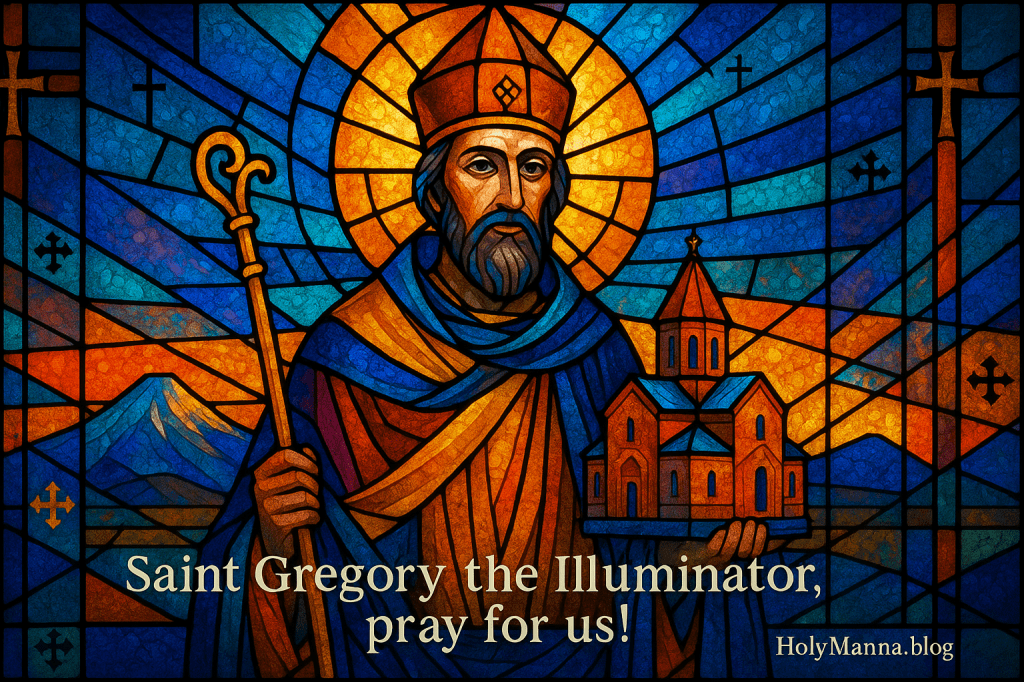
Torch of Armenia’s Dawn
Saint Gregory the Illuminator, known in Armenian as Grigor Lusavorich, stands as the towering figure who led the conversion of Armenia to Christ and organized the Church throughout the land. By time honored tradition, King Tiridates III embraced the Gospel through Gregory’s witness, and Armenia became the first kingdom to adopt Christianity as its public faith. Gregory is venerated across the Christian world for healing a nation divided by violence, for establishing a durable ecclesial structure, and for founding a spiritual legacy that still draws pilgrims to the shadow of Mount Ararat. He is honored as a confessor and bishop who turned a royal court into a school of discipleship and transformed a people by the light of the Gospel.
Roots of a Radiant Mission
Gregory was born of Parthian nobility in the third century, the son of Anak, who was implicated in the assassination of King Khosrov II of Armenia. As an infant he was rescued and brought to Caesarea in Cappadocia, where he was raised in the Christian faith. As a young man he married a devout Christian named Miriam and became the father of two sons, Aristaces and Vrtanes, both of whom later served as bishops and successors in the Armenian Church. Gregory returned to Armenia and entered service under King Tiridates III. When commanded to offer sacrifice to the goddess Anahit, he refused and confessed the one Lord Jesus Christ. The king, enraged and mindful of Gregory’s family history, subjected him to a series of brutal punishments and finally cast him into the deep dungeon of Khor Virap. By the providence of God, Gregory survived in that pit for many years, sustained by the mercy that often hides in the hearts of the lowly. His steadfastness became the anvil upon which the future of a nation was forged.
Foundations of a Christian Nation
The turning point came when a community of consecrated virgins, including Saints Hripsime and Gayane, were martyred after refusing the king’s advances. Soon afterward, Tiridates was struck by a terrifying malady that shattered his pride and sanity. According to the royal chronicles, his sister Khosrovidukht received a vision that the cure would come only through Gregory. The prisoner was drawn up from Khor Virap, emaciated yet unbroken in spirit. Gregory prayed over the king, preached the Gospel, and called him to repentance. The healing that followed opened the door for the baptism of the king, the court, and multitudes of the people. Gregory then traveled to Caesarea and was ordained bishop by Leontius of Caesarea, strengthening Armenia’s communion with the apostolic faith. He organized dioceses, appointed pastors, and encouraged the faithful to worship God in spirit and truth. One of the most cherished episodes in Armenian memory recounts Gregory’s vision at Vagharshapat. He beheld the Only Begotten descending in radiant light, striking the earth with a golden hammer and revealing the site for the Mother Cathedral. There Gregory founded Etchmiadzin, “the place where the Only Begotten descended,” which became the beating heart of Armenian Christian life. Throughout these years the bishop preached Christ crucified and risen, toppled pagan shrines, raised churches and schools, and shepherded a people into the sacraments. The miracle that best sums up Gregory’s life is not only a single healing, but a society remade by grace.
Chains, Courage, and the Pit
Gregory’s path was marked by trial. He endured torture, starvation, and long imprisonment because he refused idolatry. He suffered as a confessor rather than as a martyr, since he did not die from persecution. After years of evangelization he resigned the patriarchal office and withdrew into ascetic solitude, dedicating his last season on earth to prayer and penance. His sons, Aristaces and Vrtanes, continued his work as Catholicoi, guiding the Church through the difficult transition from a newly baptized kingdom to a mature Christian nation. Gregory’s perseverance proved that sanctity is often forged in silence and suffering long before a crown is given.
A Light That Does Not Go Out
Gregory’s relics became a sign of communion across lands and centuries. A portion has long been venerated at San Gregorio Armeno in Naples, a testament to the early and enduring devotion beyond Armenia. In our own times, relics were solemnly enshrined at the great Cathedral of Saint Gregory the Illuminator in Yerevan, a church raised to mark the anniversary of Armenia’s conversion and to welcome pilgrims into renewed faith. Gregory is also honored as patron in Nardò, Italy. At Khor Virap, where the saint once languished in darkness, countless pilgrims now descend into the stone chamber to pray for light. At the Mother See of Holy Etchmiadzin, founded in the brilliance of Gregory’s vision, the faithful gather for worship and for the veneration of saints whose relics recall the nearness of Christ to His Church.
Living His Legacy Today
Gregory teaches us that Christian courage is luminous charity rather than rage. He refused to adore what cannot save, he suffered without despair, and when deliverance came he built up the Body of Christ with tireless love. The Church reminds us that “The communion of saints is the Church.” CCC 946. Holiness is not a solitary project, and Gregory’s sanctity became the lamp of an entire people. The Church also affirms that “The religious sense of the Christian people has always found expression in various forms of piety… such as the veneration of relics, visits to sanctuaries, pilgrimages.” CCC 1674-1675. To honor Gregory at Etchmiadzin or Khor Virap is to be drawn into Christ’s own love for His members. Finally, the Church professes that “The Church is apostolic because she is founded on the apostles and continues to be taught, sanctified, and guided by the apostles until Christ’s return, through their successors.” CCC 857. Gregory’s ordination and mission in communion with the wider Church model this apostolic note in action.
How can we live this today? Say no to the idols of approval, comfort, and control. Frequent the sacraments, study the Scriptures, and support your parish’s missionary works. Consider a pilgrimage, even if only to a local shrine, and ask Saint Gregory to intercede for a deeper conversion. If you feel buried in your own “pit,” remember that grace can raise you to new life and turn your wounds into a witness.
Engage with Us!
We would love to hear your reflections in the comments.
- Where do you feel invited to say “no” to false idols and “yes” to Christ, as Gregory did before King Tiridates?
- What “pit” has God carried you through, and how can that experience help you witness to others?
- Have you ever made a pilgrimage or venerated a relic? How did it draw you closer to Jesus and His Church?
- What might it look like to make your home a little “Etchmiadzin,” a place where Christ’s light descends each day?
May the Lord strengthen you to live a radiant faith, doing everything with the love and mercy Jesus taught us.
Saint Gregory the Illuminator, pray for us!
Follow us on Instagram and Facebook for more insights and reflections on living a faith-filled life.

 Holy Manna!
Leave a comment