Memorial of Saint Jerome, Priest and Doctor of the Church – Lectionary: 456
Gathered in Zion, Formed by the Word, Set for Jerusalem
What if your true birthplace is not the city on your driver’s license but the place where God writes your name into His family? Today’s readings paint a single, luminous picture: God gathers all nations to Himself, Jesus carries this gathering to fulfillment on His road to Jerusalem, and the Church becomes credible in that mission when she is steeped in Scripture, the legacy of Saint Jerome. In Zechariah 8:20–23, peoples from many cities rush toward the Lord and even clutch a Jew’s cloak, saying, “Let us go with you, for we have heard that God is with you.” The magnetism of holiness draws the world. Psalm 87 sings the miracle that follows: God’s ledger of citizenship is rewritten so that of Zion it will be said, “Each one was born in it.” The Lord counts former outsiders as native sons and daughters of His city, which is the seed of the Church’s catholicity. In Luke 9:51–56, Jesus “resolutely determined to journey to Jerusalem,” embracing the Paschal Mystery that will open Zion’s gates to all, and when a Samaritan village refuses Him, He rebukes the impulse to call down fire and simply presses on to another village. The Kingdom advances through mercy, patience, and fidelity, not through coercion or retaliation, which the Church receives as a permanent lesson for mission. Saint Jerome stands beside these texts as priest and Doctor who gave the Church her biblical tongue; his conviction that “Ignorance of the Scriptures is ignorance of Christ” challenges us to let the Word shape our zeal so that it is strong, discerning, and merciful. The Catechism reminds us that Jesus’ ascent to Jerusalem unveils the heart of salvation (CCC 557–560), that the Kingdom is universally offered (CCC 543), that the People of God are drawn from every nation (CCC 781), and that prayerful, constant Scripture reading belongs to every disciple (CCC 133; see also CCC 2585–2589 on the Psalms). The central theme is clear: God is making a single people from many languages, registered as native-born in Zion, by the cross and resurrection Jesus goes to embrace, and Scripture equips us to carry that merciful mission to the next village, and the next, until all can say, “This one was born there.”
First Reading – Zechariah 8:20-23
Drawn to the Cloak
In the late sixth century before Christ, after the exile to Babylon, Judah lived under Persian rule and began to rebuild life around the Second Temple in Jerusalem. The prophet Zechariah addressed a discouraged people who wondered whether God still dwelt among them. Chapters 7 and 8 answer with consolation. Fasting will turn into feasting, the city will be restored, and Jerusalem will once again radiate the presence of the Lord. Our passage unveils a striking promise for Israel and for the world. The nations will not be coerced. They will be attracted. They will stream toward Zion because God is palpably present among His people. Within today’s theme, this reading prepares us to see Jesus’ determined journey to Jerusalem as the decisive moment by which God gathers the nations, and it invites us to receive Saint Jerome’s witness that a Church formed by Scripture becomes credible, magnetic, and merciful in mission.
Zechariah 8:20-23
New American Bible (Revised Edition)
20 Thus says the Lord of hosts:
There will yet come peoples and inhabitants of many cities; 21 and the inhabitants of one city will approach those of another, and say, “Come! let us go to implore the favor of the Lord and to seek the Lord of hosts. I too am going.” 22 Many peoples and strong nations will come to seek the Lord of hosts in Jerusalem and to implore the favor of the Lord.
23 Thus says the Lord of hosts:
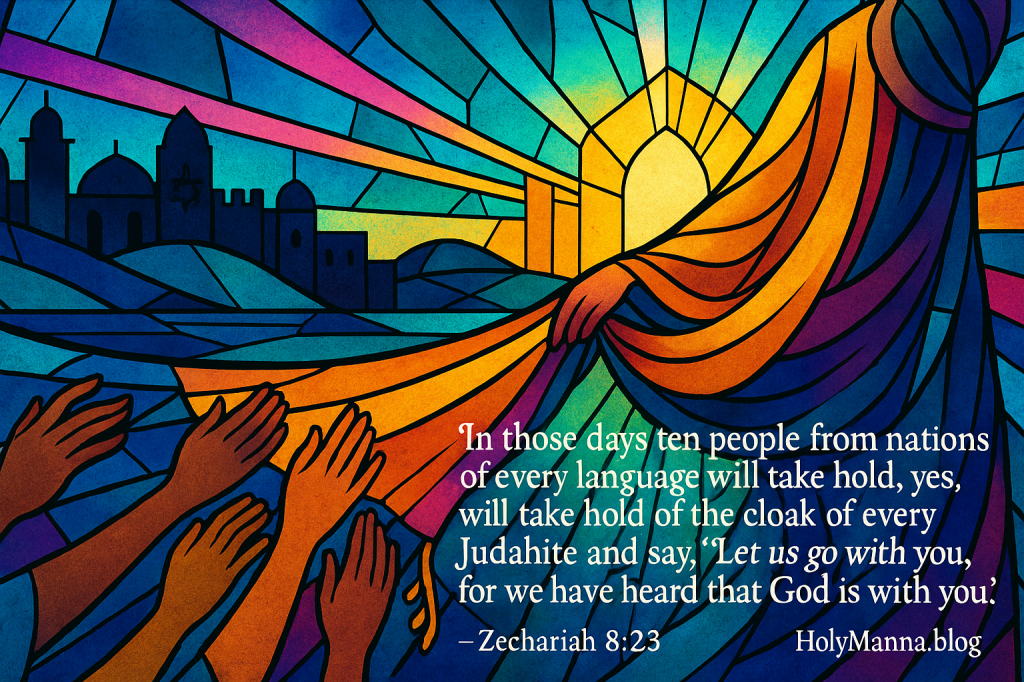
In those days ten people from nations of every language will take hold, yes, will take hold of the cloak of every Judahite and say, “Let us go with you, for we have heard that God is with you.”
Detailed Exegesis
Verse 20 – “Thus says the Lord of hosts: There will yet come peoples and inhabitants of many cities;”
This divine oracle assures a future that transcends Judah’s immediate recovery. The title “Lord of hosts” underlines God’s universal sovereignty. The phrase “There will yet come” signals that restoration is not only local but also international. God intends to make Zion a center of pilgrimage for the nations.
Verse 21 – “and the inhabitants of one city will approach those of another, and say, ‘Come! let us go to implore the favor of the Lord and to seek the Lord of hosts. I too am going.’”
Zechariah depicts evangelization as holy contagion. Desire multiplies from city to city. The language of “implore the favor” evokes grace received in God’s presence, while “seek the Lord” recalls the covenant call to worship in Jerusalem. The personal resolve, “I too am going”, shows that mission grows through witness and accompaniment rather than compulsion.
Verse 22 – “Many peoples and strong nations will come to seek the Lord of hosts in Jerusalem and to implore the favor of the Lord.”
Both “many peoples” and “strong nations” will bend toward Zion. Power does not exclude the powerful from grace. All are invited to seek the Lord. Jerusalem functions sacramentally as the place of God’s dwelling. In Christian fulfillment, the Church becomes the visible sign that draws the nations into communion with the Lord present among His people.
Verse 23 – “Thus says the Lord of hosts: In those days ten people from nations of every language will take hold, yes, will take hold of the cloak of every Judahite and say, ‘Let us go with you, for we have heard that God is with you.’”
“Ten” symbolizes fullness and universality. The gesture of grabbing the cloak expresses humble petition and a desire to share in Israel’s grace and identity. The confession “God is with you” echoes the Immanuel theme and anticipates the Church’s Pentecost moment, when the Gospel is heard in “every language.” In Christ, the new Zion embraces all peoples who cling to the garment of the Messiah and to the people who bear His name.
Teachings
Zechariah heralds the catholicity that God will accomplish in Christ. The Church recognizes in this oracle the plan to form one people from all nations, a plan that comes to light at Jerusalem in the Paschal Mystery and goes forth from Jerusalem at Pentecost. The Catechism captures the Church’s relationship to the Word that forms such a people: “In Sacred Scripture, the Church constantly finds her nourishment and her strength.” (CCC 104). Saint Jerome, whose memorial we keep today, presses the point with his classic maxim: “Ignorance of the Scriptures is ignorance of Christ.” Saint Augustine describes the unity of God’s plan that Zechariah announces and Christ fulfills: “The New Testament lies hidden in the Old, and the Old Testament is unveiled in the New.” Historically, this prophecy speaks to a post exilic community under Persian sovereignty that had begun rebuilding the Temple and city. Religiously, it declares that Israel’s election is ordered to mission. Culturally, it imagines peoples of “every language” discovering their true home in Zion, which the Church confesses to be fulfilled as the nations are gathered into Christ’s Body.
Reflection
God’s strategy is not domination. It is attraction through holiness, mercy, and the palpable presence of God among His people. If the nations are to grab the cloak, then the cloak must be near them, not hidden away. In daily life this means we let God’s Word shape our character, we worship with reverence, and we carry the fragrance of Christ into ordinary places. We can invite a friend to Mass and accompany them, we can pray Psalm 87 and ask the Lord to make our parish a living Zion, and we can let our speech be gentle so that those who differ will still say, “God is with you.” Where is the Lord asking you to be more visible and more merciful so that others might be drawn to Him? Who are the “ten” in your life who might reach for the cloak if you drew near with patience and hope? How will you let Scripture, through the intercession of Saint Jerome, make your heart a place where others can discover that they, too, were born in Zion?
Responsorial Psalm – Psalm 87
Where Outsiders Become Native-Born
Composed by the Korahite guild of temple singers, Psalm 87 is a liturgical hymn that celebrates Zion as the locus of God’s dwelling and the birthplace of a renewed people. In Israel’s religious imagination, Zion symbolizes the Lord’s abiding presence, covenant fidelity, and the joyful center of worship. Culturally, the psalm engages the surrounding nations by naming them and envisioning their surprising enrollment as citizens of God’s city. Historically, this likely reflects the post exilic hope that the restored Jerusalem would radiate a holiness that attracts the world. Within today’s theme, the psalm explains the magnetism seen in Zechariah 8:20–23 and prepares for the mercy shown in Luke 9:51–56. God does not build His people by exclusion. He rewrites the registry so that those once far off can say with truth and joy that they were born in Zion. Saint Jerome’s labor in Scripture serves this catholic vision, since a Church fluent in the Word can sing this psalm credibly before the nations.
Psalm 87
New American Bible (Revised Edition)
Zion the True Birthplace
1 A psalm of the Korahites. A song.
His foundation is on holy mountains,
2 The Lord loves the gates of Zion
more than any dwelling in Jacob.
3 Glorious things are said of you,
O city of God!
Selah
4 Rahab and Babylon I count
among those who know me.
See, Philistia and Tyre, with Ethiopia,
“This one was born there.”
5 And of Zion it will be said:
“Each one was born in it.”
The Most High will establish it;
6 the Lord notes in the register of the peoples:
“This one was born there.”
Selah
7 So singers and dancers:
“All my springs are in you.”
Detailed Exegesis
Verse 1 – “A psalm of the Korahites. A song. His foundation is on holy mountains,”
The superscription places the hymn in the temple tradition of the sons of Korah. The image of foundations on “holy mountains” frames Zion as God’s deliberate architectural choice. The city is not great because of walls but because of the One who founded it.
Verse 2 – “The Lord loves the gates of Zion more than any dwelling in Jacob.”
The “gates” represent entry into worship and communal life. God “loves” them because Zion concentrates His saving presence. Among all the sanctuaries of Israel, Jerusalem is singled out as the covenant’s epicenter, anticipating the Church as the visible city set on a hill.
Verse 3 – “Glorious things are said of you, O city of God!”
The liturgy proclaims Zion’s prerogatives. Glory in Israel is the manifestation of God’s own presence. The verse signals that what follows will be one of Zion’s most glorious distinctions. God will ascribe new birth to the nations.
Verse 4 – “Rahab and Babylon I count among those who know me. See, Philistia and Tyre, with Ethiopia, ‘This one was born there.’”
“Rahab” is a poetic name for Egypt. “Babylon”, “Philistia”, “Tyre”, and “Ethiopia” represent a sweep of political and cultural powers once hostile or distant. God speaks in the first person. He “counts” them as His own. The astonishing verdict, “This one was born there”, assigns Zion as their true birthplace. Divine recognition precedes human merit. God’s registry makes enemies into natives.
Verse 5 – “And of Zion it will be said: ‘Each one was born in it.’ The Most High will establish it;”
The prophecy intensifies from some to “each one.” Zion’s maternity extends to all who receive God’s declaration. The foundation of this status is not civic achievement but the action of “the Most High.” God alone establishes the city and confers its citizenship.
Verse 6 – “the Lord notes in the register of the peoples: ‘This one was born there.’”
Ancient cities kept rolls of citizens. The psalm imagines the Lord Himself writing the census of salvation. The repeated formula underscores certainty. “This one was born there.” What God inscribes cannot be erased. The Church hears here a figure of baptismal incorporation into Christ.
Verse 7 – “So singers and dancers: ‘All my springs are in you.’”
The procession culminates in festal joy. “Springs” evoke life, worship, and grace flowing from God’s dwelling. To say, “All my springs are in you,” is to confess that every life giving gift has its source in the Lord who dwells in Zion.
Teachings
The psalm proclaims a universal birthright granted by God’s choice and mercy. The Church receives this as a figure of her catholic mission and sacramental life. The Catechism teaches the primacy of Scripture for the Church’s identity and worship, a truth that grounds our reading of Psalm 87: “In Sacred Scripture, the Church constantly finds her nourishment and her strength.” (CCC 104). Saint Jerome reminds us that the Church’s song must be rooted in the Word itself: “Ignorance of the Scriptures is ignorance of Christ.” Saint Augustine articulates the unity of God’s plan celebrated by this psalm and fulfilled in Christ: “The New Testament lies hidden in the Old, and the Old Testament is unveiled in the New.” Historically, naming “Rahab” and “Babylon” dramatizes the reach of salvation. Religiously, the registry image anticipates baptismal enrollment into the People of God. Culturally, the nations’ inclusion shows that God’s city is the mother city of a reconciled humanity, which the Church manifests as she gathers all peoples into the Body of Christ.
Reflection
If God is writing new birth into the registry, then our parishes and homes should look like welcome desks rather than gatehouses. We can pray this psalm for our city and ask the Lord to make us a living Zion. We can learn the names of those at the margins of our community so that our intercession can be concrete. We can prepare more reverently for Sunday Mass and ask the Holy Spirit to make our liturgy radiant with the beauty that attracts hearts. We can keep a simple “registry” at home by writing the names of those we are praying to invite to Confession and the Eucharist. Who in your life does the Lord want to count among those who know Him? Where might He be asking you to sing, “All my springs are in you,” in a place that feels spiritually dry? How is the Lord inviting you, through the intercession of Saint Jerome, to become more fluent in Scripture so that your witness helps others discover that they were born in Zion?
Holy Gospel – Luke 9:51–56
Mercy on the Road
As Jesus’ public ministry reaches a turning point, Luke 9:51–56 opens the great travel narrative toward Jerusalem. Historically, Jews and Samaritans had deep tensions over the proper sanctuary for worship, with Samaritans venerating Mount Gerizim and Jews making pilgrimage to Jerusalem. Culturally, hospitality for travelers was a sacred duty, and rejection signaled more than discourtesy. Religiously, Luke’s phrase about Jesus’ “being taken up” refers to His Passion, Resurrection, and Ascension, the Paschal Mystery that will open Zion’s gates for all. Within today’s theme, Jesus’ resolute movement to Jerusalem fulfills the promise of Zechariah 8 and the hope sung in Psalm 87. God is forming one people from many nations. The Lord teaches that this gathering advances by mercy rather than retaliation. Saint Jerome’s love for Scripture equips the Church to discern true zeal from wrathful impulse, so that our mission remains Christlike on the road.
Luke 9:51-56
New American Bible (Revised Edition)
Departure for Jerusalem; Samaritan Inhospitality. 51 When the days for his being taken up were fulfilled, he resolutely determined to journey to Jerusalem, 52 and he sent messengers ahead of him. On the way they entered a Samaritan village to prepare for his reception there, 53 but they would not welcome him because the destination of his journey was Jerusalem. 54 When the disciples James and John saw this they asked, “Lord, do you want us to call down fire from heaven to consume them?” 55 Jesus turned and rebuked them, 56 and they journeyed to another village.
Detailed Exegesis
Verse 51 – “When the days for his being taken up were fulfilled, he resolutely determined to journey to Jerusalem,”
Luke signals divine timing. “Being taken up” compresses the cross, Resurrection, and Ascension into one mystery. Jesus’ firm resolve reveals obedience to the Father. The journey is not a detour. It is the pathway to enthronement and universal salvation.
Verse 52 – “and he sent messengers ahead of him. On the way they entered a Samaritan village to prepare for his reception there,”
Jesus anticipates the mission of the Church by sending forerunners. Entering Samaritan territory shows the Kingdom’s outreach beyond traditional boundaries. Preparation for reception hints at liturgical hospitality. The Lord desires to dwell among those once estranged.
Verse 53 – “but they would not welcome him because the destination of his journey was Jerusalem.”
The refusal is theological. The issue is Jerusalem. Old wounds resurface around the locus of worship. This rejection foreshadows the cross and clarifies that the Kingdom’s advance will meet resistance tied to identity and worship.
Verse 54 – “When the disciples James and John saw this they asked, ‘Lord, do you want us to call down fire from heaven to consume them?’”
The “sons of thunder” recall Elijah calling fire on hostile captains. Their impulse springs from zeal but misreads the moment. They presume authority and timing that belong to God alone. The desire to purify by force contradicts the mercy of the Messiah’s hour.
Verse 55 – “Jesus turned and rebuked them,”
The Lord’s turning is pedagogical. He confronts misguided zeal and purifies it. True discipleship learns to endure rejection without vengeance. The rebuke aligns the apostles’ spirit with the meekness of the Lamb going to Jerusalem.
Verse 56 – “and they journeyed to another village.”
Mission continues without bitterness. The simplest line becomes a pastoral strategy. When a door closes, the Gospel moves on. Mercy keeps the road open for future grace. The Church learns to accept refusals while preserving charity.
Teachings
The Gospel manifests how the Kingdom advances by mercy on the way to the cross. The Catechism situates our reading within the Church’s life in the Word: “In Sacred Scripture, the Church constantly finds her nourishment and her strength.” (CCC 104). Formed by Scripture, the Church learns to follow Christ’s face set toward Jerusalem. She also heeds the call that Saint Jerome made perennial: “Ignorance of the Scriptures is ignorance of Christ.” (CCC 133, citing Jerome). The Gospel corrects distorted zeal by anchoring us in the pattern of Jesus, who receives rejection without retaliation and continues His saving mission. In the wider Scriptural canon, this mercy aligns with the apostolic exhortation, “Do you not know that God’s kindness is meant to lead you to repentance?” (Rom 2:4). Historically, the Samaritan Jewish schism explains the immediate cause of rejection. Theologically, Jesus’ steady progress to Jerusalem reveals that salvation will be accomplished by obedient love rather than by coercive displays of power.
Reflection
Rejection is not a cue for retaliation. It is a summons to mercy, patience, and fidelity. In daily life, we can choose to keep moving toward holiness when conversations about faith grow tense. We can bless rather than curse in traffic, at work, or online. We can pray for those who refuse us and return to them later with a softer heart. We can keep Scripture before our eyes each day so that our zeal is formed by Christ. Where do you feel the sting of rejection today, and how might Jesus be inviting you to keep walking to the next village with peace? Whom can you bless this week instead of calling down “fire from heaven” in your thoughts or words? How will you let the Word, through the intercession of Saint Jerome, make your resolve firm and your mercy constant on the road to Jerusalem?
Born in Zion, Walking in Mercy, Formed by the Word
Today’s readings unveil one radiant story. In Zechariah 8:20–23, God promises that peoples from many cities will take hold of Israel’s cloak and say, “Let us go with you, for we have heard that God is with you.” In Psalm 87, the Lord Himself writes a new registry in which the nations can rejoice, “This one was born there.” In Luke 9:51–56, Jesus sets His face toward Jerusalem for the Paschal Mystery and teaches His disciples that the Kingdom advances through mercy, not retaliation, as He quietly moves on to another village when rejected. The Memorial of Saint Jerome crowns this vision by reminding us that the Church’s heart beats with Scripture. As the Catechism teaches, CCC 104 and CCC 133 call us to receive the Word that nourishes and forms us, while CCC 557–560 reveals the meaning of Christ’s journey to Jerusalem. The message is clear and cohesive. God gathers a single people from every language, grants them native birth in Zion, and forms them by the Word so that they can carry a merciful mission into the world.
Here is the invitation for this week. Open the Scriptures each day, even for a few minutes, and ask Saint Jerome to intercede that you might know Christ through His Word. Choose mercy where you feel slighted. Bless rather than curse, pray rather than punish, and keep moving toward holiness when doors seem to close. Invite someone to come with you to Mass and accompany them with patience and joy so that they can discover their true home in God’s city. Pray Psalm 87 and ask the Lord to make your parish a place where outsiders become native born in grace. What simple step will you take today to cling to Christ’s cloak, to walk the road of mercy with Him, and to let the Word make your life a living Zion?
Engage with Us!
We would love to hear your thoughts in the comments below. Share how the Lord is speaking to you through today’s readings and the Memorial of Saint Jerome.
- First Reading — Zechariah 8:20–23: Who are the people in your life who might be ready to say, “Let us go with you, for we have heard that God is with you.”? How can you bring your “cloak” of witness closer to them this week so that your life quietly says, “God is with you.”?
- Responsorial Psalm — Psalm 87: Where do you need to let God write into your heart the truth, “This one was born there.”? In what concrete place of dryness will you pray, “All my springs are in you.” and ask the Lord to make your parish a living Zion?
- Holy Gospel — Luke 9:51–56: When you face rejection, where are you tempted to call down “fire from heaven” in your thoughts or words? What is one practical way you can imitate Jesus and simply keep going, as it is said, “they journeyed to another village.”?
Go in peace and live a life of faith. Open the Scriptures, choose mercy, and do everything with the love and compassion Jesus taught us so that others may discover their true home in God.
Sacred Heart of Jesus, we trust in You!
Immaculate Heart of Mary, pray for us!
Saint Michael the Archangel, defend us in battle!
Follow us on Instagram and Facebook for more insights and reflections on living a faith-filled life.

 Holy Manna!
Leave a comment