Feast of Saints Michael, Gabriel, and Raphael, Archangels – Lectionary: 647
The King and His Messengers
What if the veil lifted for a moment and you saw the true center of the universe, the place where heaven’s worship and earth’s history meet in one Person? Today’s feast draws that curtain back. In Daniel 7:9-14, the prophet beholds the Ancient of Days enthroned while “thousands upon thousands were ministering to him, and myriads upon myriads stood before him”; into this blazing court comes “one like a son of man” who receives “dominion, splendor, and kingship”, a rule that “shall not pass away”. In Psalm 138:1-5, David responds in harmony with that same court, singing “in the presence of the angels to you I sing” and proclaiming that all kings will learn the ways of the Lord. Then, in John 1:47-51, Jesus promises Nathanael a fuller unveiling: “You will see the sky opened and the angels of God ascending and descending on the Son of Man.” The ladder between heaven and earth is not a place. It is Christ Himself.
The Church celebrates on this day the Feast of Saints Michael, Gabriel, and Raphael, a consolidation of ancient devotions once kept on separate days and now observed together on September 29 in the Roman Rite. Their Hebrew names reveal their missions. Michael, “Who is like God,” is the great protector and champion of God’s people, seen contending against the dragon in Revelation 12. Gabriel, “God is my strength,” announces the Incarnation to Mary in Luke 1. Raphael, “God heals,” guides and restores in Tobit. The tradition behind today’s readings is rich in Second Temple Jewish imagery, where angelic hosts are understood as real personal beings who serve the living God and assist in His governance of creation. The New Testament receives and clarifies this heritage by centering every angelic task on Jesus Christ. As The Catechism teaches, “Christ is the center of the angelic world” (CCC 331). The angels belong to Him, they serve His saving work, and they adore His face made visible in the Incarnate Son (CCC 331–333). In the sacred liturgy, we do not sing alone. We join their hymn of Sanctus in a real, though mysterious, communion with the heavenly temple (CCC 335). God’s providence even appoints angels to guard and guide us on the way to that temple (CCC 336).
Here is the thread that binds today’s Scriptures and the feast into one tapestry: Heaven is opened in Christ. The archangels reveal, defend, and heal under His everlasting kingship. Daniel shows the enthronement of the Son of Man. The psalm teaches the song earth must learn from heaven. The Gospel discloses the living ladder by which angels move in the service of our salvation. Will you let the worship of heaven shape your prayer, your courage, and your mission today?
First Reading – Daniel 7:9-10, 13-14
The Court of Heaven and the Son of Man
Empires rise and fall, but Daniel opens the throne room that outlasts them all. Written within the crucible of Israel’s trials in the Second Temple period, Daniel uses apocalyptic imagery to unveil God’s hidden governance of history. Thrones are set, a river of fire flows, and the Ancient of Days presides as judge while angelic hosts minister in His presence. Into this blazing court comes “one like a son of man”, presented before the Ancient of Days and granted an everlasting kingdom. On the Feast of Saints Michael, Gabriel, and Raphael, this scene grounds our theme: heaven is opened in Christ. The archangels do not draw attention to themselves. They reveal, defend, and heal under the dominion of the Son of Man, whose kingship is universal and whose reign cannot be destroyed. The vision is not fantasy. It is the ultimate reality toward which our worship, our courage in battle, and our healing in grace are ordered.
Daniel 7:9-10, 13-14
New American Bible (Revised Edition)
9 As I watched,
Thrones were set up
and the Ancient of Days took his throne.
His clothing was white as snow,
the hair on his head like pure wool;
His throne was flames of fire,
with wheels of burning fire.
10 A river of fire surged forth,
flowing from where he sat;
Thousands upon thousands were ministering to him,
and myriads upon myriads stood before him.
The court was convened, and the books were opened.
13 As the visions during the night continued, I saw coming with the clouds of heaven
One like a son of man.
When he reached the Ancient of Days
and was presented before him,
14 He received dominion, splendor, and kingship;
all nations, peoples and tongues will serve him.
His dominion is an everlasting dominion
that shall not pass away,
his kingship, one that shall not be destroyed.
Detailed Exegesis
Verse 9 – “As I watched, Thrones were set up and the Ancient of Days took his throne. His clothing was white as snow, the hair on his head like pure wool; His throne was flames of fire, with wheels of burning fire.”
Daniel’s vision draws on temple and chariot imagery familiar to Israel, resonating with Ezekiel’s fiery throne and wheels. White garments signify purity and righteousness, while fire signifies holiness that judges and purifies. The “thrones” indicate a heavenly court in session, the true tribunal above every human court. In the context of today’s feast, the angels serve in this court as ministers of God’s holiness. They are not distant abstractions. They are personal spirits who assist in God’s governance, reflecting The Catechism’s teaching that Christ is the center and Lord of the angelic world, and that angels are His servants in the economy of salvation.
Verse 10 – “A river of fire surged forth, flowing from where he sat; Thousands upon thousands were ministering to him, and myriads upon myriads stood before him. The court was convened, and the books were opened.”
The “river of fire” is judgment flowing from God’s throne. The countless ministers are the angelic hosts. The “books” evoke divine memory and justice, the comprehensive knowledge of every deed. With the court convened, history is seen sub specie aeternitatis. The archangels fit naturally here. Michael is the defender amid judgment, Gabriel bears messages that order history to salvation, and Raphael mediates God’s healing within His providential plan. The phrase “books were opened” invites an examination of conscience and a renewed hope, since judgment belongs to the God who is merciful and just.
Verse 13 – “As the visions during the night continued, I saw coming with the clouds of heaven One like a son of man. When he reached the Ancient of Days and was presented before him,”
Coming on the clouds is a divine prerogative in the Old Testament. The “Son of Man” is a human figure vested with God’s authority. Jesus will take this title as His favorite self-designation, identifying Himself with this figure and uniting humanity and divinity in His person. In today’s Gospel, He promises Nathanael that he will see heaven opened and angels ascending and descending upon the Son of Man. The archangels’ missions are therefore Christocentric. They move because He reigns.
Verse 14 – “He received dominion, splendor, and kingship; all nations, peoples and tongues will serve him. His dominion is an everlasting dominion that shall not pass away, his kingship, one that shall not be destroyed.”
Here is the climax. Authority, glory, and kingship are conferred upon the Son of Man in perpetuity. The universality of “all nations, peoples and tongues” anticipates the Gospel’s mission to the ends of the earth and the Church’s catholicity. In the liturgy, we already participate in this kingdom as we unite our voices to the angels who adore the King. The unshakable permanence of His rule grounds Christian hope, especially when earthly powers seem dominant.
Teachings
The Catechism situates this vision within the mystery of Christ and the angels. “Christ is the center of the angelic world.” (CCC 331). His life is inseparable from their adoration and service: “From the Incarnation to the Ascension, the life of the Word incarnate is surrounded by the adoration and service of angels.” (CCC 333). In worship we do not stand alone: “In her liturgy, the Church joins with the angels to adore the thrice-holy God.” (CCC 335). God’s providence extends personally to us through angelic guardians: “Beside each believer stands an angel as protector and shepherd leading him to life.” (CCC 336, quoting St. Basil). The tradition clarifies the angelic mission with precision. St. Gregory the Great teaches, “The name ‘angel’ denotes a function, not a nature.” (St. Gregory the Great, Homily 34 on the Gospels). Their nature is spiritual. Their office is to be sent in service of God’s plan, which culminates in Christ the King. Jesus explicitly unites Daniel’s vision to Himself when He declares to the high priest, “You will see the Son of Man seated at the right hand of Power and coming on the clouds of heaven.” (Matthew 26:64). Read through this lens, Daniel 7 is not a distant myth. It is a Christological window onto the present reign of Jesus who governs, judges, and saves, surrounded by the ministering hosts we honor today.
Reflection
Daniel invites us to pray and act as citizens of a kingdom that already reigns from heaven. Let your prayer consciously join the angels in adoration. Ask St. Michael to defend your heart from the lies that accuse you before the throne. Invite St. Gabriel to strengthen your yes to God’s will and to make your words instruments of truth. Welcome St. Raphael to guide your steps and to bring God’s healing to your wounds and relationships. Examine your conscience before the “opened books,” then entrust your life to the mercy of the Son of Man whose dominion does not pass away. Where is Christ asking you to live today as if heaven is truly opened? What concrete habit will help your prayer harmonize with the worship of the angels? Which archangel’s patronage do you most need right now, and how will you ask for it with faith?
Responsorial Psalm – Psalm 138:1-5
Singing With the Angels Before the King
Israel’s hymnbook teaches earth how to echo heaven. Composed for worship that encompassed temple, covenant, and kingship, Psalm 138 brings us into a liturgy where human voices consciously join the angelic hosts. On the Feast of Saints Michael, Gabriel, and Raphael, the psalm’s setting “in the presence of the angels” reveals our theme in practice: heaven is opened in Christ, and the Church learns to praise within His royal court. The Davidic voice bows toward the holy temple, gives thanks for God’s mercy and faithfulness, and envisions a day when even earthly rulers will learn the ways of the Lord. This is not private devotion. It is the sound of the Kingdom, the worship that the archangels model and into which they invite us.
Psalm 138:1-5
New American Bible (Revised Edition)
Hymn of a Grateful Heart
1 Of David.
I thank you, Lord, with all my heart;
in the presence of the angels to you I sing.
2 I bow low toward your holy temple;
I praise your name for your mercy and faithfulness.
For you have exalted over all
your name and your promise.
3 On the day I cried out, you answered;
you strengthened my spirit.
4 All the kings of earth will praise you, Lord,
when they hear the words of your mouth.
5 They will sing of the ways of the Lord:
“How great is the glory of the Lord!”
Detailed Exegesis
Verse 1 – “Of David. I thank you, Lord, with all my heart; in the presence of the angels to you I sing.”
David’s gratitude is total and public. The phrase “in the presence of the angels” situates praise before the heavenly court we saw in Daniel 7. The archangels do not replace our song. They amplify it as fellow servants before the throne. In the Mass we echo this verse each time we sing the Sanctus, joining the angelic liturgy that never ceases.
Verse 2 – “I bow low toward your holy temple; I praise your name for your mercy and faithfulness. For you have exalted over all your name and your promise.”
The posture is adoration. The content is covenant love and fidelity. God’s “name” and “promise” are exalted, which means His revealed identity and His sworn word govern Israel’s hope. Gabriel’s annunciation in Luke 1 shows that God’s promise culminates in Christ. Our bow toward the temple becomes our Eucharistic adoration of the Word made flesh, the true Temple.
Verse 3 – “On the day I cried out, you answered; you strengthened my spirit.”
Praise is not escapism. It springs from answered prayer. The Lord’s response fortifies the inner person. Raphael’s healing guidance in Tobit reflects this strengthening work. In the Gospel, angels ministered to Jesus after temptation, and they continue to assist the members of His Body, strengthening us to persevere.
Verse 4 – “All the kings of earth will praise you, Lord, when they hear the words of your mouth.”
The horizon widens to the nations. When rulers hear God’s words, they will praise. This anticipates the universal dominion given to the Son of Man in Daniel 7:14. The archangels defend and announce this kingship in history, directing earthly power to acknowledge the true King.
Verse 5 – “They will sing of the ways of the Lord: ‘How great is the glory of the Lord!’”
The end of history is doxology. The “ways of the Lord” are His faithful acts of salvation that elicit the only fitting response. In the liturgy we already learn this song. The Church’s voice, joined to the angels, becomes a sign that Christ’s Kingdom is present and advancing.
Teachings
The Church explicitly teaches that angelic worship and Christian worship converge. “In the meantime, the whole life of the Church benefits from the mysterious and powerful help of angels.” (CCC 334). “In her liturgy, the Church joins with the angels to adore the thrice-holy God.” (CCC 335). God’s providence extends personally to the faithful through their guardians. “From its beginning until death, human life is surrounded by their watchful care and intercession.” (CCC 336). The Fathers clarify the angelic office with precision. St. Gregory the Great writes, “The name ‘angel’ denotes a function, not a nature.” (St. Gregory the Great, Homily 34 on the Gospels). Scripture confirms their ministry on our behalf. “Are they not all ministering spirits sent to serve, for the sake of those who are to inherit salvation?” (Hebrews 1:14). Read in this light, Psalm 138 is a school of doxology. It trains our hearts to adore with the angels and to announce God’s fidelity so that even the mighty of the earth learn to praise.
Reflection
Let your prayer today be deliberately angelic. Begin by giving thanks with your whole heart and name aloud the mercies you have received. Bow in adoration before the Lord’s presence, whether in a quiet place at home or before the Blessed Sacrament. Ask St. Michael to guard your mind so your worship is undivided. Ask St. Gabriel to place God’s word on your lips so that others hear and praise. Ask St. Raphael to strengthen your spirit where you are tired or wounded. Resolve to let your speech this week teach the “ways of the Lord” by recounting God’s faithfulness to at least one person. What song of gratitude will you offer today in the presence of the angels? Where is the Lord inviting you to bow low and trust His promise again? Whom will you encourage by telling how great the glory of the Lord has been in your life?
Holy Gospel – John 1:47-51
The Open Sky and the Living Ladder
The Fourth Gospel introduces us to Nathanael at the dawn of Jesus’ public ministry, when the first disciples are gathering around the Word made flesh. Within the world of first century Judaism, the fig tree can symbolize prayerful study and peace, echoing Israel’s hope to sit unafraid “under vine and fig tree.” A “true Israelite” without duplicity recalls Jacob, the patriarch renamed Israel, whose story includes both cunning and a life-changing encounter with God. Jesus’ promise that Nathanael will see the angels of God ascending and descending upon the Son of Man evokes Genesis 28, where Jacob dreams of a ladder that bridges heaven and earth. On the Feast of Saints Michael, Gabriel, and Raphael, this Gospel reveals that Christ Himself is the living ladder. The archangels and all angelic hosts move in service of His saving work. Heaven opens where He is. Faith begins where He finds us, reads our hearts, and invites us to see “greater things.”
John 1:47-51
New American Bible (Revised Edition)
47 Jesus saw Nathanael coming toward him and said of him, “Here is a true Israelite. There is no duplicity in him.” 48 Nathanael said to him, “How do you know me?” Jesus answered and said to him, “Before Philip called you, I saw you under the fig tree.” 49 Nathanael answered him, “Rabbi, you are the Son of God; you are the King of Israel.” 50 Jesus answered and said to him, “Do you believe because I told you that I saw you under the fig tree? You will see greater things than this.” 51 And he said to him, “Amen, amen, I say to you, you will see the sky opened and the angels of God ascending and descending on the Son of Man.”
Detailed Exegesis
Verse 47 – “Jesus saw Nathanael coming toward him and said of him, ‘Here is a true Israelite. There is no duplicity in him.’”
Jesus reads Nathanael’s heart before any confession is made. “True Israelite” signals covenant identity purified of Jacob’s old guile. Integrity is the soil where revelation takes root. In the context of today’s feast, angelic ministry surrounds this unveiling, for the angels serve truth and worship the One who is Truth.
Verse 48 – “Nathanael said to him, ‘How do you know me?’ Jesus answered and said to him, ‘Before Philip called you, I saw you under the fig tree.’”
The Lord’s knowledge is personal and prior. The fig tree hints at prayerful study and messianic peace. Jesus’ “I saw you” discloses divine sight that precedes our seeking. This anticipates the way angels minister by God’s initiative, not ours. Grace moves first.
Verse 49 – “Nathanael answered him, ‘Rabbi, you are the Son of God; you are the King of Israel.’”
Nathanael leaps from question to confession. Titles that belong to Israel’s hope are placed on Jesus. “Son of God” and “King of Israel” harmonize with Daniel 7, where the Son of Man receives everlasting dominion. Angelic fidelity points to this royal identity. Their praise is the soundtrack of this recognition.
Verse 50 – “Jesus answered and said to him, ‘Do you believe because I told you that I saw you under the fig tree? You will see greater things than this.’”
Faith sparked by a personal sign will mature through greater revelations. The Gospel will unveil water made wine, the Bread of Life, and the glory of the Cross and Resurrection. The Lord promises growth. The angels stand ready to assist that growth by strengthening believers and guarding the way.
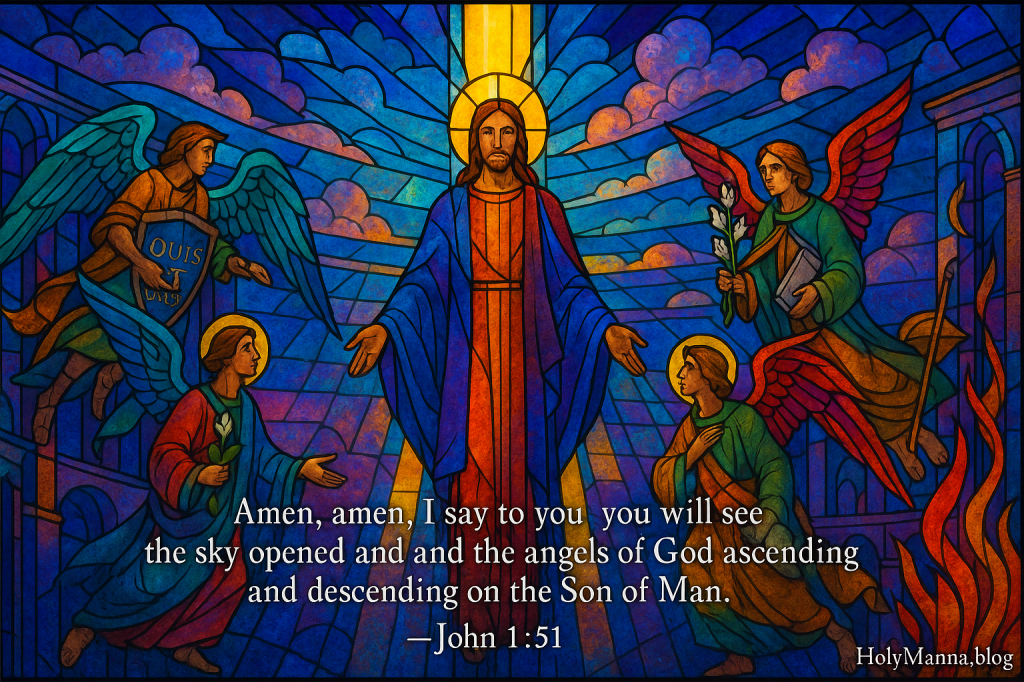
Verse 51 – “And he said to him, ‘Amen, amen, I say to you, you will see the sky opened and the angels of God ascending and descending on the Son of Man.’”
“Amen, amen” signals solemn truth. Jesus identifies Himself as Jacob’s ladder. He is the bridge, temple, and liturgy in person. The angels’ movement “on the Son of Man” means their entire mission is Christocentric. Where He is present, heaven is open and grace is at work.
Teachings
The Catechism places today’s Gospel within the mystery of Christ and the angels. “Christ is the center of the angelic world.” (CCC 331). Our worship already participates in their praise: “In her liturgy, the Church joins with the angels to adore the thrice-holy God.” (CCC 335). God’s providence extends personally to each of us through their help: “From its beginning until death, human life is surrounded by their watchful care and intercession.” (CCC 336). Scripture describes their ministry on our behalf: “Are they not all ministering spirits sent to serve, for the sake of those who are to inherit salvation?” (Hebrews 1:14). The Fathers clarify their office. St. Gregory the Great teaches, “The name ‘angel’ denotes a function, not a nature.” (St. Gregory the Great, Homily 34 on the Gospels). Read through this lens, Jesus’ promise to Nathanael is not a poetic metaphor. It is a revelation of His identity. He is the Son of Man upon whom the angelic world moves, the living temple where heaven and earth meet.
Reflection
Let your prayer be transparent before the Lord who already sees you “under the fig tree.” Speak to Him with a guileless heart. Confess where you have practiced duplicity and ask for the integrity that welcomes deeper revelation. Spend time this week in Eucharistic adoration to dwell where the sky is opened sacramentally. Invite St. Michael to defend your honesty, St. Gabriel to carry God’s word into your conversations, and St. Raphael to heal what keeps you from wholehearted faith. Resolve one concrete act that embodies your belief in the living ladder, such as reconciling with someone you have avoided, sharing a testimony of grace, or beginning a habit of daily lectio divina. Where is Jesus inviting you to move from curiosity to confession as Nathanael did? What “greater things” might He want to show you if you will pray and obey with a single heart? How will you let the angels’ worship shape your own this week?
Heaven Opened, Walk in the Light of the King
In Daniel 7, the veil lifts on the blazing court of the Ancient of Days as “one like a son of man” receives an everlasting kingdom. In Psalm 138, earth learns heaven’s song, giving thanks “in the presence of the angels” and confessing “How great is the glory of the Lord!” In John 1:47-51, Jesus promises Nathanael a fuller unveiling, “You will see the sky opened and the angels of God ascending and descending on the Son of Man.” Taken together with today’s Feast of Saints Michael, Gabriel, and Raphael, the message is clear and consoling. Heaven is opened in Christ. The archangels reveal, defend, and heal within His reign, and the Church is invited to live now as citizens of His Kingdom.
This feast is not about angels in isolation. It is about Jesus Christ, the living ladder between heaven and earth, the center of their worship and ours. As The Catechism proclaims, “Christ is the center of the angelic world.” (CCC 331). St. Michael strengthens our courage to resist evil under the King’s standard. St. Gabriel steadies our yes to the Word that saves. St. Raphael accompanies our steps and brings God’s healing into our wounds. The liturgy already places us in their company, and in every Eucharist our voices join theirs in the hymn of the thrice holy God, as CCC 335 teaches.
Here is the call to action for today. Entrust your battles to Christ the King and ask St. Michael to defend you. Carry God’s word into your conversations and ask St. Gabriel to help you speak with truth and hope. Seek reconciliation and healing where you are hurting and ask St. Raphael to guide you. Spend time in Eucharistic adoration this week, read Daniel 7, pray Psalm 138, and return to John 1:47-51 until your heart is confident that the sky is indeed opened over your life in Christ. Where is the Lord inviting you to live as a true Israelite without duplicity? What step will you take today to pray and work in the presence of the angels? How will you let the worship of heaven shape your next decision, your next word, and your next act of love?
Engage with Us!
We would love to hear your reflections in the comments below. Share how the Lord is speaking to you through these readings and this beautiful feast.
- First Reading — Daniel 7:9-10, 13-14: How does the vision of the Ancient of Days and the Son of Man reshape the way you see your daily choices, and what is one concrete act you will take this week to live under Christ’s everlasting kingship?
- Responsorial Psalm — Psalm 138:1-5: What thanksgiving will you offer today “in the presence of the angels,” and who is one person you will tell about the ways of the Lord this week so that they may join the song of praise?
- Holy Gospel — John 1:47-51: Where is Jesus inviting you to be a true Israelite without duplicity, and how will you make space to pray under your “fig tree” so that you may see greater things with the sky opened over your life?
May Saints Michael, Gabriel, and Raphael intercede for you as you take your next step of faith. Go forth in confidence, and do everything with the love and mercy Jesus taught us.
Sacred Heart of Jesus, we trust in You!
Immaculate Heart of Mary, pray for us!
Saint Michael the Archangel, defend us in battle!
Follow us on Instagram and Facebook for more insights and reflections on living a faith-filled life.

 Holy Manna!
Leave a comment