Twenty-sixth Sunday in Ordinary Time – Lectionary: 138
Crossing the Chasm of Comfort
Come, take a breath with Scripture, and let God’s word unsettle our comfort so that love can move us. In Amos 6 the prophet thunders “Woe to those who are complacent in Zion”, naming the luxury of ivory beds, rich oils, and music while the “collapse of Joseph” goes unnoticed. In eighth century B.C. Israel, such opulence signaled a spiritual blindness that ignored covenant justice, which is why exile followed. Psalm 146 then sings what Israel’s worship should have formed in every heart, a vision of the Lord who “secures justice for the oppressed”, “gives bread to the hungry”, “sets prisoners free”, and protects the stranger, the orphan, and the widow. 1 Timothy 6 brings that vision into the life of the Church, urging disciples to reject vain pursuits and to “pursue righteousness, devotion, faith, love, patience, and gentleness”, to “compete well for the faith”, and to hold fast until the appearing of the “King of kings and Lord of lords.” Finally, in The Gospel of Luke 16 Jesus tells of the rich man and Lazarus, a parable steeped in the culture of status symbols, purple garments, and banquets, revealing that a life insulated from the poor stretches into eternity as “a great chasm” that no one can cross. The Church has always read these texts together as a summons to conversion and mercy, a call articulated in The Catechism’s teaching on the preferential love for the poor and the works of mercy, as well as detachment from riches and the sober reality of judgment (CCC 2443 to 2449, CCC 2447, CCC 2544 to 2547, CCC 1033). The central theme is simple and searching, God’s people must wake from complacency, fight for holiness, and love the poor now, because this is how we live the Kingdom that God praises in Psalm 146 and that Christ will reveal in glory. Where is Lazarus near my gate, what comforts keep me from seeing him, and how will I cross the chasm with mercy today?
First Reading – Amos 6:1, 4-7
From Cushioned Couches to Coming Exile
In the eighth century before Christ, during a time of economic boom and political strength under Jeroboam II, the Northern Kingdom of Israel enjoyed luxury that masked deep covenant infidelity. The prophet Amos arrives from Judah as God’s prosecuting attorney, exposing a class that feasts, perfumes itself, and sings while the “collapse of Joseph” goes unnoticed. The opening “Woe” signals not mere sadness but a legal verdict. This passage confronts complacency that numbs the conscience, the sin of omission that refuses to be “made ill” by the suffering next door. Within today’s theme of crossing the chasm of comfort, Amos 6 lays the ground for the Psalm’s portrait of God who lifts the lowly, for 1 Timothy’s summons to pursue righteousness, and for The Gospel of Luke’s warning that ignored misery hardens into an eternal chasm. The prophet’s words read like an autopsy of a culture that lost the covenant’s heartbeat of justice and mercy.
Amos 6:1, 4-7
New American Bible (Revised Edition)
Third Woe
1 Woe to those who are complacent in Zion,
secure on the mount of Samaria,
Leaders of the first among nations,
to whom the people of Israel turn.
4 Those who lie on beds of ivory,
and lounge upon their couches;
Eating lambs taken from the flock,
and calves from the stall;
5 Who improvise to the music of the harp,
composing on musical instruments like David,
6 Who drink wine from bowls,
and anoint themselves with the best oils,
but are not made ill by the collapse of Joseph;
7 Therefore, now they shall be the first to go into exile,
and the carousing of those who lounged shall cease.
Detailed Exegesis
Verse 1 – “Woe to those who are complacent in Zion, secure on the mount of Samaria, Leaders of the first among nations, to whom the people of Israel turn.”
Amos addresses both Zion and Samaria, signaling that no sanctuary insulates a people from judgment when leaders grow lax. “Complacent” names spiritual lethargy, not innocent rest. Security rooted in seats of power replaces trust in the Lord. The covenant called Israel to be a light to the nations, yet the leaders have become a cautionary tale. This verse sets the trial’s charge, a people anesthetized by status and influence while justice withers.
Verse 4 – “Those who lie on beds of ivory, and lounge upon their couches; Eating lambs taken from the flock, and calves from the stall;”
Ivory inlays and choice meats mark conspicuous consumption. The imagery is not a critique of beauty or feast days in themselves, it is an indictment of a lifestyle insulated from the poor. The covenant law demanded care for the landless and the laborer. Indulgence without mercy becomes a sign of covenant amnesia.
Verse 5 – “Who improvise to the music of the harp, composing on musical instruments like David,”
The comparison to David is ironic. David’s music healed and worshiped. Here music anesthetizes. Art that was meant to lift hearts to God now lulls conscience to sleep. The verse exposes culture used as narcotic rather than as offering.
Verse 6 – “Who drink wine from bowls, and anoint themselves with the best oils, but are not made ill by the collapse of Joseph;”
“Bowls” suggests excess. “Best oils” suggests curated luxury. The piercing clause is the refusal to be “made ill” at the “collapse of Joseph.” Amos identifies the sin beneath the sins, a hardened indifference that will not share in the suffering of the body. In biblical imagination, true worship always produces solidarity with the afflicted. Refusing that solidarity profanes worship.
Verse 7 – “Therefore, now they shall be the first to go into exile, and the carousing of those who lounged shall cease.”
The verdict lands. Those first in comfort will be first in chains. Historically, this anticipates the Assyrian conquest in 722 B.C., when the Northern Kingdom fell. The couches become a memory, and the party ends. The warning is medicinal as well as judicial, since exile aims at conversion.
Teachings
Amos reveals a perennial temptation for God’s people, the drift from worship into insulated comfort that forgets mercy. The Church defines mercy as concrete works for bodies and souls, and she binds this to justice. The Catechism teaches, “The works of mercy are charitable actions by which we come to the aid of our neighbor in his spiritual and bodily necessities. Instructing, advising, consoling, comforting are spiritual works of mercy, as are forgiving and bearing wrongs patiently. The corporal works of mercy consist especially in feeding the hungry, sheltering the homeless, clothing the naked, visiting the sick and imprisoned and burying the dead. Among all these, giving alms to the poor is one of the chief witnesses to fraternal charity, it is also a work of justice pleasing to God.” (CCC 2447). Amos unmasks the refusal of such mercy as a covenant failure. The same moral logic explains why final separation from God is possible, since the heart that rejects love hardens itself against communion. The Catechism states, “To die in mortal sin without repenting and accepting God’s merciful love means remaining separated from him forever by our own free choice. This state of definitive self exclusion from communion with God and the blessed is called ‘hell.’” (CCC 1033). Historically, the Assyrian exile verifies the prophetic warning. Theologically, Amos aligns with Israel’s wisdom that prosperity without righteousness is a trap, and with the New Testament’s insistence that love for the poor is not an optional extra but the very shape of saving faith.
Reflection
Amos asks us to examine the cushions of our lives, not to despise beauty or rest, but to see whether our comforts conceal a refusal to suffer with others. Begin with the gate closest to you. Name the Lazarus who is near, the neighbor who is lonely, the family that is stretched thin, the stranger in your parish who needs a welcome. Choose one concrete work of mercy and schedule it today. Reorder your budget with a set percentage for almsgiving. Fast from a small luxury this week and give its cost to someone in need. Pray with Psalm 146 and ask the Lord who “secures justice for the oppressed” to reshape your habits until your life looks like his. Where have I grown numb to the “collapse of Joseph” around me? What would it cost me to be “made ill” by that collapse and to act? How might my home, my calendar, and my bank account become altars of mercy this week?
Responsorial Psalm – Psalm 146:7-10
The God Who Bends Low to Lift Up
Composed within the closing Hallelujah psalms, Psalm 146 gathers Israel’s worship around the Lord’s character. In the ancient Near Eastern world, kings often advertised their power with monuments and victories. Israel sings a different anthem. The true King reveals his reign through justice for the oppressed, bread for the hungry, freedom for captives, healing for the blind, and protection for the stranger, the orphan, and the widow. Prayed after the exile, this psalm reorients hearts that might trust in princes or in prosperity. It names the concrete mercy by which God rules. Within today’s theme, the psalm stands as God’s own self portrait against the complacency unmasked in Amos 6 and as the pattern of holiness urged in 1 Timothy 6. It also prepares us to hear The Gospel of Luke 16 with clarity, since the rich man’s failure is precisely a refusal to let God’s priorities govern his gate.
Psalm 146:7-10
New American Bible (Revised Edition)
7 secures justice for the oppressed,
who gives bread to the hungry.
The Lord sets prisoners free;
8 the Lord gives sight to the blind.
The Lord raises up those who are bowed down;
the Lord loves the righteous.
9 The Lord protects the resident alien,
comes to the aid of the orphan and the widow,
but thwarts the way of the wicked.
10 The Lord shall reign forever,
your God, Zion, through all generations!
Hallelujah!
Detailed Exegesis
Verse 7 – “secures justice for the oppressed, who gives bread to the hungry. The Lord sets prisoners free;”
The psalm opens with verbs of divine action. Justice is not abstract. God secures it for real people who are crushed. Bread is given to bodies that are hungry. Freedom is announced to those bound. The Church recognizes here the shape of the corporal works of mercy, since worship of the Lord who acts in this way must produce a people who act likewise.
Verse 8 – “the Lord gives sight to the blind. The Lord raises up those who are bowed down; the Lord loves the righteous.”
Healing and elevation belong to God’s reign. Sight signals both physical restoration and spiritual illumination. To raise the bowed down is to reverse the weight of shame and oppression. Love for the righteous is not favoritism but fidelity to those who mirror his ways. In Christ these lines come alive when he opens blind eyes and lifts the burdened, revealing the Father’s heart.
Verse 9 – “The Lord protects the resident alien, comes to the aid of the orphan and the widow, but thwarts the way of the wicked.”
The resident alien, the orphan, and the widow were the most vulnerable in Israel’s society. God’s protection means advocacy, shelter, and provision. His thwarting of the wicked shows that injustice is not neutral space. God opposes it. A people who belong to this Lord must become a shelter for the vulnerable in their midst.
Verse 10 – “The Lord shall reign forever, your God, Zion, through all generations! Hallelujah!”
The psalm crescendos with an eternal horizon. God’s reign is not seasonal or cyclical. It is forever. Zion’s praise becomes an inheritance for every generation. The cry of Hallelujah seals the vision that true kingship is mercy put into motion.
Teachings
The Catechism links worship to concrete mercy. It teaches, “The works of mercy are charitable actions by which we come to the aid of our neighbor in his spiritual and bodily necessities. Instructing, advising, consoling, comforting are spiritual works of mercy, as are forgiving and bearing wrongs patiently. The corporal works of mercy consist especially in feeding the hungry, sheltering the homeless, clothing the naked, visiting the sick and imprisoned and burying the dead. Among all these, giving alms to the poor is one of the chief witnesses to fraternal charity, it is also a work of justice pleasing to God.” (CCC 2447). The psalm’s catalogue of God’s actions becomes the Church’s program of discipleship. Saints echo this logic. Saint Teresa of Calcutta insists, “If we have no peace, it is because we have forgotten that we belong to each other.” This belonging flows from our adoption in Christ and directs our resources toward the vulnerable. The Psalm’s protection of the stranger also illuminates the Christian duty of hospitality, a virtue that shaped early Christian communities and remains a sign of authentic faith. By singing Psalm 146 the Church learns to measure holiness by love’s nearness to the poor and by trust in the Lord’s everlasting reign rather than in passing powers.
Reflection
Pray this psalm slowly and let each verb become a petition and a plan. Ask the Lord to secure justice in your city and then ask how you can participate this week. Offer a meal or a grocery card to someone who is hungry. Visit a prisoner or write a letter to someone who is confined or forgotten. Support your parish’s ministry to migrants, or volunteer with a local shelter. Let your home become a place where the bowed down are raised by encouragement and practical help. Above all, praise the Lord who reigns forever. His mercy is not a slogan. It is the shape of his Kingdom. Which verb of this psalm is God inviting me to embody today? Who is the stranger, the orphan, or the widow within my reach? How will I craft my prayer, my calendar, and my budget so that my life sings Hallelujah in deeds?
Second Reading – 1 Timothy 6:11-16
Fight the Good Fight with a Gentle Heart
1 Timothy is a pastoral letter from Saint Paul to his younger co worker Timothy amid the bustle of Ephesus, a city proud of its commerce, status, and competing teachers. Paul speaks as a spiritual father who knows how easily wealth, controversy, and weariness can blur a disciple’s focus. In this passage he gathers Timothy into the Church’s living tradition, calling him to visible holiness, public witness, and confident hope in Christ the universal King. Within today’s theme of waking from complacency and loving the poor, this text supplies the interior posture required for authentic mercy. It names the virtues that train a heart to see Lazarus, it binds our witness to the confession of Christ before Pilate, and it fixes our eyes on the Lord who will appear and judge in glory.
1 Timothy 6:11-16
New American Bible (Revised Edition)
11 But you, man of God, avoid all this. Instead, pursue righteousness, devotion, faith, love, patience, and gentleness. 12 Compete well for the faith. Lay hold of eternal life, to which you were called when you made the noble confession in the presence of many witnesses. 13 I charge [you] before God, who gives life to all things, and before Christ Jesus, who gave testimony under Pontius Pilate for the noble confession, 14 to keep the commandment without stain or reproach until the appearance of our Lord Jesus Christ 15 that the blessed and only ruler will make manifest at the proper time, the King of kings and Lord of lords, 16 who alone has immortality, who dwells in unapproachable light, and whom no human being has seen or can see. To him be honor and eternal power. Amen.
Detailed Exegesis
Verse 11 – “But you, man of God, avoid all this. Instead, pursue righteousness, devotion, faith, love, patience, and gentleness.”
Paul contrasts Timothy with false pursuits, then commands a chase. To “pursue” is athletic language. Holiness is not passive drift. The list spans the moral life from justice toward neighbor to devotion toward God, sustained by faith and love and shaped by patient, gentle strength. The Church calls these steady habits “virtues”, stable dispositions that make the good possible and joyful.
Verse 12 – “Compete well for the faith. Lay hold of eternal life, to which you were called when you made the noble confession in the presence of many witnesses.”
Again the arena image appears. The Christian life involves real combat against sin and discouragement. “Lay hold” evokes Baptismal grace and Timothy’s public profession, likely sealed at his ordination. Faith is received as gift, then seized daily in perseverance and witness before others.
Verse 13 – “I charge you before God, who gives life to all things, and before Christ Jesus, who gave testimony under Pontius Pilate for the noble confession,”
Paul situates Timothy’s ministry coram Deo, before the living God, and under the gaze of Christ who stood before Pilate. The disciple’s confession echoes the Master’s confession. Witness to truth may cost honor or comfort, yet it participates in Christ’s own testimony.
Verse 14 – “to keep the commandment without stain or reproach until the appearance of our Lord Jesus Christ”
Timothy must guard the Gospel in doctrine and life with moral integrity “without stain”, and he must persevere “until the appearance”, the Parousia. Hope in Christ’s return clarifies priorities and steadies courage when the world prizes ease.
Verse 15 – “that the blessed and only ruler will make manifest at the proper time, the King of kings and Lord of lords,”
History is not random. At the proper time the Father unveils the sovereignty of the Son. The titles proclaim universal dominion. Every power and project is relativized under Christ the King, which frees Christians to serve without fear of earthly loss.
Verse 16 – “who alone has immortality, who dwells in unapproachable light, and whom no human being has seen or can see. To him be honor and eternal power. Amen.”
Paul ends in doxology. God’s transcendence is real, yet gift. The One who dwells in light beyond our sight draws near in Christ so that we may share his life. Worship crowns doctrine and fuels mission.
Teachings
Virtue makes Paul’s summons concrete. The Catechism defines virtue with precision, “Human virtues are firm attitudes, stable dispositions, habitual perfections of intellect and will that govern our actions, order our passions, and guide our conduct according to reason and faith.” (CCC 1803). The struggle and steadiness of verses 11 to 12 are not stoicism. They are grace aided habits formed in friendship with God. The spiritual combat implicit in “Compete well for the faith” is not optional. The Catechism teaches, “The way of perfection passes by way of the Cross. There is no holiness without renunciation and spiritual battle.” (CCC 2015). Public witness stands at the heart of Christian identity. Echoing Christ before Pilate, The Catechism states, “Before Pilate, Christ proclaims that he ‘has come into the world, to bear witness to the truth’ (Jn 18:37). The Christian is not to ‘be ashamed then of testifying to our Lord’ (2 Tim 1:8).” (CCC 2471). Hence every baptized believer must profess the faith openly. The Catechism is explicit, “The disciple of Christ must not only keep the faith and live on it, but also profess it, confidently bear witness to it, and spread it.” (CCC 1816). Paul’s proclamation of Christ as “King of kings and Lord of lords” resonates with the Church’s confession of Christ’s universal lordship. The Catechism affirms, “Christ died and lived again, that he might be Lord both of the dead and of the living.” (CCC 668). Finally, Paul’s language of “unapproachable light” gestures toward the mystery of the Beatific Vision. The Catechism explains, “Because of his transcendence, God cannot be seen as he is, unless he himself opens up his mystery to man’s immediate contemplation and gives him the capacity for it.” (CCC 1028). These teachings clarify that Paul is not merely giving Timothy private advice. He is handing on the Church’s way of life, a way that resists complacency, proclaims truth, and serves in hope of Christ’s appearing.
Reflection
Take Paul’s list as today’s training plan. Ask the Holy Spirit to cultivate righteousness toward your neighbor, devotion in prayer, faith that moves through discouragement, love that acts, patience under pressure, and gentleness that refuses contempt. Choose one arena where you will “compete well” for the faith, perhaps in a tough conversation, a habit you must change, or a work of mercy you will commit to this week. Renew your Baptismal confession by praying the Creed slowly and aloud. Offer a brief act of witness today, maybe an invitation to Mass or a word of encouragement seasoned with the name of Jesus. Let hope in Christ’s appearing purify your choices and quiet your fear. Which single virtue is God asking me to pursue with focus this week? Where is the fight for the faith most real in my life right now? How will my words and actions publicly confess Christ today so that others can see his light?
Holy Gospel – Luke 16:19-31
A Gate, A Name, and A Great Chasm
In The Gospel of Luke, Jesus speaks into a first century world that displayed wealth with purple garments and fine linen, where daily banquets marked status and where the poor often lay outside the gates of the rich. The name Lazarus means God helps, which sharpens the parable’s irony. The one who seems abandoned is the one whom God carries. The image of the bosom of Abraham evokes intimacy at the messianic banquet and the blessed repose of the righteous. The mention of the netherworld reflects Second Temple Jewish language about postmortem recompense. Jesus does more than describe social contrasts. He unveils the moral weight of our choices. The failure to love the poor at our gate shapes the soul and stretches into eternity as a chasm that no one can cross. Within today’s theme of waking from complacency and serving the poor, this parable exposes insulated luxury, insists on the sufficiency of Moses and the prophets, and anticipates the scandal that some will not believe even when someone rises from the dead.
Luke 16:19-31
New American Bible (Revised Edition)
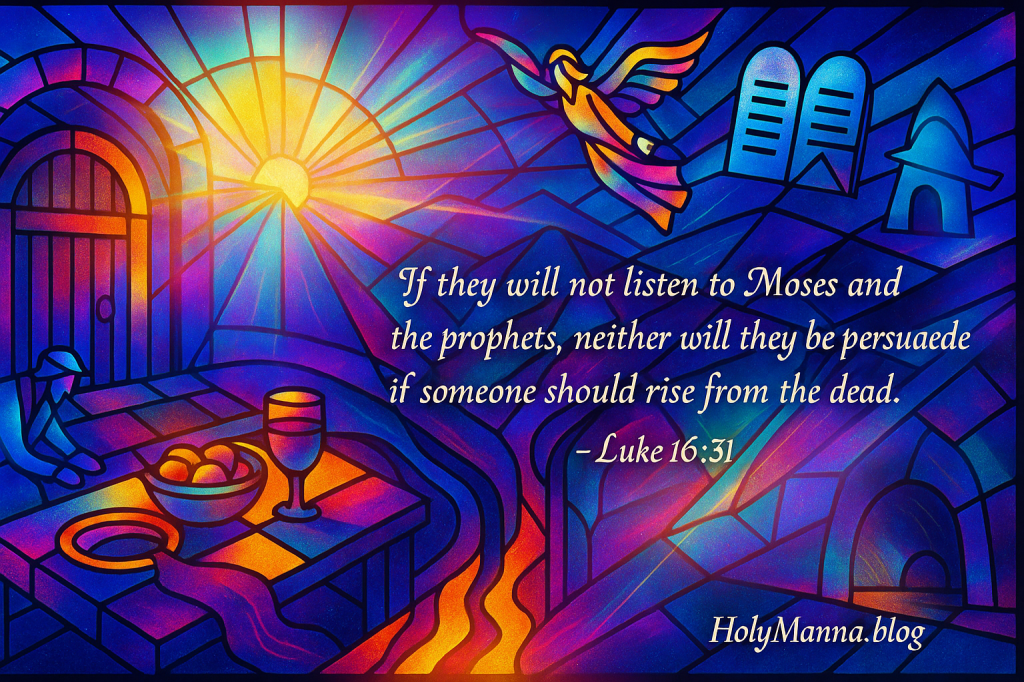
19 “There was a rich man who dressed in purple garments and fine linen and dined sumptuously each day. 20 And lying at his door was a poor man named Lazarus, covered with sores, 21 who would gladly have eaten his fill of the scraps that fell from the rich man’s table. Dogs even used to come and lick his sores. 22 When the poor man died, he was carried away by angels to the bosom of Abraham. The rich man also died and was buried, 23 and from the netherworld, where he was in torment, he raised his eyes and saw Abraham far off and Lazarus at his side. 24 And he cried out, ‘Father Abraham, have pity on me. Send Lazarus to dip the tip of his finger in water and cool my tongue, for I am suffering torment in these flames.’ 25 Abraham replied, ‘My child, remember that you received what was good during your lifetime while Lazarus likewise received what was bad; but now he is comforted here, whereas you are tormented. 26 Moreover, between us and you a great chasm is established to prevent anyone from crossing who might wish to go from our side to yours or from your side to ours.’ 27 He said, ‘Then I beg you, father, send him to my father’s house, 28 for I have five brothers, so that he may warn them, lest they too come to this place of torment.’ 29 But Abraham replied, ‘They have Moses and the prophets. Let them listen to them.’ 30 [c]He said, ‘Oh no, father Abraham, but if someone from the dead goes to them, they will repent.’ 31 Then Abraham said, ‘If they will not listen to Moses and the prophets, neither will they be persuaded if someone should rise from the dead.’”
Detailed Exegesis
Verse 19 – “There was a rich man who dressed in purple garments and fine linen and dined sumptuously each day.”
Purple and fine linen signal extreme wealth. Daily feasting, rather than Sabbath joy, points to self indulgence as a rhythm of life. Luke’s Gospel often warns that such insulation can blind the heart to God and neighbor.
Verse 20 – “And lying at his door was a poor man named Lazarus, covered with sores,”
The poor man has a name that means God helps. The rich man remains unnamed. Proximity heightens responsibility. The gate becomes the place of decision, where the neighbor’s need meets our freedom.
Verse 21 – “who would gladly have eaten his fill of the scraps that fell from the rich man’s table. Dogs even used to come and lick his sores.”
The scraps reveal there was more than enough. The dogs accent the scandal of neglect. Creation shows more instinctive compassion than the rich man’s heart.
Verse 22 – “When the poor man died, he was carried away by angels to the bosom of Abraham. The rich man also died and was buried,”
Death levels status. Angels carry Lazarus to Abraham’s embrace, a picture of covenant consolation. The rich man’s burial contrasts with Lazarus’s exaltation. Earthly appearance is not a reliable measure of divine favor.
Verse 23 – “and from the netherworld, where he was in torment, he raised his eyes and saw Abraham far off and Lazarus at his side.”
The reversal is stark. Sight now belongs to the one who refused to see. Distance is introduced. What was a small gate becomes a great divide.
Verse 24 – “And he cried out, ‘Father Abraham, have pity on me. Send Lazarus to dip the tip of his finger in water and cool my tongue, for I am suffering torment in these flames.’”
The rich man still treats Lazarus as a servant. He seeks relief without repentance. The request for water recalls the mercy he refused to give. The measure we measure with is measured back to us.
Verse 25 – “Abraham replied, ‘My child, remember that you received what was good during your lifetime while Lazarus likewise received what was bad; but now he is comforted here, whereas you are tormented.’”
Abraham’s tender address intensifies the verdict. The issue is not that Lazarus is saved because he was poor, nor that the rich man is condemned because he was rich. The moral fault is the hard heart that ignored the neighbor. Divine justice heals by right order.
Verse 26 – “Moreover, between us and you a great chasm is established to prevent anyone from crossing who might wish to go from our side to yours or from your side to ours.”
The chasm is the fixed result of choices made in freedom. The refusal to cross a small threshold of mercy becomes an unbridgeable gulf.
Verse 27 – “He said, ‘Then I beg you, father, send him to my father’s house,’”
Concern awakens, yet it remains self referential. He thinks in terms of sending Lazarus again. He has not learned the dignity of the one he ignored.
Verse 28 – “‘for I have five brothers, so that he may warn them, lest they too come to this place of torment.’”
Fear of consequences replaces love of God. Yet even this fear can become a moment of grace if it leads to conversion before death.
Verse 29 – “But Abraham replied, ‘They have Moses and the prophets. Let them listen to them.’”
Revelation is sufficient. The Scriptures already command love for the poor, almsgiving, justice, and mercy. The problem is not lack of light but refusal to hear.
Verse 30 – “He said, ‘Oh no, father Abraham, but if someone from the dead goes to them, they will repent.’”
The demand for a sign ignores the sign already given. Miracles cannot substitute for a listening heart.
Verse 31 – “Then Abraham said, ‘If they will not listen to Moses and the prophets, neither will they be persuaded if someone should rise from the dead.’”
The parable points toward the Resurrection. Even the greatest sign will not compel a heart that loves comfort more than truth. Faith begins in listening obedience.
Teachings
The Church reads this parable as a grave summons to mercy and conversion. The Catechism defines the works of mercy that the rich man failed to practice. It teaches, “The works of mercy are charitable actions by which we come to the aid of our neighbor in his spiritual and bodily necessities. Instructing, advising, consoling, comforting are spiritual works of mercy, as are forgiving and bearing wrongs patiently. The corporal works of mercy consist especially in feeding the hungry, sheltering the homeless, clothing the naked, visiting the sick and imprisoned and burying the dead. Among all these, giving alms to the poor is one of the chief witnesses to fraternal charity, it is also a work of justice pleasing to God.” (CCC 2447). The finality of the great chasm corresponds to the sober teaching on the possibility of definitive self exclusion from God. The Catechism states, “To die in mortal sin without repenting and accepting God’s merciful love means remaining separated from him forever by our own free choice. This state of definitive self exclusion from communion with God and the blessed is called ‘hell.’” (CCC 1033). The parable also highlights the sufficiency of revelation given in the Law and the Prophets, which the Church receives and fulfills in Christ who is risen. Refusal to listen is a moral act that shapes destiny. Therefore authentic worship must flow into concrete love for the poor, and hope in the Resurrection must translate into a life that crosses gates with compassion.
Reflection
Stand at your own gate with Jesus and look. Name the Lazarus God has placed within your reach. Make the parable practical by choosing an act of mercy that will cost time, attention, or money. Set a fixed portion of your monthly budget for almsgiving. Share a meal with someone who is isolated. Support or visit a ministry that serves migrants, orphans, widows, or prisoners. Examine your heart for the habits that keep you insulated and bring them to Confession. Pray with Psalm 146 until God’s verbs become your verbs. Ask the Holy Spirit for a listening heart that welcomes Moses and the prophets and that believes the One who is risen. Who is at my gate today and what is one concrete step I will take to serve them? What comforts have made me slow to see and act? How will I reorder my calendar and budget this week so that love crosses the threshold before the chasm forms?
Bridge the Chasm with Mercy
Today’s readings move our hearts from comfort to compassion and from habit to holiness. In Amos 6 the prophet warns a people cushioned by luxury with the cry “Woe to those who are complacent in Zion”, unveiling how indifference to a neighbor’s ruin corrodes covenant life. Psalm 146 answers with God’s own pattern of kingship as he “secures justice for the oppressed” and “gives bread to the hungry”, inviting our worship to become works of mercy. In 1 Timothy 6 Paul trains the disciple’s interior life to “pursue righteousness, devotion, faith, love, patience, and gentleness” and to “compete well for the faith”, because only a converted heart can sustain converted habits. Finally, in The Gospel of Luke 16 Jesus names the stakes with the rich man and Lazarus, where the small gate of neglected mercy hardens into “a great chasm” that no one can cross. Together these passages reveal one call. Wake from complacency. Let God’s verbs become your verbs. Form a gentle, courageous heart that crosses the threshold of another’s need.
Here is your invitation. Ask the Holy Spirit to show you the Lazarus at your gate and to reorder your calendar, your table, and your budget so that love becomes concrete. Set aside time for Adoration and Confession, then carry that grace into a deliberate work of mercy for someone specific this week. Pray Psalm 146 slowly each day and let its words direct your choices. Return to 1 Timothy 6 and choose one virtue to practice with focus until it becomes the new instinct of your soul. Read The Catechism on the works of mercy and say yes to a practical step before the day ends. Who is God placing in my path today, and how will I serve them before night falls? What comfort must I surrender so that my life mirrors the Heart that lifts the lowly? May the Lord who reigns forever make us a people who see, love, and act, until the chasm closes and our gates become doors of grace.
Engage with Us!
Share your reflections in the comments below so we can pray and grow together as a community of disciples who see and serve with the Heart of Christ.
- Amos 6:1, 4-7: Where do I notice complacency creeping into my life, especially when others nearby are suffering? What specific act of mercy will I choose this week to move from comfort to compassion?
- Psalm 146:7-10: Which verb of God’s mercy most challenges me today to act, and how will I embody it for someone specific? Where can I become a shelter for the stranger, the orphan, or the widow in my city or parish?
- 1 Timothy 6:11-16: Which single virtue from Paul’s list is the Holy Spirit inviting me to pursue with focus this week? How will I publicly confess my faith in ordinary conversations with gentleness and courage?
- The Gospel of Luke 16:19-31: Who is the “Lazarus” at my gate, and what concrete step will I take to serve them before the day ends? What habits keep me insulated, and how will I surrender them to Jesus in prayer and Confession?
May the Lord strengthen you to live a life of faith, acting with the love and mercy that Jesus taught us in every choice, every conversation, and every work of your hands.
Sacred Heart of Jesus, we trust in You!
Immaculate Heart of Mary, pray for us!
Saint Michael the Archangel, defend us in battle!
Follow us on Instagram and Facebook for more insights and reflections on living a faith-filled life.

 Holy Manna!
Leave a comment