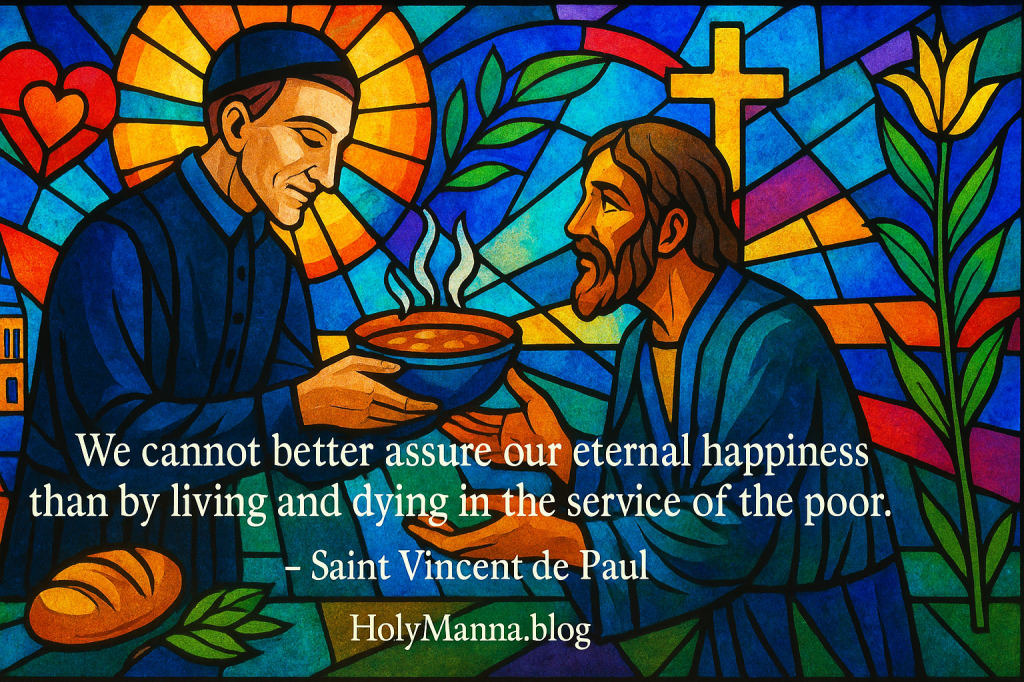
Love Organized For The Poor
Saint Vincent de Paul (1581–1660) is honored as the Apostle of Charity because he transformed merciful love into an organized, effective mission that reached the abandoned, the sick, prisoners, and the poor in city and countryside. He founded the Congregation of the Mission and, with Saint Louise de Marillac, the Daughters of Charity, renewing the formation of clergy and mobilizing laity for concrete works of mercy. The Church canonizes saints so that their lives draw us to Jesus Christ. As the Catechism of the Catholic Church teaches, “By canonizing some of the faithful, the Church…proposes them to the faithful as examples and intercessors.” (CCC 828). Vincent’s vision harmonizes with the Church’s perennial teaching on charity. “The works of mercy are charitable actions by which we come to the aid of our neighbor in his spiritual and bodily necessities.” (CCC 2447). His whole life is a living commentary on these lines.
A Grace That Grew
Vincent was born in Pouy in Gascony, France, on April 24, 1581, into a humble farming family. Gifted and industrious, he studied at Dax and Toulouse, was ordained a priest in 1600, and quickly proved to be a capable pastor and teacher. Early ministry at Clichy revealed his warmth with ordinary people and his zeal for catechesis. Two decisive moments in 1617 deepened his vocation. In Folleville, preaching on general confession, he witnessed a flood of conversions that convinced him of the spiritual abandonment of the rural poor. In Châtillon-les-Dombes, after urging help for a sick family, he saw a generous but chaotic response and organized the first Confraternity of Charity so that love would be durable and dignifying. From these seeds grew a mission that would change France. Vincent later founded the Congregation of the Mission in 1625 to evangelize the poor and support priestly formation, and the Daughters of Charity in 1633, pioneering a form of consecrated life that served Christ in the streets rather than behind cloister walls. He summed up his horizon with a line beloved by his spiritual family: “Love is inventive to infinity.”
Works That Changed France
Vincent’s charity was tender and tough, mystical and managerial. He preached parish missions that reconciled enemies, restored sacramental life, and taught simple catechism. He gathered noblewomen as Ladies of Charity to provide organized relief with personal respect. He improved the training of clergy with Tuesday Conferences and seminaries so that shepherds would truly smell like the sheep. He served as Chaplain General of the Galleys, advocating humane treatment and bringing the comfort of the Gospel to convicts in Marseille. He protected vulnerable young women, sheltered foundlings whom society discarded, and fed the hungry during the devastations of war and famine. He told his members that technique without love is not Christian service. “You will find that charity is a heavy burden to carry, heavier than the kettle of soup and the full basket; but you must keep your gentleness and your smile… It is for your love alone that the poor will forgive you the bread you give them.” He never tired of repeating the heart of the Vincentian charism. “We cannot better assure our eternal happiness than by living and dying in the service of the poor.” In the light of the Gospel, he insisted that the poor evangelize us. “In serving persons who are poor, we serve Jesus Christ.”
Holiness More Than Wonders
Vincent’s contemporaries did not chiefly speak of spectacular healing miracles worked by his hands. They spoke of an almost miraculous effectiveness of organized love, of conversions during missions, and of providential answers that followed persevering prayer. He knew that saints do not begin with marvels. They begin with fidelity. “Give me a man of prayer and he will be capable of everything.” In Vincent’s case, the lasting miracle was a people formed in mercy, a Church awakened to the presence of Christ in the poor, and a network of institutions that outlived him because they were rooted in God.
Courage In Controversy
Vincent endured hardship without seeking the spotlight. He shouldered vast relief efforts during the Thirty Years’ War and the Fronde, navigated delicate responsibilities on the royal Council of Conscience, and opposed the errors of Jansenism with clarity joined to charity. An old tale recounts a youthful captivity in North Africa. Modern scholarship debates the details of that episode, yet all agree that his documented compassion for galley convicts and enslaved Christians was real, costly, and sustained. He grew old with work and prayer, suffering illness and fatigue, but he never ceased urging his followers to see with the eyes of faith. “If you consider the poor in the light of faith, you will discover that they are taking the place of the Son of God who chose to be poor.” Vincent died peacefully in Paris on September 27, 1660, leaving France holier than he found it.
Miracles After His Death
After Vincent’s death, the Church examined miracles attributed to his intercession, including striking healings, and judged them sufficient for his beatification in 1729 and canonization on June 16, 1737. Devotion to him spread quickly because his charity had already captured hearts. Pilgrims today venerate his mortal remains at the Shrine of Saint Vincent de Paul, 95 Rue de Sèvres, Paris, where his body rests above the main altar. His heart is reverently kept at the Motherhouse of the Daughters of Charity in the Chapel of Our Lady of the Miraculous Medal at 140 Rue du Bac. These places continue to be wells of prayer where many ask for the grace to love as he loved.
Put Love Into Action
Vincent teaches that mercy must be both tender and well planned. The Catechism reminds us that Christ unites himself with the poor and that Christian love cannot be separated from justice and respect for human dignity. “God blesses those who come to the aid of the poor and rebukes those who turn away from them.” (CCC 2443). “Being more closely united to Christ, those who dwell in heaven…do not cease to intercede with the Father for us.” (CCC 956). Ask Saint Vincent to intercede for a heart that notices need, hands that move quickly, and wisdom that organizes love. Practice one corporal work of mercy each week. Learn the stories behind the faces of those you serve so that charity protects dignity. Support a local conference of the Society of Saint Vincent de Paul or your parish outreach in a steady way, not only in moments of crisis. Pray daily for the poor by name and for their advocates. Review your budget and schedule to make space for almsgiving, visiting the sick and imprisoned, mentoring youth, and accompanying migrants. In all these things, keep Vincent’s spiritual secret. “Make it a practice to judge persons and things in the most favorable light at all times and under all circumstances.”
Engage with Us!
How is Jesus inviting you to serve Him in the poor this week?
- Where have you encountered Christ in someone who is struggling, and how did that moment challenge you to act?
- Which corporal work of mercy can you commit to in a concrete way over the next seven days?
- What structures in your parish or city could you strengthen so that charity is more effective and dignifying?
- How might Saint Vincent’s courage during controversy inspire you to witness to truth with charity today?
“The poor have been given to us as our masters and patrons.” May Saint Vincent de Paul teach us to love Jesus in the poor, to organize our mercy, and to persevere with joy.
Saint Vincent de Paul, pray for us!
Follow us on Instagram and Facebook for more insights and reflections on living a faith-filled life.

 Holy Manna!
Leave a comment