Memorial of Saint Vincent de Paul, Priest – Lectionary: 454
Glory That Dwells, Mercy That Moves
Come and see how God’s majesty chooses to dwell not behind stone ramparts but within a people made spacious by love, gathered into an “unwalled” city where mercy becomes the true boundary. In Zechariah 2:5-9, 14-15, the Lord promises to be “an encircling wall of fire… and the glory in its midst”, and to dwell among a people open to “many nations.” This is the seed of a catholic vision, a people without fear because God Himself is their protection and their radiant center. The day’s psalm from Jeremiah 31:10-13 sings the same restoration: the Shepherd who once scattered now gathers, ransoms, and renews, until grief itself is transfigured into praise, for “I will turn their mourning into joy”. Yet in Luke 9:43-45, at the very moment when the crowds marvel at the “majesty of God,” Jesus unveils the path of that majesty: “The Son of Man is to be handed over to men.” Here the Scriptures teach us that God’s glory is not spectacle but self-gift. The Cross is the doorway into the unwalled city, and sacrificial love is its grammar.
This thread binds today’s Memorial of Saint Vincent de Paul to the readings with compelling clarity. Seventeenth-century France knew famine, war, and spiritual neglect, yet Vincent allowed Christ crucified to dwell at the center and to press outward in creative charity. He gathered “many nations” not by conquest but by compassion: forming the Congregation of the Mission and, with Saint Louise de Marillac, the Daughters of Charity, so that the Church would become a living sign of God’s encircling fire for the abandoned, the sick, and the poor. In the language of The Catechism, the Church is God’s building and field, catholic in scope and missionary by nature (CCC 756; CCC 830-831), and the preferential love for the poor is not an optional virtue but a mark of authentic discipleship (CCC 2443-2449). Christ’s Passion is the heart of our redemption and the pattern of our life (CCC 571; CCC 609-611; CCC 616-618). To pray these texts is to hear one call: welcome the indwelling Lord, let His Cross break down the walls of self-protection, and become a channel of restoration for others until mourning is turned to joy.
Where is Jesus inviting you today to let His mercy widen your heart, so that God’s glory can dwell within you and gather others through you?
First Reading – Zechariah 2:5-9, 14-15
When God Dwells Within
In the late sixth century before Christ, after the return from Babylonian exile, the prophet Zechariah received a series of night visions that encouraged a fragile remnant to rebuild Jerusalem and the Temple under Persian rule. The measuring cord symbolizes restoration and divine intention, as if God were the master builder surveying a city destined for more than stone defenses. In Zechariah 2:5-9, 14-15, the Lord promises to be both protection and presence, a living “wall of fire” and the “glory in its midst,” while opening the city to the nations. This vision prepares the way for the Church as God’s dwelling among a gathered people, catholic in scope and missionary in life, as taught in The Catechism (CCC 756; CCC 830-831). It harmonizes with today’s theme: God draws near to dwell with His people and to gather many into an unwalled city of mercy. In the Memorial of Saint Vincent de Paul, we see this vision take flesh as charity organizes itself for the sake of the poor, revealing that divine glory shines most clearly where love becomes concrete service.
Zechariah 2:5-9, 14-15
New American Bible (Revised Edition)
Third Vision: The Man with the Measuring Cord. 5 I raised my eyes and looked, and there was a man with a measuring cord in his hand. 6 I asked, “Where are you going?” And he said, “To measure Jerusalem—to see how great its width is and how great its length.”
7 Then the angel who spoke with me advanced as another angel came out to meet him 8 and he said to the latter, “Run, speak to that official: Jerusalem will be unwalled, because of the abundance of people and beasts in its midst. 9 I will be an encircling wall of fire for it—oracle of the Lord—and I will be the glory in its midst.”
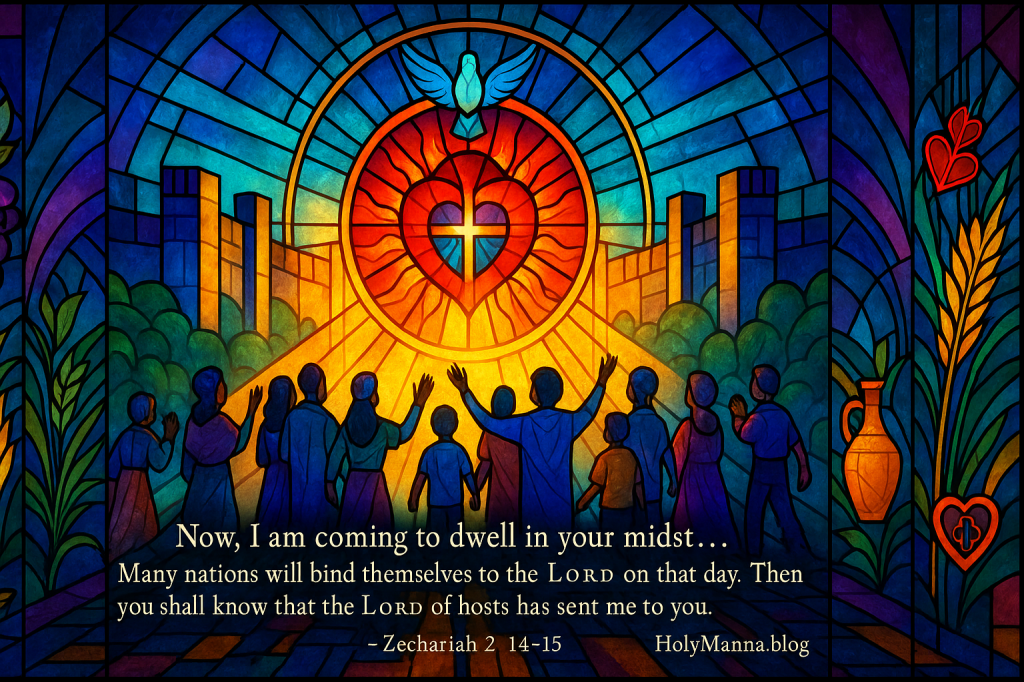
14 Sing and rejoice, daughter Zion! Now, I am coming to dwell in your midst—oracle of the Lord. 15 Many nations will bind themselves to the Lord on that day. They will be my people, and I will dwell in your midst. Then you shall know that the Lord of hosts has sent me to you.
Detailed Exegesis
Verse 5 – “I raised my eyes and looked, and there was a man with a measuring cord in his hand.”
Zechariah’s lifted eyes signal prophetic readiness. The measuring cord evokes restoration and intentional design. God is not improvising with His people. He is surveying, planning, and committing to a future that surpasses the ruins of the past. The Church inherits this confidence that history is providential, not accidental, because God orders His household as a wise builder, as reflected in The Catechism’s image of the Church as God’s building and field (CCC 756).
Verse 6 – “I asked, ‘Where are you going?’ And he said, ‘To measure Jerusalem, to see how great its width is and how great its length.’”
The prophet’s question unveils God’s intention to expand His people. Measuring hints at growth and sufficiency, not scarcity. In salvation history, God’s plans regularly exceed human expectations. The Lord’s desire is to make His people spacious, capable of welcoming others. This anticipates the universality of the Gospel and the catholicity of the Church (CCC 830-831).
Verse 7 – “Then the angel who spoke with me advanced as another angel came out to meet him.”
The heavenly coordination suggests that God’s purposes unfold with precision. Angelic messengers frame the vision as an urgent, well-guided mission. Divine providence is not static. It moves toward fulfillment. The Church trusts these initiatives of God and discerns them in prayer and mission.
Verse 8 – “And he said to the latter, ‘Run, speak to that official: Jerusalem will be unwalled, because of the abundance of people and beasts in its midst.’”
The command to run communicates urgency. Jerusalem’s future will be unwalled because God’s blessing will overflow. The city will not be defined by exclusion but by generous inclusion and fecundity. This anticipates a messianic people who trust God more than fortifications. The image challenges the Church to be open, missionary, and confident that divine abundance can sustain real hospitality.
Verse 9 – “I will be an encircling wall of fire for it, oracle of the Lord, and I will be the glory in its midst.”
Here is the heart of the vision: God Himself is both perimeter and presence. Fire signifies protection, purification, guidance, and theophany, recalling the pillar of fire in the Exodus. Glory in the midst signals the return of God’s presence to the community. In Christian fulfillment, this points to Christ dwelling in His Body, the Church, and to the Holy Spirit who forms the Church as a living temple (CCC 737-739; CCC 797-798). The safest city is the one God surrounds and fills.
Verse 14 – “Sing and rejoice, daughter Zion! Now, I am coming to dwell in your midst, oracle of the Lord.”
Joy flows from God’s nearness. Indwelling is not merely symbolic. The Lord chooses proximity, communion, and intimacy. In Christ, God comes to dwell bodily among us. In the sacraments, especially the Eucharist, He remains with His people. This is the source of the Church’s joy and mission.
Verse 15 – “Many nations will bind themselves to the Lord on that day. They will be my people, and I will dwell in your midst. Then you shall know that the Lord of hosts has sent me to you.”
The horizon is universal. The covenant widens to include the nations. Knowledge of God comes through His effective presence and missionary expansion. This verse foreshadows Pentecost and the catholic mission that embraces every people and culture. The Church exists to gather, not to retreat, and to manifest a unity that only God can achieve (CCC 781; CCC 830).
Teachings
Zechariah’s vision of an unwalled city with God as a fiery wall discloses the nature of the Church as God’s living dwelling. The Catechism teaches that the Church is God’s cultivated field and spiritual house, built of living stones and destined to expand in history (CCC 756). It also affirms the Church’s universality and missionary impulse as essential, not optional, dimensions of her identity (CCC 830-831). The divine indwelling reaches its summit in Christ and is communicated to us through the Holy Spirit and the sacraments, especially the Eucharist, by which the Church is made and remade as God’s presence among the nations (CCC 737-739; CCC 1324).
Saint Augustine describes the rest and fulfillment that come when God dwells within: “You have made us for yourself, O Lord, and our heart is restless until it rests in you.” This longing is satisfied not by walls but by worship and communion. Saint Vincent de Paul shows how that communion turns outward in creative charity: “Charity is inventive to infinity.” In his works and foundations, divine presence becomes visible as protection for the vulnerable and dignity for the poor. The same Lord who promises, “I will be the glory in its midst,” commissions His Church to be a credible sign of that glory through works of mercy and evangelization. Significant to the setting of Zechariah is the post-exilic rebuilding, when the people learned anew that holiness depends on God’s presence more than on stone defenses. In Christian life this becomes a pastoral principle: holiness and mission flourish where God’s indwelling is welcomed and where love widens the boundaries of belonging.
Reflection
God promises to surround and fill His people, which means our true security is His presence and our true mission is His welcome. Ask for the grace to become an “unwalled” disciple who trusts God as the fiery perimeter and who makes room for others. Welcome the Lord in daily prayer and in the Eucharist, then let that Presence move you to concrete acts of mercy in the Vincentian spirit: visit someone who is isolated, give generously to a person in need, volunteer with a work of charity, and advocate for the dignity of the poor. Let your planning reflect God’s measuring cord by setting aside time and resources each week for intercession and service. Where is the Lord inviting you to take down walls of fear and self-protection so that He can be your encircling fire? How might you widen your heart this week to make room for someone who has no room elsewhere? What specific step can you take today to let God’s indwelling presence become visible in patient service, courageous generosity, and persevering love?
Responsorial Psalm – Jeremiah 31:10-13
Gathered by the Shepherd, Restored to Joy
These verses from Jeremiah 31 arise from the promise of restoration after the Babylonian exile. Israel had known scattering, famine, and humiliation, yet God speaks as a faithful Shepherd who gathers, ransoms, and restores His people to a joyful communion. In Israel’s memory, this evokes the first Exodus and anticipates a new one, where God Himself leads His flock back to Zion and renews their life with abundance. Proclaimed as today’s Responsorial Psalm, this canticle fits our theme perfectly: God does not merely rebuild walls. He indwells His people, encircling them with His presence and turning sorrow into praise. In the Memorial of Saint Vincent de Paul, the promise becomes concrete. Divine compassion moves outward to the poor and the abandoned. The Church becomes the place where scattered lives are gathered, guarded, and made to flourish like “watered gardens,” because Christ the Shepherd continues His mission through our works of mercy and our Eucharistic thanksgiving.
Jeremiah 31:10-13
New American Bible (Revised Edition)
10 Hear the word of the Lord, you nations,
proclaim it on distant coasts, and say:
The One who scattered Israel, now gathers them;
he guards them as a shepherd his flock.
11 The Lord shall ransom Jacob,
he shall redeem him from a hand too strong for him.
12 Shouting, they shall mount the heights of Zion,
they shall come streaming to the Lord’s blessings:
The grain, the wine, and the oil,
flocks of sheep and cattle;
They themselves shall be like watered gardens,
never again neglected.
13 Then young women shall make merry and dance,
young men and old as well.
I will turn their mourning into joy,
I will show them compassion and have them rejoice after their sorrows.
Detailed Exegesis
Verse 10 – “Hear the word of the Lord, you nations, proclaim it on distant coasts, and say: The One who scattered Israel, now gathers them; he guards them as a shepherd his flock.”
The restoration is not a private consolation but a global proclamation. God’s fidelity to Israel is meant for “the nations.” This anticipates the catholic horizons of the Gospel, where the Shepherd’s gathering becomes the Church’s mission to all peoples. The shepherd image announces protective nearness. God’s authority is expressed as care, vigilance, and guidance, not domination. In Christ, the Good Shepherd, this care becomes visible and sacramental, drawing scattered hearts into one flock.
Verse 11 – “The Lord shall ransom Jacob, he shall redeem him from a hand too strong for him.”
Ransom and redemption evoke Exodus language and foreshadow Christ’s Paschal Mystery. Israel cannot save itself from the grip of stronger powers, just as humanity cannot free itself from sin and death. God acts decisively. In the light of the Gospel, the “ransom” is Christ’s self-gift on the Cross and His victory in the Resurrection. This teaches disciples to trust grace over self-reliance and to enact redemption’s fruits by defending those under “hands too strong for them,” especially the poor, the sick, and the oppressed.
Verse 12 – “Shouting, they shall mount the heights of Zion, they shall come streaming to the Lord’s blessings: The grain, the wine, and the oil, flocks of sheep and cattle; They themselves shall be like watered gardens, never again neglected.”
Joy is loud and embodied. The ascent to Zion culminates in worship that overflows into concrete wellbeing. Grain, wine, and oil name the staples of covenant life and hint at the Eucharistic mystery, where God’s gifts become the sacrament of His presence. “Watered gardens” suggest the Holy Spirit’s renewing work, healing neglect and restoring dignity. In the Vincentian key, material sufficiency and spiritual consolation belong together. True worship always bears fruit in justice and mercy.
Verse 13 – “Then young women shall make merry and dance, young men and old as well. I will turn their mourning into joy, I will show them compassion and have them rejoice after their sorrows.”
The renewal embraces every generation. God Himself promises to transform grief into celebration. Compassion is not sentiment but divine action that reverses loss. In Christian life this becomes ecclesial: the community rejoices because the Risen Lord dwells in its midst, and that joy becomes strength for service. When the Church lives this compassion, the world sees mourning turned to joy in tangible ways.
Teachings
Jeremiah’s song of gathering and renewal blossoms fully in Christ and in the sacramental life of the Church. The Eucharist crowns this movement of return and thanksgiving. The Catechism teaches with luminous clarity: “The Eucharist is ‘the source and summit of the Christian life.’” (CCC 1324). The grace that enables restoration is not our achievement but God’s gift. The Catechism states: “Grace is favor, the free and undeserved help that God gives us to respond to his call to become children of God, adoptive sons, partakers of the divine nature and of eternal life.” (CCC 1996). Because the Shepherd’s table forms us into one Body, the sacrament compels charity. The Catechism teaches: “The Eucharist commits us to the poor.” (CCC 1397). Saint Vincent de Paul gives this commitment a practical edge that still stirs the heart: “Let us love God, my brethren, but let it be with the strength of our arms and the sweat of our brow.” His famous insight, “Charity is inventive to infinity,” captures how divine compassion keeps finding new ways to gather the scattered and to turn mourning into joy. Historically, Jeremiah 31 sits near the promise of the New Covenant written on the heart, which Christians see fulfilled in Christ and poured into the Church at Pentecost. The Shepherd’s gathering thus becomes the Church’s missionary identity, where worship and works of mercy are inseparable.
Reflection
Let this psalm teach you to hear, to return, and to rejoice. Begin by listening each day to a short portion of Scripture so that your heart learns the Shepherd’s voice. Ask God to ransom you from the “hand too strong” in your life, whether that is a habit of sin, a fear, or a wound, and invite trusted companions to walk with you. Offer Eucharistic thanksgiving by setting aside time for adoration or by arriving early for Mass to pray for the scattered and the suffering. Make your joy concrete by choosing one work of mercy this week. Visit a person who is isolated, contribute to a local work of charity in the spirit of Saint Vincent de Paul, and accompany someone who is grieving until joy begins to flicker again. Where is the Shepherd asking you to let yourself be gathered rather than to fix everything alone? What “watered garden” practices will you plant this week so that grace can renew what has felt neglected in your soul? How will you let the Eucharist commit you to the poor in a specific and sacrificial way today?
Holy Gospel – Luke 9:43-45
Majesty Revealed in the Cross
In Luke 9:43-45, Jesus speaks His second Passion prediction immediately after a moment of public astonishment at His mighty deeds. The setting follows the healing of a possessed boy, shortly after the Transfiguration earlier in the chapter, when expectations of a triumphant Messiah would have been culturally strong in first century Judaism. Many hoped for visible victory over enemies and a swift restoration of Israel. Jesus redirects that expectation by revealing the true road to glory through His self-giving Passion. He teaches the disciples to interpret majesty through the Cross, not through spectacle. This fits today’s theme with precision. God draws near to dwell with His people, gathers the nations, and manifests His glory by a love that suffers and saves. In the Memorial of Saint Vincent de Paul, this truth becomes practical. Vincent contemplated the Crucified and then moved outward in inventive charity, showing that the wisdom of the Cross becomes the pattern of Christian service to the poor.
Luke 9:43-45
New American Bible (Revised Edition)
43 And all were astonished by the majesty of God.
The Second Prediction of the Passion. While they were all amazed at his every deed, he said to his disciples, 44 “Pay attention to what I am telling you. The Son of Man is to be handed over to men.” 45 But they did not understand this saying; its meaning was hidden from them so that they should not understand it, and they were afraid to ask him about this saying.
Detailed Exegesis
Verse 43 – “And all were astonished by the majesty of God.”
Luke names the reaction to Jesus’ works as astonishment at divine majesty. Yet Gospel astonishment is not an end in itself. It is an invitation to deeper listening. The majesty of God is not merely power displayed. It is the radiance of a saving love that will be most clearly revealed on Calvary. The disciples must move from amazement to understanding, from excitement to obedient receptivity.
Verse 44 – “While they were all amazed at his every deed, he said to his disciples, ‘Pay attention to what I am telling you. The Son of Man is to be handed over to men.’”
Jesus interrupts the crowd’s enthusiasm with a solemn command. “Pay attention” signals a revelation that will challenge their assumptions. The title “Son of Man” recalls Daniel 7 and Jesus’ own preferred self-designation, uniting exaltation with suffering. “To be handed over” anticipates betrayal, arrest, and Passion. Here Jesus defines messianic glory as self-offering love. He prepares the Church to recognize that the center of the Good News is the Paschal Mystery, not continuous public triumphs.
Verse 45 – “But they did not understand this saying; its meaning was hidden from them so that they should not understand it, and they were afraid to ask him about this saying.”
The disciples experience holy bewilderment. Understanding is “hidden,” not to mock them but to mature them. Fear to ask reveals a common spiritual blockage. We prefer consolations to the cost of love. Jesus invites questions, yet they remain silent. Christian discipleship requires courage to bring our confusion to the Lord and to let Him reinterpret our hopes in the light of the Cross and Resurrection.
Teachings
The Catechism centers the Gospel precisely where Jesus directs our attention in this passage. “The Paschal mystery of Christ’s cross and Resurrection stands at the center of the Good News that the apostles, and the Church following them, are to proclaim to the world.” (CCC 571). The meaning of “handed over” is the free gift of divine love. “By embracing in his human heart the Father’s love for men, Jesus ‘loved them to the end,’ for ‘greater love has no man than this, that a man lay down his life for his friends.’” (CCC 609). The saving power of that love explains why the Cross is redemptive. “It is love ‘to the end’ that confers on Christ’s sacrifice its value as redemption and reparation, as atonement and satisfaction.” (CCC 616).
Saint Vincent de Paul translates these truths into pastoral charity: “Let us love God, my brethren, but let it be with the strength of our arms and the sweat of our brow.” In other words, contemplation of the Crucified leads to concrete service. The scandal of the Cross becomes the wisdom of daily mercy. The disciples’ fear to ask is healed when the Church dares to listen, to question, and to obey the Lord who gives Himself for the life of the world.
Reflection
Let the Lord teach you to hear beyond the noise of success and the thrill of the moment. Choose one practice of attentive listening each day. Read the Gospel slowly, pause at a word or phrase, and ask Jesus to reveal where He is inviting you to follow Him more closely. Bring your confusions to prayer without embarrassment. Ask for the grace to accept the Cross that love requires in your vocation today. Serve someone who cannot repay you, and let that hidden service become your school of understanding. Spend time before a crucifix and say with faith, “Jesus, I trust that your majesty is love poured out for me.” Where is the Lord asking you to pay attention today when you would rather be distracted by quick victories? What question are you afraid to ask Jesus that might open the door to deeper discipleship? How will you allow the wisdom of the Cross to shape a concrete act of charity in the spirit of Saint Vincent de Paul this week?
Let Glory Dwell, Let Mercy Flow
Today’s Word gathers us into an unwalled city of grace. In Zechariah 2:5-9, 14-15, God promises to be “an encircling wall of fire” and “the glory in its midst”, dwelling among a people enlarged by His presence. In Jeremiah 31:10-13, the faithful Shepherd gathers the scattered, ransoms the captive, and keeps His pledge to “turn their mourning into joy” until hearts become “watered gardens.” In Luke 9:43-45, Jesus reveals the hidden key to divine majesty, “The Son of Man is to be handed over to men.” The Cross is not a detour from glory. It is the doorway through which God’s indwelling love restores, gathers, and sends.
The Memorial of Saint Vincent de Paul shows this unity in action. He contemplated Christ crucified, then built spaces where the poor discovered that God’s protective fire is real in the warmth of concrete charity. The city without walls becomes visible wherever the Eucharist forms us into one Body and commits us to the least. Let the promise of The Catechism guide your steps, since the Eucharist is the source and summit that makes this gathering possible and fruitful in daily mercy (CCC 1324).
Welcome the Lord who longs to dwell in your midst. Ask for a heart made spacious by prayer, healed by reconciliation, and nourished by the Eucharist, then carry that Presence into works of patient service. Speak a word of encouragement to someone who grieves, share a meal with someone who is isolated, and give generously in the spirit of Saint Vincent so that another’s mourning may begin to turn into joy. Where is Jesus inviting you to let His love be your fiery perimeter today? How will you allow the majesty of the Cross to shape one concrete act of mercy this week, so that others may taste the joy of being gathered and restored?
Engage with Us!
Share your reflections in the comments below. We would love to hear how God is speaking to you through today’s Scriptures and the witness of Saint Vincent de Paul.
- First Reading – Zechariah 2:5-9, 14-15. Where is the Lord inviting you to become an unwalled disciple who trusts Him as your encircling fire, and whom is He asking you to welcome into that spaciousness this week?
- Responsorial Psalm – Jeremiah 31:10-13. From what “hand too strong” do you need the Shepherd to ransom you today, and how will you let the Eucharist commit you to the poor in a concrete act of love?
- Holy Gospel – Luke 9:43-45. What would it look like to pay attention to Jesus when His path leads through the Cross, and what question are you afraid to ask Him that could open the door to deeper discipleship?
Go in peace and live a life of faith. Do everything with the love and mercy that Jesus taught us, so that His glory may dwell within you and His compassion may flow through you.
Sacred Heart of Jesus, we trust in You!
Immaculate Heart of Mary, pray for us!
Saint Michael the Archangel, defend us in battle!
Follow us on Instagram and Facebook for more insights and reflections on living a faith-filled life.

 Holy Manna!
Leave a comment