Healers Without Price
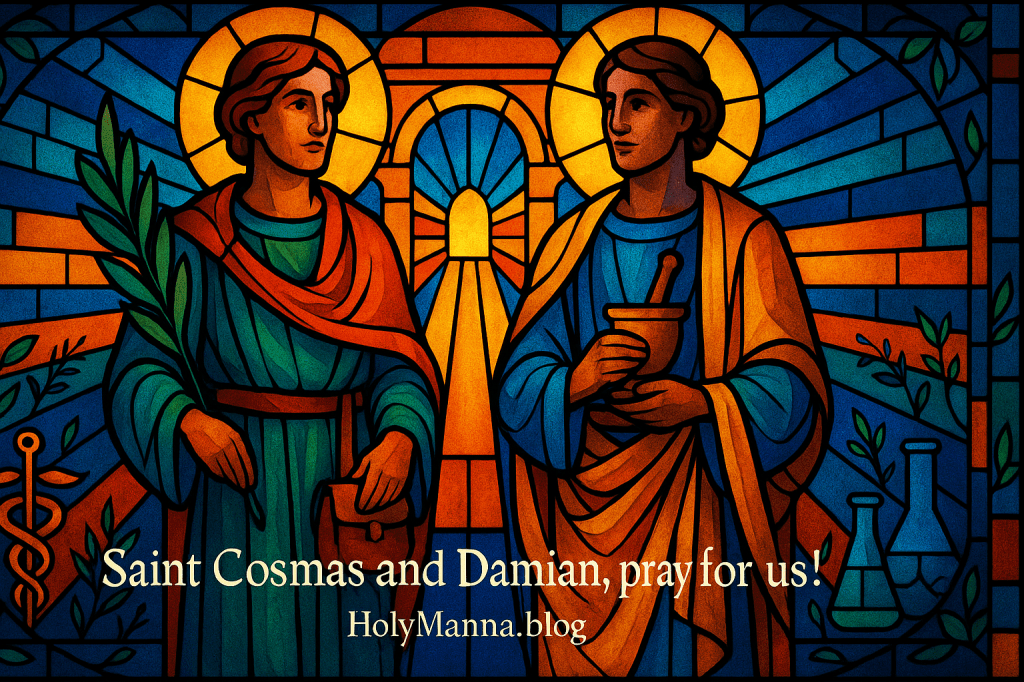
Saints Cosmas and Damian are twin physician martyrs whose medical practice became a proclamation of the Gospel. They treated the sick without accepting payment, a freely given charity that reflected Christ’s mercy and drew many hearts to the faith. The Church has reverenced them from antiquity, placing their names in the Roman Canon at Mass and invoking them as patrons of physicians, surgeons, pharmacists, and all who care for the sick. Their feast in the Roman Rite is September 26, and devotion to them flourished in both East and West. No authentic sayings of Cosmas and Damian have been preserved, yet their silent testimony of gratuitous love continues to speak with authority.
Hearts for the Gospel
Early tradition situates their birth in Arabia and their professional formation in the eastern Mediterranean, where they became known for skill, gentleness, and prayerful confidence in Christ. They eventually practiced in Aegae of Cilicia in present day southern Turkey, a bustling port where cultures and illnesses converged. Their fame did not rest on novelty or luxury but on the simplicity of Christian love. They served the poor, counseled the anxious, encouraged the despairing, and offered medical help as a work of evangelization. Later sources remember that they had several brothers who stood by them in the faith. What set the twins apart was not only competence but a radiant coherence between creed and clinic.
Medicine as Mercy
Cosmas and Damian lived what the Lord commands in The Gospel of Matthew: “Without cost you have received; without cost you are to give.” (The Gospel of Matthew 10:8). They understood medicine as participation in the tenderness of Christ, the divine Physician who touches wounds of body and soul. The Church echoes this in The Catechism: “Heal the sick!” The Church has received this charge from the Lord and strives to carry it out by taking care of the sick…” (The Catechism, 1509). In their hands, bandages and balms became signs of neighborly love, while prayer remained the first remedy. Patients learned from them that every person possesses inviolable dignity and that health is a gift entrusted to our stewardship. Their clinic was a living homily about God’s generosity and the proper use of human expertise for the common good.
Signs of Grace
Ancient memory consistently links their care with remarkable healings that stirred conversions. Many were restored through ordinary remedies accompanied by extraordinary prayer, which showed that God’s compassion animated their skill. Medieval hagiography highlights striking episodes that express the Church’s confidence in their intercession. One beloved narrative recalls a speaking camel vindicating their honesty when they were falsely accused of taking payment, a symbolic reminder that God defends those who serve Him with purity of heart. Another famous story, cherished in Christian art, is the Miracle of the Black Leg, where a sacristan of their Roman church was healed of a diseased limb while he slept, a sign that the Lord can make all things new through the prayers of His saints. While such accounts are presented in a legendary mode, they communicate a theological truth that marked their lives: God confirms charity with grace.
Trial by Fire
During the Great Persecution under Emperor Diocletian, the local governor Lysias arrested Cosmas and Damian and demanded that they renounce Christ. The twins would not betray the One who is the Way, the Truth, and the Life. Tradition relates that they were subjected to chains, scourging, fire, crucifixion, stoning, arrows, and even drowning, yet they were preserved by God from each torment until they finally received the martyr’s crown by beheading. Their witness was not reckless bravado but serene trust. They had already surrendered the right to profit from their profession. Now they surrendered even their lives, confident that nothing could separate them from the love of God in Christ Jesus.
Glory in Their Wake
After their death, veneration spread quickly. Their relics were honored in the East, and Emperor Justinian later attributed his recovery from illness to their intercession, adorning a church in their name in Constantinople. In Rome, Pope Felix IV dedicated the basilica of Santi Cosma e Damiano in the early sixth century, setting their memory like a lamp in the heart of the ancient Forum. The apse mosaic still proclaims Christ in glory with the twin physicians presented to Him, a visual catechesis in stone and glass that has consoled pilgrims for centuries. Across the Christian world, guilds of doctors and pharmacists placed themselves under their patronage. The faithful came to them with bodily ailments and spiritual wounds, and many testified to healings that strengthened faith, renewed families, and inspired works of mercy.
What the Church Teaches Through Their Witness
Cosmas and Damian embody the Gospel logic of gift. They show that professional excellence can be an altar where Christians offer their talents for the glory of God and the good of neighbor. The Church teaches that caring for the sick is a corporal work of mercy, a real participation in Christ’s compassion. The Catechism reminds us that “The works of mercy are charitable actions by which we come to the aid of our neighbor in his spiritual and bodily necessities.” (The Catechism, 2447). It also teaches that safeguarding health serves the common good and demands prudence, justice, and solidarity (The Catechism, 2288). Finally, their ongoing help manifests the communion of saints, where, as The Catechism beautifully confesses, “Being more closely united to Christ, those who dwell in heaven… do not cease to intercede with the Father for us.” (The Catechism, 956). To honor these saints is to embrace this communion and to let charity inform every decision, especially when someone is vulnerable.
Walking in Their Footsteps
Cosmas and Damian invite every Christian to make love the measure of daily work. Physicians and nurses can remember them before entering a patient’s room, asking for gentleness, clarity, and courage. Leaders can examine budgets and policies with the poor in mind, seeking ways to expand access to care. Families can accompany members who are ill with prayer, patience, and concrete help. Parish communities can organize visitation of the sick, support for caregivers, and anointing liturgies that lift up those who suffer. Students and trainees can see their studies as preparation for service, not self-promotion. All of us can pray with confidence when illness shakes our peace, since the Lord hears and the saints intercede. In the spirit of the twin doctors, let us receive freely from God each day and give freely to those He places in our path.
Engage with Us!
I would love to hear your thoughts and prayers in the comments below.
- How does the saints’ refusal to accept payment challenge the way you think about service, career, and success?
- Where is Christ inviting you to practice the corporal works of mercy, especially visiting or caring for the sick, this week?
- Do you ask for the intercession of the saints when you face illness, stress, or difficult decisions? How might you begin today?
Take heart. Live your faith boldly, love concretely, and do everything with the mercy Jesus taught us.
Saint Cosmas and Damian, pray for us!
Follow us on Instagram and Facebook for more insights and reflections on living a faith-filled life.

 Holy Manna!
Leave a comment