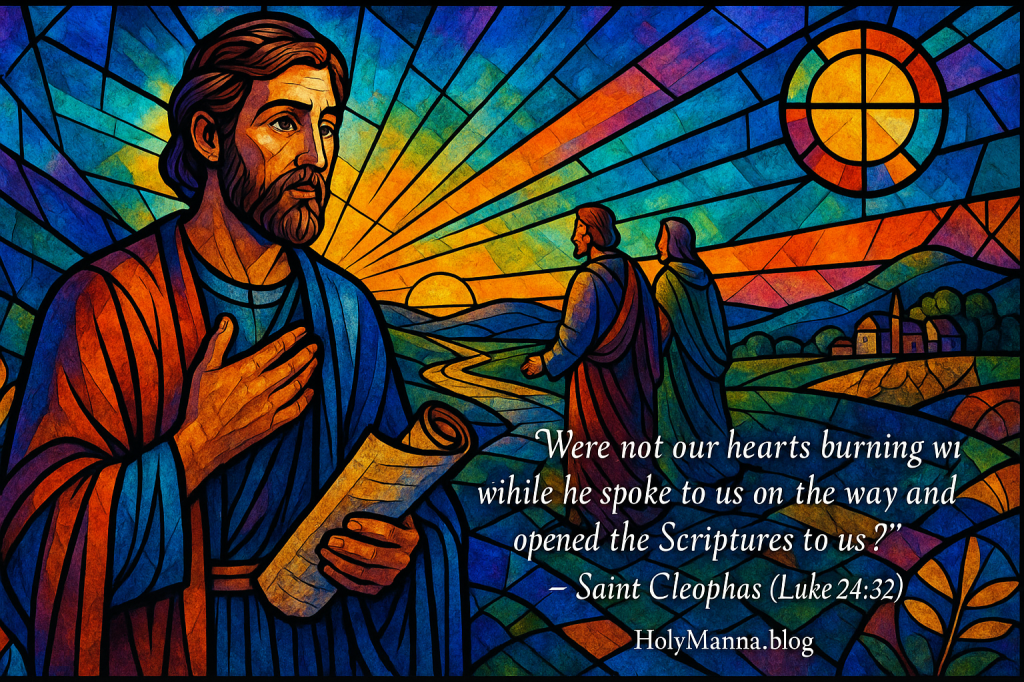
Hearts Aflame on the Road to Emmaus
Saint Cleophas, also spelled Cleopas, steps onto the stage of salvation history in The Gospel of Luke (Luke 24: 13-35) as one of the two disciples who met the risen Christ on Easter Sunday along the road to Emmaus. He is revered because he received from Jesus the most luminous Bible lesson ever given and recognized the Lord in the breaking of the bread, which the Church from the earliest centuries has seen as a sign of the Eucharist. Cleophas stands as a living reminder that Christ draws near to discouraged hearts, opens the Scriptures, and reveals himself sacramentally. In Western tradition he is commemorated in late September, and Christian memory cherishes him as a firsthand witness of the Resurrection whose story outlines the pattern of the Mass that we celebrate today.
Within the Holy Family’s Circle
What we know with certainty about Cleophas begins in Scripture. Luke names him directly, and the narrative gives us a window into his disposition. He is honest about sorrow, hospitable to a mysterious Stranger, and teachable when the Scriptures are opened. Tradition also remembers a figure named Clopas connected to “Mary of Clopas” in The Gospel of John, and some early writers proposed that Clopas was related to Saint Joseph. While scholars discuss whether Cleophas and Clopas are the same person, the Church keeps both possibilities in view without forcing a conclusion. The surest ground is the inspired text: Cleophas speaks frankly to Jesus whom he does not yet recognize, “Are you the only visitor to Jerusalem who does not know the things that have taken place there in these days?” He and his companion later plead with him, “Stay with us, for it is nearly evening.” These brief, human lines reveal a disciple whose faith is awakening and whose heart is ready to receive grace.
Scripture Opened, Bread Broken, Eyes Opened
Cleophas’s encounter portrays a twofold movement that the Church identifies with the Liturgy of the Word and the Liturgy of the Eucharist. First, Jesus walks with them and interprets Moses and the prophets so that their story is reframed by God’s saving plan. Then, at table, he takes bread, blesses it, breaks it, and gives it to them. In that instant their eyes are opened, and they recognize him. The miracle in Cleophas’s life is not primarily thunder and lightning; it is the quiet fire of a heart set ablaze by Scripture and the sacramental vision given in the breaking of the bread. “Were not our hearts burning within us while he spoke to us on the way and opened the Scriptures to us?” This Emmaus moment is why The Catechism of the Catholic Church speaks of the Eucharist as the “Breaking of Bread” and why the Church insists that Word and Sacrament form one act of worship. Cleophas teaches us to bring confusion to the Word, to welcome Jesus to our table, and to let recognition blossom where faith and charity meet.
Witness in a World of Opposition
After the Emmaus revelation, Cleophas immediately returns to Jerusalem to share the news with the Eleven. This swift obedience is already a kind of holy courage, since public witness to the Resurrection could bring suspicion and hostility. The New Testament does not give further biographical detail, and later traditions vary about the rest of his life. Some ancient memories suggest he continued to bear witness among the first believers and that opposition followed. Other strands propose that he suffered for the name of Jesus and may have been killed in fidelity to the Gospel. The Church does not define a precise manner of his death, but she honors him as a faithful disciple whose love moved him from sadness to proclamation and from fear to bold confession.
A Memory That Heals Pilgrim Hearts
There is no universal catalogue of posthumous miracles uniquely tied to Saint Cleophas in the Church’s liturgical books. Yet the place associated with his story, Emmaus, has drawn pilgrims since early centuries as a site of prayer, penance, and conversion. Churches arose in that region as tangible reminders that Christ meets his people on the road and at the table. Countless believers attest that meditating on the Emmaus narrative has brought interior healing, reconciled them to the Church through Confession, and deepened their love for the Eucharist. In this sense, Cleophas’s memory continues to work quiet wonders, not through relic processions widely recorded in history, but through the living Word and the sacramental life that his story spotlights.
Walking Your Own Emmaus Road
Saint Cleophas invites us to a spirituality that is simple and profound. Begin by letting Jesus interpret your life with Scripture. Make time each day for lectio divina with a passage from The Gospel of Luke or the daily Mass readings, and ask the Lord to reveal how your struggles fit within his saving plan. Come to Mass ready to recognize him in the Eucharist by preparing before liturgy, fasting as you are able, and uniting joys and sorrows to the sacrifice of the altar. Practice the hospitality of Cleophas by inviting Christ into your home through blessing your meals, keeping sacred images, and carving out a prayer corner. Finally, imitate his courage by sharing how Jesus has met you on your road, especially with those who are downcast or far from the Church. Let the Emmaus pattern shape your week. Listen to the Word, welcome the Lord, and run to witness.
Engage with Us!
I would love to hear your thoughts and your prayer reflections in the comments below.
- When have you felt your heart “burning within” as God’s Word spoke to you in a homily or while reading Scripture?
- How can you prepare this week to recognize Jesus more clearly “in the breaking of the bread” at Mass?
- Which parts of Cleophas’s story encourage you to witness to the Resurrection in your family, parish, or workplace?
- What practical step will you take to let Jesus walk with you on your personal road to Emmaus this week?
May the Lord Jesus make our hearts burn with love, open our eyes in the Eucharist, and strengthen us to live every day with the mercy and courage that he taught us.
Saint Cleophas, pray for us!
Follow us on Instagram and Facebook for more insights and reflections on living a faith-filled life.

 Holy Manna!
Leave a comment