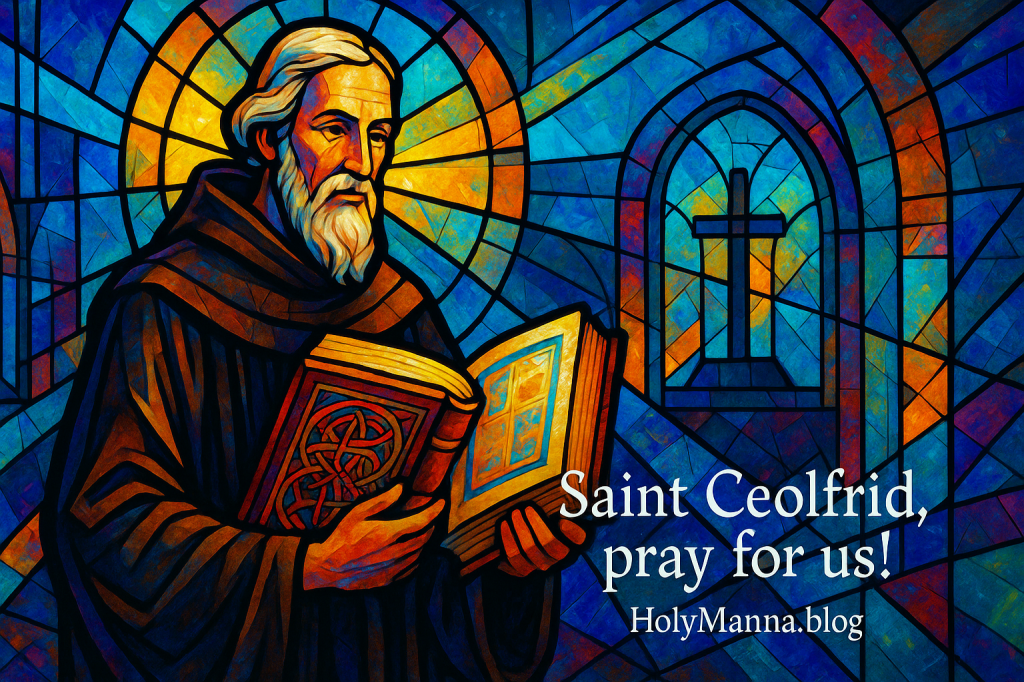
The Abbot Who Brought the Bible to Life
Saint Ceolfrid, also spelled Ceolfrith, was the Northumbrian Benedictine abbot who helped the Church fall in love with Scripture anew. As the guiding mind behind the twin monasteries of Monkwearmouth and Jarrow, he shaped the intellect and holiness of the Venerable Bede, set Roman liturgy and chant firmly in northern England, and commissioned three complete one volume Bibles, among them the celebrated Codex Amiatinus, the earliest surviving complete Latin Vulgate Bible. His feast is kept on 25 September. Bede remembered him as “a man who worked hard at everything.” His legacy is a Church more rooted in the Word of God, more disciplined in prayer, and more serious about truth and beauty at the service of worship.
From Noble Roots to Monastic Wisdom
Born around the year 642 into a well placed Northumbrian family, Ceolfrid was drawn early to the monastery. He first embraced the Benedictine life at Ripon under Saint Wilfrid, where he advanced in learning and discipline and was ordained a priest. His horizons widened when he came under the influence of Benedict Biscop, the visionary founder who led multiple journeys to Rome to bring back books, relics, art, and the Roman way of singing and praying. Ceolfrid traveled in those circles, absorbed the Roman tradition, and learned how scholarship could serve sanctity. In 681 Benedict sent Ceolfrid with a band of monks to found the new house at Jarrow. Ceolfrid became its first abbot and later, after the deaths of the founding abbots, he was entrusted with the governance of both Monkwearmouth and Jarrow. There he formed the young Bede, fostered a spirit of study and psalmody, and cultivated a stable monastic culture grounded in the Rule of Saint Benedict, the calendar and customs of Rome, and a distinctly English zeal for learning.
Scribes, Song, and a Giant Bible
Ceolfrid’s holiness looked like fidelity, foresight, and fatherly steadiness. He enlarged the libraries of the twin monasteries, ensured the copying and careful correction of biblical and patristic texts, and maintained a scriptorium whose work would echo through centuries. He championed Roman liturgical usage, promoted chant and the daily Divine Office, and kept his communities anchored in the Eucharist and the Psalms. He commissioned three complete pandects of the Bible in Latin so that his monks could pray and study from an authoritative, beautifully crafted text. One of these volumes, the Codex Amiatinus, is the earliest complete witness to the Vulgate and remains a touchstone for biblical scholarship. Ceolfrid also played a quiet but decisive role in healing divisions over the date of Easter and the proper tonsure in the north, sending teaching and craftsmen to help neighboring peoples adopt Catholic practice in communion with the Apostolic See. The earliest sources do not record spectacular wonder working during his lifetime. Instead they shine a light on what might be called his daily miracles: the formation of saints and scholars, the preservation and transmission of Scripture, and the crafting of beauty that leads the mind to God. In the words of The Catechism of the Catholic Church, the Church “has always venerated the Scriptures as she venerates the Lord’s Body.” (CCC 103). Ceolfrid lived that truth and made it tangible for his monks.
Shepherd in the Plague and Pilgrim of Rome
Ceolfrid was not a martyr, but he walked a path of real suffering. In 686 a devastating plague struck Jarrow and reduced the choir to almost nothing. Tradition recalls that only the abbot and one boy were left strong enough to carry the Divine Office, which they did patiently until more brethren could be trained. The rebuilding that followed demanded patience, tenderness, and a refusal to abandon the common life. Age brought new trials. After decades of leadership, Ceolfrid resigned the abbacy in 716, longing to pray at the tombs of the Apostles and to place one of the great Bibles as a gift before the Pope. He set out for Rome with a small company of monks and the enormous pandect. The road proved too hard for his aging body. He fell ill and died at Langres in Burgundy on 25 September 716, entrusting his sons to God and to the Rule he had taught them so well. His last journey, a pilgrimage of filial love to Peter, shows us a shepherd who never stopped seeking the face of Christ.
Signs at the Tomb and a Living Legacy
Ceolfrid was buried at Langres. Medieval devotion grew around his memory, and pilgrims sought favors near his resting place, grateful for the wisdom and steadiness of the abbot from the far North. His most visible and enduring “miracle,” however, is the Codex Amiatinus itself, a monumental sign that the Word of God endures and that the labor of monks can serve the whole Church. The codex eventually came to be treasured in Italy, where it aided later correctors of the Vulgate and continues to inform biblical scholars today. Even more, the culture he fostered at Monkwearmouth Jarrow became a seedbed for English Christianity, nurturing Bede’s scholarship, shaping preachers and missionaries, and giving future generations a model of how prayer, learning, and beauty can belong together for the glory of God.
Loving the Word with the Church
Ceolfrid’s life teaches us to love Scripture practically. He reminds us that good intentions are not enough. We need habits that place the Word at the center of our day. The Church urges every Christian to return again and again to the Bible: “The Church forcefully and specifically exhorts all the Christian faithful to learn ‘the surpassing knowledge of Jesus Christ,’ by frequent reading of the divine Scriptures.” (CCC 133). She adds the classic admonition from Saint Jerome that “ignorance of the Scriptures is ignorance of Christ.” Let Ceolfrid mentor you at home. Keep a Bible where you will reach for it. Read the daily Mass readings and pray a Psalm aloud. Learn a simple tone and sing a few verses. Make a small “scriptorium” space with a crucifix, a candle, and your Bible, and let that corner become the heart of your day. When questions or disagreements arise among Christians, imitate Ceolfrid’s patient clarity, his rootedness in the Apostolic See, and his love for unity in truth. And when work feels hidden or tedious, remember that God can turn steady fidelity into a gift for generations.
Engage with Us!
We would love to hear how Saint Ceolfrid’s witness moves you. Share your thoughts and graces in the comments.
- How can you make Scripture more central in your daily routine this week—morning lectio, family reading after dinner, or praying a Psalm at night?
- Where do you see a need for unity in worship or belief among Christians around you, and how can you respond with charity and truth like Ceolfrid?
- What “library” are you building for your soul right now—what faithful books, prayers, or practices are forming you?
- If a spiritual “plague” has thinned your zeal, how might you start again with simple fidelity—one Psalm, one chapter, one quiet visit to the Blessed Sacrament?
May Saint Ceolfrid’s love for God’s Word inspire us to live our faith with persevering study, joyful worship, and the merciful love of Jesus.
Saint Ceolfrid, pray for us!
Follow us on Instagram and Facebook for more insights and reflections on living a faith-filled life.

 Holy Manna!
Leave a comment