Thursday of the Twenty-fifth Week in Ordinary Time – Lectionary: 452
First Things First
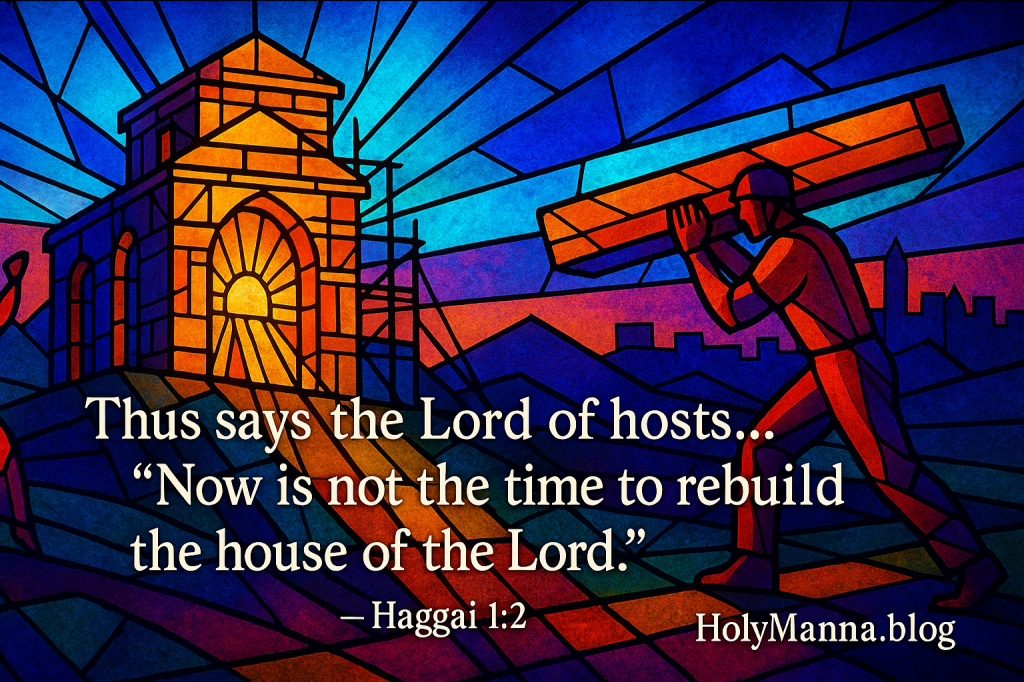
If your soul feels thin and scattered, could it be that God’s house is unfinished in you? In Haggai 1:1–8, the Lord confronts a returned people who have prioritized comfort over communion. “Is it time for you to dwell in your paneled houses while this house lies in ruins?” The setting is the early Persian period under Darius I, when the exiles had come home, laid a foundation for the Second Temple, and then stalled. Haggai’s charge is concrete and urgent: “Go up into the hill country; bring timber, and build the house, that I may be pleased with it, and that I may be glorified.” Worship is not an accessory added after life is arranged. Worship arranges life.
Psalm 149 shows what happens when God is placed first. Israel does not whisper private devotion. The faithful “make music with tambourine and lyre,” and their praise becomes a public sign of covenant fidelity. “Sing to the Lord a new song, his praise in the assembly of the faithful.” The psalm’s “two-edged sword” imagery signals that true praise includes obedience to God’s judgments and courageous fidelity in the world. For Christians, this fidelity centers in the Church’s liturgy, where Christ gathers and sanctifies His people. As The Catechism teaches, sacred worship is both interior and embodied in visible places and rites (CCC 1179–1181). The virtue of religion orders our choices to God (CCC 2098), and the Eucharist is the “source and summit” from which all rebuilding flows (CCC 1324).
Into this call to rebuild and rejoice, Luke 9:7–9 places Herod Antipas, who hears of Jesus’ works and is intrigued but unconverted. “Who then is this about whom I hear such things?” Herod “kept trying to see him,” but only as a spectacle. Curiosity without surrender cannot build a temple. Today’s readings therefore converge on a single summons: put God first. Pick up timber, that is, reorder your priorities and your calendar for the Lord. Lift up praise in the assembly that becomes mission in the streets. Seek Jesus not as a novelty but as King. Where is the Lord inviting you to rebuild His dwelling in your heart, your home, and your parish today?
First Reading – Haggai 1:1-8
Rebuild What Really Matters
After decades in exile, Judah returned to a shattered Jerusalem with a divine mandate to restore worship at the center of life. Under Darius I around 520 BC, the people had rebuilt their own homes but left the Lord’s house desolate. Haggai 1:1–8 enters this stalled moment and exposes a spiritual misalignment: comfort had displaced communion. The prophet’s message is concrete and urgent. Rebuilding the Temple is not a luxury project. It is the visible sign that God comes first and that the community’s life is ordered around His presence. This reading advances today’s theme by calling us to put God first, to let worship arrange our priorities, and to rebuild His dwelling in our hearts, our homes, and our parishes.
Haggai 1:1-8
New American Bible (Revised Edition)
Prophetic Call to Work on the Temple. 1 On the first day of the sixth month in the second year of Darius the king, the word of the Lord came through Haggai the prophet to the governor of Judah, Zerubbabel, son of Shealtiel, and to the high priest Joshua, son of Jehozadak: 2 Thus says the Lord of hosts: This people has said: “Now is not the time to rebuild the house of the Lord.”
3 Then the word of the Lord came through Haggai the prophet: 4 Is it time for you to dwell in your paneled houses while this house lies in ruins?
5 Now thus says the Lord of hosts:
Reflect on your experience!
6 You have sown much, but have brought in little;
you have eaten, but have not been satisfied;
You have drunk, but have not become intoxicated;
you have clothed yourselves, but have not been warmed;
And the hired worker labors for a bag full of holes.
7 Thus says the Lord of hosts:
Reflect on your experience!
8 Go up into the hill country;
bring timber, and build the house
that I may be pleased with it,
and that I may be glorified, says the Lord.
Detailed Exegesis
Verse 1 – “On the first day of the sixth month in the second year of Darius the king, the word of the Lord came through Haggai the prophet to the governor of Judah, Zerubbabel, son of Shealtiel, and to the high priest Joshua, son of Jehozadak.”
The precise timestamp roots this oracle in history and signals covenant seriousness. Naming Zerubbabel and Joshua unites royal and priestly leadership for a single task. God addresses both governance and worship because the restoration of Israel requires ordered authority under the Lord.
Verse 2 – “Thus says the Lord of hosts: This people has said: ‘Now is not the time to rebuild the house of the Lord.’”
The Lord quotes the people’s rationalization. Delay reveals disordered love. The phrase “house of the Lord” centers the Temple as the sign of God-with-us. Postponing the work postpones God’s glory among the people.
Verse 3 – “Then the word of the Lord came through Haggai the prophet:”
Repetition of the prophetic formula underscores divine initiative. The Lord pursues His people with a second address, highlighting mercy as He confronts them again.
Verse 4 – “Is it time for you to dwell in your paneled houses while this house lies in ruins?”
“Paneled houses” evokes finished, comfortable interiors. The contrast with the ruined Temple exposes a spiritual inversion. The people have invested in self while neglecting the place of divine presence. The question invites examination of priorities.
Verse 5 – “Now thus says the Lord of hosts: Reflect on your experience!”
The command to reflect is a covenant wake-up call. God urges an audit of life’s outcomes. Reflection is not mere introspection. It is a moral reckoning before the Lord who measures fruit by fidelity.
Verse 6 – “You have sown much, but have brought in little; you have eaten, but have not been satisfied; You have drunk, but have not become intoxicated; you have clothed yourselves, but have not been warmed; And the hired worker labors for a bag full of holes.”
Five images portray futility. Abundance of effort yields scarcity of joy. Consumption without communion cannot satisfy. The “bag full of holes” is a vivid metaphor for lives that leak meaning because they are not ordered to God. The verse harmonizes with the wisdom tradition that apart from the Lord, labor is vanity.
Verse 7 – “Thus says the Lord of hosts: Reflect on your experience!”
The refrain doubles the summons. True conversion includes sustained attention. God invites the people to move from regret to resolve.
Verse 8 – “Go up into the hill country; bring timber, and build the house that I may be pleased with it, and that I may be glorified, says the Lord.”
The Lord provides a simple, actionable plan. Worship requires tangible obedience. When God is pleased, His glory returns to the center of communal life. Historically, this command anticipates the renewed effort that will culminate in the Second Temple’s completion, a sign that God again dwells among His people.
Teachings
Haggai’s call reveals that worship rightly orders life. The Catechism teaches that Christian worship is both interior and visible. “The worship ‘in spirit and truth’ of the New Covenant is not tied exclusively to any place.” (CCC 1179). Yet sacred places matter as signs of God’s dwelling. “A church, ‘a house of prayer in which the Eucharist is celebrated and reserved’.” (CCC 1181). At the heart of this reordered life stands the Eucharist: “The Eucharist is ‘the source and summit of the Christian life’.” (CCC 1324). The virtue of religion begins with adoration. “Adoration is the first act of the virtue of religion.” (CCC 2096). Adoration acknowledges God as Creator and Lord and directs every other act of prayer and sacrifice toward Him (CCC 2097). The inner emptiness described in verse 6 mirrors Saint Augustine’s confession, “You have made us for yourself, O Lord, and our hearts are restless until they rest in you.” (Confessions I.1). Historically, the community returned under Cyrus, laid a foundation, then stalled amid opposition until the prophetic word rekindled courage as seen also in Ezra 4–6. Haggai shows that rebuilding worship is not a private preference. It is the covenant path to communal fruitfulness under God.
Reflection
If your energy feels spent and your joy runs through holes, consider what you are building. Begin with adoration before the Blessed Sacrament and ask the Lord to reorder your week around the liturgy. Make a concrete plan to serve in your parish so that your praise in the assembly becomes love in action. Set aside time to examine your calendar, budget, and habits, and ask where God’s house is neglected in your life. Replace delay with simple obedience. Choose one timber you can carry today, such as daily prayer, Sunday Mass on time with preparation, or reconciliation if you have been away. What comfort has taken the place of communion in your schedule? Which single step will you take today to rebuild the Lord’s dwelling in your heart and in your home? How will you let your worship arrange your life this week so that God is pleased and glorified?
Responsorial Psalm – Psalm 149:1-6, 9
Praise That Builds and Battles
In Psalm 149 Israel is summoned to a liturgy that sings, dances, and obeys. This is not private spirituality. It is public covenant worship that overflows into faithful action. In the post-exilic world of restoration and rebuilding, this psalm forms a people whose praise anchors identity and mission. Today’s theme calls us to put God first. The psalm shows that when worship takes the lead, God delights in His people, lifts up the lowly, and equips them to live His judgments in the world. Praise becomes the breath of a rebuilt heart and the cadence of a rebuilt community.
Psalm 149:1-6, 9
New American Bible (Revised Edition)
Praise God with Song and Swo
1 Hallelujah!
Sing to the Lord a new song,
his praise in the assembly of the faithful.
2 Let Israel be glad in its maker,
the people of Zion rejoice in their king.
3 Let them praise his name in dance,
make music with tambourine and lyre.
4 For the Lord takes delight in his people,
honors the poor with victory.
5 Let the faithful rejoice in their glory,
cry out for joy on their couches,
6 With the praise of God in their mouths,
and a two-edged sword in their hands,
9 To execute the judgments decreed for them—
such is the glory of all God’s faithful.
Hallelujah!
Detailed Exegesis
Verse 1 – “Hallelujah! Sing to the Lord a new song, his praise in the assembly of the faithful.”
A “new song” is the sound of fresh deliverance. Praise is communal, not solitary. The “assembly” signals liturgical identity. God forms His people by gathering them to remember His works and to proclaim His reign.
Verse 2 – “Let Israel be glad in its maker, the people of Zion rejoice in their king.”
Joy springs from who God is to His people. He is Maker and King. Gladness is not sentiment. It is covenant recognition that life and order come from God. Rejoicing is an act of allegiance that places God first.
Verse 3 – “Let them praise his name in dance, make music with tambourine and lyre.”
Embodied praise engages movement and music. Worship is not abstract. It is the whole person offered to God. Instruments and dance express a joy that refuses to be muted when God restores His people.
Verse 4 – “For the Lord takes delight in his people, honors the poor with victory.”
God’s delight is the reason for worship. He crowns the humble with salvation. The psalm reverses worldly hierarchies and reveals the Father’s preference for the lowly who trust Him.
Verse 5 – “Let the faithful rejoice in their glory, cry out for joy on their couches.”
Covenant glory is the gift of belonging to God. Joy is not confined to the sanctuary. It spills into domestic life. Even “on their couches,” the faithful carry liturgical joy into everyday spaces.
Verse 6 – “With the praise of God in their mouths, and a two-edged sword in their hands,”
The image unites doxology and duty. For ancient Israel, it evokes the vocation to enact God’s just rule. For Christians, the primary weapon is the Word of God, “living and effective, sharper than any two-edged sword” in Hebrews 4:12. Praise on the lips and fidelity in action belong together.
Verse 9 – “To execute the judgments decreed for them, such is the glory of all God’s faithful. Hallelujah!”
Obedience to God’s judgments is described as “glory.” The people’s honor is to live God’s will publicly. The final “Hallelujah” returns all glory to God, who glorifies the humble who keep His ways.
Teachings
The psalm discloses the nature and aim of Christian praise. The Catechism teaches the character of praise in the life of prayer. “Praise is the form of prayer which recognizes most immediately that God is God. It lauds God for his own sake, gives him glory for who he is, simply because HE IS.” CCC 2639. The Church also treasures sacred music and embodied worship. “The musical tradition of the universal Church is a treasure of inestimable value, greater even than that of any other art.” CCC 1156. Worship shapes a people who act. The virtue of religion begins with adoration and orders all life to God. “Adoration is the first act of the virtue of religion.” CCC 2096. In the Mass, our praise springs from and returns to the Eucharist. “The Eucharist is ‘the source and summit of the Christian life’.” CCC 1324. The “assembly of the faithful” finds its fulfillment in the Church gathered for the sacred liturgy, where Christ Himself presides and sanctifies. “Christ is present in the sacrificial offering of the Mass, in the person of the minister, in the Eucharistic species, and in his word.” CCC 1373. Thus, Psalm 149 trains us for a life where liturgical praise becomes moral courage, and where the Word of God, like a two-edged sword, guides us to enact His judgments with mercy and truth.
Reflection
Let praise lead your rebuilding this week. Begin or end each day with a “new song” to the Lord, even if it is a simple psalm or a whispered “Hallelujah.” Bring your body into worship by singing at Mass and by a posture of adoration before the Blessed Sacrament. Carry the assembly’s joy back to your home, and let it shape your speech and choices. Open Scripture each day and let the two edged sword of the Word read your heart. Choose one concrete act of obedience that enacts God’s judgments in love, such as reconciling with someone, serving a neighbor in need, or refusing a dishonest shortcut at work. Where will you let God’s praise interrupt your comfort today? How can you carry the assembly’s song into your household rhythms this week? What single act of obedience will let your worship become action for the glory of God?
Holy Gospel – Luke 9:7-9
From Curiosity to Conversion
Herod Antipas, the tetrarch of Galilee and Perea and son of Herod the Great, hears the ripples of Jesus’ mighty works and grows uneasy. This Herod had imprisoned and executed John the Baptist, a fact that haunts today’s scene and exposes a conscience that is stirred but not surrendered. In a first century world charged with messianic expectation, reports of healings and exorcisms awaken ancient hopes and old fears. Into this atmosphere Luke 9:7–9 presents a ruler who wants to see Jesus as a spectacle rather than receive Him as Lord. The passage fits today’s theme by contrasting shallow intrigue with decisive obedience. Rebuilding God’s house requires more than fascination with holy things. It requires conversion to the true King.
Luke 9:7-9
New American Bible (Revised Edition)
7 Herod the tetrarch heard about all that was happening, and he was greatly perplexed because some were saying, “John has been raised from the dead”; 8 others were saying, “Elijah has appeared”; still others, “One of the ancient prophets has arisen.” 9 But Herod said, “John I beheaded. Who then is this about whom I hear such things?” And he kept trying to see him.
Detailed Exegesis
Verse 7 – “Herod the tetrarch heard about all that was happening, and he was greatly perplexed because some were saying, ‘John has been raised from the dead’.”
Herod’s perplexity signals a troubled conscience confronted by grace. Reports of Jesus’ ministry are public and powerful. Popular explanations reach for categories of resurrection and prophecy. The mention of John’s rising exposes Herod’s unresolved guilt and the spiritual confusion that results when one resists the light.
Verse 8 – “Others were saying, ‘Elijah has appeared’; still others, ‘One of the ancient prophets has arisen.’”
The crowd interprets Jesus through Israel’s story. Elijah evokes the expectation of a forerunner and of prophetic fire. The reference to the ancient prophets acknowledges continuity with God’s saving action. Yet all these guesses fall short. Jesus fulfills and surpasses the prophets because He is the Son. Fascination with the past cannot replace recognition of the present Lord.
Verse 9 – “But Herod said, ‘John I beheaded. Who then is this about whom I hear such things?’ And he kept trying to see him.”
Herod names his sin and still stops short of repentance. He desires to see Jesus but not to follow Him. The verb of continued seeking without surrender exposes a counterfeit curiosity. True seeing in the Gospel requires faith, humility, and conversion. The question “Who then is this” is the right question, but it must be answered by worship, not by voyeurism.
Teachings
This brief scene clarifies how signs invite faith and how faith must mature into understanding and conversion. The Catechism teaches: “The signs worked by Jesus attest that the Father has sent him. They invite belief in him. To those who turn to him in faith, he grants what they ask.” CCC 548. Faith is not blind. It longs to know the One it receives. “Faith seeks understanding. It is intrinsic to faith that a believer desires to know better the One in whom he has put his faith, and to understand better what He has revealed.” CCC 158. Curiosity without repentance remains sterile, but grace calls us home through conversion. “Interior repentance is a radical reorientation of our whole life, a return, a conversion to God with all our heart, an end of sin, a turning away from evil, with repugnance toward the evil actions we have committed.” CCC 1431. In the liturgy where the Church gathers to hear and to see Jesus, He is truly present and acts. “Christ is present in the sacrificial offering of the Mass, in the person of the minister, in the Eucharistic species, and in his word.” CCC 1373. Therefore the answer to “Who then is this” is given most fully in the Eucharistic celebration, where the faithful do not merely hear reports about Jesus but encounter Him and are changed.
Reflection
Move from interest to obedience. Bring your unresolved places to the Lord in confession and ask for a new heart that does not only want to see but also to follow. Make a concrete choice to seek Jesus where He has promised to be found in Scripture and in the Eucharist. Replace passive consumption of religious content with active discipleship. Set a time this week for adoration and let your question become worship. Where are you curious about Jesus but hesitant to surrender to Him? What sin do you need to name plainly before God so that curiosity can become conversion? How will you answer Herod’s question with your life by meeting Jesus in His word and at His altar this week?
Holy Gospel – Luke 9:7-9
From Curiosity to Conversion
Herod Antipas, the tetrarch of Galilee and Perea and son of Herod the Great, hears the ripples of Jesus’ mighty works and grows uneasy. This Herod had imprisoned and executed John the Baptist, a fact that haunts today’s scene and exposes a conscience that is stirred but not surrendered. In a first century world charged with messianic expectation, reports of healings and exorcisms awaken ancient hopes and old fears. Into this atmosphere Luke 9:7–9 presents a ruler who wants to see Jesus as a spectacle rather than receive Him as Lord. The passage fits today’s theme by contrasting shallow intrigue with decisive obedience. Rebuilding God’s house requires more than fascination with holy things. It requires conversion to the true King.
Luke 9:7-9
New American Bible (Revised Edition)
7 Herod the tetrarch heard about all that was happening, and he was greatly perplexed because some were saying, “John has been raised from the dead”; 8 others were saying, “Elijah has appeared”; still others, “One of the ancient prophets has arisen.” 9 But Herod said, “John I beheaded. Who then is this about whom I hear such things?” And he kept trying to see him.
Detailed Exegesis
Verse 7 – “Herod the tetrarch heard about all that was happening, and he was greatly perplexed because some were saying, ‘John has been raised from the dead’.”
Herod’s perplexity signals a troubled conscience confronted by grace. Reports of Jesus’ ministry are public and powerful. Popular explanations reach for categories of resurrection and prophecy. The mention of John’s rising exposes Herod’s unresolved guilt and the spiritual confusion that results when one resists the light.
Verse 8 – “Others were saying, ‘Elijah has appeared’; still others, ‘One of the ancient prophets has arisen.’”
The crowd interprets Jesus through Israel’s story. Elijah evokes the expectation of a forerunner and of prophetic fire. The reference to the ancient prophets acknowledges continuity with God’s saving action. Yet all these guesses fall short. Jesus fulfills and surpasses the prophets because He is the Son. Fascination with the past cannot replace recognition of the present Lord.
Verse 9 – “But Herod said, ‘John I beheaded. Who then is this about whom I hear such things?’ And he kept trying to see him.”
Herod names his sin and still stops short of repentance. He desires to see Jesus but not to follow Him. The verb of continued seeking without surrender exposes a counterfeit curiosity. True seeing in the Gospel requires faith, humility, and conversion. The question “Who then is this” is the right question, but it must be answered by worship, not by voyeurism.
Teachings
This brief scene clarifies how signs invite faith and how faith must mature into understanding and conversion. The Catechism teaches: “The signs worked by Jesus attest that the Father has sent him. They invite belief in him. To those who turn to him in faith, he grants what they ask.” CCC 548. Faith is not blind. It longs to know the One it receives. “Faith seeks understanding. It is intrinsic to faith that a believer desires to know better the One in whom he has put his faith, and to understand better what He has revealed.” CCC 158. Curiosity without repentance remains sterile, but grace calls us home through conversion. “Interior repentance is a radical reorientation of our whole life, a return, a conversion to God with all our heart, an end of sin, a turning away from evil, with repugnance toward the evil actions we have committed.” CCC 1431. In the liturgy where the Church gathers to hear and to see Jesus, He is truly present and acts. “Christ is present in the sacrificial offering of the Mass, in the person of the minister, in the Eucharistic species, and in his word.” CCC 1373. Therefore the answer to “Who then is this” is given most fully in the Eucharistic celebration, where the faithful do not merely hear reports about Jesus but encounter Him and are changed.
Reflection
Move from interest to obedience. Bring your unresolved places to the Lord in confession and ask for a new heart that does not only want to see but also to follow. Make a concrete choice to seek Jesus where He has promised to be found in Scripture and in the Eucharist. Replace passive consumption of religious content with active discipleship. Set a time this week for adoration and let your question become worship. Where are you curious about Jesus but hesitant to surrender to Him? What sin do you need to name plainly before God so that curiosity can become conversion? How will you answer Herod’s question with your life by meeting Jesus in His word and at His altar this week?
Rebuild, Rejoice, and Respond
In Haggai 1:1-8 the Lord exposes delay and invites decisive love. “Go up into the hill country; bring timber, and build the house.” In Psalm 149 praise becomes the public rhythm of a people who belong to God. “Sing to the Lord a new song, his praise in the assembly of the faithful.” In Luke 9:7-9 Herod’s restless curiosity asks the right question without giving the right response. “Who then is this about whom I hear such things?” Together the readings call us to put God first, to let worship arrange life, and to move from interest to obedience.
Let this be the week you carry a real timber for the Lord. Choose one concrete act that rebuilds His dwelling in your heart and in your parish. Let your praise at Mass overflow into your home and your work. Seek Jesus where He promises to be found in His word and in the Eucharist. What will you set aside so that God’s house is no longer neglected in you? How will you sing a new song that becomes a new way of living? How will you answer Herod’s question with your life by meeting and following the King today? May the Holy Spirit make your yes simple and strong, so that God is pleased and glorified in you.
Engage with Us!
We would love to hear from you. Please share your reflections in the comments below and tell us how God is speaking to you through today’s readings.
- How is the Lord inviting you to “carry timber” in Haggai 1:1-8 so that His dwelling is no longer neglected in your heart, your home, or your parish, and where do you hear Him say “Reflect on your experience” today?
- What would it look like for you to “sing a new song” from Psalm 149:1-6, 9 this week, and how can your praise at Mass become a concrete act of obedience that enacts God’s judgments with mercy?
- Where might curiosity about Jesus in Luke 9:7-9 need to become conversion, and what specific step will move you from wanting to see Him to choosing to follow Him in faith and repentance?
May the Holy Spirit strengthen you to live a life of faith, to worship with joy, and to do everything with the love and mercy that Jesus has taught us.
Sacred Heart of Jesus, we trust in You!
Immaculate Heart of Mary, pray for us!
Saint Michael the Archangel, defend us in battle!
Follow us on Instagram and Facebook for more insights and reflections on living a faith-filled life.

 Holy Manna!
Leave a comment