Wednesday of the Twenty-fifth Week in Ordinary Time – Lectionary: 451
Rebuilt by Mercy, Sent with Empty Hands
Come as you are, with torn cloaks and hopeful hearts, to meet the God who rebuilds ruins and then sends His people to heal a broken world. In Ezra 9:5-9, the scribe falls to his knees at the time of the evening sacrifice and confesses a history of infidelity, yet he marvels that God has “left us a remnant” and granted new life for the restoration of His house under Persian favor. This post-exilic moment frames today’s worship as grateful returnees learning to live again as a holy people. The canticle from Tobit 13:2-4, 7-8 teaches that the Lord both “afflicts and shows mercy”, scattering and gathering, so that His people will praise Him “in the presence of the nations”, a diaspora hymn that turns chastening into witness. Into this story of mercy and mission, Luke 9:1-6 places Jesus who entrusts real authority to His apostles to cure diseases and cast out demons, while commanding “Take nothing for the journey” so that dependence on the Father becomes the Church’s signature and her credibility. The thread is clear. God restores His people by mercy, rebuilds His worship, and then sends them to proclaim and to heal with uncluttered hearts, a pattern the Church receives and lives in every age, as taught in The Catechism on ongoing conversion (CCC 1428), the universal mission of the Church (CCC 849–856), Christ’s healing continued in His Body (CCC 1506–1510), and the primacy of praise and thanksgiving (CCC 2639). What mercy is God restoring in you today, and what baggage will you set down so that you can travel lighter in His mission?
First Reading – Ezra 9:5-9
Torn Garments, Open Hands, New Mercy
Ezra prays at the evening sacrifice after the exiles return from Babylon, a period that stretches from Cyrus’s decree in the late sixth century before Christ through the reforms of priest-scribe Ezra in the fifth century before Christ. Tearing cloak and mantle was an ancient sign of grief and repentance in Israel, and lifting hands in prayer aligned the body with a heart that turns back to God. The remnant has come home to a partially restored Jerusalem, the temple has been rebuilt, and yet the people still need interior renewal. In this moment Ezra’s penitential prayer gathers Israel’s history of infidelity into a single confession and recognizes that the surprising goodwill of the Persian kings is an instrument of divine mercy. The reading fits today’s theme by showing that God restores His people so that they can rebuild worship and identity, not by boasting in their strength but by clinging to His mercy. The prayer becomes a doorway into mission, because a people humbled and forgiven is ready to live for God’s house and witness His protection before the nations.
Ezra 9:5-9
New American Bible (Revised Edition)
5 Then, at the time of the evening sacrifice, I rose in my wretchedness, and with cloak and mantle torn I fell on my knees, stretching out my hands to the Lord, my God.
A Penitential Prayer. 6 I said: “My God, I am too ashamed and humiliated to raise my face to you, my God, for our wicked deeds are heaped up above our heads and our guilt reaches up to heaven. 7 From the time of our ancestors even to this day our guilt has been great, and for our wicked deeds we have been delivered, we and our kings and our priests, into the hands of the kings of foreign lands, to the sword, to captivity, to pillage, and to disgrace, as is the case today.
8 “And now, only a short time ago, mercy came to us from the Lord, our God, who left us a remnant and gave us a stake in his holy place; thus our God has brightened our eyes and given us relief in our slavery. 9 For slaves we are, but in our slavery our God has not abandoned us; rather, he has turned the good will of the kings of Persia toward us. Thus he has given us new life to raise again the house of our God and restore its ruins, and has granted us a protective wall in Judah and Jerusalem.
Detailed Exegesis
Verse 5 – “Then, at the time of the evening sacrifice, I rose in my wretchedness, and with cloak and mantle torn I fell on my knees, stretching out my hands to the Lord, my God.”
Ezra situates his prayer at the evening sacrifice, likely around midafternoon in the temple liturgy, which underscores that true reform begins in worship. His torn garments embody sorrow for sin, and his posture of kneeling with outstretched hands shows reliance on divine help rather than human solutions. Repentance is not a private mood but an act of covenant renewal before God.
Verse 6 – “I said: ‘My God, I am too ashamed and humiliated to raise my face to you, my God, for our wicked deeds are heaped up above our heads and our guilt reaches up to heaven.’”
Shame here is not self-hatred but moral realism. Israel names its sins without excuses. The imagery of guilt towering to heaven contrasts with prayer rising to heaven, teaching that God’s mercy answers not denial but truth-telling. Confession clears the way for grace to enter and heal.
Verse 7 – “From the time of our ancestors even to this day our guilt has been great, and for our wicked deeds we have been delivered, we and our kings and our priests, into the hands of the kings of foreign lands, to the sword, to captivity, to pillage, and to disgrace, as is the case today.”
Ezra reads history theologically. Exile and humiliation are not random. They are the bitter fruit of covenant infidelity. Yet the inclusion of kings and priests shows that no one is above the call to repentance. Solidarity in sin becomes solidarity in conversion, preparing the people to receive restoration as a pure gift.
Verse 8 – “And now, only a short time ago, mercy came to us from the Lord, our God, who left us a remnant and gave us a stake in his holy place; thus our God has brightened our eyes and given us relief in our slavery.”
The key word is mercy. God preserves a remnant and plants them again in His sanctuary. The phrase “brightened our eyes” signals renewed hope and spiritual clarity. Relief does not erase the past. It transfigures it, turning survivors of judgment into stewards of worship who can rebuild life around God.
Verse 9 – “For slaves we are, but in our slavery our God has not abandoned us; rather, he has turned the good will of the kings of Persia toward us. Thus he has given us new life to raise again the house of our God and restore its ruins, and has granted us a protective wall in Judah and Jerusalem.”
God’s providence can work through pagan rulers. The “protective wall” points to divine safeguarding and the favor expressed through imperial edicts, anticipating the fuller civic restoration under Nehemiah. New life is ordered to a task. Mercy commissions the people to rebuild God’s house and their identity as His worshiping community.
Teachings
Ezra’s prayer models the Church’s ongoing call to conversion. The Catechism teaches, “Christ’s call to conversion continues to resound in the lives of Christians. This second conversion is an uninterrupted task for the whole Church who, clasping sinners to her bosom, is at once holy and always in need of purification, and follows constantly the path of penance and renewal.” (CCC 1428). This interior change is not cosmetic. It is total. The Catechism explains, “Interior repentance is a radical reorientation of our whole life, a return, a conversion to God with all our heart, an end of sin, a turning away from evil, with repugnance toward the evil actions we have committed. At the same time it entails the desire and resolution to change one’s life, with hope in God’s mercy and trust in the help of his grace.” (CCC 1431). Ezra’s focus on the temple’s restoration also prefigures the Church as God’s house. Without quoting at length, the Church summarizes this mystery by describing herself as the house of God and the dwelling place of God among men (CCC 756), which connects the rebuilding of the sanctuary with the formation of a holy people. Cooperation with grace is essential. Saint Augustine famously reminds us, “He who created you without you will not justify you without you.” (Sermon 169, 13). Ezra’s confession and plea are precisely this cooperation in action. Historically, the return from exile under Persian policy shows that God can turn the hearts of rulers to protect His people. The text’s “protective wall” can be read both as providential favor through royal decrees and as a sign of God’s own guardianship until the city’s physical walls were rebuilt. In every age the pattern remains the same. God restores a remnant, renews worship, and then sends His people to live as a visible sign of His mercy.
Reflection
God’s people in Ezra 9:5-9 do not minimize their failures. They maximize God’s mercy. The path forward is clear. Tell the truth about your sin, receive the gift of new life, and get to work rebuilding whatever lies in ruins in your vocation. Begin with concrete confession before God. Return to the sacrament of Reconciliation if it has been a while. Rebuild worship by setting a time for daily prayer and by honoring Sunday Mass with attentive preparation. Cooperate with grace by making a small rule of life that protects your prayer, your study of Scripture, and your service to others. Carry into your day the conviction that God can turn even unexpected hearts in your favor when you seek first His house. Where is the Lord inviting you to confess and return to Him with your whole heart today? What habit will you lay down so that He can brighten your eyes again? How will you help rebuild the house of God in your parish, your family, or your friendships this week?
Responsorial Psalm – Tobit 13:2-4, 7-8
Scattered in Mercy, Singing for the Nations
The Canticle of Tobit rises from the heart of the diaspora. Tobit, a righteous Israelite from the tribe of Naphtali living in Assyrian exile at Nineveh, sings praise that is honest about suffering and radiant with trust. In this setting, praise becomes public witness. God has chastened His people for covenant infidelity, yet He has preserved a remnant and remains Lord of history. This psalm fits today’s theme by turning restoration into mission. The people who have been gathered by mercy now exalt the Lord “in the presence of the nations,” announcing that no power can snatch life from His hand. Their song prepares the Church to live grateful and outward facing, rebuilt by mercy and sent in trust.
Tobit 13:2-4, 7-8
New American Bible (Revised Edition)
2 For he afflicts and shows mercy,
casts down to the depths of Hades,
brings up from the great abyss.
What is there that can snatch from his hand?
3 Give thanks to him, you Israelites, in the presence of the nations,
for though he has scattered you among them,
4 even there recount his greatness.
Exalt him before every living being,
because he is your Lord, and he is your God,
our Father and God forever and ever!
7 As for me, I exalt my God,
my soul exalts the King of heaven,
and rejoices all the days of my life.
Let all sing praise to his greatness,
8 let all speak and give thanks in Jerusalem.
Detailed Exegesis
Verse 2 – “For he afflicts and shows mercy, casts down to the depths of Hades, brings up from the great abyss. What is there that can snatch from his hand?”
The verse unites justice and mercy in the one providence of God. He permits abasement for purification and then raises up to new life. The rhetorical question underscores absolute sovereignty. Nothing competes with God’s grasp. The people can admit hard truth about exile without despair because the Lord’s hand rules both descent and rising.
Verse 3 – “Give thanks to him, you Israelites, in the presence of the nations, for though he has scattered you among them,”
Thanksgiving is not private. It is performed before the nations. Scattering becomes a stage for mission rather than a reason for silence. Gratitude evangelizes because it names God as the source of every good.
Verse 4 – “even there recount his greatness. Exalt him before every living being, because he is your Lord, and he is your God, our Father and God forever and ever!”
Place does not limit praise. “Even there” means wherever God’s people find themselves, they exalt Him as Lord and Father. The language of forever grounds witness in covenant identity. The community’s song is theological proclamation that shapes identity in exile and at home.
Verse 7 – “As for me, I exalt my God, my soul exalts the King of heaven, and rejoices all the days of my life. Let all sing praise to his greatness,”
The psalm moves from communal command to personal testimony. Tobit models joy as a stable stance, not a passing mood. Calling God “King of heaven” anchors hope beyond political powers. Personal praise invites universal chorus.
Verse 8 – “let all speak and give thanks in Jerusalem.”
The diaspora looks toward Jerusalem as the liturgical center where thanksgiving culminates. The line anticipates restoration to worship and signals that true renewal ends in gathered praise. The Church receives this in the heavenly Jerusalem, where every Eucharist is a foretaste.
Teachings
The song of Tobit embodies the Church’s call to praise and mission. The Catechism teaches, “Christ’s call to conversion continues to resound in the lives of Christians. This second conversion is an uninterrupted task for the whole Church who, clasping sinners to her bosom, is at once holy and always in need of purification, and follows constantly the path of penance and renewal.” (CCC 1428). Conversion flowers into thanksgiving because our life is a gift. The Catechism begins, “God, infinitely perfect and blessed in himself, in a plan of sheer goodness freely created man to make him share in his own blessed life.” (CCC 1). Praise thus recognizes God for who He is and trains the heart to trust His providence in every circumstance. History is not random. The Catechism confesses, “We firmly believe that God is master of the world and of its history.” (CCC 314). In this light, the scattering of Israel becomes a stage for proclamation, just as the Church is sent to all peoples. Saint Irenaeus articulates the goal of such praise and mission: “The glory of God is man fully alive, and the life of man consists in the vision of God.” (Against Heresies IV, 20, 7). When the redeemed sing before the nations, they reveal both God’s glory and humanity’s true life.
Reflection
Let your gratitude become your witness. Begin and end today with spoken thanksgiving to God, naming at least three concrete mercies. Offer a short prayer of praise before a meal in public without embarrassment. Carry a line of this canticle on your lips during trials to resist the reflex of complaint. If you feel scattered by circumstances, turn that scattering into a mission field by blessing someone where you are. Return to the Eucharist with a conscious act of praise, since every Mass is thanksgiving. Where has God lifted you from the abyss and how will you tell it “in the presence of the nations” today? What small act of public gratitude will you practice to make His greatness known? How will you join your voice to the Church’s praise so that your life becomes a song in Jerusalem and a sign of hope to the world?
Holy Gospel – Luke 9:1-6
Power to Heal, Poverty to Trust
Jesus commissions the Twelve in Galilee at a turning point in His public ministry. He entrusts them with His own authority and sends them on an itinerant mission shaped by the patterns of first century hospitality, where travelers relied on local households for lodging and food. The instruction to carry no provisions forces a visible dependence on the Father and on the generosity stirred by the Gospel. The gesture of shaking dust from the feet echoes a Jewish practice that marked separation from unbelief and served as a sober testimony rather than an act of contempt. This Gospel fits today’s theme by showing that those whom God restores by mercy are sent to proclaim and to heal with uncluttered hearts. The Twelve go out as a living sign that the Kingdom is near, that God’s house is being rebuilt in human lives, and that trust is their true provision.
Luke 9:1-6
New American Bible (Revised Edition)
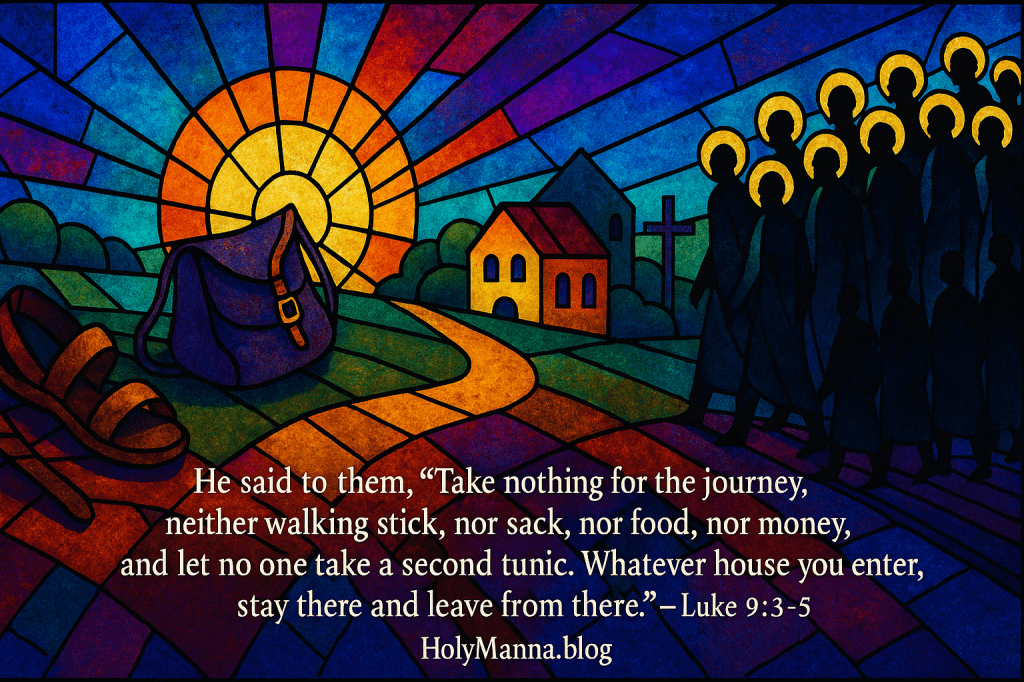
The Mission of the Twelve. 1 He summoned the Twelve and gave them power and authority over all demons and to cure diseases, 2 and he sent them to proclaim the kingdom of God and to heal [the sick]. 3 He said to them, “Take nothing for the journey, neither walking stick, nor sack, nor food, nor money, and let no one take a second tunic. 4 Whatever house you enter, stay there and leave from there. 5 And as for those who do not welcome you, when you leave that town, shake the dust from your feet in testimony against them.” 6 Then they set out and went from village to village proclaiming the good news and curing diseases everywhere.
Detailed Exegesis
Verse 1 – “He summoned the Twelve and gave them power and authority over all demons and to cure diseases,”
Jesus shares what is His. The authority that expels evil and restores the wounded is not an idea but a real participation in the mission of the Son. The Church’s apostolic ministry is derivative and relational. Power flows from communion with Christ.
Verse 2 – “and he sent them to proclaim the kingdom of God and to heal [the sick].”
Word and deed belong together. The announcement of the Kingdom is verified by works of mercy. The pattern continues in the Church where preaching and healing accompany one another in sacrament and service.
Verse 3 – “He said to them, ‘Take nothing for the journey, neither walking stick, nor sack, nor food, nor money, and let no one take a second tunic.’”
Radical simplicity is not romantic poverty. It is evangelical clarity. Traveling light removes mixed motives and reveals that the mission’s success depends on God. Detachment makes room for providence to act and for charity to be born in those who receive the messengers.
Verse 4 – “Whatever house you enter, stay there and leave from there.”
Stability within a given household resists the temptation to seek better accommodations and protects the credibility of the message. The Gospel is not a performance that upgrades venues. It is a gift that dignifies the first welcome offered.
Verse 5 – “And as for those who do not welcome you, when you leave that town, shake the dust from your feet in testimony against them.”
The sign is judicial and medicinal. It declares the seriousness of rejecting the Kingdom while freeing the messenger from resentment. The disciple bears witness and moves on, entrusting hearts to God’s timing.
Verse 6 – “Then they set out and went from village to village proclaiming the good news and curing diseases everywhere.”
Obedience turns commission into history. The Twelve do what they were told and discover that grace meets them on the road. The mission expands by faithful steps, village by village, life by life.
Teachings
The Gospel reveals the source and shape of apostolic mission. The Catechism teaches, “God, infinitely perfect and blessed in himself, in a plan of sheer goodness freely created man to make him share in his own blessed life.” (CCC 1). Mission exists because God wants to share His life. Conversion prepares messengers who can carry this life with integrity. The Catechism declares, “Christ’s call to conversion continues to resound in the lives of Christians. This second conversion is an uninterrupted task for the whole Church who, clasping sinners to her bosom, is at once holy and always in need of purification, and follows constantly the path of penance and renewal.” (CCC 1428). The interior change required for the journey is total and hopeful. The Catechism explains, “Interior repentance is a radical reorientation of our whole life, a return, a conversion to God with all our heart, an end of sin, a turning away from evil, with repugnance toward the evil actions we have committed. At the same time it entails the desire and resolution to change one’s life, with hope in God’s mercy and trust in the help of his grace.” (CCC 1431). In the apostolic pattern, Christ shares His authority so that the Church continues His works. The Catechism summarizes this continuity by teaching that the apostles were sent by Christ and that their successors continue to shepherd in His name, a mission grounded in communion with the Lord and ordered to preaching, sanctifying, and governing for the building up of the Body of Christ (cf. The Catechism on apostolic mission and succession). The Lord’s instruction to travel light highlights evangelical poverty, which the Church prizes as a sign that the Kingdom does not advance by worldly power but by grace. This poverty of spirit places the disciple at the disposal of God, so that mercy can reach the sick and the oppressed through humble servants.
Reflection
Travel lighter so that you can love better. Make one concrete act of detachment today, such as simplifying a purchase, cleaning out a distraction that eats your prayer time, or giving alms secretly. Offer a brief prayer before each task asking the Lord to provide what is needed for the next step and nothing more. Seek a house of peace by committing to stay with small beginnings in your vocation rather than chasing constant upgrades. If you meet resistance, respond with charity, release resentment to God, and move to the next open door. Where is Jesus asking you to trust His provision rather than your planning today? What will you lay down so that the Kingdom can be clearer in you? Who is the one person you can serve with healing words and practical help before this day ends?
Mercy Rebuilds, Mission Begins
Today’s readings sing one melody. In Ezra 9:5-9 a humbled remnant confesses honestly and discovers that God’s mercy rebuilds His house and brightens weary eyes. In Tobit 13:2-4, 7-8 a scattered people turn chastening into praise, proclaiming before the nations that nothing can be snatched from the Lord’s hand. In Luke 9:1-6 Jesus entrusts His authority to the Twelve and sends them with “power and authority” to heal, while commanding “Take nothing for the journey” so that trust, not tactics, becomes their provision. The pattern is clear and life giving. Mercy restores, praise rises, and mission begins. This is the Church’s heartbeat as taught in The Catechism on ongoing conversion (CCC 1428), joyful thanksgiving (CCC 2639), universal mission (CCC 849–856), and Christ’s healing continued in His Body (CCC 1506–1510). Receive mercy without excuses, give thanks without delay, and go forth without extra baggage. Make a sincere confession, return to the Eucharist with conscious praise, simplify one choice today to travel lighter, and serve one person with healing words and concrete help. Where is the Lord inviting you to let His mercy rebuild what is broken? How will you make your gratitude public so that others can see His greatness? To whom will you carry the Kingdom today, trusting that God will give you exactly what you need for the next step?
Engage with Us!
We would love to hear from you in the comments below. Share how God is speaking to you through today’s readings and how you plan to respond in prayer and action.
- First Reading — Ezra 9:5-9: Where is God inviting you to honest confession so that His mercy can give you new life? When have you experienced the Lord who “brightened our eyes” after a season of failure or fatigue? What one concrete step will you take this week to help rebuild God’s house in your parish, your family, or your friendships?
- Responsorial Psalm — Tobit 13:2-4, 7-8: How can your gratitude become public witness “in the presence of the nations” today? Where have you seen the Lord both “afflict and show mercy” in a way that deepened your trust? What simple act of praise will you practice so that your life points toward Jerusalem and the Eucharist?
- Holy Gospel — Luke 9:1-6: How does Jesus’ command “Take nothing for the journey” challenge your habits of comfort or control? Whom is the Lord sending you to serve with healing words and practical help before this day ends? What spiritual or material baggage will you lay down so that you can travel lighter in His mission?
Go forth with courage. Live a life of faith, hope, and charity, and do everything with the love and mercy Jesus taught us.
Sacred Heart of Jesus, we trust in You!
Immaculate Heart of Mary, pray for us!
Saint Michael the Archangel, defend us in battle!
Follow us on Instagram and Facebook for more insights and reflections on living a faith-filled life.

 Holy Manna!
Leave a comment