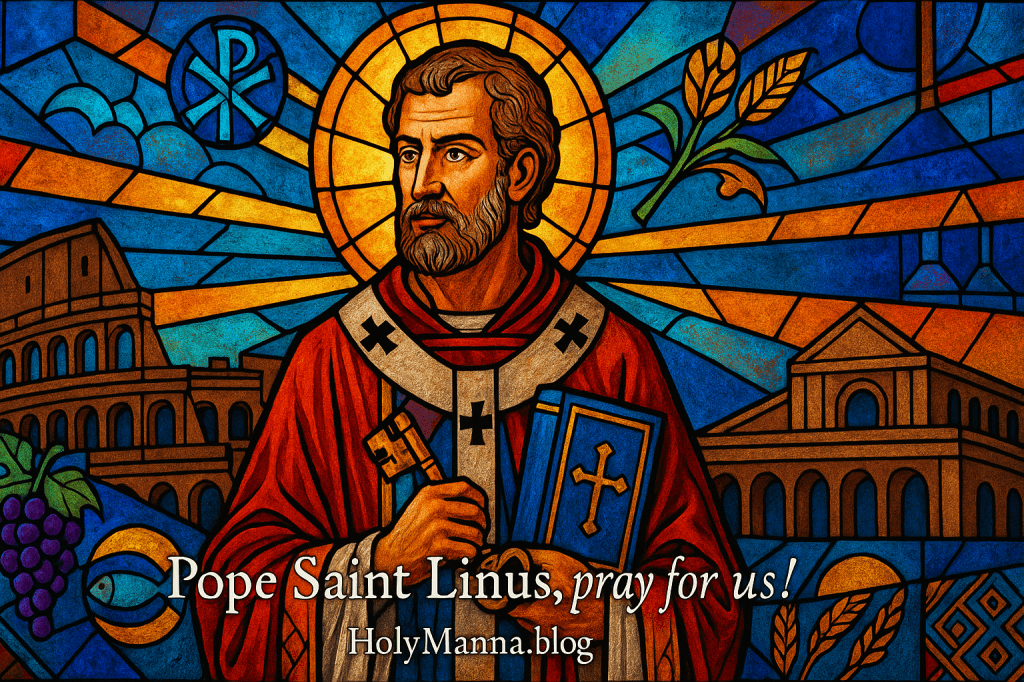
Heir to the Fisherman’s Chair
Pope Saint Linus stands at the headwaters of the papacy as the immediate successor to Saint Peter and one of the earliest shepherds of the Church in Rome. He is remembered not for a lengthy corpus of writings but for a living continuity with the apostles at a time when the Church was young, fragile, and frequently tested. The New Testament itself names Linus in 2 Timothy 4:21, placing him within the Roman Christian circle that gathered around Peter and Paul. The faithful have long honored him as a bridge between the apostolic preaching and the enduring governance of the Church, and his name is solemnly proclaimed at Mass in Eucharistic Prayer I (the Roman Canon), reminding us that the Church’s earliest memory remains present at today’s altar. The Catechism of the Catholic Church teaches that the Bishop of Rome, successor of Peter, is “the perpetual and visible source and foundation of the unity” of the Church, a reality that Linus embodies in its earliest form (CCC 882). Saint Irenaeus witnesses to this same continuity in Against Heresies, recalling that the apostles entrusted the Church of Rome to Linus with the office of bishop, “committed into the hands of Linus the office of the episcopate.”
A Name in Scripture, A Life in Rome
Very little is known with certainty about Linus’s family and birthplace. Later traditions placed his origins in Tuscany and supplied a father’s name, yet these details cannot be verified by the oldest witnesses. What we can say with confidence is that Linus belonged to the Roman Christian community during the apostolic era and was recognized by Saint Paul in 2 Timothy 4:21: “Eubulus greets you, as do Pudens, Linus and Claudia and all the brethren.” This brief greeting anchors him in time and place as a disciple who lived in the heart of the empire where Peter and Paul bore witness to Christ. Ancient writers remember him as the one who received the episcopal office from the apostles and handed it on to his successor, forming the first links in the unbroken chain of apostolic succession. He is most known for faithfully guarding the deposit of faith in Rome after Peter, for preserving communion, and for handing the leadership of the Church to the next pastor when his service was complete. As for personal sayings, no authentic writings or verified quotes by Pope Saint Linus have survived. His sanctity is seen not through his own recorded words but through the steadfast tradition that places him beside the apostles as their chosen successor.
Quiet Brilliance of the Second Bishop of Rome
Linus’s life invites us to notice how God often works through steady fidelity rather than spectacle. He governed the Church of Rome during a period likely spanning the late sixties into the seventies of the first century, a time marked by the memory of Nero’s cruelty and by the gradual organization of Christian life in house churches, presbyteral councils, and diaconal service. The early Roman community looked to its bishop to safeguard the apostolic teaching, to preside at the Eucharist, to reconcile penitents, and to maintain communion with other churches founded by the apostles. The importance of Linus is precisely here. He received the apostolic mission and ensured that the same Gospel would continue to be preached and celebrated in sacrament. Some later writers attributed to Linus a regulation about women veiling in church, likely echoing Saint Paul’s instruction in 1 Corinthians 11, but historians today do not consider that claim reliable as a papal decree. There are no securely attested public miracles from his lifetime in our most ancient sources. This silence does not diminish his holiness. It points to a shepherd whose greatest sign may have been his unwavering transmission of the faith in a city charged with both danger and destiny.
Under the Shadow of Empire
To be bishop in Rome in the generation after Peter meant living under constant social pressure and periodic suspicion. The Church had just endured fierce hostility, and the memory of Peter’s and Paul’s martyrdoms was fresh. Although specific details of Linus’s trials are not preserved, he likely faced the same risks of denunciation, harassment, and the ever present possibility of imprisonment. The Roman liturgical tradition venerates him as a martyr and celebrates his feast on September 23. Some scholars today leave open the question of whether his death was explicitly a martyrdom because the earliest historians do not describe the event. The Church has long associated his memory with the witness of those early pastors who sealed their service in union with the apostles. Whether he died by the sword or in quiet perseverance, Linus’s endurance under the shadow of empire remains part of the Church’s earliest and most precious memory.
Memory at the Heart of Rome
After his death, tradition holds that Linus was buried near Saint Peter on the Vatican Hill, a sign of his intimate bond with the apostolic foundation of the Roman Church. Over centuries the faithful have invoked his intercession and cherished his name in the Roman Canon, where Linus is prayed alongside Cletus and Clement. While we do not possess a catalog of specific posthumous miracles tied uniquely to Linus, his cult has endured in the rhythms of the Church’s prayer, in sacred art that places him among the earliest popes, and in pilgrim devotion at Rome. The Catechism explains why this remembrance matters. The saints, united to Christ, strengthen the Church by their intercession, and “they do not cease to intercede for us” as members of the one communion of saints (CCC 956; CCC 957). In this light, the quiet but constant veneration of Linus is itself a testimony to God’s fidelity in every generation.
How Linus Trains Our Hearts Today
Linus teaches the holiness of continuity. In a world that prizes novelty, he reminds us that fidelity to the apostolic faith is life giving. The Catechism describes apostolic succession as the living transmission by which the mission of the apostles continues in the Church. Christ’s flock is safeguarded when believers remain in communion with the bishops and especially with the successor of Peter, who is “the perpetual and visible source and foundation of the unity” of both bishops and faithful (CCC 882). To walk with Linus is to practice a Eucharistic and ecclesial spirituality. It is to pray for our Holy Father and our bishop by name, to receive the sacraments with grateful faith, to love the Church as our mother, and to hold fast to the teaching handed down from the apostles. It is also to embrace hidden faithfulness. Many vocations bear fruit without public notice. Parents who persevere in prayer, catechists who teach the Creed with patience, priests who quietly reconcile sinners, and single Christians who bear witness to Christ with integrity all share in the quiet brilliance that marked Linus’s service. If you wish to honor Pope Saint Linus this week, pray the Roman Canon attentively when it is used at Mass and linger when his name is proclaimed. Offer a decade of the Rosary for the unity of the Church. Read 2 Timothy and ask the Holy Spirit to deepen your love for the apostolic faith. Make a simple act of trust in the Church’s shepherds, and let that trust become charity in your parish life. Holiness often looks like showing up, staying faithful, and letting Christ do the hidden work.
Engage with Us!
We would love to hear your thoughts and your prayer intentions in the comments below.
- What does Linus’s hidden fidelity teach you about leadership and service in your parish or family?
- How does the Church’s teaching on apostolic succession strengthen your trust in Catholic doctrine and sacraments?
- When you hear Linus’s name in the Roman Canon, what rises in your heart about our communion with the early Church?
- Where is Christ inviting you to practice quiet perseverance rather than seek visible results?
- How can you pray with Saint Linus this week for unity around the successor of Peter and for courage to witness to the Gospel?
May Pope Saint Linus pray for us. Let us live our faith with the love and mercy Jesus taught us, rooted in the apostles’ teaching, faithful to the Church, and radiant with hope.
Pope Saint Linus, pray for us!
Follow us on Instagram and Facebook for more insights and reflections on living a faith-filled life.

 Holy Manna!
Leave a comment