A Poor Friar Who Prays
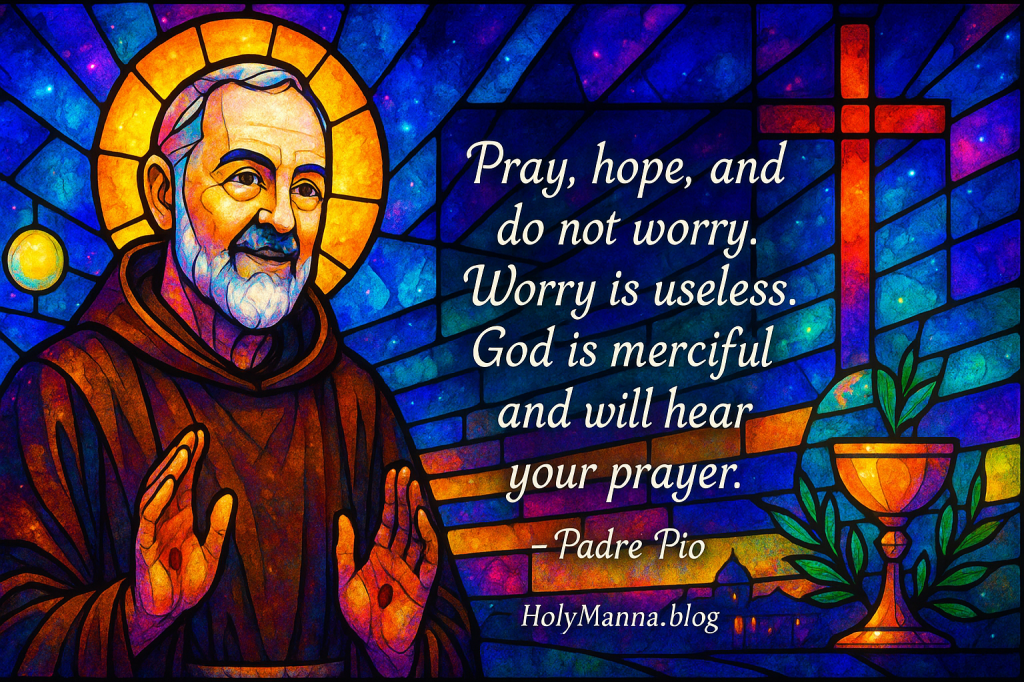
Padre Pio stands in modern Catholic memory as a living icon of the Crucified Christ, a priest wholly given to the Eucharist, reconciliation, and the relief of human suffering. He described his vocation with disarming simplicity: “I only want to be a poor friar who prays.” He spent long hours at the altar and even longer in the confessional, where he welcomed souls with fatherly firmness and tenderness. His reputation for sanctity drew pilgrims from around the world because they found in him the nearness of God, a clarity about sin and grace, and a tangible invitation to holiness. He often reminded the faithful of the primacy of prayer with the maxim that continues to console countless hearts: “Pray, hope, and do not worry. Worry is useless. God is merciful and will hear your prayer.”
The Hidden Roots of a Great Mission
Francesco Forgione was born on May 25, 1887, in Pietrelcina, a small village in southern Italy, to Grazio and Maria Giuseppa. Baptized the day after his birth, he grew in a home marked by daily prayer, hard work, and deep trust in Providence. From childhood he experienced intense love for Jesus and Mary, as well as unusual spiritual trials that later formed him for his priestly mission. At sixteen he entered the Capuchin Franciscans, receiving the name Pio. He professed solemn vows in 1907 and was ordained a priest on August 10, 1910. Because of frail health he spent seasons away from community life until obedience sent him in 1916 to the friary at San Giovanni Rotondo, where he lived until his death on September 23, 1968. There he became known not for public works or eloquence but for a life hidden in God, especially in the Holy Sacrifice of the Mass and the sacrament of Penance. He loved to teach through short, burning lines of wisdom such as “Humility is truth.” and “When you have Jesus, you have everything.” His holiness was not dramatic in its beginnings but steady, sacrificial, and rooted in daily fidelity.
Wounds for the World
On September 20, 1918, while making thanksgiving after Mass, Padre Pio received the visible stigmata, the wounds of Christ, which he bore for fifty years. He never treated this grace as a spectacle. Instead, he suffered it quietly as a deeper share in the Passion for the salvation of souls. He called the Mass his life and taught about its cosmic necessity with a line that has formed generations of Catholics: “It would be easier for the world to exist without the sun than without the Holy Mass.” He celebrated the liturgy with profound stillness and tears, inviting people to unite their crosses to Christ. In the confessional he became an instrument of divine mercy and truth, sometimes reading hearts to help penitents make a complete confession and begin anew. Testimonies from his lifetime recount physical healings, deliverance from evil, and even bilocation, always ordered to conversion and faith. He insisted that prayer is the soul’s lifeblood and counseled everyone, lay and cleric alike, “In books we seek God; in prayer we find Him. Prayer is the key which opens God’s heart.” What made his charisms fruitful was not wonder but charity, expressed in patient listening, fatherly counsel, and a relentless call to holiness.
Purified by Obedience
Padre Pio’s sanctity was tested by illness, diabolical harassment, and seasons of ecclesial scrutiny. Investigations into the phenomena surrounding him led to restrictions on his public ministry in the 1920s and early 1930s. He accepted these limitations with filial obedience, entrusting his reputation to God and the Church. His response to misunderstanding was never self defense but surrender. He advised others to do the same in their trials, assuring them, “If the soul knew the value of suffering, it would not complain.” He often explained the Christian battle with a vivid image, “The devil is like a mad dog on a chain. He can bark, he can make a lot of noise, but he can only bite if you get too close.” This realism about spiritual warfare, joined to unwavering trust in Jesus and Mary, sustained him and those who sought his guidance. Padre Pio did not die a martyr in the strict sense, yet he lived what Saint Paul calls a daily dying with Christ, pouring himself out for others until his final breath.
Mercy Made Concrete
Charity for the sick and poor took flesh in the Casa Sollievo della Sofferenza, the Home for the Relief of Suffering, which opened on May 5, 1956. Padre Pio wanted a place where cutting edge medicine and Catholic compassion met at the bedside, where every patient would be treated as Christ in disguise. He also gathered lay faithful into Padre Pio Prayer Groups that continue today, committed to Eucharistic devotion, Marian love, fidelity to the Church, and intercession for the suffering. He urged his spiritual children to serve from the heart and to anchor every work in the sacraments, confident that grace transforms ordinary lives into offerings pleasing to God.
A Mission That Grew After Death
Padre Pio passed to the Lord on September 23, 1968, leaving behind a people renewed by the sacraments and a legacy of humble holiness. After his death many reported favors and healings through his intercession. The Church examined several of these with scientific and theological rigor. Among the best known is the sudden and complete healing in 2000 of the young Matteo Pio Colella from fulminant meningitis and multiple organ failure, a grace recognized in the process that led to Padre Pio’s canonization on June 16, 2002. Pilgrims continue to flock to San Giovanni Rotondo, praying at his tomb, seeking reconciliation, and offering their sufferings in union with Christ. Padre Pio had foretold that his apostolate would not end with his earthly life. His spiritual children cherish his assurance, “After my death I will do more. My real mission will begin after my death.” The ongoing fruits of prayer, conversion, and healing among pilgrims suggest that the Lord was pleased to fulfill that promise.
Walking His Path Today
Padre Pio’s life outlines a simple and demanding path that any Christian can follow. Love the Mass and prepare for it with silence and Scripture, then live from it by making small sacrifices for love of Jesus. Go to Confession regularly, speak honestly, and do the penance with gratitude. Begin and end the day with prayer, even brief acts of trust like his beloved aspiration, “My Jesus, I love you.” Choose a concrete work of mercy for someone in need and offer it for a particular soul who is suffering. Carry trials without self pity and unite them to the Passion, remembering his counsel that suffering, accepted with love, becomes redemptive. Stay close to Our Lady with the Rosary, which he called his weapon, and keep hope alive with his evergreen reminder, “Pray, hope, and do not worry.” If you feel weak or far from God, take heart. Padre Pio’s greatness was not in being extraordinary but in saying yes to grace every day.
Engage with Us!
We would love to hear your thoughts and testimonies in the comments below. How has Padre Pio’s life, his Mass, or his confessional witness touched your own walk with Christ?
- What part of Padre Pio’s story most strengthens your hope in God’s mercy today?
- How can you make the Eucharist truly the “source and summit” of your week this month?
- When will you next go to Confession, and what grace do you most desire to receive there?
- Where is Christ inviting you to serve the suffering in your parish or city right now?
- Which of Padre Pio’s sayings will you memorize and pray with this week?
May Padre Pio intercede for us. Live your faith boldly, love with mercy, and let every action be offered with the Heart of Jesus.
Padre Pio, pray for us!
Follow us on Instagram and Facebook for more insights and reflections on living a faith-filled life.

 Holy Manna!
Leave a comment