Memorial of Saint Pius of Pietrelcina, Priest – Lectionary: 450
Building the House, Becoming the Family
The Lord gathers us today with an invitation that meets both our longing and our labor: “Let us go to the house of the Lord.” As we step toward the altar, God reveals how worship, obedience, and merciful love knit us into a living household where Christ Himself calls us family. Do you sense God asking you not only to come to His house, but to help build it with your life?
In Ezra 6:7-20, a surprising providence unfolds as foreign kings fund and protect the rebuilding of the Temple. The returned exiles complete the house, restore the priestly service, and keep Passover. This is not mere construction. It is covenant renewal in stone and sacrifice. The people reenter their identity by reentering right worship. Psalm 122 is the pilgrim’s heartbeat to this moment. Jerusalem is described as compacted unity, a city where the tribes ascend to give thanks and where justice has a throne. The psalm’s joy is not nostalgia. It is a vision for order, communion, and praise that forms a people.
In Luke 8:19-21, Jesus brings this vision to its fulfillment. When told that His mother and relatives are outside, He answers that “My mother and my brothers are those who hear the word of God and act on it.” Bloodline yields to discipleship. The family of God is gathered by hearing and doing the Word, and it is sustained at the place of worship where the Word becomes Flesh. As The Catechism teaches, the Eucharist is the “source and summit” of the Christian life (CCC 1324), and the Church is God’s household called to visible, sacred worship (CCC 1180–1181). Obedience to the Word and communion at the altar make us living stones in a Temple not made by hands (CCC 1268; 1396).
The Memorial of Saint Pius of Pietrelcina shines this theme into our century. Padre Pio spent himself at the altar and in the confessional, where the Temple of human hearts was rebuilt day after day. He summoned penitents to conversion, anchored them in the Eucharist, and fathered them into the family of God with a simple rule of trust: “Pray, hope, and don’t worry.” In him we see Ezra’s perseverance, the psalmist’s joy, and the Gospel’s criterion of kinship. Today’s readings invite us to rejoice in God’s house, to let the Word take flesh in our choices, and to allow grace to restore the ruined places within us so that Christ may recognize us as His own. Where is the Lord asking you to hear His Word, act on it, and help rebuild His dwelling in the Church and in your neighbor today?
First Reading – Ezra 6:7-8, 12, 14-20
Rebuilding the Temple, Restoring the People
The scene unfolds in the Persian period when God uses foreign rulers to shepherd His people home. After decades of exile, Israel returns to a land of rubble and memory. Under Cyrus and then Darius I, imperial decrees authorize and fund the rebuilding of the Temple in Jerusalem. This is the Second Temple, completed in the sixth year of Darius, roughly 515 BC. For Israel, this is not a mere civic project. It is the recovery of worship, identity, and covenant life. The dedication, the ordered service of priests and Levites, and the renewed celebration of Passover signal that God is rebuilding more than a building. He is rebuilding a people who live from His Word and His worship. In the light of today’s theme, obedient love builds the house of God and makes us His family. The Temple points forward to Christ’s Body and to the Church gathered in the Eucharist, where hearing and doing the Word fashions us into living stones. Are you willing to let God restore worship at the center of your life so that He can rebuild you into His household?
Ezra 6:7-8, 12, 14-20
New American Bible (Revised Edition)
7 Let the governor and the elders of the Jews continue the work on that house of God; they are to rebuild it on its former site. 8 I also issue this decree concerning your dealing with these elders of the Jews in the rebuilding of that house of God: Let these men be repaid for their expenses, in full and without delay from the royal revenue, deriving from the taxes of West-of-Euphrates, so that the work not be interrupted.
12 And may the God who causes his name to dwell there overthrow every king or people who may undertake to alter this decree or to destroy this house of God in Jerusalem. I, Darius, have issued this decree; let it be diligently executed.”
14 The elders of the Jews continued to make progress in the building, supported by the message of the prophets, Haggai and Zechariah, son of Iddo. They finished the building according to the command of the God of Israel and the decrees of Cyrus and Darius, and of Artaxerxes, king of Persia. 15 They completed this house on the third day of the month Adar, in the sixth year of the reign of King Darius. 16 The Israelites—priests, Levites, and the other returned exiles—celebrated the dedication of this house of God with joy. 17 For the dedication of this house of God, they offered one hundred bulls, two hundred rams, and four hundred lambs, together with twelve he-goats as a sin offering for all Israel, in keeping with the number of the tribes of Israel. 18 Finally, they set up the priests in their classes and the Levites in their divisions for the service of God in Jerusalem, as is prescribed in the book of Moses.
The Passover. 19 The returned exiles kept the Passover on the fourteenth day of the first month. 20 The Levites, every one of whom had purified himself for the occasion, sacrificed the Passover for all the exiles, for their colleagues the priests, and for themselves.
Detailed Exegesis
Verse 7 – “Let the governor and the elders of the Jews continue the work on that house of God; they are to rebuild it on its former site.”
Darius’ decree protects the rebuilding and affirms continuity with God’s saving plan. The Temple must rise “on its former site,” linking present obedience with God’s past fidelity. The Church reads such restorations as figures of the definitive Temple, Christ and His Body, where God dwells with His people.
Verse 8 – “I also issue this decree concerning your dealing with these elders of the Jews in the rebuilding of that house of God: Let these men be repaid for their expenses, in full and without delay from the royal revenue, deriving from the taxes of West-of-Euphrates, so that the work not be interrupted.”
Providence turns imperial resources into instruments of worship. God can move the powers of this world to serve His purposes. The phrase “so that the work not be interrupted” reveals that right worship requires sustained, concrete support. It also foreshadows the Church’s stewardship for sacred worship and works of mercy.
Verse 12 – “And may the God who causes his name to dwell there overthrow every king or people who may undertake to alter this decree or to destroy this house of God in Jerusalem. I, Darius, have issued this decree; let it be diligently executed.”
The king invokes divine protection over the Temple. “His name to dwell there” recalls the covenant promise that God’s presence sanctifies a people. The warning against destroying the house of God prefigures the gravity of desecration and the Church’s zeal for the sanctity of the liturgy.
Verse 14 – “The elders of the Jews continued to make progress in the building, supported by the message of the prophets, Haggai and Zechariah, son of Iddo. They finished the building according to the command of the God of Israel and the decrees of Cyrus and Darius, and of Artaxerxes, king of Persia.”
Prophecy and prudence work together. Haggai and Zechariah stirred hearts to finish what God commanded, while imperial decrees cleared the path. In salvation history, God’s Word animates human cooperation, joining divine command and human governance for the sake of worship.
Verse 15 – “They completed this house on the third day of the month Adar, in the sixth year of the reign of King Darius.”
A precise date seals the promise. God’s plans ripen in time. The completion in Adar, near Israel’s spring festivals, hints toward Passover’s renewal and the fresh beginning God grants His people.
Verse 16 – “The Israelites, priests, Levites, and the other returned exiles, celebrated the dedication of this house of God with joy.”
Dedication restores joy because worship restores identity. The whole assembly rejoices since the Temple is the heart of national and spiritual life. Joy is the fruit of right worship and right order before God.
Verse 17 – “For the dedication of this house of God, they offered one hundred bulls, two hundred rams, and four hundred lambs, together with twelve he-goats as a sin offering for all Israel, in keeping with the number of the tribes of Israel.”
The sacrifices proclaim atonement and communion. The twelve he-goats signify solidarity with all Israel. In the New Covenant, these sacrifices are fulfilled in Christ’s once-for-all offering, made present sacramentally in the Eucharist.
Verse 18 – “Finally, they set up the priests in their classes and the Levites in their divisions for the service of God in Jerusalem, as is prescribed in the book of Moses.”
Worship is not improvised. It is ordered according to divine revelation. The priestly and Levitical divisions echo the Church’s ministries and offices, which exist to serve the Word and the sacraments in fidelity to apostolic tradition.
Verse 19 – “The returned exiles kept the Passover on the fourteenth day of the first month.”
Passover renews the Exodus identity of God’s people. After the Temple’s dedication, Israel returns to the feast that remembers deliverance and anticipates the definitive Pasch of Christ.
Verse 20 – “The Levites, every one of whom had purified himself for the occasion, sacrificed the Passover for all the exiles, for their colleagues the priests, and for themselves.”
Purification signals readiness for holy things. The priests and Levites act for the people, prefiguring Christ the High Priest who offers Himself for all. In the Church, baptismal and penitential purification prepare us to participate worthily in the holy mysteries.
Teachings
The rebuilding of the Temple is a figure of the Church and of the Eucharistic worship that forms us into God’s family. The New Testament unveils the deeper reality of what Ezra records: “Like living stones be built into a spiritual house, to be a holy priesthood, to offer spiritual sacrifices acceptable to God through Jesus Christ.” (The First Letter of Peter 2:5). The Catechism situates this Temple typology in the Eucharist at the heart of the Church’s life: “The Eucharist is ‘the source and summit of the Christian life.’ ‘The other sacraments, and indeed all ecclesiastical ministries and works of the apostolate, are bound up with the Eucharist and are oriented toward it.’” (CCC 1324). In Christ, the sacrificial system finds its fulfillment, and the Church’s ordered worship continues that saving presence across time and cultures. Saint Augustine captures the unity of God’s plan: “The New Testament is hidden in the Old, and the Old is unveiled in the New.” The restoration of Passover in Ezra 6 foreshadows the Paschal Mystery, made present in every Mass where the Church gathers as the family who hears and does the Word. Saint Pius of Pietrelcina lived this mystery at the altar and the confessional, inviting countless souls into the rebuilt Temple of grace. His counsel remains a pastoral key to persevering obedience: “Pray, hope, and don’t worry. Worry is useless. God is merciful and will hear your prayer.”
Reflection
God rebuilds His house by rebuilding His people. He restores worship at the center so that joy, identity, and mission can flow again. Today, let the Word move you from hearing to doing. Make a concrete plan to prioritize Sunday Mass and, if possible, one weekday Mass as an offering of love. Seek reconciliation frequently so that the Lord may purify you for holy things. Offer a hidden sacrifice of time, talent, or treasure to support the Church’s worship and the poor. Read Ezra 6 prayerfully and ask the Holy Spirit to show you where the walls of prayer, mercy, and obedience need repair in your life. Where is God asking you to cooperate with His providence so that His worship does not stop in your heart or in your parish? How will you let the Eucharist become the source and summit of your week? What concrete act of obedience will you take today so that Christ will recognize you as family who hears and does the Word?
Responsorial Psalm – Psalm 122:1-5
Pilgrim Joy in the House of the Lord
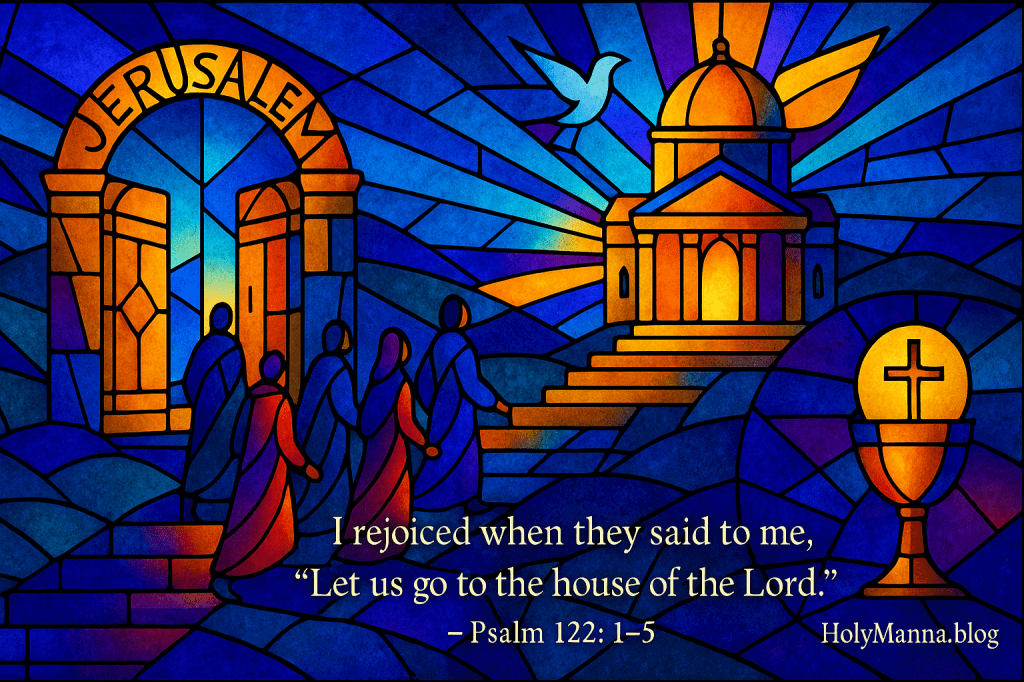
Composed as a “Song of Ascents”, Psalm 122 accompanied Israel’s festival pilgrimages to Jerusalem, the city where tribes gathered to give thanks, to hear the Law, and to be knit into one people before God. In the era recalled by Ezra 6, the Temple’s restoration made such ascent possible again and reestablished right worship at the nation’s heart. The psalm’s focus on unity, justice, and thanksgiving reveals how worship does not merely express faith. It forms a family around God’s presence. In today’s theme, obedient love builds the house of God and makes us His family. This psalm voices the interior joy of those who hear God’s call and act on it by going up to His house, a movement fulfilled for us in the Church’s liturgy where Christ gathers His brothers and sisters at the Eucharistic altar. Will you let this pilgrim song reorder your week so that worship becomes the center from which your life flows?
Psalm 122:1-5
New American Bible (Revised Edition)
A Pilgrim’s Prayer for Jerusalem
1 A song of ascents. Of David.
I rejoiced when they said to me,
“Let us go to the house of the Lord.”
2 And now our feet are standing
within your gates, Jerusalem.
3 Jerusalem, built as a city,
walled round about.
4 There the tribes go up,
the tribes of the Lord,
As it was decreed for Israel,
to give thanks to the name of the Lord.
5 There are the thrones of justice,
the thrones of the house of David.
Detailed Exegesis
Verse 1 – “I rejoiced when they said to me, ‘Let us go to the house of the Lord.’”
The psalm opens with communal invitation and interior joy. The “house of the Lord” is the Temple, the locus of God’s name and presence. Joy springs from obedience that moves feet toward worship. For Christians, this anticipates our ascent to the Eucharist where Christ Himself is our Temple and our Pasch.
Verse 2 – “And now our feet are standing within your gates, Jerusalem.”
Arrival shifts longing into presence. Standing “within your gates” signals entry into covenant space where God rules and blesses. Liturgically, to step into the church is to cross into sacred time and place where heaven touches earth.
Verse 3 – “Jerusalem, built as a city, walled round about.”
The city’s compact unity mirrors the people’s vocation to communion. The strong, well-joined structure images the Church as a spiritual house of living stones. Stability in worship safeguards unity in faith and charity.
Verse 4 – “There the tribes go up, the tribes of the Lord, As it was decreed for Israel, to give thanks to the name of the Lord.”
Pilgrimage is commanded so that gratitude may be formed in the people. Thanksgiving is not a feeling but an obedient ascent that culminates in sacrificial praise. In the New Covenant, the Eucharist is our thanksgiving, uniting all the baptized as one tribe in Christ.
Verse 5 – “There are the thrones of justice, the thrones of the house of David.”
Worship and justice meet in Jerusalem. The Davidic throne symbolizes right judgment flowing from God’s presence. Authentic liturgy shapes a people who act justly because they live under God’s reign.
Teachings
The Church recognizes in Psalm 122 the pattern of Christian worship as a pilgrimage into communion. The Catechism teaches: “A church, ‘house of prayer in which the Eucharist is celebrated and reserved, where the faithful assemble, and where is worshiped the presence of the Son of God our Savior, offered for us on the sacrificial altar for the help and consolation of the faithful’ … This house ought to be in good taste and a worthy place for prayer and sacred ceremonial.” (CCC 1181). The Eucharist itself is the summit of this ascent: “The Eucharist is ‘the source and summit of the Christian life.’ ‘The other sacraments, and indeed all ecclesiastical ministries and works of the apostolate, are bound up with the Eucharist and are oriented toward it.’ For in the blessed Eucharist is contained the whole spiritual good of the Church, namely Christ himself, our Pasch.” (CCC 1324). Our worship on earth already participates in the worship of heaven: “In the earthly liturgy we share in a foretaste of that heavenly liturgy which is celebrated in the holy city of Jerusalem toward which we journey as pilgrims.” (CCC 1090). Saint Augustine voices the pilgrim heart that longs for God’s house: “You have made us for yourself, O Lord, and our heart is restless until it rests in you.” Saint Pius of Pietrelcina lived this psalm with Eucharistic intensity and pastoral zeal, guiding souls to the altar and to reconciliation with the assurance: “Pray, hope, and don’t worry. Worry is useless. God is merciful and will hear your prayer.”
Reflection
Let this psalm tune your steps for the week ahead. Resolve to make your parish church the axis of your time through Sunday Mass and, when possible, a weekday liturgy. Arrive early enough to recollect your heart and to intercede for unity and justice in your community. Practice Eucharistic thanksgiving by naming three concrete graces at the end of each day and offering them back to God. Seek reconciliation promptly when you fall so that your feet may again stand within the Lord’s gates with joy. How will you reorder your calendar so that going to the house of the Lord is the first appointment you keep? Where is God inviting you to let worship shape your pursuit of justice this week? What gratitude will you carry to the altar, and whom will you invite to come and rejoice with you?
Holy Gospel – Luke 8:19-21
Hearing and Doing
In the heart of Galilee’s crowded ministry, the Holy Family arrives but cannot reach Jesus because the multitude presses in. Luke’s language reflects Semitic usage in which “brothers” denotes close relatives, not necessarily children of the same mother, which safeguards the Church’s constant confession of Mary’s perpetual virginity while keeping the narrative’s family setting. Jesus uses this moment to unveil a deeper bond than blood. True kinship with Him is forged by hearing the Word of God and acting upon it. This does not diminish Mary. It magnifies her, since Luke has already shown her as the first and perfect hearer and doer of the Word. In today’s theme, obedient love builds the house of God and makes us His family. The Gospel shows that entry into this family is not by ancestry but by obedience that blossoms in worship and charity, the same obedience that animated Saint Pius of Pietrelcina as he formed spiritual sons and daughters at the altar and in the confessional. Will you let Jesus’ Word define your deepest relationships and reorder your loyalties toward the Father’s will?
Luke 8:19-21
New American Bible (Revised Edition)
19 Then his mother and his brothers came to him but were unable to join him because of the crowd. 20 He was told, “Your mother and your brothers are standing outside and they wish to see you.” 21 He said to them in reply, “My mother and my brothers are those who hear the word of God and act on it.”
Detailed Exegesis
Verse 19 – “Then his mother and his brothers came to him but were unable to join him because of the crowd.”
The presence of Mary anchors the scene in real family ties while the obstructing crowd creates dramatic tension. Theologically, the crowd symbolizes all who seek access to Jesus. Mary’s nearness manifests her persevering discipleship. The mention of “brothers” in the Semitic sense of kin underscores that natural bonds are honored but about to be transcended by grace.
Verse 20 – “He was told, ‘Your mother and your brothers are standing outside and they wish to see you.’”
The messenger’s report invites a public teaching moment. “Standing outside” hints at the spatial metaphor Luke uses to move hearers from mere curiosity to committed discipleship. To “see” Jesus, in Luke’s Gospel, is often a sign of faith that must mature into obedience.
Verse 21 – “He said to them in reply, ‘My mother and my brothers are those who hear the word of God and act on it.’”
Jesus redefines family around the obedience of faith. Hearing and doing are inseparable. The Lord is not distancing Himself from Mary. He is identifying what makes her truly blessed. She is mother in the flesh and the first among the blessed because she perfectly receives and fulfills God’s Word. The criterion of kinship is discipleship that incarnates the Word in deeds, which prepares us to be gathered as one family in worship.
Teachings
The Church names this response “the obedience of faith.” The Catechism teaches: “To obey (from the Latin ob-audire, to ‘hear or listen to’) in faith is to submit freely to the word that has been heard, because its truth is guaranteed by God, who is Truth itself.” (CCC 144). This obedience flowers at the altar where the Word made flesh binds us into one family. The Catechism affirms: “The Eucharist is ‘the source and summit of the Christian life.’ ‘The other sacraments, and indeed all ecclesiastical ministries and works of the apostolate, are bound up with the Eucharist and are oriented toward it.’ For in the blessed Eucharist is contained the whole spiritual good of the Church, namely Christ himself, our Pasch.” (CCC 1324). Regarding Mary, the Church confesses her exemplary discipleship: “By her complete adherence to the Father’s will, to his Son’s redemptive work, and to every prompting of the Holy Spirit, the Virgin Mary is the Church’s model of faith and charity.” (CCC 967). The saints echo this primacy of the Word. Saint Jerome insists, “Ignorance of the Scriptures is ignorance of Christ.” Saint Pius of Pietrelcina translates hearing into trustful action with pastoral clarity: “Pray, hope, and don’t worry. Worry is useless. God is merciful and will hear your prayer.”
Reflection
Let Jesus’ definition of family shape your week. Begin each day by placing yourself in the Lord’s presence with a brief, attentive reading of the Gospel and a concrete resolution to live one truth you have heard. Ask the Blessed Virgin Mary to intercede for a heart that listens and obeys as hers did. Examine your loyalties and your calendar to ensure that Sunday Mass and time for personal prayer receive your first and best attention. Seek reconciliation promptly when you fail so that the Word may again be free to bear fruit in you. Where is the Lord inviting you to move from hearing to doing today? What relationship or decision needs to be reordered by the Father’s will so that you may belong to Jesus’ family more fully? How will you let the Eucharist gather your week into obedient love for God and neighbor?
Gathered, Built, and Sent
Today the Word shows us how God rebuilds His house and forms His family. In Ezra 6, the Temple rises again, priests and Levites take their places, and Passover is renewed. Worship restores identity and joy. Psalm 122 gives that joy a voice as pilgrims enter the holy city with the cry, “Let us go to the house of the Lord.” In Luke 8:19-21, Jesus reveals the deepest kinship of all when He says, “My mother and my brothers are those who hear the word of God and act on it.” The Memorial of Saint Pius of Pietrelcina brings this pattern into our lives today. At the altar and in the confessional he helped rebuild souls into living stones of the Church, encouraging us with his simple trust, “Pray, hope, and don’t worry.”
The path forward is clear and grace filled. Let the Eucharist be your center, since it is the source and summit of the Christian life as taught in CCC 1324. Entrust your heart to Christ through faithful Sunday Mass, a renewed habit of daily Scripture, and sincere reconciliation when you fall. Offer concrete acts of charity that make worship visible in love. Support your parish so that the work of God does not stop in your community. Ask the Blessed Virgin Mary to help you hear and do the Word as she did, so that Jesus may recognize you as His own.
Step toward the Lord this week with a pilgrim’s joy. Bring your family, your friends, and your struggles to the house of God. Let Him rebuild what is broken and send you as a living sign of His mercy. What one act of obedience to the Word will you take today so that your life proclaims, with joy, that you belong to the family of God?
Engage with Us!
We would love to hear your reflections in the comments below. Share what the Holy Spirit stirred in your heart as you prayed with today’s readings and the Memorial of Saint Pius of Pietrelcina.
- First Reading: Ezra 6:7-8, 12, 14-20. Where is the Lord inviting you to let Him rebuild worship at the center of your life? What concrete step can you take this week to support the Church’s prayer and the works of mercy in your parish? How might the renewal of Passover in this passage shape the way you approach the Eucharist?
- Responsorial Psalm: Psalm 122:1-5. What does it look like for your feet to “stand within the Lord’s gates” in your daily schedule? How can your worship lead to greater unity and justice in your family, workplace, or neighborhood? Whom is God prompting you to invite to the house of the Lord next Sunday?
- Holy Gospel: Luke 8:19-21. Where is Jesus calling you to move from hearing to doing the Word today? What relationship or decision needs to be reordered so that you belong more fully to His family? How will you ask Mary’s intercession to listen and obey as she did?
Go in peace, live a life of faith, and let every word and action be offered with the love and mercy that Jesus taught us.
Sacred Heart of Jesus, we trust in You!
Immaculate Heart of Mary, pray for us!
Saint Michael the Archangel, defend us in battle!
Follow us on Instagram and Facebook for more insights and reflections on living a faith-filled life.

 Holy Manna!
Leave a comment