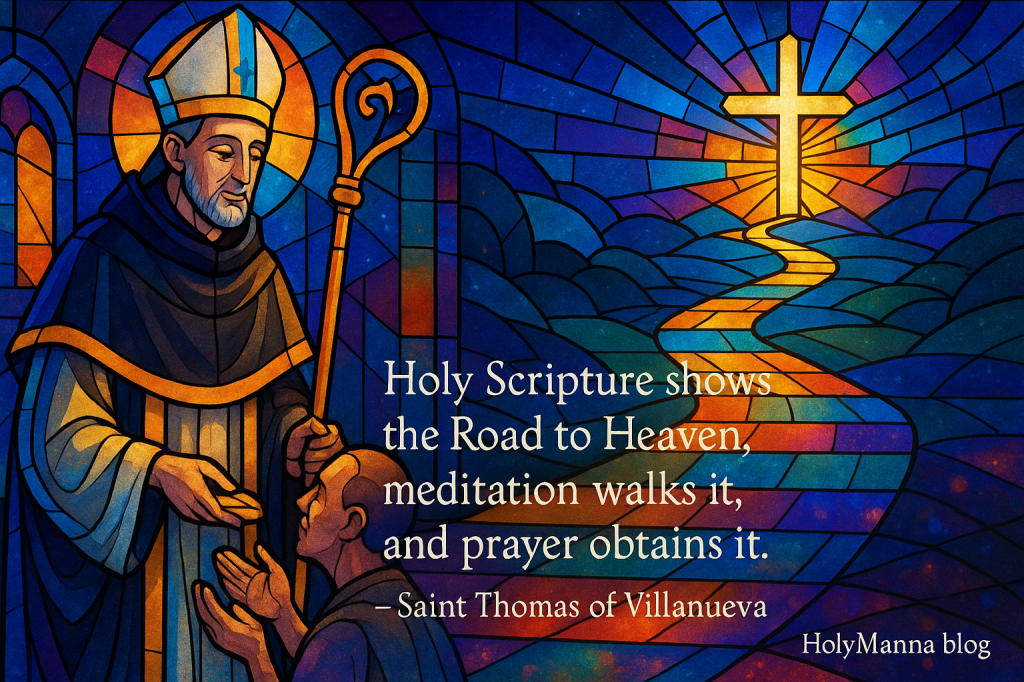
A Shepherd After the Heart of Christ
Saint Thomas of Villanueva was a sixteenth century Augustinian friar and the reforming Archbishop of Valencia whose preaching, austere life, and tireless administration for the poor earned him the enduring title Father of the Poor. He embodied the Church’s preferential love for the needy taught in the Catechism of the Catholic Church (CCC 2443 to 2449; 2447), and he exercised the episcopal office as service in the spirit described by the Catechism (CCC 893; 1551). His holiness was not only personal piety but a concrete, organized charity that transformed a diocese. Many short sayings circulating online are misattributed to him, and reliable brief, verified quotations in standard English anthologies are scarce; yet his recorded actions and homiletic themes consistently proclaim the Gospel of mercy and justice.
Roots of Mercy in Castile
Thomas was born in 1488 in Fuentellana in the region of Castile and grew up in nearby Villanueva de los Infantes, the town from which he takes his surname. His parents practiced regular almsgiving, and this rhythm of family charity formed his conscience early. Gifted intellectually, he entered the University of Alcalá as a teenager and distinguished himself in the arts and in theology, eventually teaching philosophy and logic. The hunger for deeper union with Christ drew him to the Order of Saint Augustine in 1516, where he embraced a life of prayer, study, and evangelical poverty. He was ordained a priest in 1518 and soon became a sought after preacher, known for sermons that united doctrinal clarity with piercing appeals to conversion. Within the Augustinian family he taught theology and served as prior in several houses, shaping younger friars by word and example. His reputation for integrity led Emperor Charles V to call him to preach and advise at court, though Thomas always preferred the cloister and the pulpit to the intrigues of power. What he is most known for is a relentless commitment to the poor, an insistence that authentic devotion must take flesh in works of mercy, and a humble lifestyle that kept him personally close to those he served.
Charity That Looks Like Good Governance
When Thomas became Archbishop of Valencia in 1544, he approached the office as a charge to shepherd souls and rebuild broken structures. He undertook a thorough visitation of parishes, convoked a diocesan synod to correct abuses, and insisted on sound preaching and catechesis so that the faith would be intelligible and compelling. He rebuilt the city hospital after a devastating fire and established a foundling home next to his residence to welcome infants abandoned in distress. He arranged for early morning Masses so that laborers could worship before work, provided chaplains for the sick and imprisoned, and set up a system of district almoners whose mission was to search out the ashamed poor who would never come to the chancery doors. Each day hundreds of people received food from his household. He founded colleges to form clergy and laity, anticipating the seminary vision later articulated at Trent, because he knew that durable charity requires well formed hearts and minds. Accounts from his contemporaries also speak of graces that accompanied his ministry, including healings and providential multiplications of food for those who arrived at his door. He did not seek marvels. He preferred to vanish behind Christ’s mercy, living simply, patching his own habit, and investing diocesan resources in people rather than finery. His life taught that the corporal and spiritual works of mercy named in the Catechism are not optional extras but the shape of Christian love itself (CCC 2447).
The Weight of Reform and a Holy Passing
Thomas did not suffer martyrdom, yet he knew real trials. Reform demands prudence and courage, and he faced criticism from those who preferred custom to conversion as well as the constant exhaustion that accompanies rebuilding a neglected local Church. He bore ill health with patience and continued preaching and visiting as strength allowed. Near the end he gave away what little remained to the poor and asked that his own comforts be used for those who had none. He died in Valencia on September 8, 1555, after offering Mass, commending his flock to the mercy of God. Tradition remembers him insisting that even in death he wished to keep nothing back from the poor, a final homily in silence that matched the content of a lifetime of preaching.
Graces Flowing From a Bishop’s Tomb
After his death, devotion to Thomas spread quickly. The faithful sought his intercession for healings and temporal needs, and early hagiographical accounts record favors obtained at his tomb. His memory became a school of mercy for clergy and laity, inspiring charitable confraternities, hospitals, and educational works that bore his name or took their spirit from his example. The Church recognized the heroism of his virtue with beatification in 1618 and canonization in 1658. His feast is kept on September 22, and his relics continue to be honored in Valencia, where pilgrims give thanks for graces received and ask to learn the generous discipline of love he lived so well.
Learning His Rhythm of Love
Saint Thomas of Villanueva shows modern disciples how to make love of neighbor strategic and sustainable. He prayed, preached, taught, and then built structures that dignified the poor. He lived what the Catechism teaches when it calls the Eucharist the source and summit of the Church’s life (CCC 1324), because his liturgical worship overflowed into concrete service. We can imitate him by praying before we plan, by forming our minds in the faith, and by giving in ways that respect the person in need. We can examine our homes and parishes and ask what can be repurposed for mercy, which schedule adjustments would allow us to serve more consistently, and how our budgets can reflect the priorities of the Kingdom. His example encourages bishops and priests to govern as stewards of grace and urges lay people to see themselves as co workers of the truth in every sphere of culture. If a memorable one liner from his pen is hard to document, the lasting quotation is his life itself, which reads like a Gospel commentary written in bread, shelter, formation, and friendship.
Engage with Us
I would love to hear how Saint Thomas of Villanueva speaks to your walk with Christ. What stirred you most, and where is the Lord inviting you to act today?
- Where is Christ asking me to organize my charity so that it lifts people with dignity rather than offering only momentary relief?
- How can my parish more intentionally live the works of mercy in our neighborhood this month, beginning with one simple initiative?
- What concrete step will I take this week to place the Eucharist at the center of my decisions about time, talent, and treasure?
- In what ways do I need to simplify my lifestyle so that others might be fed, clothed, or sheltered through my sacrifice?
May the intercession of Saint Thomas of Villanueva make us generous, creative, and joyful in mercy, so that in all things we live by faith and do everything with the love and tenderness that Jesus taught us.
Saint Thomas of Villanueva, pray for us!
Follow us on Instagram and Facebook for more insights and reflections on living a faith-filled life.

 Holy Manna!
Leave a comment