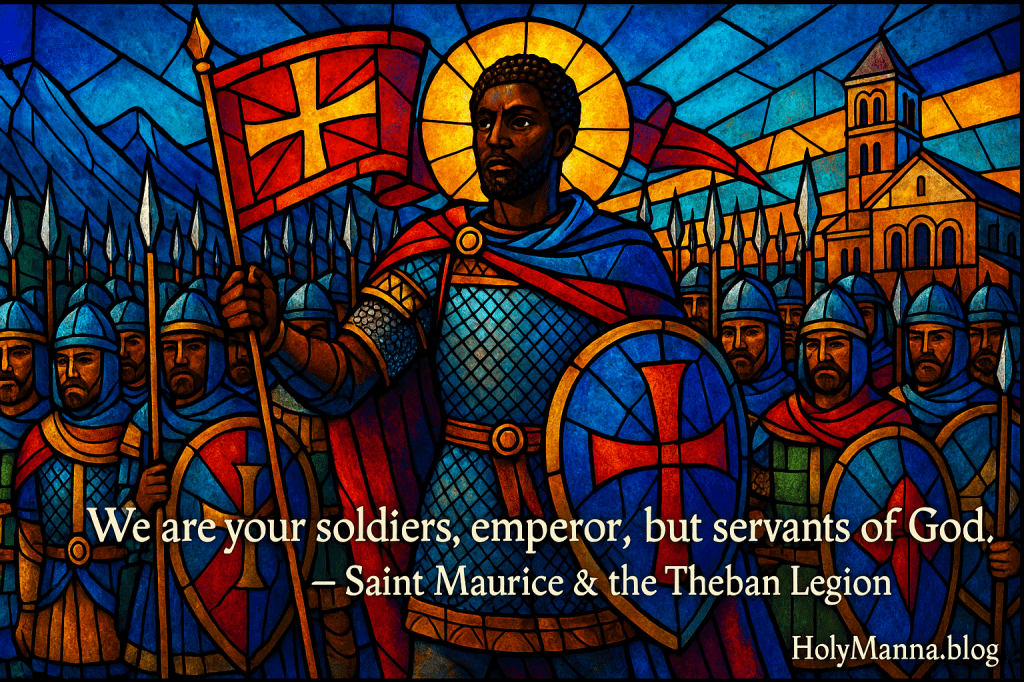
A Banner of Conscience
Saint Maurice, the commander of the Theban Legion, stands as one of the Church’s clearest witnesses to the unity of faith and justice. He is remembered not for military victories, but for a courageous refusal to violate the Gospel by participating in idolatry or in violence against innocent Christians. His choice cost him his life and the lives of many of his soldiers, yet his witness became a lamp for the whole Church. The Catechism teaches that martyrdom is the summit of Christian testimony: “Martyrdom is the supreme witness given to the truth of the faith. It means bearing witness even unto death.” This is why the Church venerates Maurice as a model of rightly formed conscience and fortitude, a saint for soldiers, leaders, and every disciple who must choose Christ when it is costly.
The Soldier Who Would Not Kill the Innocent
Ancient tradition locates Maurice’s origins in Roman Egypt, associated with Thebes, a region with a strong and early Christian presence. He rose within the imperial army and came to command a full legion of soldiers known as the Thebans, many of whom were Christians. When imperial authority ordered sacrifices to the gods and demanded participation in actions that targeted fellow Christians, Maurice and his men refused. Their refusal was not rebellion for its own sake. It was obedience to the first commandment and to the command of charity. Christian soldiers could render to Caesar what belonged to Caesar, but they could not offer worship to idols or shed innocent blood. In the tension between duty and discipleship, Maurice chose fidelity to Jesus Christ, and his men stood with him.
A Commander’s Holiness in the Ranks
Accounts of Maurice’s life portray a commander whose authority flowed from integrity and prayer. He formed his men to be disciplined, brave, and just, reminding them that military service must be governed by the law of Christ. There are no reliably documented miracles performed by Saint Maurice during his lifetime. The sign he gave was the moral miracle of a conscience that would not be purchased by fear or rewards. No verified personal sayings of Saint Maurice survive in the historical record. What endures is the substance of his witness: a Christian leader who accepted suffering rather than break faith with God. The Catechism calls this the virtue of fortitude, by which the disciple remains constant in the pursuit of the good. “Fortitude ensures firmness in difficulties and constancy in the pursuit of the good. It strengthens the resolve to resist temptations and to overcome obstacles in the moral life.” In that strength, Maurice shepherded his legion to the very threshold of heaven.
Decimation and the Crown of Witness
The emperor’s response to the Thebans’ refusal was severe. Tradition recounts that the legion was subjected to decimation, a brutal punishment in which one of every ten soldiers was put to death, employed as a terror to force compliance. When Maurice and his companions persisted in their fidelity, a final order was given for execution near Agaunum in the Alps, usually dated to the years around 285 to 290. The Roman Martyrology honors Maurice with several named companions, including Exsuperius, Candidus, Victor, Innocent, and Vitalis, commemorating their heavenly birthday on September 22. Their martyrdom has never been celebrated as an act of political defiance, but as a clear lesson in Christian obedience. When human commands contradict the divine law, the Christian must follow God. The Catechism teaches the same principle for every age: “The citizen is obliged in conscience not to follow the directives of civil authorities when they are contrary to the demands of the moral order.”
Graces From Agaunum
After the execution of Maurice and his men, devotion to the Theban martyrs grew at the site of their sacrifice. Pilgrims came to Agaunum to venerate their graves and to ask for their intercession. Early Christian writers recorded favors received through their prayers, and the shrine quickly became a place of consolation for the afflicted and encouragement for those facing trials. While specific healings from that earliest period are not cataloged with modern precision, the enduring memory of answered prayers and spiritual assistance shaped the Church’s devotion for centuries. The fruit of their intercession could be seen in conversions, reconciliations, and the strengthening of believers who faced persecution of many kinds. The Catechism reminds us why such memories matter to the Church: “The Church has painstakingly collected the records of those who persevered to the end in witnessing to their faith.” The history of Agaunum is one such record of grace at work through the communion of saints.
Song Without Ceasing
On the ground where the legion fell, King Sigismund of Burgundy founded the Abbey of Saint-Maurice in the year 515. The abbey became renowned for perpetual praise, the laus perennis, where choirs of monks continued the psalms in an unbroken stream of prayer for the Church and the world. Across fifteen centuries the abbey has treasured the memory of the Theban martyrs, preserved their relics with reverence, welcomed pilgrims, cared for sacred art, and kept alive a tradition of worship that binds earth to heaven. That uninterrupted witness has made Saint-Maurice one of the most venerable monastic centers in the West and a living torch of the martyrs’ faith.
From Abbey to Empire
The veneration of Saint Maurice spread widely through the Alps and beyond. Rulers, knights, and commoners invoked his patronage, seeing in him the model of a soldier who served justice rather than cruelty. The tradition of the Sword of Saint Maurice in imperial regalia symbolized the truth that authority must be under God. In Christian art, Maurice is frequently depicted as a Black African knight, most famously in the thirteenth-century statue at Magdeburg Cathedral. That portrayal testifies to the universality of the Gospel and the Church’s embrace of every people and tongue. It also reminds Christians that sanctity is not the special inheritance of one culture but the calling of all nations. Through images, processions, and local patronage, Maurice shaped Christian imagination about courage, service, and the right use of power.
Courage That Conquers Fear
Saint Maurice places before us the luminous harmony of obedience and freedom. He obeyed his superiors where conscience allowed, and he stood free in Christ where conscience must not yield. That same pattern can direct our choices at work, in family life, and in civic responsibilities. When convenience tempts us away from integrity, Maurice asks us to return to prayer and to choose the good even when it costs us something. The Catechism calls this the way of fortitude that resists temptation and endures trial. “It enables one to conquer fear, even fear of death, and to face trials and persecutions.” You may not face an executioner, but you can offer daily martyrdoms of patience, honesty, purity, and charity. You can refuse gossip, defend the weak, speak truth without cruelty, and forgive as you have been forgiven. If you keep your eyes on Christ, you will find the strength to serve without compromising the Gospel.
Engage with Us!
We would love to hear your thoughts and prayers in the comments.
- Where do you face pressure to “go along” with something that does not align with the Gospel, and how might Saint Maurice’s example strengthen your resolve today?
- How does “We must obey God rather than men” challenge or comfort you in your current vocation as parent, student, leader, or friend?
- What would “perpetual praise” look like in your life this week, inspired by the laus perennis of Agaunum?
- How can you protect the vulnerable in your community with courage and charity rather than outrage or apathy?
Keep going. Stay faithful. Let every choice be shaped by the love and mercy Jesus taught us.
Saint Maurice & the Theban Legion, pray for us!
Follow us on Instagram and Facebook for more insights and reflections on living a faith-filled life.

 Holy Manna!
Leave a comment