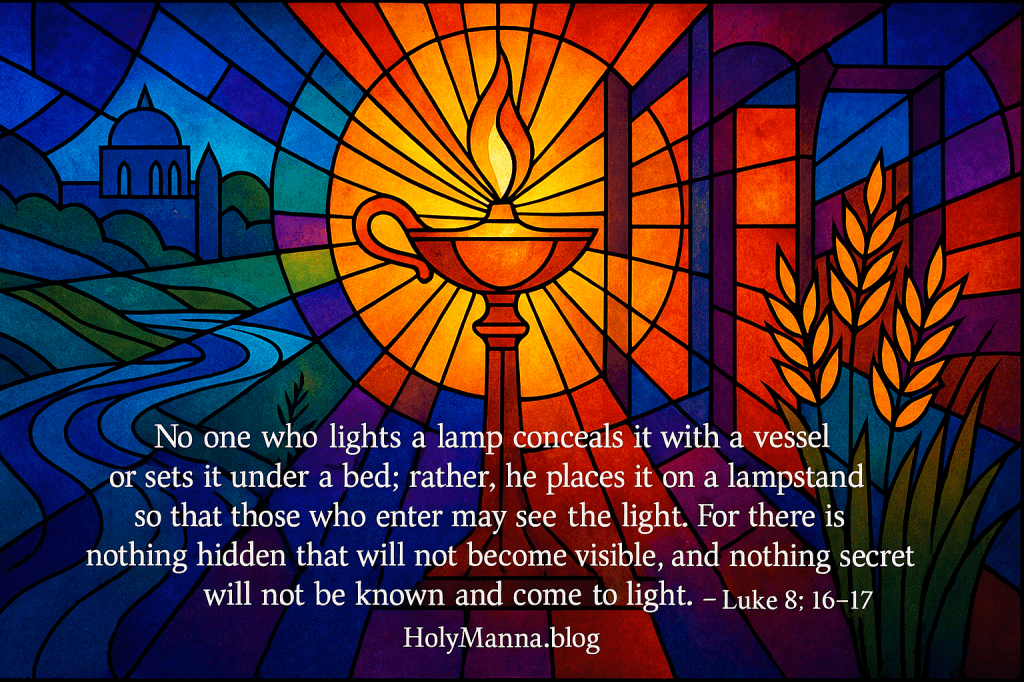
Monday of the Twenty-fifth Week in Ordinary Time – Lectionary: 449
Return, Rebuild, and Radiate
God’s mercy does not only bring us home. It gives us a mission. In Ezra 1:1-6 the living God moves the heart of a foreign king so that His people may return and rebuild His house in Jerusalem. Exiles become builders as neighbors supply silver and gold, and the Lord turns a scattered remnant into a worshipping people once more. Psalm 126 is the song of that homecoming. What began in dust and tears becomes laughter and harvest, the testimony of a people whose restoration is so visible that the nations say, “The Lord had done great things for them.” In Luke 8:16-18 Jesus completes the arc. Restoration is not meant to be hidden within private comfort. Grace is a lamp that belongs on a stand, “so that those who enter may see the light.” The movement is clear. God restores us to rebuild His worship and to radiate His presence before the world.
Historically, this day’s readings gather us in the early Persian period when Cyrus permitted Judean exiles to return and begin the Second Temple. Culturally, Psalm 126 echoes the pilgrim ascent to Zion and the shock of joy that follows long sorrow. Religiously, Jesus speaks into ordinary households where a single lamp could illumine an entire room. The image is simple and searching. Rebuilt worship must blossom into public witness. As The Catechism teaches, “The disciple of Christ must not only keep the faith and live on it, but also profess it, confidently bear witness to it, and spread it.” CCC 1816. The Church herself is called to be the visible sign of God’s saving plan, a people gathered for right worship and sent for radiant proclamation CCC 748 to 752, 2105. Where is the Lord asking you today to help rebuild His house in hearts and habits, and to place your lamp where others can see the light?
First Reading – Ezra 1:1-6
From Exile to Builders of the House of God
The opening of Ezra 1:1-6 stands at a hinge point of salvation history. In the first year of Cyrus the Great, around 538 B.C., God uses a Gentile emperor to release the Judean exiles and commission the rebuilding of the Jerusalem Temple. Persian policy often favored the restoration of local shrines for political stability, yet Ezra insists that this turning of the imperial heart is the work of the Lord who keeps His promises. The reference to the word spoken by Jeremiah recalls the promised end of exile and the return to the land, the people, and the worship of God. Culturally, the call for silver, gold, goods, and livestock reflects the concrete, communal cost of worship and the public nature of Israel’s religion. Religiously, the return is not merely geographic. It is liturgical. God restores His people so that the nations may see His glory in a rebuilt house and in a rejoicing people. In light of today’s theme of restoration for mission, this passage shows that grace does not end with comfort. It begins a new chapter of obedient rebuilding that will finally shine as a lamp for all to see, preparing our hearts to place the light on a stand, as in Luke 8:16-18, and to sing with Psalm 126 that the Lord has done great things.
Ezra 1:1-6
New American Bible (Revised Edition)
The Decree of Cyrus. 1 In the first year of Cyrus, king of Persia, in order to fulfill the word of the Lord spoken by Jeremiah, the Lord stirred up the spirit of Cyrus king of Persia to issue a proclamation throughout his entire kingdom, both by word of mouth and in writing: 2 “Thus says Cyrus, king of Persia: ‘All the kingdoms of the earth the Lord, the God of heaven, has given to me, and he has charged me to build him a house in Jerusalem, which is in Judah. 3 Those among you who belong to any part of his people, may their God be with them! Let them go up to Jerusalem in Judah to build the house of the Lord the God of Israel, that is, the God who is in Jerusalem. 4 Let all those who have survived, in whatever place they may have lived, be assisted by the people of that place with silver, gold, goods, and livestock, together with voluntary offerings for the house of God in Jerusalem.’”
5 Then the heads of ancestral houses of Judah and Benjamin and the priests and Levites—everyone, that is, whose spirit had been stirred up by God—prepared to go up to build the house of the Lord in Jerusalem. 6 All their neighbors gave them help in every way, with silver, gold, goods, livestock, and many precious gifts, besides all their voluntary offerings.
Detailed Exegesis
Verse 1 – “In the first year of Cyrus, king of Persia, in order to fulfill the word of the Lord spoken by Jeremiah, the Lord stirred up the spirit of Cyrus king of Persia to issue a proclamation throughout his entire kingdom, both by word of mouth and in writing.”
God is the prime mover of history. The verb “stirred up” reveals divine initiative working through political events. The mention of Jeremiah frames the return as fulfillment, not accident. God’s providence is personal and purposive. The written and spoken proclamation underscores the public dimension of salvation. This is a restoration to be seen and heard.
Verse 2 – “Thus says Cyrus, king of Persia: ‘All the kingdoms of the earth the Lord, the God of heaven, has given to me, and he has charged me to build him a house in Jerusalem, which is in Judah.’”
Cyrus acknowledges the “God of heaven”, a title common in postexilic writings and compatible with Persian religious language, yet here it confesses Israel’s God as sovereign over kings. The charge to “build him a house” places worship at the center. The true end of political favor is the glory of God.
Verse 3 – “‘Those among you who belong to any part of his people, may their God be with them! Let them go up to Jerusalem in Judah to build the house of the Lord the God of Israel, that is, the God who is in Jerusalem.’”
“Let them go up” evokes pilgrimage language and the ascent to Zion. The blessing “may their God be with them” frames the return as divine companionship, not mere permission. The repetition “build the house of the Lord” drives home the priority of liturgy and covenant identity.
Verse 4 – “‘Let all those who have survived, in whatever place they may have lived, be assisted by the people of that place with silver, gold, goods, and livestock, together with voluntary offerings for the house of God in Jerusalem.’”
Restoration requires solidarity. Those who do not return still participate through material support. Worship is never a private project. It is a shared sacrifice. “Voluntary offerings” show that love, not compulsion, funds the rebuilding. This anticipates the Church’s stewardship for the mission of God.
Verse 5 – “Then the heads of ancestral houses of Judah and Benjamin and the priests and Levites, everyone, that is, whose spirit had been stirred up by God, prepared to go up to build the house of the Lord in Jerusalem.”
Leadership and laity respond together. The same Spirit who moved a king now moves a remnant. Vocation is communal and ordered. Priests and Levites point to the restoration of sacrificial worship. The verb “prepared” signals intentional readiness, not impulsive zeal.
Verse 6 – “All their neighbors gave them help in every way, with silver, gold, goods, livestock, and many precious gifts, besides all their voluntary offerings.”
Neighbors become partners. God’s providence supplies means as well as mission. The abundance gestures toward Psalm 126. Those who sowed in tears now move toward a harvest of joy. The generosity of many hands lifts the lamp high for all to see.
Teachings
The rebuilding of the Temple prefigures the mystery of the Church as God’s house and the believer as a living stone. 1 Peter 2:5 declares, “Like living stones, let yourselves be built into a spiritual house to be a holy priesthood to offer spiritual sacrifices acceptable to God through Jesus Christ.” The movement from exile to worship becomes, in Christ, the transformation of sinners into a visible dwelling for God. The grace that stirs hearts must become public witness. The Catechism teaches, “The disciple of Christ must not only keep the faith and live on it, but also profess it, confidently bear witness to it, and spread it: ‘All however must be prepared to confess Christ before men and to follow him along the way of the Cross, amid the persecutions which the Church never lacks.’ Service of and witness to the faith are necessary for salvation: ‘So every one who acknowledges me before men, I also will acknowledge before my Father who is in heaven; but whoever denies me before men, I also will deny before my Father who is in heaven.’” CCC 1816. The social dimension of worship is likewise affirmed: “The duty of offering God genuine worship concerns man both individually and socially.” CCC 2105. The Church is constituted to be seen, a city on a hill, so that the nations may say, as in Psalm 126, that the Lord has done great things.
Reflection
God still stirs hearts to go up and build. Perhaps the ruins are not stones in Jerusalem but habits, parishes, families, and friendships that need the mortar of prayer and the timber of charity. Restoration starts where we are and moves outward with visible love. Choose one concrete way to support the house of God today. Offer time for your parish. Contribute generously to a mission. Encourage a friend back to the sacraments. Place the lamp of grace where it will illumine others. Where is the Lord inviting you to prepare, to rise, and to help rebuild His house in your corner of the world? What voluntary offering of time, talent, or treasure will place your lamp on the stand today so that others may see the light?
Responsorial Psalm – Psalm 126
The Joy That the World Can See
Psalm 126 rises from the moment of homecoming after the Babylonian exile and it belongs to the collection called the Songs of Ascents, pilgrim prayers likely sung as Israel went up to Jerusalem for the great feasts. Historically it remembers the return catalyzed by the decree of Cyrus that we saw in Ezra 1:1-6. Culturally it speaks the language of the land with images of dried southern riverbeds that suddenly surge with water after seasonal rains. Religiously it is a liturgy of memory and hope, a communal thanksgiving that becomes a petition for ongoing restoration. In the flow of today’s theme, the psalm teaches that God’s restoration is not private consolation. It is a public sign that the nations can see and a seed of mission that must be sown with trust until joy ripens into a visible harvest.
Psalm 126
New American Bible (Revised Edition)
The Reversal of Zion’s Fortunes
1 A song of ascents.
When the Lord restored the captives of Zion,
we thought we were dreaming.
2 Then our mouths were filled with laughter;
our tongues sang for joy.
Then it was said among the nations,
“The Lord had done great things for them.”
3 The Lord has done great things for us;
Oh, how happy we were!
4 Restore our captives, Lord,
like the dry stream beds of the Negeb.
5 Those who sow in tears
will reap with cries of joy.
6 Those who go forth weeping,
carrying sacks of seed,
Will return with cries of joy,
carrying their bundled sheaves.
Detailed Exegesis
Verse 1 – “When the Lord restored the captives of Zion, we thought we were dreaming.”
The restoration is God’s work from the first word to the last. The return feels like a dream because grace outstrips human calculation. The memory of deliverance steadies present faith. The community remembers in order to hope again.
Verse 2 – “Then our mouths were filled with laughter; our tongues sang for joy. Then it was said among the nations, ‘The Lord had done great things for them.’”
Joy is not muted. It bursts into laughter and song. The witness spreads beyond Israel. Outsiders testify to God’s action. Restoration is meant to be seen, which prepares the heart to heed Jesus in Luke 8:16-18 and place the lamp on a stand for all who enter to see the light.
Verse 3 – “The Lord has done great things for us; Oh, how happy we were!”
The community interiorizes the testimony. What the nations observed, Israel confesses. This is the heart of authentic worship, a grateful naming of God’s deeds. In Christian life this becomes Eucharistic thanksgiving that shapes identity and mission.
Verse 4 – “Restore our captives, Lord, like the dry stream beds of the Negeb.”
Memory becomes petition. The image of southern wadis that suddenly flood after rain captures the swift and surprising power of God to renew desolate places. The people ask not only for complete release but for the ongoing renewal of hearts and society.
Verse 5 – “Those who sow in tears will reap with cries of joy.”
Sowing is slow and hidden. Tears acknowledge the cost of fidelity in a world still marked by loss. Faith reads sorrow as seed. In Christ the path from cross to resurrection is inscribed in every faithful act of planting.
Verse 6 – “Those who go forth weeping, carrying sacks of seed, will return with cries of joy, carrying their bundled sheaves.”
The psalm ends with movement. The faithful go out burdened with seed and return bearing harvest. Grace does not cancel human cooperation. It empowers it. Perseverance under God’s promise turns quiet sowing into overflowing sheaves that all can see.
Teachings
The psalm’s outward facing joy harmonizes with the Church’s call to public witness. The Catechism teaches, “The disciple of Christ must not only keep the faith and live on it, but also profess it, confidently bear witness to it, and spread it: ‘All however must be prepared to confess Christ before men and to follow him along the way of the Cross, amid the persecutions which the Church never lacks.’ Service of and witness to the faith are necessary for salvation: ‘So every one who acknowledges me before men, I also will acknowledge before my Father who is in heaven; but whoever denies me before men, I also will deny before my Father who is in heaven.’” CCC 1816. The movement from tears to joy also illuminates the pattern of Christian hope. Thanksgiving is the Church’s native language in worship, and it trains our eyes to recognize God’s restorations great and small. In recalling the Lord’s past deeds, the community learns to expect new floods in dry places and to become a living sign that invites the nations to say again, “The Lord had done great things for them.”
Reflection
Restoration begins with remembering and continues with sowing. Name one concrete deliverance the Lord has already worked in your life and give thanks for it today. Choose one field to sow in tears with hope, whether it is a strained relationship, a parish ministry, or a habit of daily prayer. Sing a simple hymn of gratitude and let that joy spill into an act of generosity for someone who is still in a season of drought. Where is God asking you to remember His deeds and to keep planting despite the tears? What seed of faithfulness can you carry into the field today so that, in time, you may return with sheaves and a song of joy?
Holy Gospel – Luke 8:16-18
Grace That Must Be Seen
In Luke 8:16-18 Jesus speaks in everyday images from first century life. A small clay oil lamp in a Galilean home could illuminate the whole single room if it was set on a raised stand. Hiding such a lamp under a vessel or a bed would be wasteful and dangerous. Culturally the image is obvious, yet spiritually it is searching. Divine grace is not meant to be concealed. It belongs in a place where it can give light to others. Religiously this teaching follows the parable of the sower and focuses on how we receive and respond to the word of God. Hearing becomes responsibility, and responsibility becomes mission. In the flow of today’s theme, restoration leads to rebuilding, and rebuilding leads to radiance. What God stirs and restores must be set where the world can see.
Luke 8:16-18
New American Bible (Revised Edition)
16 “No one who lights a lamp conceals it with a vessel or sets it under a bed; rather, he places it on a lampstand so that those who enter may see the light. 17 For there is nothing hidden that will not become visible, and nothing secret that will not be known and come to light. 18 Take care, then, how you hear. To anyone who has, more will be given, and from the one who has not, even what he seems to have will be taken away.”
Detailed Exegesis
Verse 16 – “No one who lights a lamp conceals it with a vessel or sets it under a bed; rather, he places it on a lampstand so that those who enter may see the light.”
Jesus assumes the normal logic of a household. Light is meant to be seen and to guide others who enter. The lamp stands for the grace of revelation and the witness of a disciple. Christian life is public by nature. It is ordered toward the visibility of truth and charity. The placement on a stand anticipates the Church’s mission to be a city set on a hill and harmonizes with the call in Psalm 126 for the nations to recognize the Lord’s deeds.
Verse 17 – “For there is nothing hidden that will not become visible, and nothing secret that will not be known and come to light.”
This is both promise and warning. God’s truth is victorious. Hidden things are unveiled. For the disciple, integrity matters because God’s light discloses reality. Hypocrisy will be exposed, but so will faithful fidelity that seemed unnoticed. The eschatological unveiling strengthens persistence in quiet goodness.
Verse 18 – “Take care, then, how you hear. To anyone who has, more will be given, and from the one who has not, even what he seems to have will be taken away.”
Hearing is moral and fruitful, not merely auditory. Attentive, obedient listening multiplies grace. Neglectful listening diminishes even initial gifts. This principle of increase and loss applies to faith, hope, charity, and understanding. The more we place the lamp where it can shine, the more light we receive. The more we hide or ignore the word, the dimmer our interior becomes.
Teachings
Jesus’ call to visible light and careful hearing is at the heart of Christian witness. The Catechism teaches, “The disciple of Christ must not only keep the faith and live on it, but also profess it, confidently bear witness to it, and spread it: ‘All however must be prepared to confess Christ before men and to follow him along the way of the Cross, amid the persecutions which the Church never lacks.’ Service of and witness to the faith are necessary for salvation: ‘So every one who acknowledges me before men, I also will acknowledge before my Father who is in heaven; but whoever denies me before men, I also will deny before my Father who is in heaven.’” CCC 1816. The social dimension of letting the lamp shine is likewise affirmed: “The duty of offering God genuine worship concerns man both individually and socially.” CCC 2105. Hearing the word rightly also belongs to the Church’s understanding of the parables and proclamation of the Kingdom. “Through his parables he invites people to the feast of the kingdom, but he also asks for a radical choice… To those who sincerely open themselves to him, they understand the mystery of the Kingdom.” cf. CCC 546. Finally, Scripture confirms this evangelizing visibility: “Let your light shine before others, that they may see your good works and give glory to your Father in heaven.” Matthew 5:16.
Reflection
Ask the Lord for a listening heart that obeys promptly and a courageous heart that sets grace where it can be seen. Name one place where you have kept the lamp under a vessel through silence, fear, or routine, and move the lamp to a stand with a concrete act of witness. Offer to pray with a friend. Speak one gentle word of truth at work. Share your testimony of how God has restored you. Read the Gospel aloud at home and discuss it with those who enter your door. Where is Jesus asking you to take care how you hear so that your life bears more light for others? What specific stand will you place your lamp on today so that those who enter may see the light and give glory to God?
Rise, Rebuild, and Shine
God restores us so that worship may be renewed and His glory may be seen. In Ezra 1:1-6 the Lord stirs hearts and even moves a foreign king so that the Temple can be rebuilt. In Psalm 126 the community remembers deliverance, asks for fresh renewal, and trusts that tears sown in fidelity will return as sheaves of joy. In Luke 8:16-18 Jesus makes the mission unmistakable, “No one who lights a lamp conceals it with a vessel or sets it under a bed; rather, he places it on a lampstand so that those who enter may see the light.” Today’s readings trace one grace filled arc. God brings us home, God rebuilds our worship, and God sends us to radiate His light.
Let this be your simple rule for the day. Return to the Lord in prayer, rebuild the habits and places of worship in your life and parish, and set your lamp on a stand through concrete acts of witness and charity. Name one ruin the Lord is asking you to help restore. Choose one field where you will keep sowing even with tears. Decide one place where you will let your light be seen for the good of another. Where is the Lord inviting you to return, to rebuild, and to shine today so that others may see the light and give glory to God?
Engage with Us!
We would love to hear from you in the comments below. Share what stirred your heart, what challenged you, and how the Lord is inviting you to respond today.
- First Reading: Ezra 1:1-6. Where is God stirring your spirit to help rebuild His house in your parish, family, or friendships? What concrete step can you take this week to contribute time, talent, or treasure to God’s work?
- Responsorial Psalm: Psalm 126. Which memory of God’s past faithfulness can you name today that will help you keep sowing even through tears? How can your gratitude become a visible witness that helps others say that the Lord has done great things for you?
- Holy Gospel: Luke 8:16-18. What lamp have you been keeping hidden that the Lord is asking you to place on a stand for others to see? How will you “take care how you hear” by practicing attentive prayer and translating it into a clear act of loving witness today?
Go forth with courage. Live a life of faith, hope, and charity, and do everything with the love and mercy that Jesus taught us.
Sacred Heart of Jesus, we trust in You!
Immaculate Heart of Mary, pray for us!
Saint Michael the Archangel, defend us in battle!
Follow us on Instagram and Facebook for more insights and reflections on living a faith-filled life.

 Holy Manna!
Leave a comment