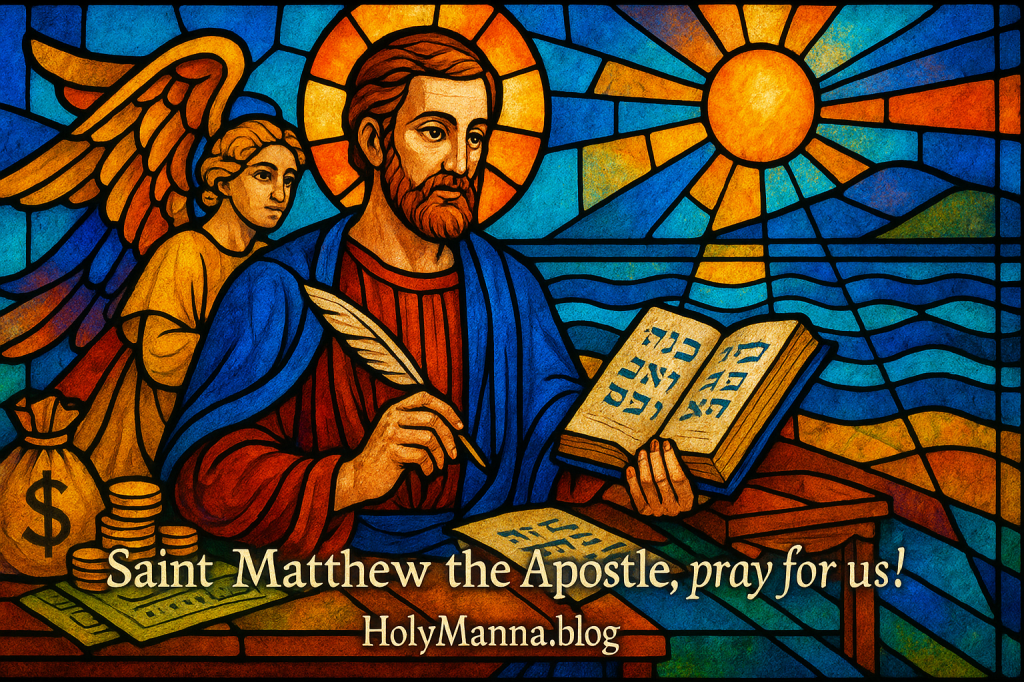
The Tax Collector Who Became a Saint
Matthew, also called Levi, stands among the Twelve and is traditionally recognized as the inspired author of The Gospel according to Matthew. He is revered as a living sign of Christ’s mercy because he rose from a tax booth to follow Jesus with decisive love. His Gospel shaped how Christians learn the way of the Kingdom, pray the Lord’s Prayer, and live the Beatitudes. In Christian symbolism he is represented by the winged man, pointing to the Gospel’s emphasis on Jesus’ true humanity and royal lineage. The Church celebrates his feast on September 21 to honor both his apostolic witness and his enduring catechesis through the Gospel.
From Tax Booth To Table Fellowship With The Lord
Matthew was a tax collector in Capernaum, a profession despised by many Jews because it served Roman interests and often involved extortion. In that setting Jesus approached him at the customs post and invited a total life change. “Follow me.” (Matthew 9:9) Matthew rose and followed, then hosted a banquet where Jesus sat with other tax collectors and sinners, a gesture that scandalized the self assured and consoled the contrite. Hearing their objections, Jesus offered a line that Matthew alone preserves with this clarity: “Go and learn what this means, ‘I desire mercy, not sacrifice.’ For I have come not to call the righteous but sinners.” (Matthew 9:13)
This conversion is not a momentary thrill. It is the pattern of Christian life. As The Catechism of the Catholic Church teaches, Jesus calls to conversion, and this call remains at the heart of the Gospel’s power to heal and restore. See CCC 1427–1429.
The Evangelist Who Taught Us The Way Of The Kingdom
From the earliest centuries the Church received The Gospel according to Matthew as the first in order and the most explicitly catechetical in structure. It opens with Jesus’ genealogy and infancy, unfolds five great discourses that echo the five books of Moses, and culminates in the Passion, Resurrection, and Great Commission. Within these pages Matthew hands on the Sermon on the Mount and the Beatitudes, which remain the charter of Christian holiness. “Blessed are the poor in spirit, for theirs is the kingdom of heaven.” (Matthew 5:3)
Matthew’s Gospel is particularly attentive to fulfillment of the Scriptures, repeatedly noting that events occur “that it might be fulfilled.” It highlights Jesus as Son of David and Emmanuel, God with us, and it gives a profound ecclesial moment at Caesarea Philippi: “You are Peter, and on this rock I will build my church… I will give you the keys of the kingdom of heaven.” (Matthew 16:18–19) Finally, Matthew records the Risen Lord’s universal mandate that continues to shape Christian mission: “Go therefore and make disciples of all nations… and behold, I am with you always, to the close of the age.” (Matthew 28:19–20)
Because Scripture is inspired, what Matthew wrote for our salvation remains living doctrine for the Church. Reading his Gospel with faith is not mere study. It is a school of discipleship in which Christ himself teaches. See CCC 105–108.
The Miracle Of Mercy Made Visible
Unlike some apostles, Matthew’s own miracles are not recorded by name in the New Testament. The sign that defines him is the miracle of grace in his conversion and his courageous hospitality to sinners at his table with Jesus. Through this table fellowship, Matthew became a conduit of the Divine Physician’s healing to those most in need. His Gospel then multiplies this mercy by preserving many of the Lord’s mighty deeds so that generations could meet Jesus with living faith. When we read Matthew’s accounts of healings, exorcisms, and restorations, we are encountering the evangelist’s greatest miracle in history’s memory. He gives the world a faithful portrait of the Savior’s power and compassion. “Those who are well have no need of a physician, but those who are sick.” (Matthew 9:12)
Trials, Mission, And The Witness Of Blood
After Pentecost, ancient tradition holds that Matthew first preached the Gospel among his own people and later traveled beyond Judea to proclaim Christ among the nations. The details diverge across sources, but the consistent memory is that Matthew persevered amid opposition and bore witness to the end. Many accounts remember him as a martyr for the faith, associating his death with missionary labors in regions once called Ethiopia or in the East. Iconography often places a halberd or axe in his hand, recalling the tradition that he sealed his preaching with the shedding of blood.
Whatever the precise contours, the Church venerates Matthew as a disciple who did not look back. The one who left a lucrative post for Christ accepted hardship for the Kingdom. His steadfastness reminds us that the Christian way involves carrying the cross with trust in the Lord who saves. “Whoever loses his life for my sake will find it.” (Matthew 16:25)
A Shrine Of Hope And A River Of Pilgrims
Centuries after his earthly life, Matthew’s memory drew the faithful to honor God in his servant. The principal place of his veneration in the West is the Cathedral of Salerno in southern Italy, where the crypt houses his relics and where the apostle’s intercession is sought by countless pilgrims. Local tradition speaks of favors received at his tomb and of a manna associated with his shrine, signs that, while belonging to pious tradition, express the Church’s confidence that the saints continue to help us in Christ.
The veneration of relics is not superstition. It springs from the Incarnation and the communion of saints. As The Catechism teaches, the Church on earth is united to the Church in glory. Honoring the apostles means honoring the God who worked marvels through them and still consoles his people through their intercession. See CCC 956–957.
Reflection: Discipleship In Matthew’s Three Movements
First, respond quickly to the Lord. Matthew rose and followed, which shows that the grace of vocation invites a prompt, trusting yes. Second, learn mercy at Jesus’ side. The evangelist preserves the Lord’s heart in the verse that can shape every day: “I desire mercy, not sacrifice.” (Matthew 9:13) Third, live on mission. Matthew ends by placing us under the Great Commission. The Kingdom calls for concrete choices and daily works of love. The Catechism teaches that the parables demand a radical decision for the Kingdom, and that detachment from riches opens the heart to Christ. See CCC 546 and CCC 2544. Let Matthew’s Gospel be your plan of life, and let the Beatitudes be your daily examen. “You, therefore, must be perfect, as your heavenly Father is perfect.” (Matthew 5:48)
Engage with Us!
Share your thoughts and prayer in the comments. How does Saint Matthew’s conversion challenge your own choices this week?
- Where is Jesus inviting you to “rise” from complacency and follow him today?
- What “tax table” in your life needs to become a table of mercy and reconciliation?
- How can you concretely live the Great Commission in your family, work, or parish this month?
- What practice of detachment will you adopt to make room for God’s Kingdom?
May Saint Matthew teach us to move quickly at the Lord’s word, to love with the mercy we have received, and to spend our lives so that others may come to know Jesus Christ.
Saint Matthew, pray for us!
Follow us on Instagram and Facebook for more insights and reflections on living a faith-filled life.

 Holy Manna!
Leave a comment