Twenty-fifth Sunday in Ordinary Time – Lectionary: 135
Justice, Prayer, and the Only Master
Pause for a moment and ask yourself: Where does my money point my heart today? The readings today present an urgent theme: God calls His people to serve Him alone by practicing justice toward the poor, ordering society through prayer, and stewarding wealth with integrity.
In Amos 8:4-7, the prophet exposes a marketplace culture eager to bend holy time and honest measures to profit, “fix our scales for cheating”, and he delivers God’s solemn verdict, “Never will I forget a thing they have done”. This eighth century context in the Northern Kingdom included prosperity built on exploitation, manipulated weights like the ephah and the shekel, and impatience with sacred days such as the new moon and the sabbath. God reveals that economic sin is never only economic. It is worship gone wrong.
Sung at Israel’s great feasts, including Passover, Psalm 113 is part of the Hallel that praises the Lord who stoops from the heights to lift the lowly. The psalm anchors today’s theme in God’s own character: “He raises the needy from the dust, lifts the poor from the ash heap” (Psalm 113:7 to 8). The moral law of fair scales and merciful stewardship flows from this liturgical vision. We become like the God we praise, or we become like the idols we chase.
In the Roman world of 1 Timothy 2:1-8, Christians are told to pray for rulers so that public life can be peaceful and dignified, open to the Gospel. This is not capitulation to power. It is evangelical realism rooted in the confession that there is “one mediator between God and the human race, Christ Jesus” (1 Timothy 2:5). When the Church intercedes, society gains space for truth, and disciples gain freedom to live charity and justice.
Finally, in Luke 16:1-13, Jesus reframes money as a test and a tool. A steward in first century estates managed accounts and promissory notes; Jesus highlights his urgency, not his fraud, and commands disciples to be faithful in the smallest entries of the ledger. The lesson climaxes in the nonnegotiable standard for worship and wealth: “You cannot serve God and mammon” (Luke 16:13).
Read together, the texts invite a conversion of economic life and public prayer in the direction of mercy, integrity, and undivided love for God. As you move through the passages, keep in view the teaching of The Catechism on justice in commerce and care for the poor (CCC 2409, 2443 to 2449), the universal destination of goods (CCC 2402 to 2406), and intercession for civil authorities (CCC 1900). What would change in your day if you handled every coin, every calendar block, and every conversation as worship of the living God?
First Reading – Amos 8:4-7
Cheating the Poor and Calling It Business
Israel in the eighth century before Christ enjoyed material prosperity, especially under Jeroboam II, but that comfort hid a spiritual sickness. Merchants hurried through sacred days like the new moon and the sabbath, chafing at worship because it delayed profit. They manipulated the ephah and the shekel, the standard measures for buying and selling, to defraud the vulnerable. The prophet Amos enters this marketplace culture and unmasks its idolatry: to twist time and scales against the poor is to worship mammon. In the arc of today’s readings, this oracle exposes the dark heart of unjust wealth that Luke 16 will challenge and that Psalm 113 will answer with the divine pattern of lifting the lowly. It reveals that economic injustice is never only about money. It is about whom we serve, and whether our use of wealth aligns with the God who raises the poor from the dust.
Amos 8:4-7
New American Bible (Revised Edition)
4 Hear this, you who trample upon the needy
and destroy the poor of the land:
5 “When will the new moon be over,” you ask,
“that we may sell our grain,
And the sabbath,
that we may open the grain-bins?
We will diminish the ephah,
add to the shekel,
and fix our scales for cheating!
6 We will buy the destitute for silver,
and the poor for a pair of sandals;
even the worthless grain we will sell!”
7 The Lord has sworn by the pride of Jacob:
Never will I forget a thing they have done!
Detailed Exegesis
Verse 4 – “Hear this, you who trample upon the needy and destroy the poor of the land:”
Amos begins with a courtroom summons. The verbs “trample” and “destroy” expose systemic harm, not isolated mistakes. The prophet teaches that God hears the cries silenced by markets and laws. This anticipates Psalm 113, where the Lord’s exaltation appears precisely in His condescension to the poor.
Verse 5 – “‘When will the new moon be over,’ you ask, ‘that we may sell our grain, And the sabbath, that we may open the grain-bins? We will diminish the ephah, add to the shekel, and fix our scales for cheating!’”
Holy time is treated as an obstacle to sales. The “new moon” and “sabbath” were liturgical signposts reminding Israel that time belongs to God. To resent them reveals disordered worship. The triad of frauds is concrete: a smaller ephah for buyers, a heavier shekel for payments received, and calibrated scales to tilt every transaction. The sin is premeditated. This verse frames wealth as a test of fidelity in small things, the very point Jesus draws in Luke 16:10.
Verse 6 – “‘We will buy the destitute for silver, and the poor for a pair of sandals; even the worthless grain we will sell!’”
Human persons become line items priced below a pair of sandals. The poor are leveraged, not loved. Even chaff and sweepings are packaged as product. Amos names a predatory economy that monetizes desperation. This offends the Creator who confers dignity on every person and commands just measures and just wages.
Verse 7 – “The Lord has sworn by the pride of Jacob: Never will I forget a thing they have done!”
God seals judgment with an oath. “The pride of Jacob” likely refers to the Lord Himself as Israel’s true glory. Divine memory here is not nostalgia. It is the certainty that injustice will face the truth. What the dishonest steward fears in Luke 16—a full accounting—is exactly what Amos announces.
Teachings
Amos’s indictment aligns with the Church’s perennial moral doctrine on economic life. The seventh commandment reaches into the details of commerce and contracts. The Catechism teaches: “Every manner of taking and using another’s property unjustly is contrary to the seventh commandment.” (CCC 2409). It specifies sins that mirror Amos’s list: “Business fraud; paying unjust wages; taking advantage of the ignorance or hardship of another.” (CCC 2409). The foundation is the universal destination of goods entrusted by God to human stewardship: “In the beginning God entrusted the earth and its resources to the common stewardship of mankind to take care of them, master them by labor, and enjoy their fruits.” (CCC 2402). Because God’s own heart bends toward the poor, the Church binds worship to mercy: “God blesses those who come to the aid of the poor and rebukes those who turn away from them.” (CCC 2443). She then names the concrete works that embody justice and love: “The corporal works of mercy consist especially in feeding the hungry, sheltering the homeless, clothing the naked, visiting the sick and imprisoned, and burying the dead. Among all these, giving alms to the poor is one of the chief witnesses to fraternal charity.” (CCC 2447). Drawing from the Fathers, The Catechism cites Saint John Chrysostom’s piercing judgment: “Not to share one’s wealth with the poor is to steal from them and to take away their livelihood.” (CCC 2446). Amos’s oracle stands inside this tradition as a prophetic baseline: worship without justice is false, and markets without mercy deform the image of God in society.
Reflection
God refuses to forget the poor whom others forget. If He remembers the victims of exploitation, then disciples must remember them in budgets, schedules, and habits. Begin with honest scales in your own life. Keep your word in small agreements. Pay promptly and fairly. Refuse the quiet advantages that come from another’s disadvantage. Practice weekly almsgiving that you plan for as carefully as any bill. Let your prayer shape your pocket, and let your pocket validate your prayer. Where might impatience with worship reveal a heart too attached to profit? Which concrete choice this week could convert money into mercy for someone in need? How will you ensure that every transaction and every hour reflects service to God and not to mammon?
Responsorial Psalm – Psalm 113:1-2, 4-8
The God Who Stoops to Raise the Lowly
This psalm opens the Egyptian Hallel, a set of festival hymns (Psalms 113 to 118) sung at Israel’s great feasts, including Passover. In temple and household liturgy, Israel learned to praise the Lord who is infinitely exalted and yet intimately present to the poor. That twofold truth grounds today’s theme of just stewardship and undivided worship. If God is enthroned above the nations and at the same time lifts the needy from the ash heap, then the people who bear His name must order wealth, time, and authority toward mercy. In the company of Amos 8:4 to 7 and Luke 16:1 to 13, Psalm 113 turns praise into a program for life. It teaches that right worship generates right justice, and that the Lord’s condescension to the lowly is not an exception but the pattern of His glory.
Psalm 113:1-2, 4-8
New American Bible (Revised Edition)
Praise of God’s Care for the Poor
1 Hallelujah!
Praise, you servants of the Lord,
praise the name of the Lord.
2 Blessed be the name of the Lord
both now and forever.
4 High above all nations is the Lord;
above the heavens his glory.
5 Who is like the Lord our God,
enthroned on high,
6 looking down on heaven and earth?
7 He raises the needy from the dust,
lifts the poor from the ash heap,
8 Seats them with princes,
the princes of the people,
Detailed Exegesis
Verse 1 – “Hallelujah! Praise, you servants of the Lord, praise the name of the Lord.”
The liturgy summons the covenant people by their truest identity, “servants of the Lord.” Praise is not optional ornamentation. It is obedience to reality. Naming the Lord is a public act that dethrones idols and prepares the heart to handle money, power, and time as gifts rather than gods.
Verse 2 – “Blessed be the name of the Lord both now and forever.”
The horizon of praise stretches from this moment into eternity. Continuous blessing sanctifies the calendar the merchants of Amos wished to compress for profit. If God’s name is blessed at all times, then economic life must bow to worship, not the other way around.
Verse 4 – “High above all nations is the Lord; above the heavens his glory.”
The sovereignty of God relativizes every human hierarchy. No empire or market sets the final terms of value. The psalm places policy, price, and prestige under a higher throne, which frees disciples to act justly even when it costs them.
Verse 5 – “Who is like the Lord our God, enthroned on high,”
This rhetorical question exposes the absurdity of trusting mammon. There is none like Him. The verse invites reverent awe, which is the beginning of wisdom for decisions large and small.
Verse 6 – “looking down on heaven and earth?”
The Lord’s transcendence does not mean distance. The gaze of God rests upon the whole created order. He sees the hidden corners of the marketplace where scales are fixed and wages are delayed. He also sees the secret alms and quiet fidelity of the just.
Verse 7 – “He raises the needy from the dust, lifts the poor from the ash heap,”
Here the psalm’s theology descends into history. The verbs “raises” and “lifts” echo God’s Exodus mercy and anticipate the Gospel’s beatitudes. The Lord does not merely observe poverty. He acts to reverse it, and He calls His people to become instruments of that lifting.
Verse 8 – “Seats them with princes, the princes of the people,”
Divine mercy is not a token gesture. It is enthronement. The poor are not tolerated at the margin. They are honored at the center. This anticipates the Church’s teaching that the goods of the earth have a universal destination and that social order must reflect the dignity of the least.
Teachings
The Catechism describes praise as a distinct and necessary form of prayer that orients all other actions toward God: “Praise is the form of prayer which recognizes most immediately that God is God. It lauds God for his own sake and gives him glory, quite beyond what he does, but simply because HE IS.” (CCC 2639). When the psalm exalts the Lord above the nations and above the heavens, it trains the heart to serve God alone, which is the culmination of Luke 16:13.
This same Lord bends low to raise the poor. The Catechism states: “God blesses those who come to the aid of the poor and rebukes those who turn away from them. ‘It is by what they have done for the poor that Jesus Christ will recognize his chosen ones.’” (CCC 2443). The moral consequence is concrete and communal. Drawing on the Fathers, The Catechism cites Saint John Chrysostom’s uncompromising insight: “Not to share one’s wealth with the poor is to steal from them and to take away their livelihood; it is not our own goods which we hold, but theirs.” (CCC 2446).
Because God “seats” the poor with princes, the Church teaches the universal destination of goods and the responsibility of stewardship: “In the beginning God entrusted the earth and its resources to the common stewardship of mankind to take care of them, master them by labor, and enjoy their fruits.” (CCC 2402). She specifies the practical shape of mercy in daily life: “The corporal works of mercy consist especially in feeding the hungry, sheltering the homeless, clothing the naked, visiting the sick and imprisoned, and burying the dead. Among all these, giving alms to the poor is one of the chief witnesses to fraternal charity.” (CCC 2447). In the light of Psalm 113, praise is the fuel for this mission, and mercy is its visible fruit.
Reflection
Praise forms vision. If you begin and end your day blessing the name of the Lord, you will see budgets, calendars, and neighbors differently. Set times to pray the words of Psalm 113 and let them critique impatience with worship. Choose a specific work of mercy this week and plan it as carefully as any appointment. If you manage money, set aside a tithe for alms and accountability. If you manage time, protect Sunday so that praise governs profit. How would your choices change if you believed that God is watching in love over every transaction and every hour? Whom could you lift from the ash heap today by a phone call, a meal, or a bill paid without delay? Where is the Lord inviting you to move from admiration of His mercy to imitation of it?
Second Reading – 1 Timothy 2:1-8
Intercede for a Just Peace under the One Mediator
Paul writes to Timothy in the setting of the early Church’s mission within the Roman world, likely with Timothy serving in Ephesus, where public order, imperial cult pressures, and civic suspicion of Christians formed a challenging environment. Into that tension Paul gives a liturgical strategy that shapes social witness: pray first, pray for everyone, and pray especially for rulers so that the Gospel can be lived openly in devotion and dignity. The command does not sacralize political power. It evangelizes public life by placing it under the lordship of Christ who is the one Mediator and who “gave himself as ransom for all.” In the flow of today’s theme, this reading shows how prayer orders society toward justice for the vulnerable in the spirit of Amos, how praise of God’s condescension in Psalm 113 becomes intercession for the lowly, and how allegiance to Christ in Luke 16 frees disciples from anxious anger so that they can serve God rather than mammon.
1 Timothy 2:1-8
New American Bible (Revised Edition)
Prayer and Conduct. 1 First of all, then, I ask that supplications, prayers, petitions, and thanksgivings be offered for everyone, 2 for kings and for all in authority, that we may lead a quiet and tranquil life in all devotion and dignity. 3 This is good and pleasing to God our savior, 4 who wills everyone to be saved and to come to knowledge of the truth.
5 For there is one God.
There is also one mediator between God and the human race,
Christ Jesus, himself human,
6 who gave himself as ransom for all.
This was the testimony at the proper time. 7 For this I was appointed preacher and apostle (I am speaking the truth, I am not lying), teacher of the Gentiles in faith and truth.
8 It is my wish, then, that in every place the men should pray, lifting up holy hands, without anger or argument.
Detailed Exegesis
Verse 1 – “First of all, then, I ask that supplications, prayers, petitions, and thanksgivings be offered for everyone,”
Paul stacks four words for prayer to emphasize breadth and persistence. Intercession is not an optional ministry for a few. It is the Church’s first reflex. The Catechism describes this form of prayer: “Intercession is a prayer of petition which leads us to pray as Jesus did.” (CCC 2634). Gratitude belongs beside petition because thanksgiving acknowledges God’s providence over public affairs.
Verse 2 – “for kings and for all in authority, that we may lead a quiet and tranquil life in all devotion and dignity.”
The aim of prayer for rulers is a space for holy living, not political dominance. “Quiet and tranquil” names social peace that allows the Church to worship, to serve the poor, and to preach the Gospel. The Catechism teaches our duty here: “It is the duty of citizens to contribute along with the civil authorities to the good of society in a spirit of truth, justice, solidarity, and freedom.” (CCC 2239), and specifically “to pray for those who govern them.” (CCC 1900).
Verse 3 – “This is good and pleasing to God our savior,”
Prayer for all, including rulers, reflects the saving will of God. The title “Savior” applied to God subverts imperial claims since in the Roman world “Savior” could be used of the emperor. The Church locates salvation in God alone.
Verse 4 – “who wills everyone to be saved and to come to knowledge of the truth.”
Universal salvific will grounds universal intercession. The scope of prayer matches the scope of God’s desire. The Catechism cites this verse when it teaches that “all salvation comes from Christ the Head through the Church which is his Body.” (CCC 846). Praying for all expresses confidence that truth can be known and embraced.
Verse 5 – “For there is one God. There is also one mediator between God and the human race, Christ Jesus, himself human,”
Christian intercession is anchored in monotheism and in the unique mediation of the incarnate Son. Because He is true God and true man, He bridges the gap in His very person. The Catechism confesses: “Jesus Christ is true God and true man, in the unity of his divine person.” (CCC 480). Our prayer participates in His.
Verse 6 – “who gave himself as ransom for all. This was the testimony at the proper time.”
The cross is the ground of mediation. “Ransom” evokes liberation from slavery to sin and death. The “proper time” signals the decisive moment in salvation history. The Catechism teaches: “The sacrifice of Christ is unique, it completes and surpasses all other sacrifices.” (CCC 614), and our share in it is real: “The sacrifice of Christ and the sacrifice of the Eucharist are one single sacrifice.” (CCC 1367).
Verse 7 – “For this I was appointed preacher and apostle, I am speaking the truth, I am not lying, teacher of the Gentiles in faith and truth.”
Paul’s insistence underscores the universality of the mission. “Teacher of the Gentiles” shows that the Gospel’s horizon includes every people and culture. The Church’s intercession therefore refuses tribal limits.
Verse 8 – “It is my wish, then, that in every place the men should pray, lifting up holy hands, without anger or argument.”
Liturgical posture and moral disposition meet. “Holy hands” implies a reconciled life. “Without anger or argument” names the interior freedom required for authentic worship. This verse fits today’s call to choose God over mammon, since greed breeds resentment while prayer purifies desire.
Teachings
Paul’s call to universal intercession is echoed throughout The Catechism: “In intercession, he who prays looks ‘not only to his own interests, but also to the interests of others,’ even to the point of praying for those who do him harm.” (CCC 2635). Regarding public authority, the Church commands respect, contribution to the common good, and prayer: “Those subject to authority should regard those in authority as representatives of God.” and “Insofar as they are able, citizens are obliged in conscience not to follow the directives of civil authorities when they are contrary to the demands of the moral order.” (CCC 1900, 2242). This balance explains why the Church prays for rulers while reserving the right to conscientious objection.
Christ’s unique mediation stands at the center. The Catechism teaches the singularity and universality of His redeeming work: “There is no other name under heaven given among men by which we must be saved.” (CCC 432), and “By his glorious cross Christ has won salvation for all men.” (CCC 617). Our participation in His mediation is liturgical and ethical: “The whole Church participates in the priesthood of Christ.” (CCC 1368), so the faithful “lift up holy hands” by offering their lives with the Eucharist and by living reconciled with one another. Historically, the earliest Christians prayed publicly for emperors and officials to secure peace for the Gospel’s advance, a pattern consistent with this passage and with the Church’s continuing practice in the Universal Prayer at Mass.
Reflection
Pray first. Pray widely. Pray concretely. Begin each day by naming leaders in your city, your nation, and your workplace before God, and ask for the tranquil conditions that help families and the poor to flourish. Examine your heart before you lift your hands. Forgive the grievances that harden prayer into argument. Set a weekly fast or almsgiving intention for those who govern and for those most affected by their decisions. Let Sunday Mass be the place where you join the one Mediator who ransomed you, and where your voice for others becomes part of His. Whom is God inviting you to intercede for by name this week? What anger must you surrender so that your hands are holy in prayer? How can your intercession today make room for justice, mercy, and the quiet dignity of a holy life for many?
Holy Gospel – Luke 16:1-13
Clever with Coins, Faithful with Souls
Jesus speaks into a first century world where large estates employed stewards to manage accounts, renegotiate debts, and collect promissory notes. Honor, obligation, and social reciprocity governed these transactions as much as raw profit did. In this setting the Lord presents a startling parable about a steward who, facing dismissal, acts with urgent shrewdness to secure a future welcome. Jesus does not praise fraud. He praises prudent foresight that converts earthly resources into relationships. Within today’s theme, this Gospel is the capstone: like Amos 8:4 to 7, it exposes the danger of worshiping profit; like Psalm 113, it reveals God’s preference for lifting the lowly; like 1 Timothy 2:1 to 8, it calls us to order public and personal life under the one true Master. The lesson is simple and searching. Wealth is a test, a tool, and a temporary trust. Use it now for mercy, because “You cannot serve God and mammon.”
Luke 16:1-13
New American Bible (Revised Edition)
The Parable of the Dishonest Steward. 1 Then he also said to his disciples, “A rich man had a steward who was reported to him for squandering his property. 2 He summoned him and said, ‘What is this I hear about you? Prepare a full account of your stewardship, because you can no longer be my steward.’ 3 The steward said to himself, ‘What shall I do, now that my master is taking the position of steward away from me? I am not strong enough to dig and I am ashamed to beg. 4 I know what I shall do so that, when I am removed from the stewardship, they may welcome me into their homes.’ 5 He called in his master’s debtors one by one. To the first he said, ‘How much do you owe my master?’ 6 He replied, ‘One hundred measures of olive oil.’ He said to him, ‘Here is your promissory note. Sit down and quickly write one for fifty.’ 7 Then to another he said, ‘And you, how much do you owe?’ He replied, ‘One hundred kors of wheat.’ He said to him, ‘Here is your promissory note; write one for eighty.’ 8 And the master commended that dishonest steward for acting prudently.
Application of the Parable. “For the children of this world are more prudent in dealing with their own generation than are the children of light. 9 I tell you, make friends for yourselves with dishonest wealth, so that when it fails, you will be welcomed into eternal dwellings. 10 The person who is trustworthy in very small matters is also trustworthy in great ones; and the person who is dishonest in very small matters is also dishonest in great ones. 11 If, therefore, you are not trustworthy with dishonest wealth, who will trust you with true wealth? 12 If you are not trustworthy with what belongs to another, who will give you what is yours? 13 No servant can serve two masters. He will either hate one and love the other, or be devoted to one and despise the other. You cannot serve God and mammon.”
Detailed Exegesis
Verse 1 – “Then he also said to his disciples, ‘A rich man had a steward who was reported to him for squandering his property.’”
Jesus addresses disciples, so this is formation for Christians, not a mere business tip. “Squandering” signals irresponsible stewardship. Everything we hold is the Master’s property, which reframes our budgets and plans as spiritual matters.
Verse 2 – “He summoned him and said, ‘What is this I hear about you? Prepare a full account of your stewardship, because you can no longer be my steward.’”
Accountability is inevitable. The steward must render a “full account.” Jesus hints at judgment day, when each of us will answer for what we did with time, talents, and treasure.
Verse 3 – “The steward said to himself, ‘What shall I do, now that my master is taking the position of steward away from me? I am not strong enough to dig and I am ashamed to beg.’”
The steward faces a vocational crisis and reckons honestly with his limits. His interior dialogue invites us to examine our own habits before the day of accounting arrives.
Verse 4 – “‘I know what I shall do so that, when I am removed from the stewardship, they may welcome me into their homes.’”
He devises a plan for future welcome. Jesus will later translate this into eternal terms. Use temporal goods to prepare for eternal dwelling.
Verse 5 – “He called in his master’s debtors one by one. To the first he said, ‘How much do you owe my master?’”
The steward turns to relationships, not hoarding. The “one by one” suggests personal engagement. Mercy is always particular.
Verse 6 – “He replied, ‘One hundred measures of olive oil.’ He said to him, ‘Here is your promissory note. Sit down and quickly write one for fifty.’”
A large reduction in oil debt would create gratitude and social obligation. Scholars debate whether the steward removed his own commission or simply wrote off interest. In either case he sacrifices near term gain for long term welcome.
Verse 7 – “Then to another he said, ‘And you, how much do you owe?’ He replied, ‘One hundred kors of wheat.’ He said to him, ‘Here is your promissory note; write one for eighty.’”
The pattern continues. Wheat, a staple commodity, receives a smaller reduction, perhaps reflecting a different margin. The point is not the math but the mindset of urgent, strategic generosity.
Verse 8 – “And the master commended that dishonest steward for acting prudently. For the children of this world are more prudent in dealing with their own generation than are the children of light.”
The commendation targets prudence, not dishonesty. Jesus laments that worldly people often show more clever urgency for passing goals than disciples do for eternal ones. He calls us to holy shrewdness.
Verse 9 – “I tell you, make friends for yourselves with dishonest wealth, so that when it fails, you will be welcomed into eternal dwellings.”
“Mammon” fails. Mercy does not. Use money to make friends in Christ by almsgiving and justice. Those friendships echo into eternity as welcome.
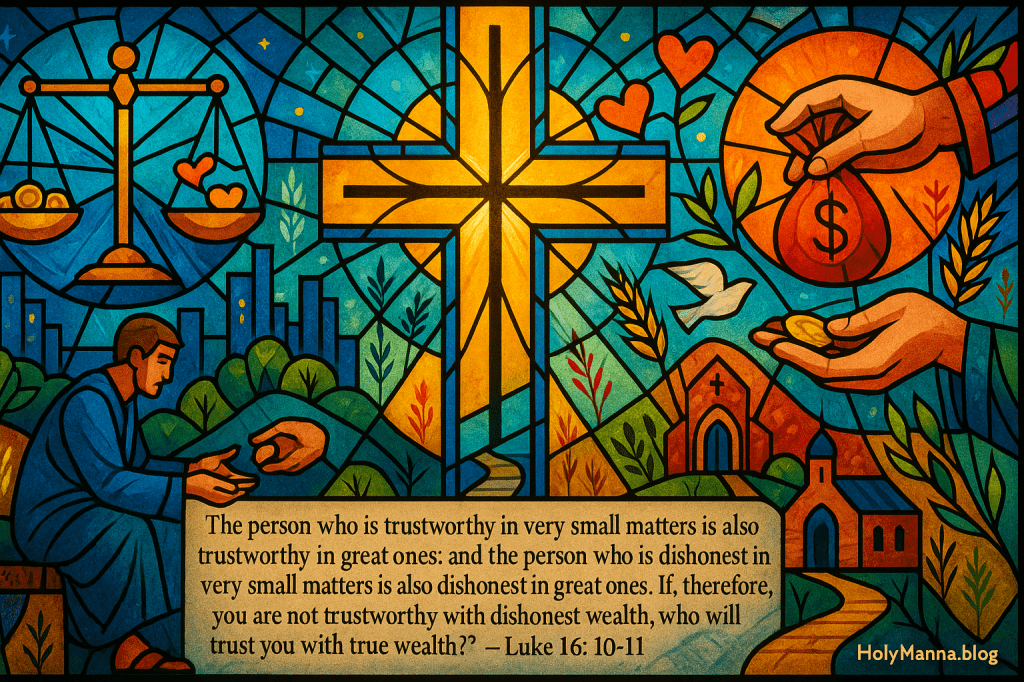
Verse 10 – “The person who is trustworthy in very small matters is also trustworthy in great ones; and the person who is dishonest in very small matters is also dishonest in great ones.”
Character is consistent across scale. God tests us with small things so that we can receive great ones. Daily honesty prepares us for heavenly trust.
Verse 11 – “If, therefore, you are not trustworthy with dishonest wealth, who will trust you with true wealth?”
Earthly money is “dishonest” in the sense that it is unstable and easily corrupting. “True wealth” is grace, wisdom, and the life of God. Faithful use of money disposes us to receive spiritual riches.
Verse 12 – “If you are not trustworthy with what belongs to another, who will give you what is yours?”
Everything we manage belongs to God. If we misuse what is God’s, we are not ready for the inheritance He desires to give us.
Verse 13 – “No servant can serve two masters. He will either hate one and love the other, or be devoted to one and despise the other. You cannot serve God and mammon.”
Here is the decisive choice. Worship creates a hierarchy of loves. If money rules, God is sidelined. If God rules, money becomes a means of love.
Teachings
Jesus’s praise of prudence calls us to the cardinal virtue that orders means to our true end. The Catechism teaches: “Prudence is the virtue that disposes practical reason to discern our true good in every circumstance and to choose the right means of achieving it.” (CCC 1806). The parable warns against the idolatry of wealth. The Catechism defines idolatry: “Idolatry consists in divinizing what is not God.” (CCC 2113), and it critiques economic absolutism: “A theory that makes profit its exclusive norm and ultimate end of economic activity is morally unacceptable.” (CCC 2424). On honesty in commerce it states: “Every manner of taking and using another’s property unjustly is contrary to the seventh commandment.” (CCC 2409).
Jesus also insists on detachment from riches as a condition of freedom. The Catechism instructs our desires: “The beatitude we are promised confronts us with decisive moral choices. It invites us to purify our hearts of bad instincts and to seek the love of God above all else. It teaches us that true happiness is not found in riches or well being, in human fame or power, or in any human achievement.” (CCC 1723). The Church therefore urges works of mercy that convert wealth into love. Drawing from the Fathers, she teaches: “Not to share one’s wealth with the poor is to steal from them and to take away their livelihood; it is not our own goods which we hold, but theirs.” (CCC 2446). Finally, the whole passage presumes stewardship. All goods are entrusted to us for a time. The Catechism states: “In the beginning God entrusted the earth and its resources to the common stewardship of mankind to take care of them, master them by labor, and enjoy their fruits.” (CCC 2402). Saint Ignatius of Loyola expresses the same end with bracing clarity: “Man is created to praise, reverence, and serve God our Lord, and by this means to save his soul. The other things on the face of the earth are created for man to help him in attaining the end for which he is created.” (Spiritual Exercises, Principle and Foundation).
Reflection
Ask for holy shrewdness. Make a plan to turn money into mercy before the audit comes. Choose one concrete act of generosity you will do this week that costs you something and blesses someone in need. Review your recurring expenses and redirect a portion to almsgiving and parish mission. Set up accountability for honest business practices in the smallest details. Pray daily for freedom from the envy and anxiety that money often fuels, and for fidelity to the one Master who ransomed you. If you had to render a full account today, how would you wish you had used your wealth, your time, and your influence? Which small trust can you handle faithfully this week so that God can entrust you with true wealth? What step can you take today to ensure that your heart serves God and not mammon?
One Master, One Mission
Today the Word draws a single line through every page. Amos 8:4-7 unmasks the lie that profit can excuse injustice and makes clear that God remembers every fixed scale and every trafficked heart. Psalm 113 sings the truth behind that judgment, that the Lord is exalted precisely in His mercy, “He raises the needy from the dust”. 1 Timothy 2:1-8 hands the Church her public posture, to pray first and to pray for all under the kingship of Christ, “the one mediator between God and the human race”. Luke 16:1-13 then presses the decision home with a steward’s ledger and a disciple’s soul, teaching holy urgency, fidelity in little things, and the final verdict of love, “You cannot serve God and mammon.” Together the readings call us to worship that becomes justice, to prayer that makes room for peace, and to stewardship that spends itself on mercy.
Here is your invitation. Let your praise shape your practices. Examine the small agreements on your calendar and in your budget, and choose integrity where it costs you. Set aside alms before you set aside extras, and make generosity a planned habit rather than a passing mood. Pray daily for leaders by name so that the poor may flourish and the Church may live openly in devotion and dignity. Return to the sacraments, especially the Eucharist, where the one Mediator ransoms and reconciles, and where your offering joins His. Make a concrete plan this week to convert money into friendship in Christ, to lift someone from the ash heap, and to keep Sunday as the day that orders all the others. What would change if every coin, every conversation, and every choice became your answer to the Lord’s question about whom you truly serve? May the Father who seats the lowly with princes teach our hands to do the same, and may our lives become a clear and joyful yes to Him who alone is worthy.
Engage with Us!
We would love to hear from you in the comments below. Share what moved you in today’s Scriptures and how the Lord is speaking into your daily life.
- First Reading (Amos 8:4-7): Where might impatience with worship or profit driven habits be shaping your choices, and what one concrete change can you make this week to practice honest, merciful stewardship?
- Responsorial Psalm (Psalm 113:1-2, 4-8): How will daily praise reshape your view of money, time, and neighbors, and whom is God inviting you to help Him lift from the ash heap today?
- Second Reading (1 Timothy 2:1-8): Which leaders will you name in prayer this week, and what anger or argument do you need to surrender so that you can lift up holy hands in peace?
- Holy Gospel (Luke 16:1-13): What small trust can you handle faithfully today, and how will you convert part of your resources into concrete mercy for someone who needs it, choosing to serve God rather than mammon?
Go in confidence and hope. Live a life of faith, and do everything with the love and mercy Jesus taught us.
Sacred Heart of Jesus, we trust in You!
Immaculate Heart of Mary, pray for us!
Saint Michael the Archangel, defend us in battle!
Follow us on Instagram and Facebook for more insights and reflections on living a faith-filled life.

 Holy Manna!
Leave a comment