A Church Raised From the Ashes
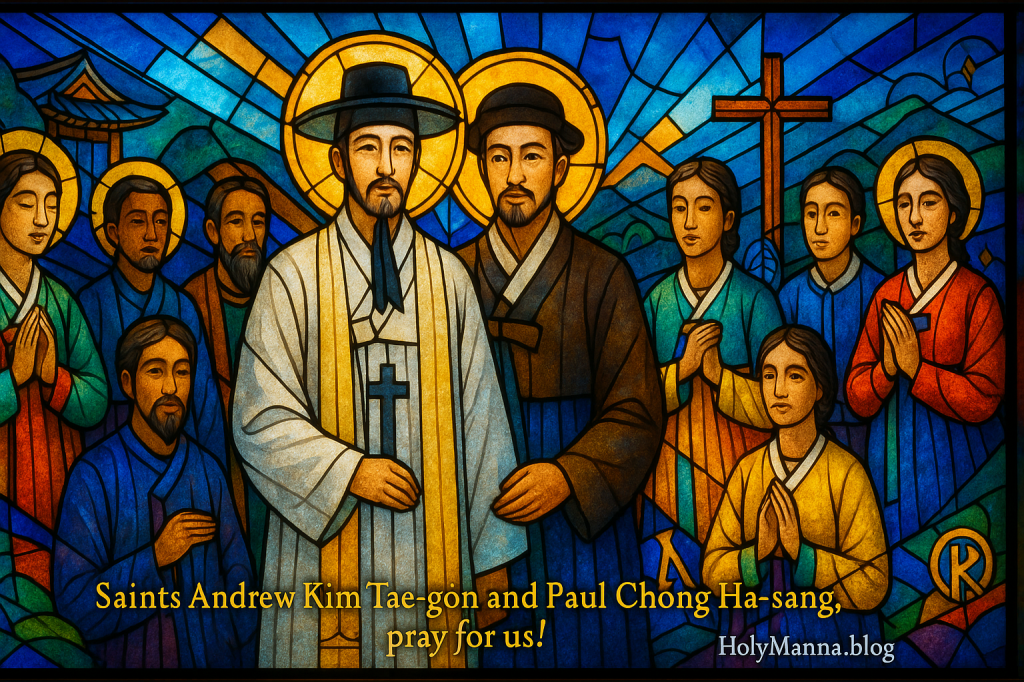
The Korean Church is one of the few in history born primarily through lay initiative. Long before missionaries could safely enter, scholars encountered the Gospel in China, carried books home, and formed small Christian communities in secret. Into this hidden vineyard stepped Saint Andrew Kim Tae-gŏn, the first Korean-born Catholic priest, and Saint Paul Chŏng Ha-sang, a brilliant lay apostle who linked the persecuted faithful with the universal Church. Together with 101 companions, their heroic fidelity under torture and death became the seed from which the modern Korean Church blossomed. Their feast invites us to a sturdy, joyful discipleship that springs from Baptism, is nourished by the Eucharist, and matures in courageous witness.
Roots and Rising Courage
Andrew Kim Tae-gŏn was born on August 21, 1821 in Solmoe near Dangjin, into a family already marked by suffering for Christ. As a teenager he was baptized and soon sensed a priestly vocation. Because seminaries could not operate openly in Korea, he journeyed across seas to Macau for formation and was ordained a priest in 1844 in Shanghai. From the beginning, his vocation fused contemplation and daring. He studied and prayed, and then risked his life to return home so that his people could receive the sacraments.
Paul Chŏng Ha-sang was born in 1795 into a noble family devoted to the fledgling Church. When his father was martyred in the 1801 persecution, Paul’s childhood was branded by the Cross. That loss forged his zeal. As he matured, he wrote boldly to Church authorities requesting missionaries for the Korean flock, composed catechetical instructions, and strengthened scattered Christians. He became a living testimony to the dignity and indispensability of the lay apostolate.
Both saints are remembered for the same spiritual melody sung in two different keys. Andrew gave his life to offer the Mass and shepherd the underground Church. Paul organized, taught, and pleaded for pastoral care. Their holiness shows how God weaves priestly and lay vocations into one tapestry for the salvation of souls.
Hidden Altars and Open Hearts
Andrew’s priesthood was brief and luminous. He mapped clandestine sea routes to bring missionaries into Korea, moved from home to home to hear confessions, and celebrated the Eucharist in fields and cellars where the faithful gathered in trembling joy. The “miracles” most clearly recorded from these years are not spectacular signs, but transformed lives. There were reconciliations among families torn by fear, courage in catechumens who asked for Baptism though it might cost their lives, and the quiet heroism of parents passing the faith to their children.
Paul’s life displayed another steady wonder. He tirelessly knit together a persecuted Church, teaching sound doctrine, refuting slanders, and giving the faithful a reason for hope. He helped them see that the Cross is not an interruption of Christian life but its narrow gate. In this sense their ministry produced daily miracles of grace. Sinners converted, the timid were emboldened, and a scattered flock became one body in Christ.
From prison, Andrew wrote to comfort and fortify believers with lines the Church preserves for prayer. “My dear brothers and sisters, consider this: the Lord has ruled over all things from the beginning. If we suffer now for His name, we are blessed, for He will not abandon those who hope in Him.”
Steel in the Soul
Wave after wave of persecution struck Korean Catholics in 1801, 1839, 1846, and 1866. Officials demanded that Christians renounce the faith and trample the Cross as a public sign of apostasy. Andrew was arrested while arranging safe passage for missionaries. Interrogated and tortured, he answered with calm clarity and charity. On September 16, 1846, at Saenamteo by the Han River, he was beheaded. Before his death, he urged his flock to remain steadfast in Christ and to forgive their persecutors. “Since the Lord commands us to love our enemies and pray for those who persecute us, let us do so with all our hearts, that we may become true children of the heavenly Father.”
Paul’s turn came during the Gihae persecution of 1839. He confessed Christ openly, refused to betray fellow believers, and accepted execution with serenity. Their companions included bishops and priests, but mostly lay men and women. There were mothers with infants, elderly catechists, teenage students, servants, and scholars. Their constancy embodied the teaching of The Catechism that “martyrdom is the supreme witness given to the truth of the faith.” Their suffering became a participation in the Passion of the Lord that bears fruit for the whole Church.
After Blood, Blossom
The martyrs’ blood became the seed of a Church that now flourishes across Korea and far beyond. Pilgrims still travel to Solmoe, Andrew’s birthplace, and to sites of execution such as Saenamteo and Seosomun, as well as Jeoldusan Martyrs’ Shrine with its museum of relics. Countless faithful report favors received through the martyrs’ intercession. There are conversions of loved ones, reconciled families, renewed vocations, and courage in spiritual trials. The most striking posthumous “miracle” is ecclesial and visible. A Church almost extinguished now sends missionaries to the world and welcomes seekers who come simply because the story of these martyrs will not stop burning in human hearts.
Fire For Our Times
The Korean martyrs teach us that holiness is possible in every state of life and every circumstance. They show us how to pray for enemies even as we refuse to deny the truth. They remind us that the sacraments are worth risk and sacrifice because they keep us in living communion with Jesus. Imitation begins with small obediences. It begins with daily mental prayer, Sunday Mass made central, monthly Confession that keeps the heart clean, and intentional witness at work and at home. When you are misunderstood for choosing the Gospel, remember Saint Andrew’s quiet certainty that God governs history and guards His own. “We give thanks to the Lord who has counted us worthy to suffer for His name; let us be joyful and persevere to the end.”
Ask Saint Paul to intercede for your lay apostleship. Ask Saint Andrew to enkindle priestly love for the Eucharist in your parish. Ask all the companions to teach you how to carry the Cross with hope. As The Catechism teaches, faith must be confessed not only with the lips but by a life shaped by charity, patience, and truth. Today is an excellent day to begin again.
Engage with Us!
We would love to hear how these saints challenge and encourage you. Share your thoughts and prayers in the comments below.
- Where is Christ inviting you to a bolder, more public witness of faith this week?
- How can you support the missionary life of the Church—through prayer, almsgiving, or personal service—right now?
- What does the Korean Church’s lay-led beginning say to your role as a baptized Catholic today?
- Who is one person you can forgive, bless, or serve in Jesus’ name, following the martyrs’ charity?
Take heart. Walk with Christ in courage and joy. Do everything with the love and mercy Jesus taught us.
Saints Andrew Kim Tae-gŏn and Paul Chŏng Ha-sang, pray for us!
Follow us on Instagram and Facebook for more insights and reflections on living a faith-filled life.

 Holy Manna!
Leave a comment