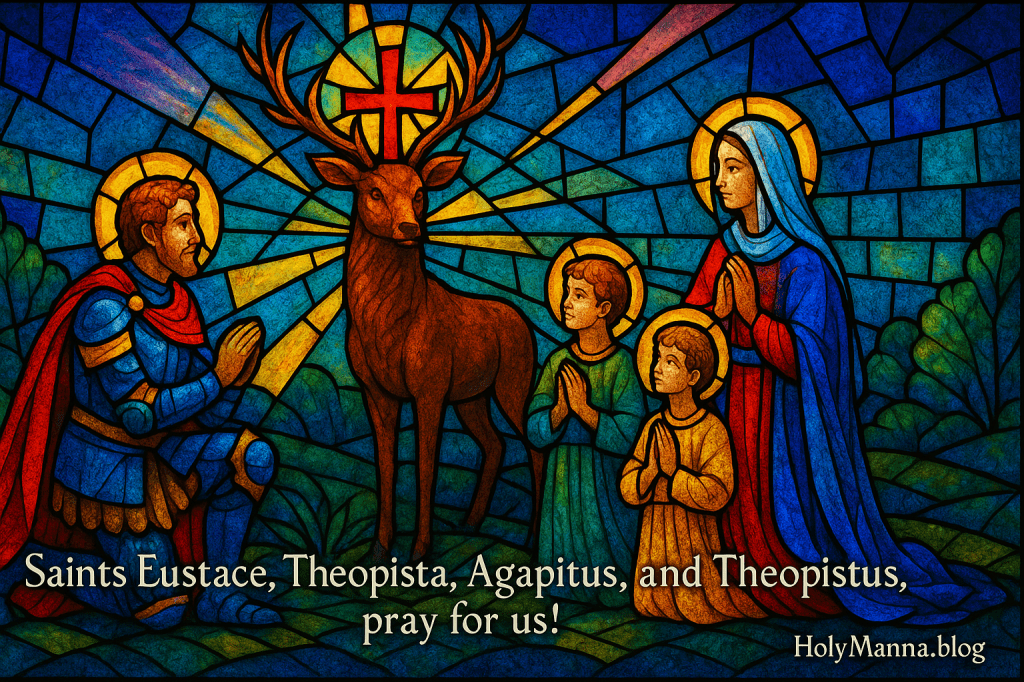
A Cross in the Antlers, A Family for the Gospel
Saint Eustace, his wife Theopista, and their sons Agapitus and Theopistus stand in Christian memory as a household forged by grace and faithful under pressure. Their story tells of a renowned Roman officer who encountered a stag bearing a radiant cross between its antlers, heard the voice of Christ, and surrendered his life to the Lord. From that moment, the entire family lived and died for Jesus. Across East and West their cult took deep root, their feast is traditionally kept on September 20, and Eustace is honored as patron of hunters and a model for families who suffer losses yet persevere. The Church proposes their witness as a signpost to Christ, not for the precision of every detail in their legendary Acta, but for the clarity of their fidelity. “Being more closely united to Christ, those who dwell in heaven… do not cease to intercede with the Father for us.” (CCC 956)
The Household Baptized by Light
Before baptism his name was Placidus, a high ranking officer serving the emperor. While hunting in the hills near Tibur, he beheld the famous stag with a luminous cross and heard the Lord call him by name. Moved by awe and contrition, he sought instruction and baptism with his wife, called Tatiana in some sources and Theopista after baptism, together with their two young sons, Agapitus and Theopistus. The conversion is framed by the Church as the primacy of grace and the obedience of an entire household to the Gospel. In their baptism they received not only new names but a new mission. The Christian family, says the Catechism, is an ecclesial reality, “a specific revelation and realization of ecclesial communion.” (CCC 2204) Their home became a small church where prayer, mutual forgiveness, and courage for Christ were learned day by day. In the language of the Catechism, “The home is the first school of Christian life.” (CCC 1657)
Providence in Motion
After their conversion, the family was tried in rapid succession. They lost wealth and status, and during a difficult journey abroad they were separated. In the traditional account, Theopista is taken by a ship’s captain, while the two boys are carried off on the riverbank, one by a lion and the other by a wolf. The animals release them, and each child is rescued by different caretakers. Years pass. Eustace is summoned back to military command during a crisis, serves with distinction, and by a chain of providences is reunited with his wife and sons. The narrative is filled with symbols of how God gathers what is scattered. For readers today the point is clear. Christian hope does not deny sorrow. It believes that Christ can make reunions from ruins. “We know that in everything God works for good for those who love him.” (Romans 8:28)
Courage in the Arena
Following a great victory, the imperial court demanded ritual sacrifice to the gods. Eustace and his family refused, and they confessed Christ openly. They were then thrown to wild beasts, but the animals refused to harm them. They were finally put to death in a superheated bronze bull. The Church recognizes in this testimony the essence of martyrdom. “Martyrdom is the supreme witness given to the truth of the faith: it means bearing witness even unto death.” (CCC 2473) Their steadfastness echoes the apostolic word, “We must obey God rather than men.” (Acts of the Apostles 5:29) For those under pressure at work, in public life, or among friends, their example teaches that truth, charity, and worship belong to God first. Fortitude, says the Catechism, “ensures firmness in difficulties and constancy in the pursuit of the good.” (CCC 1808)
From Martyr’s Ashes to Living Intercession
After their death, devotion to the Eustace family flourished. In Rome the church of Sant’Eustachio bears on its façade a stag’s head with a cross, a catechesis in stone for all who pass. In Paris, the great church of Saint Eustache became a center of veneration and Christian culture. The family’s story inspired artists across centuries, with scenes of Eustace’s vision appearing in altarpieces and devotional paintings that taught the faithful to recognize Christ’s call in the ordinary course of life. Pilgrims have long invoked their help for family needs, for courage in trials, and for those who hunt or labor outdoors. The Church’s tradition sees such devotion as a participation in the communion of saints, where heavenly friends intercede for earthly pilgrims. As the Catechism affirms, “They do not cease to intercede for us and to care for those whom they have left on earth.” (CCC 2683)
What We Know and How We Pray
The Church has always distinguished between strict historical detail and the enduring theological and spiritual value of the saints’ witness. Many particulars about Eustace, Theopista, Agapitus, and Theopistus come to us in legendary form, yet their veneration is ancient and edifying. They are included in the Roman Martyrology, and their cult remains a living part of Christian memory. By proposing them to the faithful, the Church directs our gaze to Christ, who is the source and goal of all sanctity. “By canonizing some of the faithful… the Church… proposes the saints to [the faithful] as models and intercessors.” (CCC 828) Regarding verified quotes, no direct sayings of Saint Eustace or his family have been preserved with historical certainty. In their case, the most trustworthy words are their deeds, which speak a language the Gospel always understands. That language is faith, hope, and love tested by fire.
Imitating a Household of Hope
The Eustace family invites us to persevere when life unravels, to guard our conscience when success tempts compromise, and to see our homes as places where Christ is loved first. Begin by praying together each day, even for a few minutes, and by blessing meals with gratitude. Ask forgiveness quickly and teach children to speak the Holy Name with reverence. When pressed to make public sacrifices to modern idols, answer with gentle clarity and a firm yes to Jesus. Offer your professional work as worship. Remember that holiness is often quiet and consistent. Entrust family separations, losses, or anxieties to the intercession of Saints Eustace, Theopista, Agapitus, and Theopistus, and anchor your hope in God’s providence. As the Catechism reminds us, “The virtue of hope responds to the aspiration to happiness which God has placed in the heart of every man.” (CCC 1818)
Engage with Us!
We would love to hear your thoughts and prayers in the comments below.
- Where do you feel called to greater fortitude for Christ right now?
- How does the Eustace family’s unity under pressure challenge or encourage your own family life?
- Have you ever experienced God’s providence turning a setback into a reunion or restoration?
- What “public sacrifices” to modern idols are you tempted to make, and how can grace help you refuse them?
- Will you ask Saints Eustace, Theopista, Agapitus, and Theopistus to intercede for someone you love today?
Take heart. Live your faith with courage, charity, and hope, and do everything with the love and mercy Jesus taught us.
Saints Eustace, Theopista, Agapitus, and Theopistus, pray for us!
Follow us on Instagram and Facebook for more insights and reflections on living a faith-filled life.

 Holy Manna!
Leave a comment