Memorial of Saint Andrew Kim Tae-gŏn, Priest, and Paul Chŏng Ha-sang, and Companions, Martyrs – Lectionary: 448
Rooted to Confess, Joyful to Serve, Persevering to Bear Fruit
Where is your heart ready to receive the seed of the Word today, and what fruit is Christ longing to grow in you? Today’s readings trace a single path of discipleship that is both interior and public. In 1 Timothy, Paul sets our gaze on Christ who made the “noble confession” before Pilate, and he urges us to keep the commandment “until the appearance of our Lord,” honoring the “King of kings and Lord of lords” who dwells in “unapproachable light.” In Psalm 100, the covenant people answer that lordship not with grim duty but with praise, entering God’s courts with thanksgiving and choosing a posture of worship that “serves the Lord with gladness.” In The Gospel of Luke, Jesus reveals that the Word bears its harvest only in those who welcome it deeply, who “bear fruit through perseverance.” The heart that worships with joy, confesses with courage, and endures with fidelity is the “good soil” where the Kingdom quietly multiplies.
The Memorial of Saints Andrew Kim Tae-gŏn, Paul Chŏng Ha-sang, and Companions illuminates this path with flesh and blood. The Church in Korea was uniquely seeded by lay believers who encountered the faith through texts, then sought Baptism and shepherds. In a culture where Christianity was outlawed, these disciples cultivated “good soil” under persecution. Saint Paul Chŏng, a lay catechist and strategist for the underground Church, helped bring missionary priests to Korea and offered his life in witness. Saint Andrew Kim, the first native Korean priest, was ordained after studies abroad and returned to shepherd a hidden flock, only to offer his “noble confession” with his blood. Their courage answers 1 Timothy’s royal Christ with public fidelity, their joy echoes Psalm 100’s liturgy in the midst of trials, and their constancy embodies The Gospel of Luke’s call to fruitful perseverance. As The Catechism teaches, “The disciple of Christ must not only keep the faith and live on it, but also profess it.” (CCC 1816). And when that profession costs everything, “martyrdom is the supreme witness to the truth of the faith.” (CCC 2473). Will we receive the Word with a good and generous heart, serve the Lord with gladness, and stand firm in public confession so that our lives become a hundredfold harvest for Christ?
First Reading – 1 Timothy 6:13-16
Steadfast Confession before the King of Kings
Paul writes to Timothy as a spiritual father fortifying a young shepherd in a turbulent Church. The setting is the late apostolic era, when the Gospel meets Roman power and pagan culture, and when Christian communities must hold fast to the deposit of faith amid confusion and persecution. Paul’s solemn charge invokes God as the giver of life and recalls Christ’s “noble confession” before Pontius Pilate, presenting Jesus as the pattern for courageous witness. This passage crowns the letter’s exhortations with a royal doxology: Christ will appear at the proper time as “King of kings and Lord of lords”, the One who “alone has immortality” and “dwells in unapproachable light.” Read within today’s theme of persevering fidelity, the text summons us to a glad, public confession that is rooted in worship and matures through perseverance. The Memorial of Saints Andrew Kim Tae-gŏn, Paul Chŏng Ha-sang, and Companions exemplifies this very charge. Their courageous confession under hostile scrutiny mirrors Christ before Pilate and shows what it means to receive the Word as good soil that bears fruit even unto martyrdom.
1 Timothy 6:13-16
New American Bible (Revised Edition)
13 I charge [you] before God, who gives life to all things, and before Christ Jesus, who gave testimony under Pontius Pilate for the noble confession, 14 to keep the commandment without stain or reproach until the appearance of our Lord Jesus Christ 15 that the blessed and only ruler will make manifest at the proper time, the King of kings and Lord of lords, 16 who alone has immortality, who dwells in unapproachable light, and whom no human being has seen or can see. To him be honor and eternal power. Amen.
Detailed Exegesis
Verse 13 – “I charge [you] before God, who gives life to all things, and before Christ Jesus, who gave testimony under Pontius Pilate for the noble confession,”
Paul frames his command in a liturgical courtroom, summoning God the Life-Giver and Christ the Witness. The memory of Jesus before Pilate (see The Gospel of John 18:33-37) grounds Christian testimony in the Lord’s own fearless truth. Confession is not merely private sincerity. It is a public allegiance to the kingship of Christ. In the context of persecution, as in the early Korean Church, this verse assures believers that their witness is offered “before God” and patterned on Christ Himself.
Verse 14 – “to keep the commandment without stain or reproach until the appearance of our Lord Jesus Christ”
“Keep the commandment” means guard the whole Gospel deposit and live it with integrity. “Without stain or reproach” speaks to moral clarity and doctrinal fidelity together. The horizon is eschatological: perseverance “until the appearance” (the epiphaneia) of Christ. Discipleship is therefore long fidelity, not temporary enthusiasm. It resists both scandal and compromise while awaiting the Lord who will vindicate His servants.
Verse 15 – “that the blessed and only ruler will make manifest at the proper time, the King of kings and Lord of lords”
History is not random. God “makes manifest” in His kairos, His proper time. The titles exalt Christ above every throne and tribunal. For communities facing pressure from imperial or cultural powers, this proclamation emboldens endurance. The martyrs lived from this certainty: no earthly authority claims final lordship over conscience.
Verse 16 – “who alone has immortality, who dwells in unapproachable light, and whom no human being has seen or can see. To him be honor and eternal power. Amen.”
Christ possesses life in Himself and communicates it. “Unapproachable light” evokes the mystery of the Godhead whom no unaided eye can see, yet whom the saints behold by grace. The doxology fixes our eyes on worship. Perseverance is sustained by adoration. Before such glory, compromise loses its allure and fear its power.
Teachings
The Church insists that faith must be professed openly. The Catechism of the Catholic Church states: “The disciple of Christ must not only keep the faith and live on it, but also profess it, confidently bear witness to it, and spread it.” (CCC 1816). In times when confession demands sacrifice, the Church teaches the meaning of supreme witness: “Martyrdom is the supreme witness given to the truth of the faith: it means bearing witness even unto death. The martyr bears witness to Christ who died and rose, to whom he is united by charity.” (CCC 2473). The early Christian conviction summarized by Tertullian resonates with today’s Memorial: “The blood of Christians is seed.” (Apologeticus 50). The Korean Martyrs confirm Paul’s vision. Nourished by the Word, formed in catechesis, and strengthened by the sacraments, they kept the commandment “without stain” and confessed Christ before hostile powers, trusting the “proper time” when the true King would be revealed.
Reflection
Persevering confession grows where worship and integrity meet. Begin each day by acknowledging Jesus as “Lord of lords” and ask for grace to keep the commandment “without stain or reproach.” Practice small, concrete acts of public faith, such as making the Sign of the Cross before meals and speaking Christ’s name with reverence when asked about your hope. Let adoration shape your courage by spending time before the Eucharistic Lord who dwells in the brightness of divine light veiled for our sake. Examine the thorns that choke perseverance, especially anxiety and the pursuit of comfort, and replace them with thanksgiving from Psalm 100. Where is Christ inviting you to make a humble but clear confession today? How might adoration, daily Scripture, and an act of charity fortify your roots so that you bear fruit when trials come? Will you ask the intercession of Saints Andrew Kim Tae-gŏn, Paul Chŏng Ha-sang, and their Companions to help you receive the Word with a good and generous heart and to persevere until the Lord’s appearing?
Responsorial Psalm – Psalm 100
Entering the King’s Courts with Joyful Fidelity
Psalm 100 is a terse, jubilant processional hymn that likely accompanied temple entry in ancient Israel. In a culture shaped by covenant identity and liturgical rhythms, this psalm summoned worshipers to recognize the Lord’s kingship and to cross His threshold with songs of gratitude. Its imagery of belonging to God as His flock speaks to a people who know themselves as chosen, formed, and shepherded. This fits today’s theme of persevering fidelity before the “King of kings and Lord of lords” because joy in worship strengthens courage in witness. The psalm’s call to “serve the Lord with gladness” is the interior disposition that allows the seed of the Word to take deep root and bear fruit “through perseverance.” The Korean Martyrs lived this movement from praise to public confession. Their steadfast joy under trial shows that gratitude is not sentiment but a power that makes hearts into good soil.
Psalm 100
New American Bible (Revised Edition)
Processional Hymn
1 A psalm of thanksgiving.
Shout joyfully to the Lord, all you lands;
2 serve the Lord with gladness;
come before him with joyful song.
3 Know that the Lord is God,
he made us, we belong to him,
we are his people, the flock he shepherds.
4 Enter his gates with thanksgiving,
his courts with praise.
Give thanks to him, bless his name;
5 good indeed is the Lord,
His mercy endures forever,
his faithfulness lasts through every generation.
Detailed Exegesis
Verse 1 – “Shout joyfully to the Lord, all you lands;”
The psalm opens with a universal summons. Israel’s worship is not a private rite but a proclamation meant for “all lands.” Praise here is missional. It acknowledges the Lord as Creator and King over every nation. This outward-facing joy resonates with the Church’s call to evangelize by the radiance of worship.
Verse 2 – “serve the Lord with gladness; come before him with joyful song.”
To “serve” is to render the worship owed to God and to offer one’s life in covenant fidelity. Gladness is not mere mood. It is the fruit of knowing God’s goodness and mercy. Joyful song is the audible sign of an interior allegiance. In the life of the Church, sung praise forms the heart to confess Christ openly when trials arise.
Verse 3 – “Know that the Lord is God, he made us, we belong to him, we are his people, the flock he shepherds.”
Knowledge in biblical faith is relational. To “know” the Lord is to live the truth of our origin and destiny. The confession “he made us” undercuts self-sufficiency and opens us to trust. “We belong to him” is the covenant heartbeat that grounds identity beyond circumstance. The shepherd image anticipates Christ the Good Shepherd who lays down His life for the sheep. Belonging liberates us from fear and equips a stable witness.
Verse 4 – “Enter his gates with thanksgiving, his courts with praise. Give thanks to him, bless his name;”
Liturgy trains the Church to carry gratitude as the way into God’s presence. Thanksgiving is not the result of perfect conditions. It is the chosen manner of approach. Blessing the divine name enacts a reverent memory of God’s deeds and makes the heart hospitable to the Word.
Verse 5 – “good indeed is the Lord, His mercy endures forever, his faithfulness lasts through every generation.”
The final verse names God’s character and places our praise on solid ground. Mercy and faithfulness describe the steadfast love that spans generations. Perseverance is possible because God perseveres in love toward us. The martyrs’ constancy is a mirror of His enduring fidelity.
Teachings
The Church understands adoration, praise, and thanksgiving as the first movements of the faithful heart. The Catechism of the Catholic Church teaches: “Adoration is the first act of the virtue of religion. To adore God is to acknowledge God as God, as the Creator and Saviour, the Lord and Master of everything that exists, as infinite and merciful Love.” (CCC 2096). On the humility that adoration entails, it continues: “To adore God is to acknowledge, in respect and absolute submission, the ‘nothingness of the creature’ who would not exist but for God. To adore God is to praise and exalt him and to humble oneself…” (CCC 2097). Regarding praise itself, the Church confesses: “Praise is the form of prayer which recognizes most immediately that God is God. It lauds him for his own sake, gives him glory, quite beyond what he does, but simply because he is.” (CCC 2639). Thanksgiving shapes the Church’s identity in the Eucharist: “Thanksgiving characterizes the prayer of the Church which, in celebrating the Eucharist, reveals and becomes more fully what she is.” (CCC 2637). From her heart, the Church proclaims the centrality of the Eucharist in all Christian life: “The Eucharist is ‘the source and summit of the Christian life.’” (Lumen Gentium 11). As Saint Augustine famously reminds us of love’s songful character: “Singing is for the one who loves.” (Sermon 336). Psalm 100 thus reveals why joyful worship and public confession belong together. The one who knows he belongs to God sings, serves, and stands firm.
Reflection
Thanksgiving reorders the soul. Begin prayer by speaking aloud specific reasons God is good, then let that gratitude shape the day’s choices. Enter your tasks as if stepping into the Lord’s courts, and let service be your song. When anxiety presses in, repeat this psalm’s confession that you belong to God and are shepherded by Him. Offer an act of praise when it is least convenient, and unite it to the witness of the Korean Martyrs. What doors in your life open more easily when you choose to enter them with thanksgiving? Where can you serve the Lord with gladness so that your work becomes worship? How will you let the certainty of God’s enduring mercy free you to confess Christ with a steady and joyful heart today?
Holy Gospel – Luke 8:4-15
Hearts That Hear: The Sower, the Soils, and the Courage to Persevere
In The Gospel of Luke, Jesus speaks this parable in agrarian Galilee where sowing by hand scattered seed broadly before plowing it under. The Lord draws on daily life to unveil the hidden laws of the Kingdom. Crowds have gathered from “one town after another,” which underscores the universal reach of His call. Parables invite both revelation and decision. They disclose the Kingdom to the humble while exposing resistance in the hardened heart. Within today’s theme of persevering fidelity before the “King of kings and Lord of lords”, the Parable of the Sower names the interior conditions that either choke or cultivate the Word. It prepares us to see that joyful worship in Psalm 100 and steadfast confession in 1 Timothy are not momentary emotions but fruits of a heart made into good soil. The Korean Martyrs embody this Gospel. They received the Word, guarded it through trials, and bore a harvest that still feeds the Church.
Luke 8:4-15
New American Bible (Revised Edition)
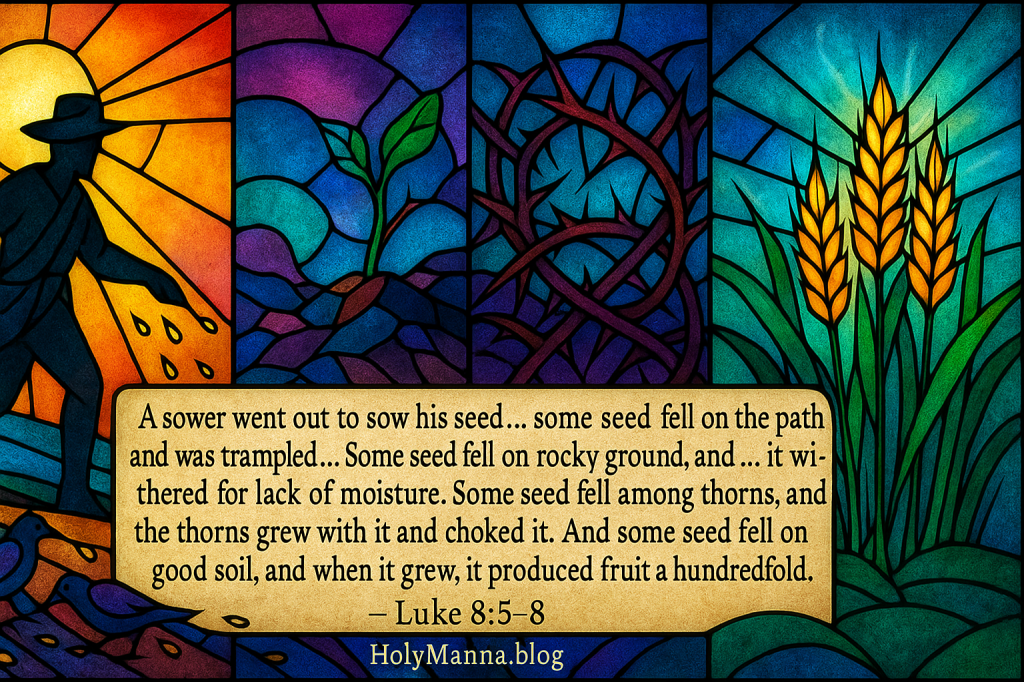
4 When a large crowd gathered, with people from one town after another journeying to him, he spoke in a parable. 5 “A sower went out to sow his seed. And as he sowed, some seed fell on the path and was trampled, and the birds of the sky ate it up. 6 Some seed fell on rocky ground, and when it grew, it withered for lack of moisture. 7 Some seed fell among thorns, and the thorns grew with it and choked it. 8 And some seed fell on good soil, and when it grew, it produced fruit a hundredfold.” After saying this, he called out, “Whoever has ears to hear ought to hear.”
The Purpose of the Parables. 9 Then his disciples asked him what the meaning of this parable might be. 10 He answered, “Knowledge of the mysteries of the kingdom of God has been granted to you; but to the rest, they are made known through parables so that ‘they may look but not see, and hear but not understand.’
The Parable of the Sower Explained. 11 “This is the meaning of the parable. The seed is the word of God. 12 Those on the path are the ones who have heard, but the devil comes and takes away the word from their hearts that they may not believe and be saved. 13 Those on rocky ground are the ones who, when they hear, receive the word with joy, but they have no root; they believe only for a time and fall away in time of trial. 14 As for the seed that fell among thorns, they are the ones who have heard, but as they go along, they are choked by the anxieties and riches and pleasures of life, and they fail to produce mature fruit. 15 But as for the seed that fell on rich soil, they are the ones who, when they have heard the word, embrace it with a generous and good heart, and bear fruit through perseverance.
Detailed Exegesis
Verse 4 – “When a large crowd gathered, with people from one town after another journeying to him, he spoke in a parable.”
The setting highlights Jesus as the teacher of Israel and of the nations. Parables are both an invitation and a judgment. They require the listener to lean in, to seek, and to choose. The crowd size contrasts with the small number who will truly understand, reminding us that hearing the Word is not the same as receiving it.
Verse 5 – “A sower went out to sow his seed. And as he sowed, some seed fell on the path and was trampled, and the birds of the sky ate it up.”
The Sower is Christ who lavishly scatters the Word. The path is compacted soil, an image of a heart made hard by habit or distraction. Trampling and birds portray hostile forces and the superficial exposure of the Word when it lies unreceived. The generosity of Christ is not in doubt. The receptivity of the heart is.
Verse 6 – “Some seed fell on rocky ground, and when it grew, it withered for lack of moisture.”
Rocky ground symbolizes impulsive enthusiasm without depth. Moisture evokes the sustaining grace that penetrates over time. Without roots, beginnings wither. The image anticipates the Church’s teaching on perseverance as a cooperation with grace that endures trial.
Verse 7 – “Some seed fell among thorns, and the thorns grew with it and choked it.”
Thorns grow simultaneously with the plant, not after it. This detail warns that spiritual life is not threatened only by overt opposition but by competing loves that grow alongside the Word. Without deliberate pruning, the good yields to the urgent.
Verse 8 – “And some seed fell on good soil, and when it grew, it produced fruit a hundredfold.” After saying this, he called out, “Whoever has ears to hear ought to hear.”
Good soil is not accident. It is cultivated docility. The hundredfold echoes the superabundance of grace in those who welcome the Word. Jesus’ cry summons decisive attention. Hearing must mature into faithful obedience.
Verse 9 – “Then his disciples asked him what the meaning of this parable might be.”
The disciples model humble inquiry. They do not pretend understanding. They ask. This movement from hearing to seeking is the hinge of understanding in the spiritual life.
Verse 10 – “He answered, ‘Knowledge of the mysteries of the kingdom of God has been granted to you; but to the rest, they are made known through parables so that “they may look but not see, and hear but not understand.”’”
The “mysteries” are God’s saving plan revealed in Christ. Grace grants insight while freedom remains. Isaiah’s lament is quoted to show that refusal to convert renders even clear light opaque. Openness is a gift we ask for and a choice we make.
Verse 11 – “This is the meaning of the parable. The seed is the word of God.”
Jesus interprets His own teaching. The Word is living seed, not static information. It contains within itself the power to transform those who receive it with faith.
Verse 12 – “Those on the path are the ones who have heard, but the devil comes and takes away the word from their hearts that they may not believe and be saved.”
There is a real enemy who opposes faith. Theft from the heart occurs when the Word never penetrates beyond the surface. Vigilance and prayer protect the heart’s threshold so that the Word can lodge and save.
Verse 13 – “Those on rocky ground are the ones who, when they hear, receive the word with joy, but they have no root; they believe only for a time and fall away in time of trial.”
Initial joy is authentic but insufficient without roots. Trials reveal whether faith is rooted in Christ or in consolations. Perseverance is the mark of mature reception.
Verse 14 – “As for the seed that fell among thorns, they are the ones who have heard, but as they go along, they are choked by the anxieties and riches and pleasures of life, and they fail to produce mature fruit.”
Jesus names the thorns plainly. Anxiety, riches, and pleasures do not only distract. They constrict the soul’s capacity to love God first. Without detachment and trust, growth stalls before fruit appears.
Verse 15 – “But as for the seed that fell on rich soil, they are the ones who, when they have heard the word, embrace it with a generous and good heart, and bear fruit through perseverance.”
This is the goal. To hear, to hold fast, and to endure. Generosity toward God and goodness toward neighbor express the Spirit’s work within. Fruit is not an event but a harvest grown through time, trial, and trust.
Teachings
The Catechism of the Catholic Church describes the assent of faith that receives the Word: “By faith, man completely submits his intellect and his will to God. With his whole being man gives his assent to God the revealer.” (CCC 143). As that seed matures, charity bears visible fruit: “The fruits of the Spirit are perfections that the Holy Spirit forms in us as the first fruits of eternal glory. The tradition of the Church lists twelve of them: charity, joy, peace, patience, kindness, goodness, generosity, gentleness, faithfulness, modesty, self control, chastity.” (CCC 1832). Trials require virtue to stand firm: “Fortitude is the moral virtue that ensures firmness in difficulties and constancy in the pursuit of the good. It strengthens the resolve to resist temptations and to overcome obstacles in the moral life. The virtue of fortitude enables one to conquer fear, even fear of death, and to face trials and persecutions.” (CCC 1808). The Church also teaches the primacy of Scripture in nourishing this growth: “In Sacred Scripture, the Church constantly finds her nourishment and her strength.” (CCC 104). Saint Jerome reminds us of the cost of neglecting the Word: “Ignorance of the Scriptures is ignorance of Christ.” (Saint Jerome, Commentary on Isaiah; cited in CCC 133). The Martyrs of Korea witness to good soil par excellence. The Word took root, and through perseverance they bore fruit a hundredfold, even to the shedding of blood for Christ.
Reflection
To become good soil you must cultivate the heart. Begin by setting a daily time to hear the Word, then hold it through the day with a simple verse repeated in prayer. Ask the Holy Spirit to reveal your path, your rocks, and your thorns, and then take one concrete step to address each: guard your heart at the start of the day with a brief prayer against the enemy’s theft, deepen your roots by committing to weekly Eucharistic Adoration, and prune your thorns by practicing detachment in one area of anxiety, riches, or pleasure. Unite your efforts to the witness of the Korean Martyrs and ask their intercession for fortitude. What is one thorn the Lord is asking you to cut back this week so that His Word can breathe and grow? Where can you choose perseverance over quick results so that faith becomes rooted rather than rushed? How will you let Scripture nourish you today so that your life bears a harvest that gives glory to God?
Joyful Hearts, Steadfast Witness
Today God gathers our hearts around one path of discipleship. In 1 Timothy, we are charged to keep the commandment before the “King of kings and Lord of lords” and to remember the Lord who “dwells in unapproachable light.” In Psalm 100, we learn the interior posture that sustains that fidelity, for we are taught to “serve the Lord with gladness” and to enter His presence with thanksgiving. In The Gospel of Luke, Jesus shows us how the Word actually matures within us. He teaches that those who receive it with a good and generous heart “bear fruit through perseverance.” The Memorial of Saints Andrew Kim Tae-gŏn, Paul Chŏng Ha-sang, and Companions brings these threads to life. They welcomed the seed of the Word, they worshiped the true King with joyful courage, and they offered their “noble confession” even to death. Their witness is a living commentary on today’s readings and a summons to our own hearts.
Let us answer this call together. Renew your allegiance to Christ in prayer today and ask for the grace to keep His commandment with purity of heart. Choose thanksgiving before every task so that worship becomes your way of life. Let Scripture take root by meditating on one verse and carrying it through your day. Seek reconciliation where needed, make a simple act of public faith, and ask the Korean Martyrs to intercede for fortitude. How will you let the Lord till your soil so that His Word takes root more deeply this week? Where can you choose persevering love over passing comfort so that your life becomes a hundredfold harvest for God’s glory? May the Eucharist strengthen you, may the Word guide you, and may the saints keep you steadfast until the appearing of our Lord Jesus Christ.
Engage with Us!
Share your reflections in the comments below so we can pray and grow together as a community.
- First Reading: 1 Timothy 6:13-16. How is the Holy Spirit inviting you to keep the commandment without stain this week? Where is Jesus asking you to make a clear, loving confession of faith in a concrete situation you will face?
- Responsorial Psalm: Psalm 100. What doorway will you choose to enter with thanksgiving today, and how will you serve the Lord with gladness there? Which specific reason for God’s enduring mercy will you name aloud in prayer before your next task?
- Holy Gospel: Luke 8:4-15. Which soil most resembles your heart right now, and why? What thorn of anxiety, riches, or pleasure will you prune this week so that the Word can breathe and grow? What single practice will help your roots deepen so you can bear fruit through perseverance?
Let us encourage one another to live a life of faith, to walk in hope, and to do everything with the love and mercy that Jesus taught us. May our hearts become good soil that yields a hundredfold for the glory of God.
Sacred Heart of Jesus, we trust in You!
Immaculate Heart of Mary, pray for us!
Saint Michael the Archangel, defend us in battle!
Follow us on Instagram and Facebook for more insights and reflections on living a faith-filled life.

 Holy Manna!
Leave a comment