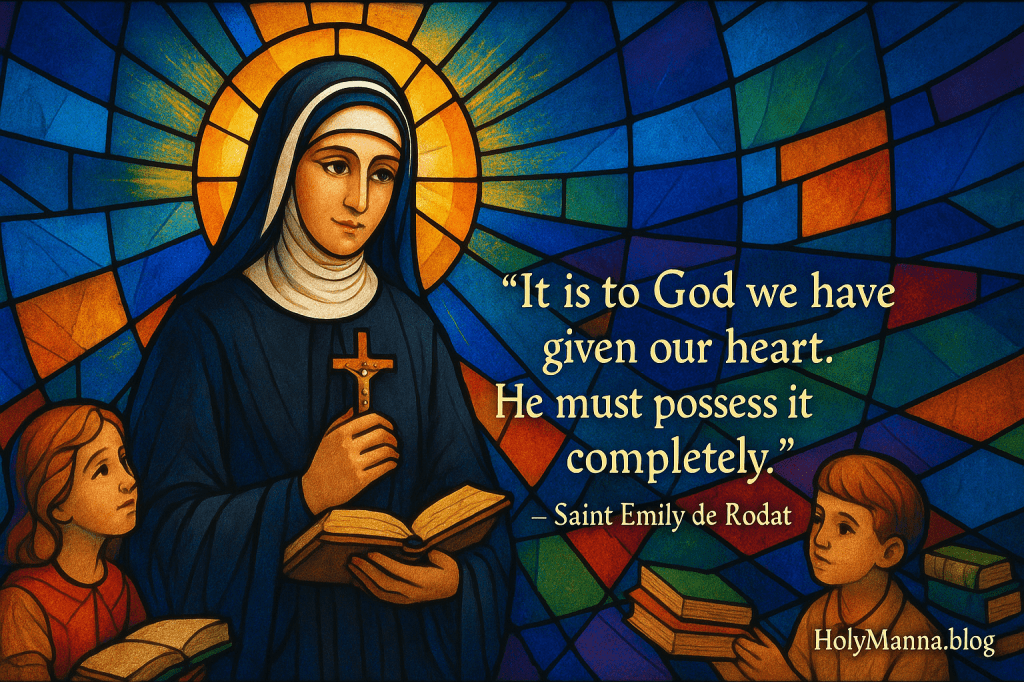
A Teacher of the Poor with a Heart Like Nazareth
Saint Emily de Rodat, foundress of the Sisters of the Holy Family of Villefranche, stands as a luminous witness to the power of charity lived in hiddenness and fidelity. In the wake of the French Revolution, when many poor children were left without catechesis or schooling, she answered Christ with a life that fused contemplation and action. She organized free schools for girls, visited prisoners, cared for the sick and elderly, and fostered houses of prayer that supported the apostolate. Her mission was to make the home of Nazareth present wherever people suffered neglect or ignorance. The Catechism teaches that “Charity is the theological virtue by which we love God above all things for his own sake, and our neighbor as ourselves for the love of God.” (CCC 1822). Emily’s entire life reveals what that looks like in concrete choices that prefer the poor, elevate human dignity, and lead souls to Jesus.
Roots in Aveyron and a Flame Awakened
Emily was born on September 6, 1787, in Druelle near Rodez in southern France. As a child she often stayed with her grandmother in Ginals and later in Villefranche de Rouergue, where the family sought steadiness during the upheaval of the Revolution. The religious climate of her youth had been shattered by persecution, closures of religious houses, and catechetical famine. Within this spiritual desert, the Lord planted a quiet fire. Emily later testified to a decisive grace that redirected her life of faith: “I was sixteen years of age when I learned to know Our Lord.” That discovery did not remain a sentiment. It unfolded into a practical desire to make Christ known to the least. After several attempts to enter established communities, and guided by wise confessors, she discerned that God was inviting her not to seek an existing cloister but to build a home for the poor. On May 3, 1816, with a few companions, she began to teach without charging fees, placing the entire work under the Holy Family and under the protection of Mary. In time the small school became a congregation dedicated to forming minds and hearts in truth and virtue.
Nazareth in the Streets and Classrooms
Emily used the language of Nazareth to describe her charism because the Holy Family’s quiet life of labor, prayer, and mutual love shaped her vision of evangelization. By “Nazareth” she meant a spirituality of hiddenness and simplicity where Jesus is found in ordinary duties done with extraordinary love, a family spirit that makes every house a little home of the Holy Family. She wanted each foundation to be a small Nazareth with the Eucharist at the heart, charity as the rule, and humble work as the path to holiness. She insisted that catechesis and literacy belong together, since the mind trained in truth becomes capable of freedom in Christ. She taught the girls entrusted to her not only to read and write but also to pray, to serve, and to hope. The first schools were simple, sometimes set up in humble rooms with limited resources. Providence repeatedly supplied what was needed, often at the last moment, which strengthened the Sisters’ confidence that God Himself was the true founder. As new foundations multiplied, Emily added works that would anchor the apostolate in prayer and widen its reach. She established houses of adoration to intercede for the missions, organized visits to prisons where she brought consolation and basic instruction, and formed Sisters for hospital service among the poor and forgotten. In each place the pattern was the same. The Sisters loved Jesus in the Eucharist, then went to love Him in those who were most vulnerable. The Catechism calls these the works of mercy, “charitable actions by which we come to the aid of our neighbor in his spiritual and bodily necessities.” (CCC 2447). Emily’s communities made that definition visible.
Hidden Mysticism and the Quiet Miracles of Fidelity
Accounts of Emily’s spiritual life describe a woman of deep interior union with God who passed through long seasons of aridity and darkness. Her sanctity did not depend on public wonders but on persevering love. Reliable histories do not record spectacular miracles worked by her during life in the manner of dramatic healings on command. What shines instead are the quiet miracles of Providence that met the needs of the poor, the conversions of students who rediscovered their dignity in Christ, the reconciliation of families whose daughters brought faith home, and the daily renewal of strength that carried Emily through fatigue and illness. She taught her Sisters to trust the Lord when consolations vanished and to remain constant in prayer, service, and humility. In that sense her life was a living catechesis on hope. Near the end of her earthly journey she suffered greatly in body, yet her peace deepened. Her example teaches that sanctity often appears ordinary on the surface while heaven does its deepest work within.
Trials that Purify Hope, Suffering that Becomes a Seed
Emily’s path was marked by contradictions. Early vocational attempts did not bear fruit. Administrative burdens weighed on her as houses multiplied. Misunderstandings arose, as they often do in apostolic foundations. Most piercing of all, she experienced a prolonged night of faith in which God seemed absent while responsibilities increased. Physical suffering also grew severe, especially in her final years, when painful illness affected her eyes and overall strength. In every trial she chose to cling to Christ and to offer her pain for souls. She drew courage from the words of the Lord in The Gospel of Matthew: “Whatever you did for one of these least brothers of mine, you did for me.” (Matthew 25:40). For Emily that verse was not a motto for a wall. It was a path for every hour. She died on September 19, 1852, in Villefranche de Rouergue, entrusting her daughters and their students to the Sacred Heart of Jesus and to Our Lady. Her suffering became seed. The congregation continued to blossom, and the charism of Nazareth continued to heal cultures wounded by ignorance and indifference.
Signs from Heaven and the Growth of a Family
After Emily’s death, favors and healings were reported through her intercession, and devotion grew around her tomb. The Church recognized cures that helped advance her cause, confirming what the faithful already sensed about her holiness. She was beatified in 1940 and canonized on April 23, 1950, by Pope Pius XII. The Sisters of the Holy Family preserved her remains in the crypt of their chapel at Villefranche de Rouergue, which remains a place of prayer. Pilgrims come asking for the same gifts that shaped Emily’s life, a humble love for Jesus, a teachable heart, and a courageous tenderness for the poor. The Catechism reminds us that through the saints “the union of the whole Church in the Spirit may be strengthened.” (CCC 957). Those who visit Emily’s resting place often leave with renewed strength for simple daily fidelity.
Lessons for Today and a Way to Begin Now
Emily’s life answers the question that many ask in a noisy age. How can I serve God if I do not feel holy and if my resources are small? Her response is to begin in Nazareth. Pray with Jesus in the Eucharist. Seek the hidden place where your heart can listen. Go to the poor near you. Offer the skills you have for those who cannot repay you. If you are a parent or teacher, form minds and hearts together. If you are a student, befriend someone who struggles to read or to believe. If your parish has a school, ask how you can help a family with fees or uniforms. If your city has a prison ministry, accompany it with prayer and simple acts of presence. Above all, do not be discouraged when you feel interior dryness. Emily learned to let fidelity carry her across spiritual deserts. The Lord sees those quiet offerings and uses them to rescue souls. In the words of the Lord that sustained her, “Whatever you did for one of these least brothers of mine, you did for me.” (Matthew 25:40). Let that promise become the pattern of your week.
Engage with Us!
We would love to hear how Saint Emily de Rodat’s story speaks to you. Share your reflections in the comments below so we can learn from one another and grow together in holiness.
- Where is Christ inviting you to be a “teacher of the poor” in your city or parish this week?
- Which work of mercy from CCC 2447 stirs your heart today, and how will you live it concretely?
- How does Saint Emily’s perseverance through spiritual darkness encourage you in your own trials?
- Who is one person—by name—you can accompany with prayer and presence this week?
- How might your home become a little “Nazareth” of simplicity, prayer, and love?
Let’s go forth strengthened by the intercession of Saint Emily de Rodat. May we live a life of faith and do everything with the love and mercy Jesus taught us.
Saint Emily de Rodat, pray for us!
Follow us on Instagram and Facebook for more insights and reflections on living a faith-filled life.

 Holy Manna!
Leave a comment