Friday of the Twenty-fourth Week in Ordinary Time – Lectionary: 447
Investing in Eternity:
Where does your heart look for security today? Today’s readings move like a single melody about true wealth that begins with warning, crescendos with wisdom, and resolves in discipleship. In 1 Timothy 6:2-12, Paul pastors a young church culture tempted to treat religion as a path to status and profit amid the prosperity and patronage systems of the Greco-Roman world. He exposes the spiritual corrosion that follows, naming the danger with clarity: “For the love of money is the root of all evils.” He then redirects desire toward the virtues that endure, calling the believer to pursue righteousness, devotion, faith, love, patience, and gentleness, and to fight the good fight for eternal life. Psalm 49 is a wisdom psalm that would have been sung to instruct Israel’s heart. It unmasks the illusion of wealth by reminding us that death severs every ledger and every title. “At his death he will not take along anything.” This is not cynicism. It is spiritual sobriety that frees us to live as stewards. Finally, Luke 8:1-3 anchors the call in a concrete scene from Jesus’ ministry. As He proclaims the Kingdom from town to town, women disciples like Mary Magdalene, Joanna, and Susanna respond to grace by supporting the mission from their resources. In a culture where public religious life was dominated by men, Luke highlights these women as models of redeemed stewardship, showing that material goods can become love in action when placed at the service of the Gospel. Read together, the Church invites us to detachment of heart, contentment in God, and generous participation in Christ’s mission. The Catechism teaches that happiness is not found in riches and calls disciples to poverty of heart and detachment that makes room for charity (CCC 1723, 2544-2547), as well as to support the Church’s material needs according to our abilities (CCC 2043). How might the Lord be asking you to convert your possessions into mission, your anxieties into trust, and your desire for more into a love that gives?
First Reading – 1 Timothy 6:2-12
Stewardship Over Gain
Paul writes to Timothy within the social fabric of the Greco-Roman world, where patronage networks, status competition, and the institution of slavery shaped daily life. The opening line assumes a hard setting in which some believers were household slaves and some were Christian masters. Into this tension, Paul insists that the Gospel reorders relationships and motives. He warns against teachers who turn piety into profit and against the corrosive desire for wealth that fractures communities. He then calls the minister to pursue the virtues that endure and to fight the good fight for eternal life. This reading fits today’s theme by contrasting greed and rivalry with contentment and generous stewardship. It harmonizes with Psalm 49, which unmasks the illusion of riches, and with Luke 8:1-3, where women disciples convert their resources into mission. The Church reads these verses as a call to detachment of heart, contentment in God, and sacrificial generosity for the Kingdom.
1 Timothy 6:2-12
New American Bible (Revised Edition)
2 Those whose masters are believers must not take advantage of them because they are brothers but must give better service because those who will profit from their work are believers and are beloved.
Teach and urge these things. 3 Whoever teaches something different and does not agree with the sound words of our Lord Jesus Christ and the religious teaching 4 is conceited, understanding nothing, and has a morbid disposition for arguments and verbal disputes. From these come envy, rivalry, insults, evil suspicions, 5 and mutual friction among people with corrupted minds, who are deprived of the truth, supposing religion to be a means of gain. 6 Indeed, religion with contentment is a great gain. 7 For we brought nothing into the world, just as we shall not be able to take anything out of it. 8 If we have food and clothing, we shall be content with that. 9 Those who want to be rich are falling into temptation and into a trap and into many foolish and harmful desires, which plunge them into ruin and destruction. 10 For the love of money is the root of all evils, and some people in their desire for it have strayed from the faith and have pierced themselves with many pains.
Exhortations to Timothy. 11 But you, man of God, avoid all this. Instead, pursue righteousness, devotion, faith, love, patience, and gentleness. 12Compete well for the faith. Lay hold of eternal life, to which you were called when you made the noble confession in the presence of many witnesses.
Detailed Exegesis
Verse 2 – “Those whose masters are believers must not take advantage of them because they are brothers but must give better service because those who will profit from their work are believers and are beloved. Teach and urge these things.”
Paul situates discipleship within unequal social realities without endorsing injustice. The command guards against presuming upon a master’s faith to justify lax service. In Christ, social nearness increases moral responsibility. Love, not entitlement, governs work. The pastoral charge to “teach and urge” shows that right doctrine must form concrete behavior.
Verse 3 – “Whoever teaches something different and does not agree with the sound words of our Lord Jesus Christ and the religious teaching”
Orthodoxy is tethered to the words of Jesus and the apostolic rule of faith. Deviations are not minor preferences. They rupture communion and derail holiness because truth and life are inseparable in Christ.
Verse 4 – “is conceited, understanding nothing, and has a morbid disposition for arguments and verbal disputes. From these come envy, rivalry, insults, evil suspicions,”
False teaching breeds sickly controversy. The spiritual disease manifests socially as envy and suspicion. The Church recognizes this dynamic whenever doctrine becomes a pretext for ego rather than a path to charity.
Verse 5 – “and mutual friction among people with corrupted minds, who are deprived of the truth, supposing religion to be a means of gain.”
Here Paul names the root: treating religion as a mechanism for status or money. Such corruption weaponizes piety and tears communities apart. The antidote is poverty of heart and service.
Verse 6 – “Indeed, religion with contentment is a great gain.”
Contentment is not passivity. It is freedom from craving that permits joyful generosity. The true profit of faith is communion with God, which no market can price.
Verse 7 – “For we brought nothing into the world, just as we shall not be able to take anything out of it.”
Memento mori purifies desire. Death cancels earthly accounts. This wisdom stabilizes the heart against anxiety and excess, echoing Psalm 49.
Verse 8 – “If we have food and clothing, we shall be content with that.”
Paul sketches a rule of sufficiency. Simplicity is evangelical, because it witnesses that God, not goods, is our good.
Verse 9 – “Those who want to be rich are falling into temptation and into a trap and into many foolish and harmful desires, which plunge them into ruin and destruction.”
The will to be rich, not wealth per se, is the snare. Disordered desire multiplies temptations and blinds judgment, endangering both faith and fraternity.
Verse 10 – “For the love of money is the root of all evils, and some people in their desire for it have strayed from the faith and have pierced themselves with many pains.”
Paul isolates avarice as a root vice that splinters the soul and wounds the Body. The image of self-inflicted piercing evokes how greed boomerangs and harms the one who clutches.
Verse 11 – “But you, man of God, avoid all this. Instead, pursue righteousness, devotion, faith, love, patience, and gentleness.”
The minister’s identity drives his ascetic strategy. Avoid the snares, then chase the virtues that mirror Christ. The list moves from covenant fidelity to relational tenderness, mapping a heart like the Lord’s.
Verse 12 – “Compete well for the faith. Lay hold of eternal life, to which you were called when you made the noble confession in the presence of many witnesses.”
Paul employs the athletic contest to describe perseverance. The “noble confession” evokes baptismal profession and possibly Timothy’s ordination. The end is not survival but seizing life with God.
Teachings
The Catechism gathers these lines into the call to evangelical poverty and right use of goods. “Jesus enjoins his disciples to prefer him to everything and everyone and bids them ‘renounce all that they have’ for his sake and that of the Gospel.” (CCC 2544). The Church warns that attachment to riches stifles charity: “The Lord grieves over the rich, because they find their consolation in the abundance of goods.” (CCC 2547). Generosity is not optional sentiment but a concrete obligation within the communion of the Church: “The fifth precept ‘You shall help to provide for the needs of the Church’ means that the faithful are obliged to assist with the material needs of the Church, each according to his own ability.” (CCC 2043). These teachings illuminate Paul’s contrast between false teachers who monetize religion and true disciples who invest their resources in the Gospel. Historically, the early Christian communities faced itinerant teachers who exploited hospitality. Apostolic instruction, like this passage, formed criteria for discernment and safeguarded the poor from spiritual and material exploitation, while urging believers to simplicity of life, almsgiving, and support of mission.
Reflection
Ask the Lord to examine your desires in the light of eternity, then take concrete steps of simplicity and generosity. Consider establishing a rule of life that prioritizes Sunday worship, daily prayer, weekly almsgiving, and regular support of your parish and the missions you believe in. Review your budget and calendar and identify one habit of excess to relinquish and one practice of service to embrace. When you feel the pull of comparison or scarcity, pray with these verses until contentment returns. Where might you be tempted to treat piety as a path to personal gain rather than a response of love? What would a simpler, freer, more generous month look like in your finances and your time? How can your work this week become an offering that builds up the Body of Christ rather than a stage for rivalry or anxiety?
Responsorial Psalm – Psalm 49:6-10, 17-20
Facing the Mirage of Wealth with Wisdom
Composed as a wisdom hymn, Psalm 49 speaks to all peoples and classes, not only to Israel, and confronts a perennial temptation in the ancient Near East and in our own age: to seek security in wealth, status, and reputation. In Israel’s worship this psalm functioned as catechesis that dismantled the illusion of riches by placing life under the judgment of God and the horizon of death. The psalmist refuses fear in “evil days” because gold cannot ransom a single soul. This fits today’s theme by clarifying the difference between hoarding and holy stewardship. In light of 1 Timothy 6, the psalm exposes the lie that piety and prosperity are the same thing, and it harmonizes with Luke 8:1-3 by preparing the heart to convert possessions into love for the Kingdom.
Psalm 49:6-10, 17-20
New American Bible (Revised Edition)
6 Why should I fear in evil days,
with the iniquity of my assailants surrounding me,
7 Of those who trust in their wealth
and boast of their abundant riches?
8 No man can ransom even a brother,
or pay to God his own ransom.
9 The redemption of his soul is costly;
and he will pass away forever.
10 Will he live on forever, then,
and never see the Pit of Corruption?
17 Do not fear when a man becomes rich,
when the wealth of his house grows great.
18 At his death he will not take along anything,
his glory will not go down after him.
19 During his life his soul uttered blessings;
“They will praise you, for you do well for yourself.”
20 But he will join the company of his fathers,
never again to see the light.
Detailed Exegesis
Verse 6 – “Why should I fear in evil days, with the iniquity of my assailants surrounding me,”
The psalmist sets a courtroom of conscience. External threats do not determine ultimate security. Fear is relativized because the Lord, not circumstances, holds life and death. This inaugurates a wisdom perspective where faith, not fortune, governs the heart.
Verse 7 – “Of those who trust in their wealth and boast of their abundant riches?”
Trusting in wealth is a theological error before it is a financial one. Boasting reveals disordered worship. The verse invites examination of what we praise and depend upon.
Verse 8 – “No man can ransom even a brother, or pay to God his own ransom.”
Redemption is God’s work. Money cannot buy life. The psalm drives a wedge between price and worth, refusing to let human dignity be monetized. It anticipates the New Covenant where Christ’s blood, not silver, is the ransom.
Verse 9 – “The redemption of his soul is costly; and he will pass away forever.”
The costliness of redemption underscores human helplessness. Death exposes the bankruptcy of self-salvation. The line prepares for the Gospel revelation of a ransom paid by God Himself.
Verse 10 – “Will he live on forever, then, and never see the Pit of Corruption?”
A rhetorical question demolishes the fantasy of immortality through wealth. Human limits are pedagogical. They teach us to seek life where it truly is.
Verse 17 – “Do not fear when a man becomes rich, when the wealth of his house grows great.”
The psalm re-educates the emotions. Another’s prosperity should not incite envy or despair. Detachment stabilizes the heart for charity.
Verse 18 – “At his death he will not take along anything, his glory will not go down after him.”
This is biblical memento mori. Coffins have no pockets. Glory borrowed from wealth evaporates at the grave, while glory received from God endures.
Verse 19 – “During his life his soul uttered blessings; ‘They will praise you, for you do well for yourself.’”
Flattery often crowns fortune. The psalm unmasks a culture that canonizes self-promotion. Praise from others is not proof of wisdom.
Verse 20 – “But he will join the company of his fathers, never again to see the light.”
The closing line brings eschatological sobriety. Without God, death closes the book. With God, death becomes a door. The psalm presses us to choose our trust now.
Teachings
The Catechism frames the psalm’s critique with the logic of beatitude: “The beatitude we are promised confronts us with decisive moral choices. It invites us to purify our hearts of bad instincts and to seek the love of God above all else; it teaches us that true happiness is not found in riches or well-being, in human fame or power, or in any creature, but in God alone, the source of every good and of all love.” (CCC 1723). The Church names evangelical poverty not as misery but as freedom for love: “The Lord grieves over the rich, because they find their consolation in the abundance of goods.” (CCC 2547). Works of mercy translate detachment into concrete charity: “The works of mercy are charitable actions by which we come to the aid of our neighbor in his spiritual and bodily necessities.” (CCC 2447). Scripture itself anchors stewardship in God’s universal lordship and the common destination of goods. “The earth is the Lord’s and all it holds, the world and those who dwell in it.” (Psalm 24:1). Israel’s law taught that property is entrusted, not absolute: “The land shall not be sold in perpetuity, for the land is mine; for you are strangers and sojourners with me.” (Leviticus 25:23). In this light, Psalm 49 rebukes the false security of wealth and redirects desire toward God’s redeeming love that alone ransoms the human heart.
Reflection
Ask for the grace to be taught by death without being paralyzed by it. Consider praying this psalm slowly and then opening your budget and calendar before the Lord. Choose one concrete simplification, like declining an unnecessary purchase, and one concrete generosity, like setting aside a fixed portion for almsgiving and parish support. Practice hiddenness by doing a good deed that no one will see. When anxiety rises as others prosper, repeat today’s lines until peace returns. Where are you quietly trusting money to secure what only God can give? How might you let gratitude and generosity interrupt habits of comparison this week? What practical step can you take today to convert possessions into love for Christ and neighbor?
Holy Gospel – Luke 8:1-3
Women Who Funded the Mission
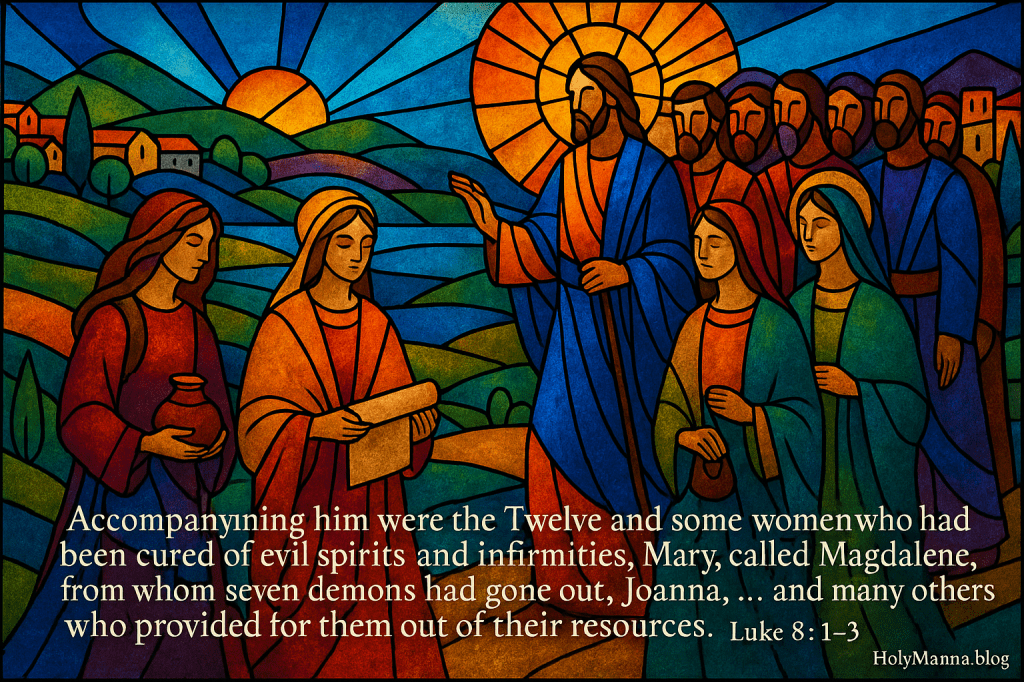
Luke situates Jesus in the rhythm of itinerant ministry across Galilee, where rabbis normally traveled with male disciples and relied on hospitality in a culture shaped by honor, shame, and patronage. By naming women among the Lord’s close followers, Luke highlights a striking feature of the early movement of Jesus. These women had received healing from evil spirits and illnesses, and they now reoriented their resources toward the Kingdom. The Gospel shows that true wealth is not hoarded but offered to Christ’s work. In harmony with 1 Timothy 6 and Psalm 49, this scene reframes possessions as instruments of love and witness, revealing that the contentment of the disciple blossoms into concrete generosity.
Luke 8:1-3
New American Bible (Revised Edition)
Galilean Women Follow Jesus. 1 Afterward he journeyed from one town and village to another, preaching and proclaiming the good news of the kingdom of God. Accompanying him were the Twelve 2 and some women who had been cured of evil spirits and infirmities, Mary, called Magdalene, from whom seven demons had gone out, 3 Joanna, the wife of Herod’s steward Chuza, Susanna, and many others who provided for them out of their resources.
Detailed Exegesis
Verse 1 – “Afterward he journeyed from one town and village to another, preaching and proclaiming the good news of the kingdom of God. Accompanying him were the Twelve”
Luke emphasizes Jesus’ movement and message. The Kingdom is not a theory. It is announced in person as Jesus brings liberation and mercy to each place He visits. The presence of the Twelve underlines the apostolic foundation. They learn that mission requires mobility, trust in Providence, and shared life. The Gospel’s economy is relational, not transactional. It prepares the way for a new understanding of stewardship as participation in Christ’s proclamation.
Verse 2 – “and some women who had been cured of evil spirits and infirmities, Mary, called Magdalene, from whom seven demons had gone out,”
Grace precedes generosity. These women do not buy access to Jesus. They respond to deliverance with devoted presence. Mary Magdalene’s specific mention signals both the depth of her healing and her central role among Jesus’ followers. Luke’s focus on women healed and then called into active discipleship challenges cultural expectations and shows that gifts, time, and presence flow from gratitude for salvation.
Verse 3 – “Joanna, the wife of Herod’s steward Chuza, Susanna, and many others who provided for them out of their resources.”
Joanna’s connection to Herod Antipas’ court suggests that the Gospel quietly penetrates even elite households. “Provided for them out of their resources” makes visible the material backbone of mission. The verb Luke uses indicates ongoing support. Stewardship is not an occasional tip. It is sustained partnership. This verse anchors today’s theme by portraying wealth converted into worship, where possessions serve persons and the proclamation of the Kingdom.
Teachings
The Catechism clarifies that discipleship includes generous support for the Church’s life and mission. “The fifth precept ‘You shall help to provide for the needs of the Church’ means that the faithful are obliged to assist with the material needs of the Church, each according to his own ability.” (CCC 2043). Works of mercy give this generosity a concrete shape that mirrors the Gospel’s pattern of healing and service. “The works of mercy are charitable actions by which we come to the aid of our neighbor in his spiritual and bodily necessities.” (CCC 2447). The Lord calls His followers to freedom from attachment so that love can govern the use of goods. “Jesus enjoins his disciples to prefer him to everything and everyone and bids them ‘renounce all that they have’ for his sake and that of the Gospel.” (CCC 2544). Luke’s naming of women among the Lord’s collaborators also resonates with the Church’s teaching on equal dignity. “In creating man ‘male and female,’ God gives man and woman an equal personal dignity.” (CCC 2334). These teachings illuminate how healed hearts become generous hands, and how equal dignity blossoms in distinct vocations that together sustain the mission of the Church.
Reflection
Ask Jesus to show you where He is “passing by” in your town today, and how your gifts can travel with Him. Consider adopting a simple rule of stewardship that includes consistent support of your parish and at least one missionary work you pray for regularly. Invite the Lord to convert any areas of fear into generous trust, and let your calendar and budget reveal your love. Practice seeing every resource as seed for the Kingdom rather than as a shield for self. How has the Lord’s healing in your life moved you to share your time, talents, and treasure? What concrete step could you take this week to support Christ’s mission through your parish or a missionary apostolate? Where might you be called to move from occasional giving to sustained partnership for the Gospel?
Opening Our Hands, Finding Our Treasure
Today the Word drew a straight line from the heart to the wallet and then to the mission of Christ. 1 Timothy 6:2-12 warned us that the love of money fractures communion and wounds the soul, while urging us to pursue righteousness, devotion, faith, love, patience, and gentleness, and to “compete well for the faith.” Psalm 49 answered our anxieties by reminding us that wealth cannot ransom a life and that “at his death he will not take along anything.” Luke 8:1-3 then showed what redeemed stewardship looks like as women healed by Jesus placed their resources at the service of the Kingdom. Read together, the message is simple and searching: detach your heart, find contentment in God, and turn your goods into love that fuels the Gospel.
Here is your invitation. Ask Jesus to convert fear into freedom and possessions into praise. Pray with Psalm 49 this week until peace returns to your decisions about time and money. Choose one act of simplification, one concrete gift to your parish or a missionary work, and one act of hidden service for someone in need. Let your calendar and your budget become your prayer. The Church teaches that true happiness is found in God alone and that disciples support the mission according to their ability, as taught in CCC 1723 and CCC 2043. If you feel the tug of comparison or scarcity, return to the Gospel scene and stand beside Mary Magdalene, Joanna, and Susanna as they quietly sustain the Lord’s work.
What step of generosity will you take today to “compete well for the faith”? How will you let Christ’s healing in your life become hope for someone else through your time, talent, and treasure? May the Holy Spirit give you a poverty of heart that is rich in love, a contentment that frees you to give, and a joyful courage to invest in the Kingdom that does not fade.
Engage with Us!
Share your reflections in the comments below and let us know how the Lord is speaking to you through today’s readings.
- First Reading: 1 Timothy 6:2-12 – Where is God inviting you to loosen your grip on wealth or status and recover contentment in Him? Which virtue named in verse 11 will you practice today, and what concrete step will you take to begin?
- Responsorial Psalm: Psalm 49:6-10, 17-20 – What fear about money or reputation can you place before the Lord in prayer today? How will you practice memento mori in a hopeful way that frees you to love more?
- Holy Gospel: Luke 8:1-3 – How has Jesus healed you, and how can that gratitude become sustained support for His mission through your parish or a missionary work? What specific percentage or time commitment could you joyfully set aside this month for the Kingdom?
May God strengthen you to live a life of faith and to do everything with the love and mercy Jesus taught us, so that your resources, time, and heart may become a living offering to Him.
Sacred Heart of Jesus, we trust in You!
Immaculate Heart of Mary, pray for us!
Saint Michael the Archangel, defend us in battle!
Follow us on Instagram and Facebook for more insights and reflections on living a faith-filled life.

 Holy Manna!
Leave a comment