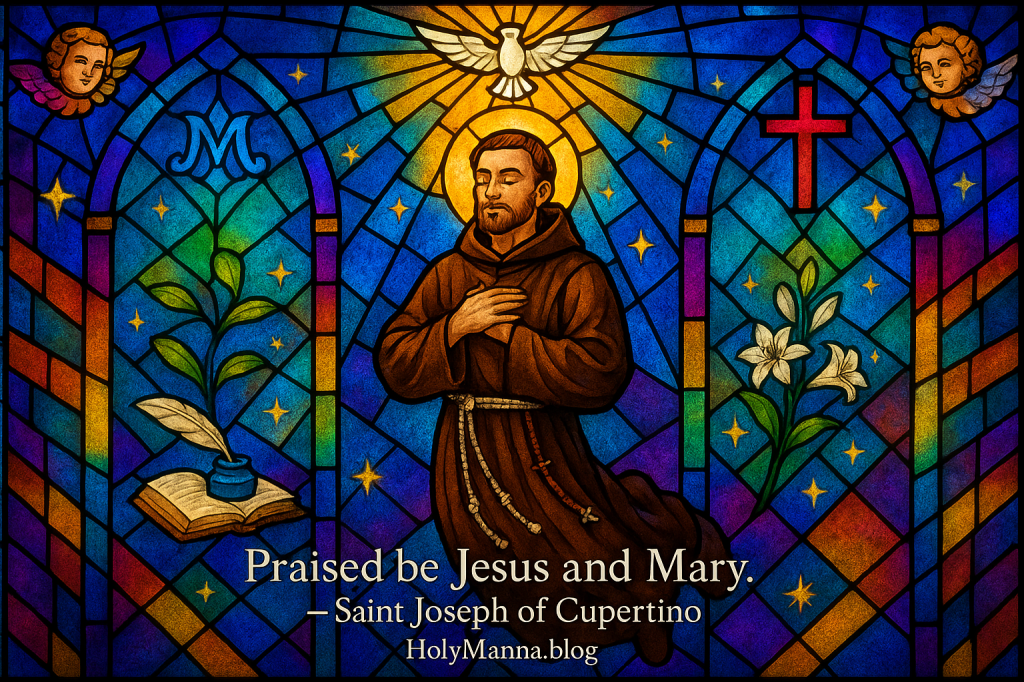
A Skyward Heart With Feet Planted in Obedience
Saint Joseph of Cupertino, the Conventual Franciscan friar lovingly known as the Flying Saint, is remembered for astonishing ecstasies and documented levitations that drew crowds to wonder and sinners to conversion. Yet his deepest legacy is not spectacle but sanctity. His life displays how God delights to lift the humble, to make prayer the soul of study, and to turn human weakness into a window for grace. Canonized in 1767 and celebrated on September 18, he is the patron of students, examinees, air travelers, pilots, and astronauts. The Church holds up saints as luminous signs of hope, and in the words of The Catechism of the Catholic Church, “By canonizing some of the faithful, the Church recognizes the power of the Spirit of holiness within her and sustains the hope of believers.” (CCC 828).
From Stable to Sanctuary
Giuseppe Maria Desa was born on June 17, 1603, in Copertino in the Apulia region of southern Italy. His father died before he was born and the family’s debts were so heavy that his mother, Francesca Panara, delivered him in a stable. As a child he was simple, absentminded, and often teased, earning the nickname Boccaperta, the open mouthed one, for his habit of staring heavenward in wonder. Drawn to religious life, he first sought the Capuchins but was dismissed after repeated mishaps. That disappointment became the doorway to God’s plan. He was taken in by the Conventual Franciscans near the shrine of Santa Maria della Grottella, where he served humbly and gradually was admitted to studies. Though he struggled academically, he prayed intensely and loved the poor. When the time for examination finally arrived, he was asked only what he had studied, and he passed. Joseph was ordained a priest in 1628. He would become known throughout Italy not for brilliance or eloquence, but for a burning love of God that drew him into rapture at the slightest mention of Jesus or Mary.
When Love Takes Flight
Joseph’s life was a continual testimony that miracles are signs which lead to the Miracle Worker. The Catechism teaches that Christ’s mighty deeds reveal the Kingdom of God and elicit faith, and that the gifts of the Spirit continue in the Church (cf. CCC 547–548). In Joseph’s case, numerous witnesses, including clergy and civic officials, testified that during prayer he would enter ecstasy and rise from the ground, sometimes remaining suspended for long periods. Sacred music, the name of Jesus or the Blessed Virgin, the sight of a crucifix, and the solemnity of the Mass often moved him to rapture. He was known to be so lost in God that he seemed unaware of those around him until obedience recalled him to earth. People came to confession moved by what they saw and heard, and many experienced interior conversions. His counsel was simple and Christ centered. Few extended sayings of his were recorded, but witnesses consistently noted his spontaneous, love filled ejaculations during ecstasy such as “Praised be Jesus and Mary.” When asked about the extraordinary phenomena around him, he deflected attention from himself to God’s mercy and urged people to love, to confess, and to receive the Eucharist frequently.
Trials in the Shadows
With the marvels came misunderstanding. Because his ecstasies drew crowds and could disrupt liturgy, superiors often restricted Joseph to celebrate Mass privately. Envy and suspicion stirred formal inquiries, and he was examined by ecclesiastical authorities. For years he lived under obedience in quiet houses, moved from place to place to guard the peace. These hidden seasons were his true school of holiness. He practiced penance prudently, embraced humiliations with patience, and submitted his gifts to the discernment of the Church. The Catechism sums up the road he walked: “The way of perfection passes by way of the Cross.” (CCC 2015). Joseph learned to let God choose both the moments of flight and the long years of stillness, content to be little so that Christ might be all in all.
Afterglow of Grace
Joseph died in Osimo on September 18, 1663, commending his soul to the Lord he adored. Devotion to him spread quickly. Pilgrims traveled to Osimo and to his native Copertino to seek his intercession and to venerate his relics. Accounts of favors received multiplied, especially among students who entrusted exams and studies to his prayer. The well known prayer invoking his help at examinations arose from popular piety that remembered how providentially he had been examined only on what he knew. Healings and consolations were reported, and his name passed into new lands with missionaries and explorers. Even the modern city of Cupertino in California ultimately traces its name to a mission era toponym honoring Saint Joseph of Cupertino, a reminder that his humble witness has quietly touched the far reaches of the world. To this day, people preparing for tests, interviews, and journeys call on him, confident that the God who lifted Joseph’s heart will steady theirs.
Lessons for Today
Joseph teaches that sanctity is possible for the distracted, the anxious, and the academically average when love of God becomes the center. Make your study an act of worship by beginning with prayer, offering your work to Jesus, and taking short pauses to lift your heart during the day. If you feel clumsy or overlooked, remember that God raises the lowly and delights to show His power through those who cannot rely on themselves. When your efforts are hemmed in by limits, let obedience and humility be your wings. Receive the sacraments regularly, especially Reconciliation and the Eucharist. Entrust your fears to Our Lady, whom Joseph loved tenderly, and let your lips learn the simple phrase that framed his life of praise, “Praised be Jesus and Mary.” In all things, imitate his docility to the Church so that your gifts, ordinary or extraordinary, remain at the service of love. As the psalmist reminds us, “The humble shall hear and be glad.” (cf. Psalm 34).
Engage with Us!
Share your thoughts and experiences with Saint Joseph of Cupertino in the comments. How does his humble trust in God encourage you today?
- Where do you most need to surrender anxious striving and ask for the Holy Spirit’s help, especially in study or work?
- How might you practice humility and obedience in a concrete way this week, following Joseph’s hidden faithfulness?
- Is there a “private chapel” space you can create for daily prayer so the Lord can lift your heart above distractions?
- Whom can you encourage this week by praying Joseph’s traditional exam prayer for them before a big test or interview?
May Saint Joseph of Cupertino steady our minds, lift our hearts, and teach us to do every task with the love and mercy that Jesus has taught us.
Saint Joseph of Cupertino, pray for us!
Follow us on Instagram and Facebook for more insights and reflections on living a faith-filled life.

 Holy Manna!
Leave a comment