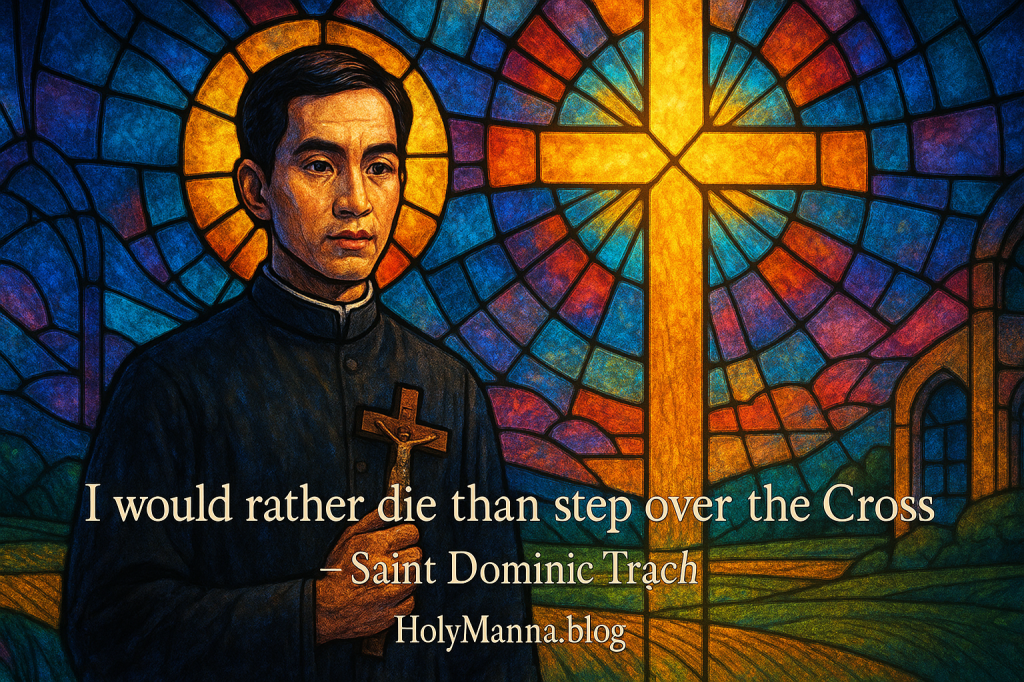
A Shepherd Who Would Not Step Over the Cross
Saint Dominic Trạch shines among the 117 Holy Martyrs of Vietnam as a diocesan priest formed by Dominican spirituality whose fidelity to Jesus never bent under pressure. He ministered in the Bùi Chu region during ferocious crackdowns on the Church, offering the sacraments in secret, strengthening frightened families, and protecting his brother priests. His life is remembered for pastoral zeal, humility, and a love for the Cross that was tested by interrogators who demanded he trample a crucifix to save his life. He refused. The Church venerates him as a model of priestly courage and evangelical charity, canonized with his companions by Saint John Paul II in 1988 and celebrated each year on November 24, the Memorial of the Vietnamese Martyrs.
From Ngoại Vối to the Altar
Dominic Trạch was born in 1793 in Ngoại Vối, within today’s Thạch Bi parish of the Bùi Chu diocese in Nam Định. Raised near the heartbeat of parish life, he entered seminary and completed his studies during the reign of Emperor Gia Long. He was ordained a priest at about thirty years of age and, the following year on June 3, 1825, was received into the Dominican family as a tertiary. Frail health marked his adulthood and he suffered from pulmonary tuberculosis, yet he embraced fasting and penance with a serene spirit. He first served at Quần Cống, then was assigned to Lục Thủy where he mentored seminarians, taught doctrine, heard confessions, and prepared catechumens for baptism. Those who knew him remembered a quiet priest with a resolute will, measured words, and a habit of visiting the poor at night to avoid drawing attention during the day.
Hidden Lamps and Open Hearts
The Vietnam of Father Trạch’s priesthood was a land where the Mass often moved from home to home and catechesis took place by whisper and candlelight. He is best known for the steady, unseen miracles that accompany pastoral charity. When persecution intensified, he remained with his flock rather than flee, organizing clandestine catechism classes, reconciling sinners through confession, bringing Holy Communion to families who had not seen a priest for months, and preparing the sick for a holy death. Accounts do not record spectacular healings or public wonders worked by him during life. Instead they highlight the miracle of perseverance. His presence revived hope in wavering hearts, inspired conversions, and kept the fragile fabric of parish life intact. The Church teaches in the Catechism that the Holy Spirit adorns the faithful with gifts for the building up of the Body of Christ, and Father Trạch’s gifts were those of quiet endurance, wise counsel, and a shepherd’s heart that would not abandon the sheep.
The Test of the Cross
Persecution swelled under Emperor Minh Mạng. Father Trạch was arrested in 1839 at Ngọc Cục but was ransomed by the faithful and returned at once to ministry. On April 11, 1840, while visiting fellow priests near Ngưỡng Nhân, he was seized again and taken to Xuân Trường and then to the provincial prison at Nam Định. Interrogators commanded him to betray missionaries, especially Bishop Jerome Hermosilla, and to trample the crucifix as proof of loyalty to imperial edicts. He would not betray a brother and he would not desecrate the sign of salvation. When officials promised amnesty if he would step on the Cross, he refused with calm conviction. The death sentence was carried out by beheading at the Bảy Mẫu execution ground on September 18, 1840. Witnesses remembered how he encouraged other prisoners as he was led away, speaking of the reward promised to those who persevere. His body was reverently taken to the Lục Thủy seminary for burial. The Catechism expresses what his life proclaims: “Martyrdom is the supreme witness to the truth of the faith.” (CCC 2473).
Seeds That Outlive the Sword
Like many martyrs of group causes, the canonization of Saint Dominic Trạch does not single out personal miracles attributed uniquely to him. The Church, however, recognizes the spiritual fruitfulness of his intercession within the communion of the 117 Vietnamese Martyrs. After his death, the faithful of Nam Định cherished his relics and preserved his memory, teaching children to honor the Cross he refused to profane. Over time, parishes, chapels, and devotional societies bearing the martyrs’ names spread across Vietnam and the diaspora. Pilgrims gather annually for the Memorial of the Vietnamese Martyrs, and countless families invoke them for courage, reconciliation after family divisions, steadfastness in vocations, and the grace to forgive persecutors. The Catechism explains the meaning of canonization for the faithful: “By canonizing some of the faithful, the Church proposes the saints to the faithful as models and intercessors.” (CCC 828). Their hidden favors often take the shape of interior strength rather than public spectacle, yet they nourish holiness in everyday disciples.
The Communion of Courage
Saint Dominic Trạch teaches us how to love the Cross in a culture that fears sacrifice. He shows that fidelity grows in small choices long before it is tested in great trials. His priestly life urges pastors to remain close to their people, and it urges every Christian to receive the sacraments frequently, to keep Sunday holy, and to guard the tongue from betrayal. The Catechism reminds us of the bond that makes his help real for us now: “The communion of saints is the Church.” (CCC 946). Draw near to Christ in the Eucharist. Go to confession with sincerity. Practice quiet works of mercy that no one sees. Refuse every compromise that diminishes your baptismal identity. Ask Saint Dominic Trạch to obtain for you the grace to honor Christ’s Cross in public and in private, with gentleness toward others and unshakable fidelity to the truth.
Engage with Us!
Share your thoughts and reflections in the comments below.
- Where might God be inviting you to a firmer public witness to Christ this week?
- What “little compromises” tempt you to step over the Cross, and how will you refuse them with charity?
- How can you draw strength from the communion of saints in your family, parish, or workplace?
- What concrete act of penance or mercy will you offer for persecuted Christians today?
May Saint Dominic Trạch intercede for us to live a life of faith, doing everything with the love and mercy Jesus taught us.
Saint Dominic Trạch, pray for us!
Follow us on Instagram and Facebook for more insights and reflections on living a faith-filled life.

 Holy Manna!
Leave a comment