Thursday of the Twenty-fourth Week in Ordinary Time – Lectionary: 446
From Awe to Overflow: When Mercy Becomes a Mission
What happens when holy reverence opens the heart to a love that cannot be repaid? Today’s readings trace a single arc that begins in awe, passes through forgiveness, and ends in visible fidelity. The Psalm lays the foundation by proclaiming that God’s works are reliable and just, and that the fear of the Lord is the beginning of wisdom (Ps 111:7–10). In the Gospel, a woman known as a sinner approaches Jesus with costly ointment and contrite tears while a Pharisee withholds basic gestures of hospitality, a contrast that makes sense within first-century dining customs where water for feet, a kiss of greeting, and oil for the head signaled honor (Lk 7:36–50). Jesus’ parable of unequal debts reframes sin and mercy in economic terms familiar to his hearers and culminates in the gift of reconciliation, “Your faith has saved you; go in peace.” Into this same wisdom-and-mercy current, 1 Timothy places a young pastor urged to let grace become a public witness. Paul reminds Timothy that a charism bestowed through the laying on of hands must be tended through disciplined reading, exhortation, and teaching so that his progress becomes evident and salvific for others (1 Tim 4:12–16). Together, these passages invite us to stand in reverent awe, to receive forgiveness that awakens great love, and to persevere in a life that makes God’s mercy tangible in speech, conduct, faith, love, and purity.
First Reading – 1 Timothy 4:12–16
A Gift Tended In Public: Youthful Holiness That Saves
Timothy serves as a young pastor in the wake of apostolic mission, likely in Ephesus, where the early Church inherited both synagogue customs and the household culture of the Greco Roman world. Public reading of Scripture, exhortation, and teaching were already marks of Christian assembly, and the laying on of hands signaled the conferral of a ministry that participates in the one priesthood of Christ. In this context, Paul urges Timothy to let grace become visible through disciplined practice that forms both himself and his flock. This passage fits today’s theme of mercy becoming mission because the gift Timothy received is not private. It is meant to overflow into exemplary speech, conduct, love, faith, and purity so that others are drawn to salvation.
1 Timothy 4:12-16
New American Bible (Revised Edition)
12 Let no one have contempt for your youth, but set an example for those who believe, in speech, conduct, love, faith, and purity. 13 Until I arrive, attend to the reading, exhortation, and teaching. 14 Do not neglect the gift you have, which was conferred on you through the prophetic word with the imposition of hands of the presbyterate. 15 Be diligent in these matters, be absorbed in them, so that your progress may be evident to everyone. 16 Attend to yourself and to your teaching; persevere in both tasks, for by doing so you will save both yourself and those who listen to you.
Detailed Exegesis
Verse 12 – “Let no one have contempt for your youth, but set an example for those who believe, in speech, conduct, love, faith, and purity.”
Paul replaces defensiveness with witness. The antidote to suspicion of youth is not argument but holiness made concrete in word, deeds, charity, trust in God, and chastity. The five markers sketch a public spirituality that answers the Gospel’s question about who truly loves Christ. Exemplarity is not self display. It is pastoral charity that safeguards the weak and persuades the skeptical.
Verse 13 – “Until I arrive, attend to the reading, exhortation, and teaching.”
This triad reflects the early Church’s liturgical rhythm. The public reading of Scripture grounds exhortation, which calls the community to conversion, while teaching hands on the apostolic rule of faith. Paul ties Timothy’s authority to fidelity to the Word. The pattern anticipates the later homiletic structure in Christian worship where hearing the Word leads to moral and doctrinal formation.
Verse 14 – “Do not neglect the gift you have, which was conferred on you through the prophetic word with the imposition of hands of the presbyterate.”
The “gift” is a charism for ministry bestowed through a concrete rite. Prophetic discernment and the laying on of hands indicate that Timothy’s service arises from God’s initiative and the Church’s recognition. Grace does not work automatically. It seeks cooperation. Neglect is possible, which is why Paul commands vigilance. The verse also witnesses to early ecclesial order in which presbyters participate in setting apart ministers for service.
Verse 15 – “Be diligent in these matters, be absorbed in them, so that your progress may be evident to everyone.”
Pastoral growth is meant to be visible. The community’s edification depends on Timothy’s steady conversion. Diligence and immersion name a disciplined habit of life. Progress in virtue and in teaching does not merely benefit the minister. It protects the flock from confusion and models the pathway of holiness that others can imitate.
Verse 16 – “Attend to yourself and to your teaching; persevere in both tasks, for by doing so you will save both yourself and those who listen to you.”
Self watch and sound doctrine belong together. Interior life without truth collapses into sentiment. Doctrine without conversion hardens into mere talk. Perseverance has a soteriological horizon. God saves through means. A faithful minister, by cooperating with grace, becomes an instrument through whom the Lord brings salvation to a people.
Teachings
The Church understands ministry as a grace that truly confers what it signifies when celebrated in faith. As the Catechism teaches, “Celebrated worthily in faith, the sacraments confer the grace that they signify.” CCC 1127. This grace is ordered to the salvation of the faithful through the life of the whole Church, and the Church affirms the decisive place of sacramental life: “The Church affirms that for believers the sacraments of the New Covenant are necessary for salvation.” CCC 1129. The Word proclaimed in the assembly is essential for such growth. Saint Jerome says, “Ignorance of Scripture is ignorance of Christ.” Commentary on Isaiah, Prologue. Charity is the form of all Christian perfection and the criterion of authentic ministry. Saint Augustine famously writes, “Love, and do what you will.” Homilies on the First Epistle of John, 7. The Eucharist nourishes this mission at the heart of ecclesial life, for “The Eucharist is ‘the source and summit of the Christian life.’” CCC 1324. These teachings illuminate Paul’s charge to Timothy. Grace given through the Church must be guarded, practiced, and made fruitful in a life of Scripture, sound teaching, and visible holiness that builds up the Body.
Reflection
Timothy’s path is not clerical trivia. It is a map for every baptized disciple who has received gifts for the good of others. Attend to Scripture daily. Guard your interior life. Let your speech, conduct, love, faith, and purity be shaped by the Lord. Do not neglect the graces you have received. Choose a concrete practice of diligence that makes progress visible to those around you. Where is the Lord asking you to grow in visible holiness this week? What specific habit will help you attend to yourself and to your “teaching,” whether in your home, your classroom, or your workplace? How will you let God’s mercy become your mission today?
Responsorial Psalm – Psalm 111:7–10
Wisdom That Begins In Awe And Blossoms Into Fidelity
Psalm 111 is a hymn of praise shaped by Israel’s memory of God’s mighty deeds and covenant faithfulness. Ancient Israel sang such psalms in the assembly to rehearse salvation history and to renew trust in the Lord whose decrees are reliable. The closing line of this psalm identifies the classic sapiential starting point for a holy life. Reverent fear of the Lord is not terror. It is filial awe that recognizes God’s holiness and yields obedient love. In the context of today’s theme, mercy becomes mission because wonder at God’s faithful works matures into an obedient life that displays His justice and truth in the world.
Psalm 111:7-10
New American Bible (Revised Edition)
7 The works of his hands are true and just,
reliable all his decrees,
8 Established forever and ever,
to be observed with truth and equity.
9 He sent release to his people,
decreed his covenant forever;
holy and fearsome is his name.
10 The fear of the Lord is the beginning of wisdom;
prudent are all who practice it.
His praise endures forever.
Detailed Exegesis
Verse 7 – “The works of his hands are true and just, reliable all his decrees,”
The psalmist links God’s saving actions with His binding words. God’s deeds reveal His character, and His decrees carry the same truth and justice that His works display. Christian wisdom understands that moral law is not arbitrary power. It is an invitation to live in the grain of God’s faithfulness.
Verse 8 – “Established forever and ever, to be observed with truth and equity.”
Divine commands are not passing policies. They are stable because they flow from the Eternal One. To observe them “with truth and equity” means more than external compliance. It requires integrity and fairness that mirror God’s own rectitude. The psalm grounds perseverance in objective reality. God is faithful, therefore His ways endure.
Verse 9 – “He sent release to his people, decreed his covenant forever; holy and fearsome is his name.”
“Release” evokes redemption and the Jubilee imagination of Leviticus, where debts are remitted and captives are set free. God’s covenant is not a temporary truce. It is His sworn self gift to a people. To confess His Name as holy and fearsome is to remember that salvation is sheer grace and that reverence is the fitting response.
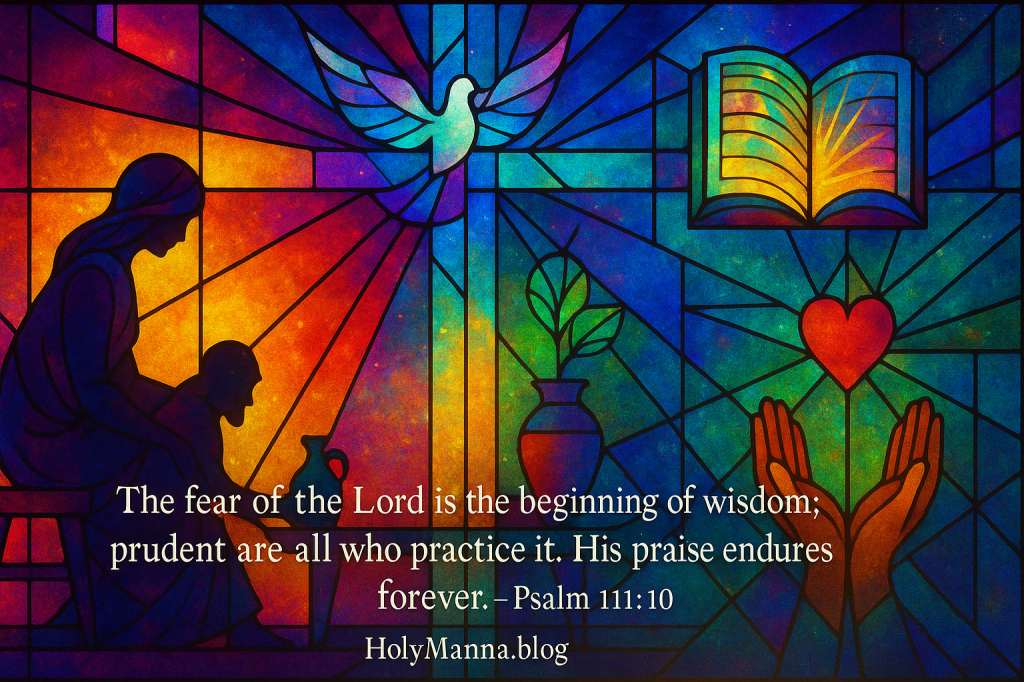
Verse 10 – “The fear of the Lord is the beginning of wisdom; prudent are all who practice it. His praise endures forever.”
The psalm ends in the school of wisdom. Fear of the Lord is the foundation upon which right judgment and right living are built. Prudence is not timidity. It is practiced wisdom that chooses the true good and the right means. The final line returns to praise, because a wise life becomes a liturgy that never ceases.
Teachings
The Catechism identifies the gift that animates this psalmic vision: “The seven gifts of the Holy Spirit are wisdom, understanding, counsel, fortitude, knowledge, piety, and fear of the Lord.” CCC 1831. This gift does not crush the soul. It filializes it. Adoration is the posture that answers God’s holiness: “Adoration is the first act of the virtue of religion.” CCC 2096. The prudence praised in the psalm is likewise defined by the Church: “Prudence is the virtue that disposes practical reason to discern our true good in every circumstance and to choose the right means of achieving it.” CCC 1806. The sainted tradition hears in this psalm a call to praise that orders the heart. Saint Augustine confesses, “You have made us for yourself, O Lord, and our heart is restless until it rests in you.” Confessions I.1. In light of the covenant, praise becomes the fitting and enduring response to a God whose decrees and deeds never fail.
Reflection
Let the psalm teach your heart to begin with awe and to continue with obedience. Consider where God’s reliable decrees invite you to live with truth and equity today. Practice prudence by choosing one concrete act that aligns with God’s justice, such as reconciling with someone you have wronged or making time for the public reading of Scripture. Let praise anchor the day from morning to night. Where is the Lord asking you to exchange self reliance for filial awe so that wisdom can begin in you? What is one decree of the Lord you will observe today with truth and equity? How will your praise endure beyond this prayer time and become visible fidelity in speech and conduct?
Holy Gospel – Luke 7:36–50
Lavish Love At The Table Of Mercy
In the first century, formal meals were occasions of honor and social signaling. Guests reclined on cushions around a low table. The host customarily provided water for washing dusty feet, a kiss of greeting, and oil as a sign of welcome. Into such a setting in a Pharisee’s home comes a woman known publicly as a sinner who brings an alabaster flask of costly ointment. Her approach violates expected boundaries yet reveals a heart seized by grace. Jesus receives her gestures as acts of repentance and love, and he confronts a host whose cool courtesy exposes an interior poverty of love. The parable of two debtors interprets the scene through familiar economic imagery and teaches that forgiven debt becomes overflowing love. This encounter gathers today’s theme into focus. Awe before God’s holiness opens the sinner to mercy, and mercy received becomes a mission of visible love.
Luke 7:36-50
New American Bible (Revised Edition)
36 A Pharisee invited him to dine with him, and he entered the Pharisee’s house and reclined at table. 37 Now there was a sinful woman in the city who learned that he was at table in the house of the Pharisee. Bringing an alabaster flask of ointment, 38 she stood behind him at his feet weeping and began to bathe his feet with her tears. Then she wiped them with her hair, kissed them, and anointed them with the ointment. 39 When the Pharisee who had invited him saw this he said to himself, “If this man were a prophet, he would know who and what sort of woman this is who is touching him, that she is a sinner.” 40 Jesus said to him in reply, “Simon, I have something to say to you.” “Tell me, teacher,” he said. 41 “Two people were in debt to a certain creditor; one owed five hundred days’ wages and the other owed fifty. 42 Since they were unable to repay the debt, he forgave it for both. Which of them will love him more?” 43 Simon said in reply, “The one, I suppose, whose larger debt was forgiven.” He said to him, “You have judged rightly.” 44 Then he turned to the woman and said to Simon, “Do you see this woman? When I entered your house, you did not give me water for my feet, but she has bathed them with her tears and wiped them with her hair. 45 You did not give me a kiss, but she has not ceased kissing my feet since the time I entered. 46 You did not anoint my head with oil, but she anointed my feet with ointment. 47 So I tell you, her many sins have been forgiven; hence, she has shown great love. But the one to whom little is forgiven, loves little.” 48 He said to her, “Your sins are forgiven.” 49 The others at table said to themselves, “Who is this who even forgives sins?” 50 But he said to the woman, “Your faith has saved you; go in peace.”
Detailed Exegesis
Verse 36 – “A Pharisee invited him to dine with him, and he entered the Pharisee’s house and reclined at table.”
Table fellowship is the arena of revelation. Reclining signals a formal banquet. A Pharisee’s invitation places Jesus within a context of religious scrutiny and social expectation. The setting makes the contrast between external propriety and interior charity unmistakable.
Verse 37 – “Now there was a sinful woman in the city who learned that he was at table in the house of the Pharisee. Bringing an alabaster flask of ointment,”
Her reputation is public. She seeks Jesus precisely because he is accessible. The alabaster flask implies expense and intentional preparation. She brings what is precious because she has already encountered a mercy that draws her near.
Verse 38 – “She stood behind him at his feet weeping and began to bathe his feet with her tears. Then she wiped them with her hair, kissed them, and anointed them with the ointment.”
Her gestures invert social expectations. Tears become water of hospitality. Hair becomes a towel. Kissing and anointing express devotion. This is embodied contrition and love. Exterior acts flow from an interior conversion that words cannot contain.
Verse 39 – “When the Pharisee who had invited him saw this he said to himself, ‘If this man were a prophet, he would know who and what sort of woman this is who is touching him, that she is a sinner.’”
The host’s interior judgment misreads both Jesus and the woman. He assumes holiness separates. Jesus reveals that holiness saves. The Pharisee’s criteria measure contamination rather than conversion.
Verse 40 – “Jesus said to him in reply, ‘Simon, I have something to say to you.’ ‘Tell me, teacher,’ he said.”
Jesus answers the unspoken thought. Addressing him by name, he invites teachability. The dialogue frames a parable that will uncover the heart.
Verse 41 – “Two people were in debt to a certain creditor; one owed five hundred days’ wages and the other owed fifty.”
Debt imagery situates sin in relational and moral obligation. The disparity highlights degrees of indebtedness without denying universality. Both are debtors.
Verse 42 – “Since they were unable to repay the debt, he forgave it for both. Which of them will love him more?”
The core is not the size of the debt but the gratuitous act of remission. Forgiveness generates love. The question presses Simon to move from analysis to affection.
Verse 43 – “Simon said in reply, ‘The one, I suppose, whose larger debt was forgiven.’ He said to him, ‘You have judged rightly.’”
Simon’s reason works. His heart still must. Right judgment becomes the doorway to conversion when it yields to love.
Verse 44 – “Then he turned to the woman and said to Simon, ‘Do you see this woman? When I entered your house, you did not give me water for my feet, but she has bathed them with her tears and wiped them with her hair.’”
Jesus contrasts omitted courtesies with the woman’s lavish hospitality. He teaches Simon to see a person rather than a category. The woman’s tears fulfill what custom required and charity perfects.
Verse 45 – “‘You did not give me a kiss, but she has not ceased kissing my feet since the time I entered.’”
A kiss of peace was a sign of honor. Her persistent kisses on his feet reveal abasement that becomes exaltation. Love stoops and in stooping is raised.
Verse 46 – “‘You did not anoint my head with oil, but she anointed my feet with ointment.’”
Oil for the head welcomes a guest. She gives more by anointing his feet. The least part receives the greatest honor. Humility magnifies love.
Verse 47 – “‘So I tell you, her many sins have been forgiven; hence, she has shown great love. But the one to whom little is forgiven, loves little.’”
Love is the fruit, not the price, of forgiveness. The proof of pardon is charity poured out. The warning is sobering. A small love often masks a small sense of sin and a small reliance on mercy.
Verse 48 – “He said to her, ‘Your sins are forgiven.’”
Jesus exercises divine prerogative. He does not merely declare healing. He effects it. The word of absolution recreates.
Verse 49 – “The others at table said to themselves, ‘Who is this who even forgives sins?’”
The question is christological. Only God forgives sins. The guests intuit the claim even if they resist its implications.
Verse 50 – “But he said to the woman, ‘Your faith has saved you; go in peace.’”
Faith receives mercy and issues in peace. Salvation is personal and ecclesial. The forgiven one is sent. Peace is the mission garment of those who have been loved.
Teachings
The Church confesses the divine authority at work in this scene. “Only God forgives sins.” CCC 1441. In Jesus, this mercy is revealed and given. “The Gospel is the revelation in Jesus Christ of God’s mercy to sinners.” CCC 1846. The absolution he speaks anticipates the sacrament he entrusts to his Church, whose grace heals and restores communion. “The whole power of the sacrament of Penance consists in restoring us to God’s grace and joining us with him in an intimate friendship.” CCC 1468. The woman’s love exemplifies contrition that springs from charity. “When it arises from a love by which God is loved above all else, contrition is called perfect.” CCC 1452. Saint Augustine gives the evangelical criterion that shines here: “Love, and do what you will.” Homilies on the First Epistle of John, 7. These teachings illuminate the Gospel’s claim. Mercy is not sentimental indulgence. It is God’s holy action that recreates the sinner and sends the reconciled into a life of visible love.
Reflection
Let the Gospel touch your habits of hospitality, your judgments of others, and your approach to repentance. Welcome Jesus today with concrete courtesies of prayer, time, and attention. Offer him what is costly by choosing reconciliation with someone you have avoided and by planning a sincere confession if you need it. Measure your discipleship by love that can be seen and by mercy that can be felt. Where do you resemble Simon’s cool correctness more than the woman’s warm contrition and love? What alabaster jar will you break open for Jesus today, whether time, treasure, or the pride that keeps you from asking forgiveness? How will you let faith receive mercy so that peace can become your mission in speech, conduct, love, faith, and purity?
Go In Peace, Let Mercy Become Your Mission
Where does awe of God become love that others can see? Today’s readings trace a single path that begins with reverent wisdom, moves through forgiveness, and blossoms into faithful witness. The Psalm teaches the posture that starts it all, “The fear of the Lord is the beginning of wisdom.” Ps 111:10. The Gospel shows mercy taking flesh in a forgiven heart that loves lavishly until Jesus says, “Your faith has saved you; go in peace.” Lk 7:50. The First Reading then calls that peace to become a pattern of life as Paul urges, “Attend to yourself and to your teaching; persevere in both tasks.” 1 Tim 4:16. Stand in awe, receive mercy, and let your progress in holiness become visible in speech, conduct, love, faith, and purity. Welcome Jesus with concrete hospitality in prayer and in your treatment of others. Seek reconciliation where you have withheld it. Return to the public reading of Scripture and to diligent practices that keep grace alive. How will you let God’s reliable decrees guide your choices today? Where is the Lord inviting you to love much because you have been forgiven much? May your day end as it began, in praise of the Holy One whose works are true and just, and may your life become a living testimony to His enduring mercy.
Engage with Us!
We would love to hear your reflections in the comments below. Share what the Lord is stirring in your heart and how you plan to respond today.
- First Reading (1 Tim 4:12–16): Where is the Lord inviting you to make your progress in holiness visible in speech, conduct, love, faith, and purity? What is one concrete practice you will adopt this week to “attend to yourself and to your teaching”?
- Responsorial Psalm (Ps 111:7–10): How does beginning with the fear of the Lord shape a wise decision you need to make today? Where can you live with truth and equity so that your life reflects God’s reliable decrees?
- Holy Gospel (Lk 7:36–50): What alabaster jar will you break open for Jesus by seeking reconciliation, showing costly love, or preparing for a sincere confession? How will you let faith receive mercy so that peace becomes visible in your relationships today?
Go forth encouraged. Live a life of faith, and do everything with the love and mercy Jesus taught us.
Sacred Heart of Jesus, we trust in You!
Immaculate Heart of Mary, pray for us!
Saint Michael the Archangel, defend us in battle!
Follow us on Instagram and Facebook for more insights and reflections on living a faith-filled life.

 Holy Manna!
Leave a comment