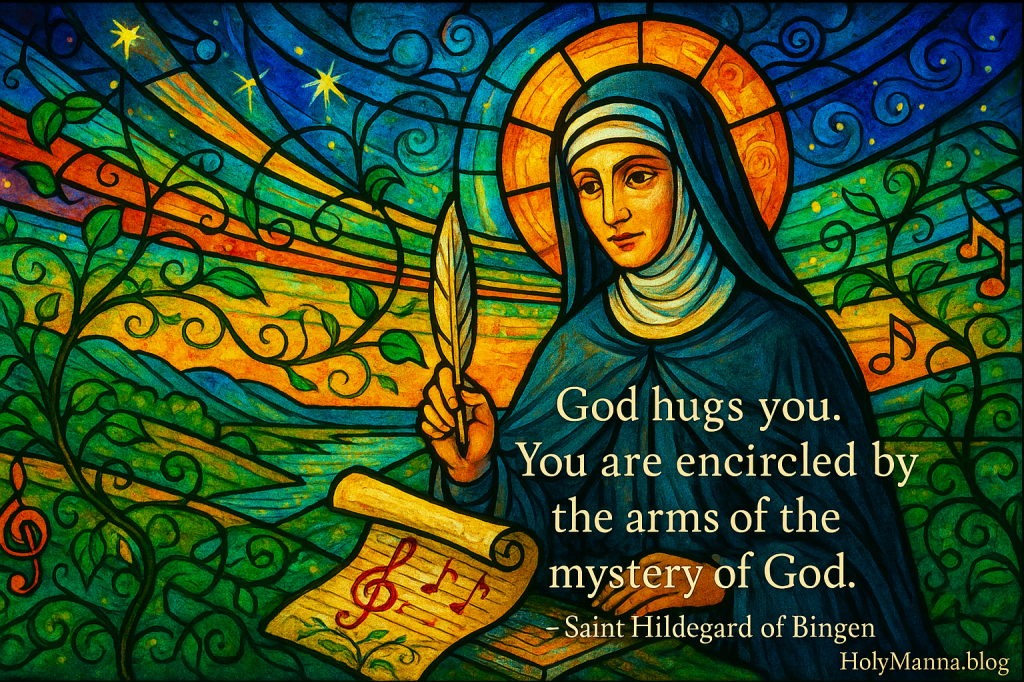
A Prophet in Song and Light
Saint Hildegard of Bingen, often called the Sibyl of the Rhine, was a Benedictine abbess, visionary theologian, composer, reformer, and spiritual guide whose life stretched from 1098 to 1179. She united contemplative prayer with creative action, leaving a body of work that includes visionary theology, sacred music, scientific observations, and an extensive correspondence with popes, abbots, emperors, and ordinary believers. In 2012 the Church formally recognized her sanctity for the universal Church and named her a Doctor of the Church. Hildegard taught that the whole cosmos sings of Christ and that the human person is called to be fully alive in Him, a theme she captured with her image of viriditas, the greening vitality of divine life at work in creation. “The Word is living, being, spirit, all verdant greening, all creativity.” She prayed with childlike trust, governed with motherly strength, and composed music that still carries souls to God.
Rooted in Monastic Soil
Hildegard was born into a noble family near Bingen in the Rhineland. As a child she was offered to God and entrusted to the guidance of the holy recluse Jutta of Sponheim at the Benedictine monastery of Disibodenberg. There she learned to read Latin, to love the Psalms, and to live the rhythm of prayer and work that marks Benedictine life. From early childhood she experienced visions. She did not presume on them, but received them in humility and long kept them interior. In midlife the Lord commanded her to speak and to write for the edification of the Church. She describes the decisive moment with striking clarity: “In the year of the Lord 1141, when I was forty two years and seven months old, a fiery light of exceeding brilliance poured into my mind and kindled my heart and breast like a flame, not burning but warming, as the sun warms anything upon which it shines.” Strengthened by counsel from holy friends, she began to set her visions into writing so that others might know the mercy and splendor of God.
Fire of the Word
After Jutta’s death Hildegard was chosen to lead the growing community. Desiring a space suited to the flourishing of her sisters, she founded a new monastery at Rupertsberg near Bingen and later a second house at Eibingen, serving as abbess of both. She wrote three great visionary works that unfold salvation history in vivid images centered on Christ: Scivias (Know the Ways), The Book of Life’s Merits, and The Book of Divine Works. She also compiled medical and natural histories, demonstrating a careful Christian reading of creation, and she created a collection of liturgical songs gathered as the Symphonia armoniae caelestium revelationum along with the musical drama Ordo Virtutum, in which the Virtues sing to a struggling soul about freedom in Christ. In her later years she undertook preaching journeys through German lands, calling clergy and laity to conversion, justice, and Eucharistic devotion. Her letters reveal pastoral boldness and tender charity as she urged emperors to pursue peace, bishops to reform abuses, and the faithful to seek holiness. “Humanity, take a good look at yourself. Inside you, you have heaven and earth and all of creation. You are a world in miniature.” In another brief line that distills her spirituality, she confesses, “I am a feather on the breath of God.”
Signs of Grace
Hildegard is remembered first for sanctity that took concrete form in wise governance, fearless preaching, luminous music, and loving counsel. Contemporary witnesses also recorded healings and divine favors connected with her blessing and intercession. People sought her prayers for illnesses of body and spirit, and she welcomed them with the heart of a mother and the mind of a teacher, often exhorting them to confession, the sacraments, and works of mercy. Her theology of creation shaped her care for the sick. She taught that God’s life giving power runs through the world as a healing greenness, and that grace perfects nature rather than abolishing it. One of her prayers to the Holy Spirit breathes this trust: “Holy Spirit, giving life to all life, moving all creatures, root of all things, washing them clean, wiping out their mistakes, healing their wounds.” The miracles remembered in her early biographies are less spectacles than signs of the Kingdom that accompany a shepherd who leads people back to Christ.
Tried Like Gold
Hildegard knew real trials. The most painful came near the end of her life when local authorities imposed an interdict on her community after the burial of a nobleman they claimed had died unreconciled. Hildegard insisted that he had been absolved and refused to disturb his grave. The interdict forbade the singing of the Divine Office and the celebration of the sacraments with music. For a community whose life was woven from sung prayer, this was no small suffering. Hildegard’s response was courageous and deeply theological. She defended sacred song as an echo of the harmony of heaven and pleaded for the lifting of the penalty, not for her own comfort but for the glory of God. The interdict was removed before her death. Her perseverance shows how a Christian can resist injustice without rancor, hold firm to truth with humility, and submit every struggle to the will of God.
A Radiant Legacy
Hildegard fell asleep in the Lord on September 17, 1179 at Rupertsberg. Shortly after her death, stories circulated of healings at her tomb and of divine favors received through her intercession, and pilgrims came to honor her memory. Over the centuries war and upheaval damaged her original monastery, and many relics were transferred to Eibingen, where veneration continued unbroken. Her music and writings never truly fell silent. Monastic communities preserved them, scholars studied them, and the faithful sang them. In our time the Church has recognized in Hildegard a teacher for the whole People of God. Her elevation as a Doctor of the Church crowns a living devotion that already filled churches and monasteries with her melodies and nourished prayer with her visions of Christ’s redeeming love. She once assured her correspondents, “God hugs you. You are encircled by the arms of the mystery of God.” That promise continues to draw pilgrims to her shrines and readers to her books, where they discover the embrace of the Lord she loved.
Learning From Saint Hildegard
Hildegard invites us to let the Gospel renew our minds and our senses so that we praise God with our whole being. She urges us to revere the liturgy, to love the Church, to study creation with wonder, and to put our gifts into service for others. You can imitate her by praying the Psalms daily, by making Sunday Mass the throne of your week, and by allowing sacred music to soften your heart and shape your choices. You can examine your relationships and speak truth with charity where correction is needed. You can ask the Holy Spirit to awaken divine greenness within your work, your friendships, and your imagination. If grief or trial weighs on you, remember Hildegard’s trust. God is stronger than every darkness, and the breath of His Spirit can lift even a feather into flight. How is the Holy Spirit inviting you to let Christ’s light renew your mind and heart today?
Engage with Us!
- Which aspect of Hildegard’s life most challenges you to grow in prayer or courage today, and why?
- How might you let sacred music or Scripture shape your week in a concrete way?
- Where is God inviting you to speak truth with charity in your family, parish, or workplace?
- What gifts or interests could you place at the service of Christ and His Church, following Hildegard’s example?
May Saint Hildegard help us live a life of deep faith, bold hope, and generous love, doing all things with the mercy and courage Jesus taught us.
Saint Hildegard of Bingen, pray for us!
Follow us on Instagram and Facebook for more insights and reflections on living a faith-filled life.

 Holy Manna!
Leave a comment