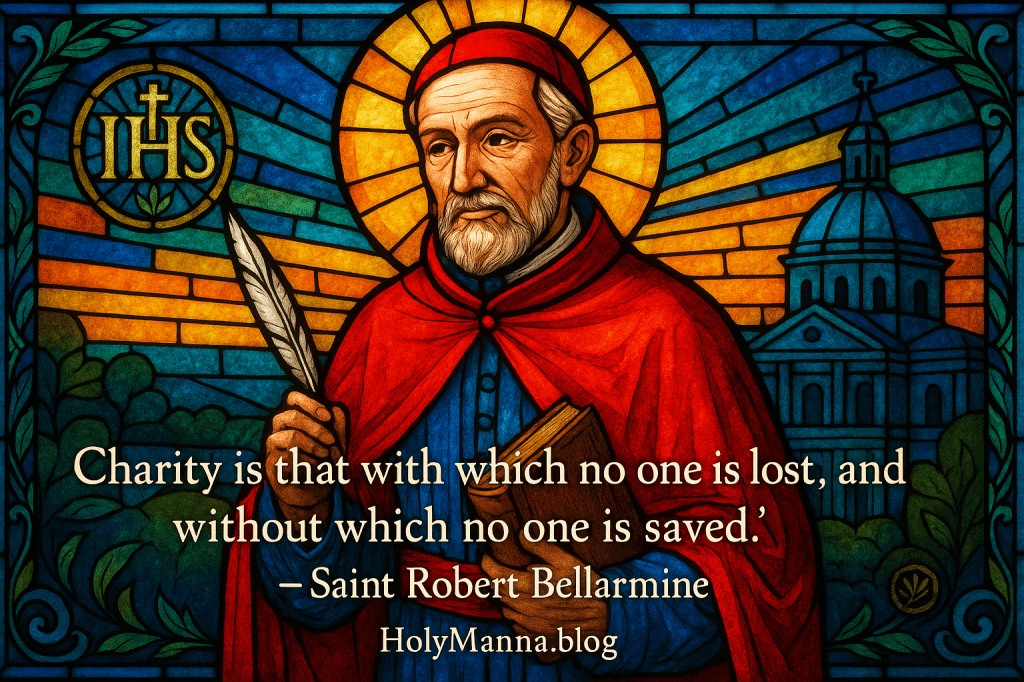
A Mind on Fire for Truth and Charity
Saint Robert Bellarmine, SJ, is a Doctor of the Church, a Jesuit cardinal, and a guardian of sound catechesis during the Catholic Reformation. He is remembered for clear teaching, steady pastoral care, and a life of concrete charity. His masterwork Disputationes de Controversiis helped the Church articulate Catholic doctrine with balance and precision, while spiritual classics like The Art of Dying Well and The Ascent of the Mind to God continue to form hearts. He was canonized in 1930 and declared a Doctor of the Church in 1931, and his feast is celebrated on September 17. Above all, he was a man who joined scholarship to holiness, conviction to gentleness, and truth to mercy. He loved to remind Christians that “He who desires to die well must live well.”
Roots in Tuscany and a Heart Given to the Society of Jesus
Robert Bellarmine was born in Montepulciano, Tuscany, on October 4, 1542, into a large family of modest means. His mother, Cinzia Cervini, was a woman of deep piety and a relative of the future Pope Marcellus II, which exposed Robert early to the life of the Church. Gifted in languages and philosophy, he entered the Society of Jesus as a young man and was formed in the Jesuit rhythm of prayer, study, and service. He studied philosophy and theology in Italy and the Low Countries, was ordained a priest in 1570, and quickly distinguished himself as a preacher and professor who could explain complex truths in simple terms. What he is most known for is the union of a brilliant theological mind with a pastor’s heart. He taught at the Roman College, where he later served as rector, and helped shape a generation of confessors, preachers, and teachers. He also assisted in important projects of the Holy See, including work connected to the authoritative revision of the Latin Bible that came to be known as the Clementine Vulgate.
Teacher of the Church and Servant of the Poor
As a theologian, Bellarmine devoted himself to clarifying what the Church believes about Scripture, Tradition, the Magisterium, the sacraments, grace, and the nature of the Church. His catechisms offered a reliable path for ordinary Catholics to know and love the faith. When Pope Clement VIII created him a cardinal in 1599 and later appointed him Archbishop of Capua, Bellarmine showed that reform begins at home. He preached frequently, visited parishes and clergy, held synods, and insisted on reverent liturgy and robust catechesis. He embraced personal austerity and gave generously to the poor, even selling furnishings from his residence during hard times so that others might eat and be clothed. He served as spiritual director to Saint Aloysius Gonzaga and encouraged Saint Francis de Sales, revealing the warm, fatherly side of a man often seen only as a towering intellect. His own spirituality was practical and focused on conversion of life. In The Art of Dying Well he counsels the daily practice of confession, the works of mercy, and humble perseverance. It is here that he teaches with luminous simplicity: “He who lives well, will die well.” Although he was not known for spectacular public miracles, his life revealed the miracle of grace at work in a scholar who never lost the heart of a pastor. His careful teaching protected the faithful from confusion, and his visible love for the poor gave credibility to every page he wrote.
Trials Without Martyrdom, Courage Without Bitterness
Bellarmine’s path included difficult controversies. He wrote carefully on the relationship between spiritual and temporal power, defending the spiritual authority of the papacy while acknowledging the rightful autonomy of civil rulers in their sphere. He engaged charitably but firmly in debates sparked by the Oath of Allegiance in England and responded to thinkers who challenged the nature of Church authority. He also played a measured role in the Galileo question. In his famous letter to Paolo Antonio Foscarini he urged patience and fidelity to Scripture rightly interpreted, writing, “If there were a true demonstration that the sun is at the center of the world and the earth in the third heaven, and that the sun does not circle the earth but the earth circles the sun, then we should have to proceed with great circumspection in explaining the Scriptures which appear to be contrary.” His counsel harmonizes with what we read in The Catechism of the Catholic Church: Scripture must be read in the Church, in the light of the same Spirit by whom it was written, attending to literary forms and unity of truth in Christ, as taught in CCC 109–119. Bellarmine endured criticism from several sides, yet he remained serene, learned, and charitable, proving that truth and courtesy can dwell in the same heart.
The Afterglow of Holiness and a Living Intercession
Saint Robert Bellarmine died in Rome on September 17, 1621. The Church recognized miracles through his intercession in the processes that led to his beatification in 1923 and canonization in 1930. His relics rest in the Church of Saint Ignatius in Rome, where students, teachers, catechists, and seekers come to ask his prayers for clarity of mind and purity of heart. Pilgrims draw encouragement from a saint who shows that holiness is not reserved for those far from public life. It flourishes in lecture halls, chancery offices, pulpits, kitchens, and city streets whenever the works of mercy are joined to a robust, obedient faith. His words still challenge and console: “Charity is that with which no one is lost, and without which no one is saved.” Remembering him each year on his feast, the Church invites us to let truth be luminous and love be concrete.
Walking the Path of Bellarmine Today
How can we apply Saint Robert’s witness? First, we can read Scripture with the mind of the Church, trusting the Magisterium to serve the Word, not to replace it, and letting reason and faith illuminate each other as The Catechism proposes. Second, we can choose a simple life that makes room for generous love. Bellarmine’s austerity was not stoic but evangelical, the fruit of friendship with Jesus who became poor for our sake. Third, we can teach the faith with clarity and tenderness. Whether you are a parent, a catechist, a student, or someone who answers questions at work, you can speak the truth in love, avoid sarcasm, pray for those who disagree with you, and never separate theology from the works of mercy. Finally, keep eternity in view. Set times for confession and communion, forgive quickly, and practice small acts of mercy that train the heart for the great test. Let this refrain from Saint Robert echo in your week: “He who desires to die well must live well.” If we live like this, we will discover the freedom of those who are ready to see the Lord face to face.
Engage with Us!
I would love to hear your thoughts and takeaways about Saint Robert Bellarmine in the comments below.
- Where do you feel called to grow in both truth and charity in your conversations about the faith this week?
- How does Bellarmine’s balance of Scripture, Tradition, and reason challenge the way you read the Bible and approach science and culture?
- What concrete act of mercy can you choose today that mirrors his hidden austerity and love for the poor?
- If you teach or share the faith, how can his clarity and pastoral heart shape your next lesson or conversation?
- Which line from The Art of Dying Well invites you to live more intentionally with heaven in view?
May the Lord make us courageous, compassionate, and faithful, so that everything we do is done with the love and mercy Jesus taught us.

 Holy Manna!
Leave a comment