Wednesday of the Twenty-fourth Week in Ordinary Time – Lectionary: 445
Children of Wisdom in the Household of God
If you knew that God’s wisdom stood before you today, how would you respond? Today’s readings invite a mature, wholehearted answer to the revelation of Christ within His Church. In 1 Timothy 3:14-16, Paul writes so that believers may “know how to behave” in the Church, the “pillar and foundation of truth.” He then preserves a likely early hymn or confession that proclaims the mystery of Christ, “manifested in the flesh” and “proclaimed to the Gentiles.” This ecclesial and liturgical context matters. The early Christian community understood itself as the living household of God, ordered for worship and witness, where doctrine is sung, guarded, and lived. Psalm 111 echoes that posture by calling us to study and praise the mighty works of the Lord. It is a liturgical psalm that celebrates God’s covenant faithfulness, which endures and provides an inheritance for His people. In the marketplaces of the ancient world, children mimicked weddings and funerals for play. Jesus draws on that familiar scene in Luke 7:31-35 to expose a fickle generation that will not rejoice with the Bridegroom or weep with the call to repentance. John’s austerity is dismissed. Jesus’ table fellowship is slandered. Yet “wisdom is vindicated by all her children.” Taken together, these texts reveal a single theme. Christ is publicly revealed, the Church is constituted to uphold that revelation, and true wisdom is recognized not by shifting feelings but by lives of praise, study, and obedient conduct that confirm the truth of the Gospel.
First Reading – 1 Timothy 3:14-16
The Church That Sings the Mystery and Guards the Truth
Written to Timothy in the context of the Ephesian church, 1 Timothy addresses order, leadership, and the witness of Christian life within a Greco Roman world shaped by household structures and public cults. Paul’s language of the “household of God” would resonate in a city famed for its temple columns and civic assemblies. The Church is not a private club. It is the “church of the living God”, an ordered community that both worships and witnesses. At the heart of this passage stands an early Christian confession that sings the mystery of Christ’s revelation. This hymn does not only inform minds. It forms a people who live the truth they proclaim. Within today’s theme of wisdom received and lived in the Church, these verses ground our praise in doctrine and our conduct in doxology. The Church is the “pillar and foundation of truth” because she is the place where the mystery of Christ is confessed, studied, and embodied for the life of the world. Paul writes so that believers may “know how to behave” as members of this household.
1 Timothy 3:14-16
New American Bible (Revised Edition)
14 I am writing you about these matters, although I hope to visit you soon. 15 But if I should be delayed, you should know how to behave in the household of God, which is the church of the living God, the pillar and foundation of truth. 16 Undeniably great is the mystery of devotion,
Who was manifested in the flesh,
vindicated in the spirit,
seen by angels,
proclaimed to the Gentiles,
believed in throughout the world,
taken up in glory.
Detailed Exegesis
Verse 14 – “I am writing you about these matters, although I hope to visit you soon.”
Paul’s personal tone underscores apostolic oversight and pastoral proximity. Written instruction prepares the Church even when an apostle cannot be physically present. The deposit of faith is reliable because it is communicated both personally and textually. The letter functions as authoritative guidance that sustains unity and continuity in doctrine and life.
Verse 15 – “But if I should be delayed, you should know how to behave in the household of God, which is the church of the living God, the pillar and foundation of truth.”
The Church is called the “household of God”, signaling kinship, belonging, and ordered charity. The phrase “church of the living God” highlights that ecclesial life flows from God’s own life, not from human ingenuity. The imagery of “pillar and foundation” evokes architectural stability. As pillars display and uphold a structure, so the Church holds up the truth for all to see and safeguards it from collapse. In a culture of shifting norms, Paul insists that ecclesial conduct and confession are inseparable. Right worship and right living uphold and exhibit the Gospel’s integrity.
Verse 16 – “Undeniably great is the mystery of devotion, ‘Who was manifested in the flesh, vindicated in the spirit, seen by angels, proclaimed to the Gentiles, believed in throughout the world, taken up in glory.’”
Paul preserves a rhythmic confession that likely served in early liturgy. “Manifested in the flesh” proclaims the Incarnation. “Vindicated in the spirit” points to the Resurrection and the Spirit’s testimony to the Son. “Seen by angels” situates the event of Christ within heaven’s acknowledgment. “Proclaimed to the Gentiles” reveals the universal scope of salvation. “Believed in throughout the world” testifies to the Church’s missionary fruit. “Taken up in glory” crowns the hymn with the Ascension. The mystery is not secret knowledge. It is the publicly revealed Christ, celebrated in worship and advanced in mission.
Teachings
The apostolic vision of the Church as the place where truth is upheld accords with the magisterial teaching that Christ’s revelation is entrusted to a living community. “The task of authentically interpreting the word of God, whether written or handed on, has been entrusted exclusively to the living teaching office of the Church.” Dei Verbum 10. This living office serves the Word by teaching only what has been handed on so that the faithful may know how to live in the household of God. The saints echo this ecclesial conviction with clarity. “He cannot have God for his Father who has not the Church for his mother.” St. Cyprian, On the Unity of the Church.* The psalm appointed for today reminds us of the contemplative response that such truth elicits. “Great are the works of the Lord, studied by all who delight in them.” Psalm 111:2. The confession in 1 Timothy 3:16 models how doctrine becomes doxology. The Church studies, sings, and safeguards the mystery of Christ so that the world may believe.
Reflection
This reading calls us to live a faith that is both confessed and embodied within the Church. Reverent study should lead to visible conduct that adorns the Gospel. Worship should overflow into mercy, hospitality, and missionary courage. The stability of the Church’s teaching is not a weight that crushes. It is a pillar that holds up the beauty of Christ so that all may see. Where is the Lord inviting you to “know how to behave” as a beloved member of His household today? How might your praise become a public witness that upholds the truth with humility and joy? What concrete step can you take this week to study, sing, and live the mystery of Christ for the good of others?
Responsorial Psalm – Psalm 111:1-6
Praise That Studies, Remembers, and Displays the Works of God
Composed as an acrostic hymn in Hebrew and paired closely with Psalm 112, Psalm 111 is a liturgical song of thanksgiving that celebrates the Lord’s mighty deeds, covenant faithfulness, and providential care. Prayed in the assembly, it forms the people to remember God’s wonders and to study His works with reverent delight. Within today’s theme of wisdom received and lived in the Church, Psalm 111 shows how praise becomes formation. God’s works are not only admired. They are studied until they shape a community that lives the truth it sings. The psalm’s movement from praise, to remembrance, to inheritance anticipates the missionary widening proclaimed in 1 Timothy 3:16 and calls forth the docile wisdom that Jesus says will be “vindicated” in Luke 7:35.
Psalm 111:1-6
New American Bible (Revised Edition)
Praise of God for Goodness to Israel
1 Hallelujah!
I will praise the Lord with all my heart
in the assembled congregation of the upright.
2 Great are the works of the Lord,
studied by all who delight in them.
3 Majestic and glorious is his work,
his righteousness endures forever.
4 He won renown for his wondrous deeds;
gracious and merciful is the Lord.
5 He gives food to those who fear him,
he remembers his covenant forever.
6 He showed his powerful deeds to his people,
giving them the inheritance of the nations.
Detailed Exegesis
Verse 1 – “Hallelujah! I will praise the Lord with all my heart in the assembled congregation of the upright.”
The psalm begins with liturgical acclaim that is public and ecclesial. Praise is not a private sentiment. It is a whole hearted act within the gathered people of God. The “assembled congregation of the upright” points to worship that forms moral integrity. The Church receives this pattern at the heart of her life where common praise shapes common conduct.
Verse 2 – “Great are the works of the Lord, studied by all who delight in them.”
God’s deeds are an object of serious contemplation. Delight does not oppose study. It fuels it. The faithful are students of salvation history. In the liturgy and in personal prayer, the Church ponders the works of the Lord until understanding becomes gratitude and mission.
Verse 3 – “Majestic and glorious is his work, his righteousness endures forever.”
God’s righteousness is stable and enduring. His works radiate beauty that reflects His character. The permanence of divine righteousness steadies the believer when cultural standards shift. The splendor of God’s deeds trains our moral vision so that we judge by His enduring justice.
Verse 4 – “He won renown for his wondrous deeds; gracious and merciful is the Lord.”
The mighty works reveal the merciful heart of God. Renown is not bare reputation. It is the memorial of mercy. As the Church remembers God’s wonders, she comes to know that justice and mercy meet in Him. This remembrance is the basis of Christian hope.
Verse 5 – “He gives food to those who fear him, he remembers his covenant forever.”
Providence and promise converge. God provides concretely and He remembers perpetually. The line prepares Christian readers to see the Eucharistic fulfillment where God feeds His people and renews the covenant in Christ’s Body and Blood. Holy fear receives sustenance as gift.
Verse 6 – “He showed his powerful deeds to his people, giving them the inheritance of the nations.”
God’s self disclosure in history leads to mission. Israel’s inheritance looks beyond itself toward the nations. In Christ the promise widens as the Gospel is proclaimed to all peoples. The Church becomes the living display that upholds the truth so that the nations may see.
Teachings
The psalm’s union of praise, study, and covenant remembrance resonates with the Church’s teaching on worship and life. The Eucharist is not a private devotion. It is the center and source from which praise and mission flow. “The Eucharist is ‘the source and summit of the Christian life.’” CCC 1324. In the Eucharistic memorial the Church does not look backward only. She participates in God’s saving work made present. This participation forms a people who live what they praise. As the tradition succinctly teaches, “Grace does not destroy nature but perfects it.” St. Thomas Aquinas, Summa Theologiae, I, q.1, a.8, ad 2. The grace remembered and received in worship heals, elevates, and orders daily life. The Scriptures themselves model how praise educates desire and intellect, since “Great are the works of the Lord, studied by all who delight in them.” Psalm 111:2. Through this pattern of praise and study, the Church becomes a wise household that upholds and displays the truth of Christ for the world.
Reflection
The psalm invites you to let praise become a school of wisdom. Begin and end your day by recalling one concrete work of God and by thanking Him aloud. Open Psalm 111 and slowly study a single line until it shapes a choice you will make today. At Mass, bring a specific memory of God’s mercy to the altar and ask for the grace to live it in public. Where is God inviting you to study His works rather than skimming past them? How can you let praise educate your choices in speech, finance, and family life this week? What one practice will help you remember God’s covenant faithfulness when you feel anxious or hurried?
Holy Gospel – Luke 7:31-35
Wisdom’s Children Answer the Music and the Mourning
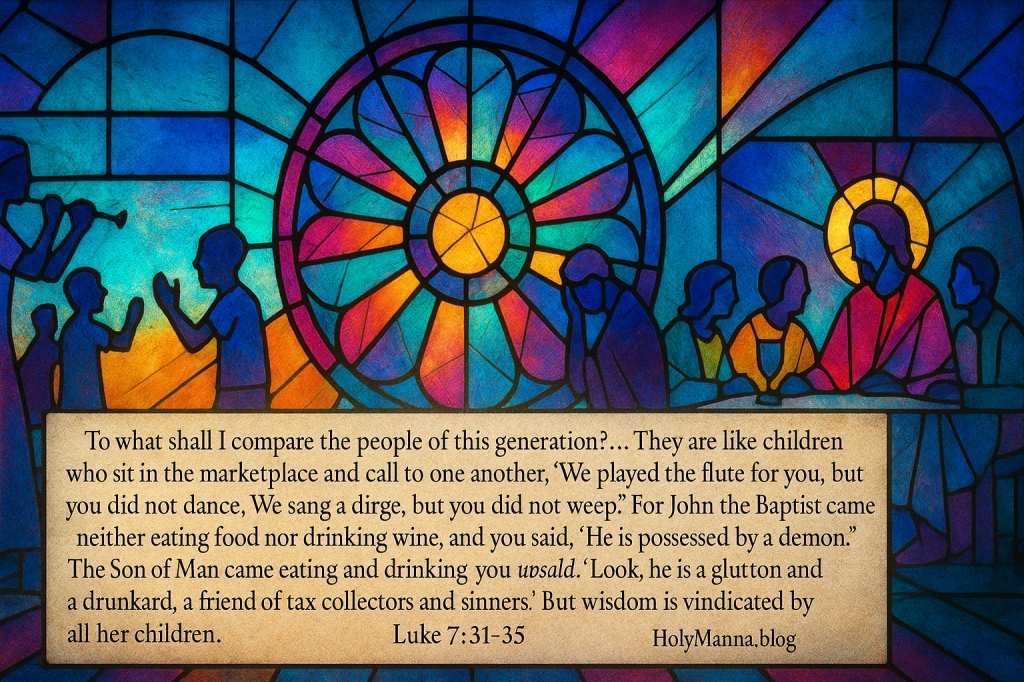
In the public squares of first century towns, children imitated adult ceremonies of wedding and funeral. They piped and they wailed. Jesus draws on this familiar scene to reveal the fickleness of a generation that refuses both joy and repentance. John the Baptist embraced prophetic austerity and called Israel to mourning for sin. Jesus, the Bridegroom, brought festal table fellowship as a sign of the Kingdom’s nearness. The same crowd rejected both. Within today’s theme of wisdom revealed in Christ and lived within the Church, this Gospel confronts the posture that critiques every messenger yet never converts. The Lord teaches that true wisdom is not noise or novelty. It is a life that conforms to the revelation upheld in the household of God proclaimed in 1 Timothy 3:14-16 and celebrated in the praise of Psalm 111.
Luke 7:31-35
New American Bible (Revised Edition)
31 “Then to what shall I compare the people of this generation? What are they like? 32 They are like children who sit in the marketplace and call to one another,
‘We played the flute for you, but you did not dance.
We sang a dirge, but you did not weep.’
33 For John the Baptist came neither eating food nor drinking wine, and you said, ‘He is possessed by a demon.’ 34 The Son of Man came eating and drinking and you said, ‘Look, he is a glutton and a drunkard, a friend of tax collectors and sinners.’ 35 But wisdom is vindicated by all her children.”
Detailed Exegesis
Verse 31 – “Then to what shall I compare the people of this generation? What are they like?”
Jesus opens with a double question that invites self-examination. Comparison is a prophetic tool. It exposes the heart. The Lord addresses not a subset but a generation that has witnessed John and Jesus. Revelation has been offered. Discernment is now required.
Verse 32 – “They are like children who sit in the marketplace and call to one another, ‘We played the flute for you, but you did not dance. We sang a dirge, but you did not weep.’”
The marketplace was a social hub. Children mimic weddings with flutes and funerals with laments. The image reveals a refusal to engage what God is doing in the present moment. The proper response to the Bridegroom is rejoicing. The proper response to prophetic warning is repentance. Immature hearts resist both. Wisdom receives the season God appoints.
Verse 33 – “For John the Baptist came neither eating food nor drinking wine, and you said, ‘He is possessed by a demon.’”
John’s asceticism confronts sin with clarity. The crowd labels holiness as madness. This is a defense mechanism against conversion. Rather than ask what God is saying through John, critics dismiss the messenger. The Church recognizes in John the rhythm of fasting and penance that prepares hearts to welcome the Messiah.
Verse 34 – “The Son of Man came eating and drinking and you said, ‘Look, he is a glutton and a drunkard, a friend of tax collectors and sinners.’”
Jesus’ table ministry manifests the nearness of salvation. Meals become signs of reconciliation. The same critics now condemn mercy as moral laxity. They miss the point that friendship with sinners is ordered to healing and holiness. The Church continues this table fellowship in the Eucharist, where the Physician welcomes the wounded for transformation.
Verse 35 – “But wisdom is vindicated by all her children.”
The final line announces the criterion. Wisdom is shown true by its offspring. Lives transformed by repentance and joy validate both John’s fasting and Jesus’ feasting. The fruit of holiness settles the dispute that criticism cannot. In the Church, the children of wisdom display the Gospel’s power through obedient love.
Teachings
The Gospel demands prudent discernment rather than cynical detachment. “Prudence is the virtue that disposes practical reason to discern our true good in every circumstance and to choose the right means of achieving it.” CCC 1806. The posture of wisdom is a gift as well as a task. “The gifts of the Holy Spirit are permanent dispositions which make man docile in following the promptings of the Holy Spirit. The seven gifts of the Holy Spirit are: wisdom, understanding, counsel, fortitude, knowledge, piety, and fear of the Lord.” CCC 1831. The right response to Christ’s revelation is faith that becomes obedience within the Church. “Faith is the theological virtue by which we believe in God and believe all that he has said and revealed to us, and that Holy Church proposes for our belief, because he is truth itself.” CCC 1814. Reason and faith together lift the soul to receive and live divine wisdom in concrete choices. “Faith and reason are like two wings on which the human spirit rises to the contemplation of truth.” *St. John Paul II, Fides et Ratio.
Reflection
Wisdom is vindicated when your life answers God’s music and God’s mourning with the right response. Make space today to ask the Lord which season He is giving you. If it is a season of flute, rejoice with gratitude and generosity at table with others. If it is a season of dirge, embrace honest repentance with fasting and reconciliation. Where are you tempted to critique the messenger rather than heed the message that calls you to conversion today? How will you let the Holy Spirit’s gift of wisdom shape one concrete decision about your time, your speech, or your relationships this week? What step can you take within the Church’s worship to let your faith be seen in works that become the child of wisdom in your life?
Let Wisdom Be Seen Today
The readings draw our eyes to Christ revealed and to the Church that upholds His truth. In 1 Timothy 3:14-16, we are shown the household of God where the mystery of Christ is confessed and guarded so that believers may know how to live. In Psalm 111, praise becomes formation as we study the Lord’s mighty works, remember His covenant, and learn to trust His enduring righteousness. In Luke 7:31-35, Jesus unmasks the fickle heart that refuses both repentance and joy, and He reminds us that “wisdom is vindicated by all her children.” Together they teach that wisdom is not an idea only. Wisdom is a life shaped by worship, by obedience, and by mission within the Church that is the “pillar and foundation of truth.”
Choose today to let your praise become practice. Set aside time to study one work of God from Psalm 111 and to thank Him aloud. Ask the Holy Spirit for the gift of wisdom, and answer the season He gives you with the right response. Rejoice with the Bridegroom in the Eucharist. Repent with sincerity in Confession. Share table fellowship that welcomes the wounded and seeks their healing in Christ. What concrete step will you take today to live as a faithful child of wisdom within the household of God? How will you let the Lord’s praise on your lips shape the decisions of your heart, your home, and your work this week?
Engage with Us!
We would love to hear your reflections in the comments below. Share how the Lord is speaking to you through these readings and how you plan to respond this week.
- First Reading – 1 Timothy 3:14-16: Where is the Lord inviting you to live as a faithful member of the household of God today? What concrete practice will help you study, sing, and safeguard the mystery of Christ in daily life? How might your conduct publicly uphold the truth you profess within the Church?
- Responsorial Psalm – Psalm 111:1-6: Which work of the Lord will you study and thank Him for today, and how will that praise shape a specific decision? How can remembrance of God’s covenant steady your heart when you feel anxious or hurried? What step can you take at Mass to let praise become a habit that forms your choices?
- Holy Gospel – Luke 7:31-35: Are you resisting either the call to repent or the invitation to rejoice, and what will it look like to answer the season God is giving you? Where are you tempted to critique the messenger rather than heed the message, and how will you respond differently? What decision this week could become a visible sign that you belong to the children of wisdom?
Go forward in faith with hope and charity. Live each day with prayerful courage and generous love. Do everything with the love and mercy Jesus taught us.
Sacred Heart of Jesus, we trust in You!
Immaculate Heart of Mary, pray for us!
Saint Michael the Archangel, defend us in battle!
Follow us on Instagram and Facebook for more insights and reflections on living a faith-filled life.

 Holy Manna!
Leave a comment