Crowned in Glory at Chalcedon
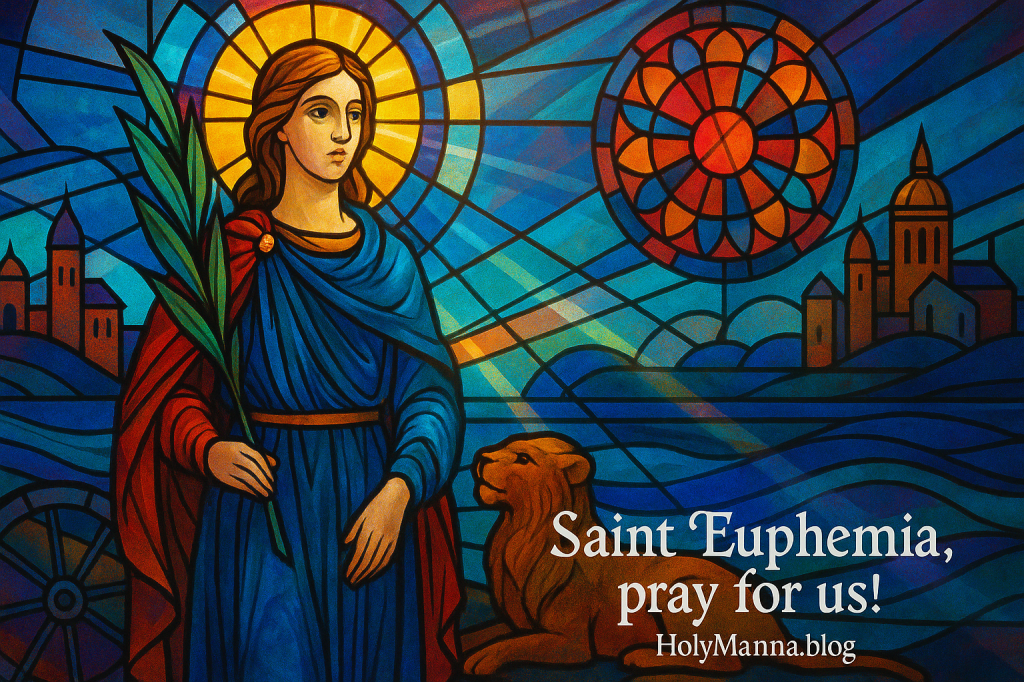
Saint Euphemia is venerated as a virgin martyr whose witness became inseparable from the Church’s confession of right belief. She is honored on September 16 in the Roman Martyrology and remembered especially for the way her tomb and church framed the Council of Chalcedon in 451. There the Fathers proclaimed the faith that Jesus Christ is one divine Person in two natures, true God and true man. Artists often depict Euphemia with the martyr’s palm, a cross, a broken wheel, or a lion or bear at her side, visual shorthand for the trials she endured and the victory of Christ in her.
A Young Disciple with a Single Heart
Tradition places Euphemia’s birth and life in Chalcedon, a city just across the waters from Constantinople. Early accounts describe her as a young Christian woman, dedicated to chastity and wholly given to Jesus. During the imperial persecutions at the beginning of the fourth century, local officials organized a mandatory pagan festival. Euphemia, along with other believers, refused to join the sacrifices. That refusal was not a theatrical gesture. It was the natural outcome of a heart already set on Christ and a conscience formed by the first commandment. While later stories supply details we cannot now verify with precision, the constant core remains the same. Euphemia was a consecrated disciple whose fidelity to Jesus brought her before the tribunal of power.
Wonders That Point Beyond Themselves
Reliable contemporary records about Euphemia’s daily works have not survived, and the Church does not preserve authenticated sayings directly from her lips. Ancient narratives, however, unanimously remember that God’s providence consoled her during the ordeal. Accounts speak of a spiked wheel that ceased its fury, of flames that did not consume her, and of angels who strengthened her to persevere. These are not spectacles for their own sake. They teach that the Lord draws near to those who suffer for his name and that miracles, when granted, direct our eyes to the Savior rather than to the servant.
Faith Tested by Fire and Beasts
After multiple torments that included scourging, the wheel, burning pans, and stones, Euphemia was exposed to wild beasts in the arena. The animals initially did not harm her. Finally a bear’s bite brought her earthly life to its completion. The Church contemplates this as the fullest witness to the truth. “Martyrdom is the supreme witness given to the truth of the faith.” CCC 2473. In Euphemia’s case, virginity and martyrdom meet, revealing a heart undivided and a love that no violence could break.
A Martyr Who Still Speaks
After her death, Euphemia’s tomb quickly became a place of prayer and healing. When the bishops gathered in 451 to address disputes about the person of Christ, they met in her martyrium. Devout tradition cherished especially in the East recounts that rival theological statements were placed at her shrine with fasting and prayer. The orthodox confession was found at her right hand, while the alternative lay at her feet. The Church in the West receives with certainty the council’s dogmatic definition preserved in its acts and honors the accompanying story as a beloved testimony to God’s care for the faithful through the intercession of his saints. Over centuries her relics were safeguarded during times of danger, including translations to Constantinople and, in periods of turmoil, temporary refuge elsewhere. Catholic devotion to Saint Euphemia also endures in Rovinj, Croatia, where an ancient local tradition venerates her as patroness after a sarcophagus bearing her relics was said to have reached the shore and been enshrined on the hill above the town. Whether in Chalcedon, Constantinople, or along the Adriatic coast, the pilgrim’s experience is consistent. The faithful ask for her prayers, give thanks for favors, and learn to cling more firmly to Christ.
Lessons for Today’s Pilgrims
Euphemia’s life calls us to three movements of the heart. First, she teaches undivided worship. She would not bend the knee to idols because her whole life belonged to Jesus. Second, she embodies resilient love. Her courage is not harsh or bitter. It is patient, steady, and free. Third, she shows that witness is fertile. Her hidden fidelity helped guard the Church’s open confession of Christ. The saints do not replace Christ or the sacraments. They lead us to him and strengthen us by their prayers. “Being more closely united to Christ, those who dwell in heaven fix the whole Church more firmly in holiness. They do not cease to intercede with the Father for us.” CCC 956. The Church also guides popular piety with care. “The religious sense of the Christian people has always found expression in various forms of piety… such as the veneration of relics.” CCC 1674. In practical terms, ask Saint Euphemia to help you guard Sunday worship, to speak the name of Jesus with clarity and charity, to keep custody of heart and senses, and to receive Holy Communion worthily and often. Where there is confusion or pressure to compromise the faith, remember her and repeat a simple prayer of trust. Lord Jesus, make my heart firm in you.
Engage with Us!
Share your thoughts and graces in the comments. How does Saint Euphemia’s courage inspire you to witness to Christ today?
- When your faith is tested, what helps you stand firm without bitterness or fear?
- Where is Christ inviting you to confess Him more clearly in word and deed this week?
- How can you integrate healthy, Christ-centered devotion to the saints and their relics into your prayer life in a way that leads you deeper into the sacraments?
- What part of the Council of Chalcedon’s confession of Christ’s divinity and humanity strengthens your love for Jesus?
Be encouraged to live your faith boldly, receive the sacraments often, love your neighbor generously, and do everything with the love and mercy Jesus taught us.
Saint Euphemia, pray for us!
Follow us on Instagram and Facebook for more insights and reflections on living a faith-filled life.

 Holy Manna!
Leave a comment