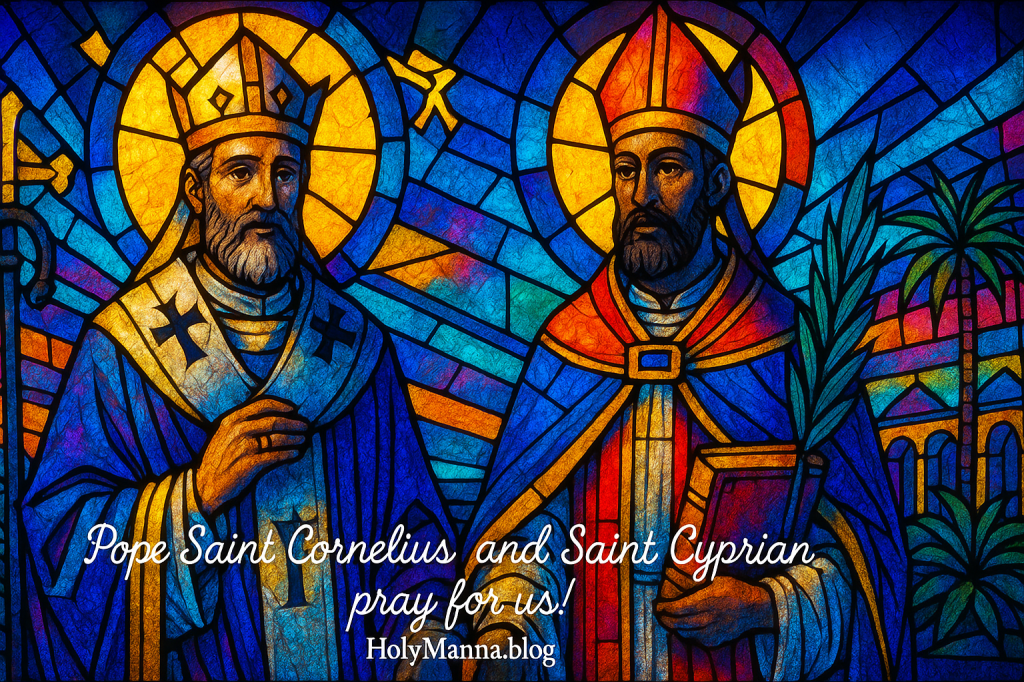
Twin Pillars of Mercy and Unity
Pope Saint Cornelius and Saint Cyprian are remembered together because their friendship and shared witness steadied the Church during one of its most painful crises. Cornelius, Bishop of Rome from 251 to 253, shepherded a traumatized flock emerging from the Decian persecution. Cyprian, Bishop of Carthage from 249 to 258, was a gifted pastor, theologian, and defender of ecclesial unity. Together they insisted that sinners who had denied Christ under torture could be reconciled through sincere penance and restored communion. Their feast on September 16 celebrates a pastoral vision that held mercy and truth together, and it honors two bishops whose courage culminated in martyrdom for Christ.
The Making of Pastors
Cornelius was a Roman priest chosen as pope after a long vacancy caused by violent persecution. His election took place in calmer months, but the wounds of the Church were deep. Many Christians had lapsed under threat of death. Others had risked everything to remain faithful. Cornelius soon faced a hard choice between a rigorism that refused forgiveness and the Gospel mandate to heal the brokenhearted. He chose the path of the Good Shepherd, gathering the scattered and calling them to conversion.
Cyprian, born Thascius Caecilius Cyprianus to a prosperous pagan family in Carthage, received an elite education in rhetoric and law. Through the influence of a priest named Caecilius and the compelling beauty of Christian charity, he embraced the faith around 246, sold part of his property, and gave to the poor. Baptism transformed his ambitions. Within a few years the community elected him bishop. His early treatise Ad Donatum narrates the interior freedom he discovered in Christ, and his later works would shape Latin Christianity for centuries.
Building the Church Back Together
The most heated controversy of their day erupted when Novatian, a learned Roman priest, claimed that the Church had no authority to reconcile the lapsed. When Cornelius was canonically elected, Novatian set himself up as a rival bishop of Rome. Cyprian immediately recognized Cornelius as the true successor of Peter and wrote in support of the Roman Church’s judgment that serious sinners could return through rigorous penance. Cyprian’s treatise De lapsis insisted on contrition, confession, and a concrete conversion of life. His famous De unitate ecclesiae offered a luminous vision of the Church as one body gathered around the bishops in communion with the Chair of Peter. From that work comes the line every generation remembers: “He cannot have God for his Father who has not the Church for his mother.”
Cyprian’s theology of unity is practical and pastoral. He writes of the bishops together sharing one responsibility under Christ: “The episcopate is one, each part of which is held by each one for the whole.” For both Cornelius and Cyprian, unity is not a vague feeling. It is a sacramental bond expressed in common faith, common worship, and communion with the successor of Peter. In this spirit, Cyprian also teaches Christians to pray as a family and not as isolated individuals, reminding us in his treatise on the Lord’s Prayer that the Church’s prayer begins with the words “We do not say ‘My Father,’ but ‘Our Father.’”
Signs of Grace in Their Lifetime
These saints are remembered more for courageous governance than for spectacular wonders, yet their lives overflow with grace. Cornelius took stock of the Roman Church he served and recorded not only the numbers of clergy but also the scale of the community’s charity. In a letter he noted the vast works of mercy that sustained the vulnerable in Rome, testifying, “There are 46 priests, 7 deacons, 7 subdeacons, 42 acolytes, 52 exorcists and readers and doorkeepers, and widows and persons in distress more than 1,500.” That single line reveals a Church already living the Gospel through organized and generous care for the poor.
Cyprian’s love shone during the mid third century pandemic later called the Plague of Cyprian. While many pagans fled from the sick, he urged Christians to nurse the ill, bury the dead, and do good to all without distinction. He preached hope in De mortalitate, teaching believers to face trial without despair and to interpret suffering in the light of the Resurrection. The visible miracles here are changed hearts, reconciled sinners, and a community that loves to the end.
The Crown of Witness
Cornelius’ mercy did not win him favor with emperors or schismatics. Under Emperor Gallus he was arrested and exiled to Centumcellae on the coast, where he died in 253, honored as a confessor and martyr. The Church at once venerated him as an authentic witness to the truth that Christ entrusted to Peter a ministry of reconciliation.
Cyprian’s path to martyrdom is unusually well documented. He was first exiled to Curubis in 257. Recalled to Carthage the next year, he stood before the proconsul and calmly confessed Christ. When told that he would be beheaded, he responded with serene faith, “Thanks be to God.” He removed his garments, knelt in prayer, gave a small gift to the executioner, and received the crown of martyrdom on September 14, 258. His death sealed a life spent rebuilding unity and teaching charity.
The Saints Who Still Shepherd Us
Veneration of Cornelius began immediately. He was buried in the Roman catacombs, and pilgrims honored him as a bishop who died for the flock. Across the centuries his intercession was invoked especially for children and for those suffering from nervous illnesses, a pastoral legacy that mirrors his earthly care for the vulnerable.
Cyprian’s tomb in Carthage became a place of prayer for North African Christians, and a basilica rose over his resting place. As time passed, portions of his relics were honored in other cities, where the faithful sought his help to remain steadfast in unity and courageous in charity. Both saints remind the Church that holiness does not end with death. It multiplies.
Living Their Lesson Today
Cornelius and Cyprian teach us to hold mercy and truth together. They call us to reconcile the fallen without diluting the demands of the Gospel. Their pastoral approach anticipates what the Church continues to teach about the sacrament of Penance and Reconciliation, where Christ heals the sinner and restores communion. The Catechism expresses it with clarity and tenderness: “Those who approach the sacrament of Penance obtain pardon from God’s mercy for the offense committed against him and are at the same time reconciled with the Church.” Their martyrdom also illuminates the highest form of Christian witness. The Catechism describes it simply and powerfully: “Martyrdom is the supreme witness given to the truth of the faith.”
To follow them, we can examine our conscience honestly, confess regularly, and make reparation where we have wounded others. We can pray for those who have drifted from the Church and accompany them back to the sacraments with patience and love. We can read the Fathers, beginning with Cyprian’s De unitate ecclesiae and On the Lord’s Prayer, and we can support our pastors who, like Cornelius and Cyprian, carry the weight of unity on their shoulders.
Engage with Us!
We would love to hear your thoughts and prayers in the comments. How does the courage of Cornelius and Cyprian challenge you to live the Gospel more openly this week?
- Where do you need God’s mercy most right now, and how can you take a concrete step toward the sacrament of Reconciliation?
- How can you help heal division in your family or parish, following Cyprian’s vision of unity?
- What does martyrdom as “supreme witness” mean in daily life—at work, online, or among friends?
- Which passage from De unitate ecclesiae or the Catechism speaks most to you about the Church as our mother?
- Who in your life has “lapsed” from the faith, and how will you intercede and accompany them this month?
Be encouraged. Christ has already conquered. With Cornelius and Cyprian as intercessors, let us live a life of faith, and do everything with the love and mercy Jesus taught us.
Pope Saint Cornelius and Saint Cyprian, pray for us!
Follow us on Instagram and Facebook for more insights and reflections on living a faith-filled life.

 Holy Manna!
Leave a comment