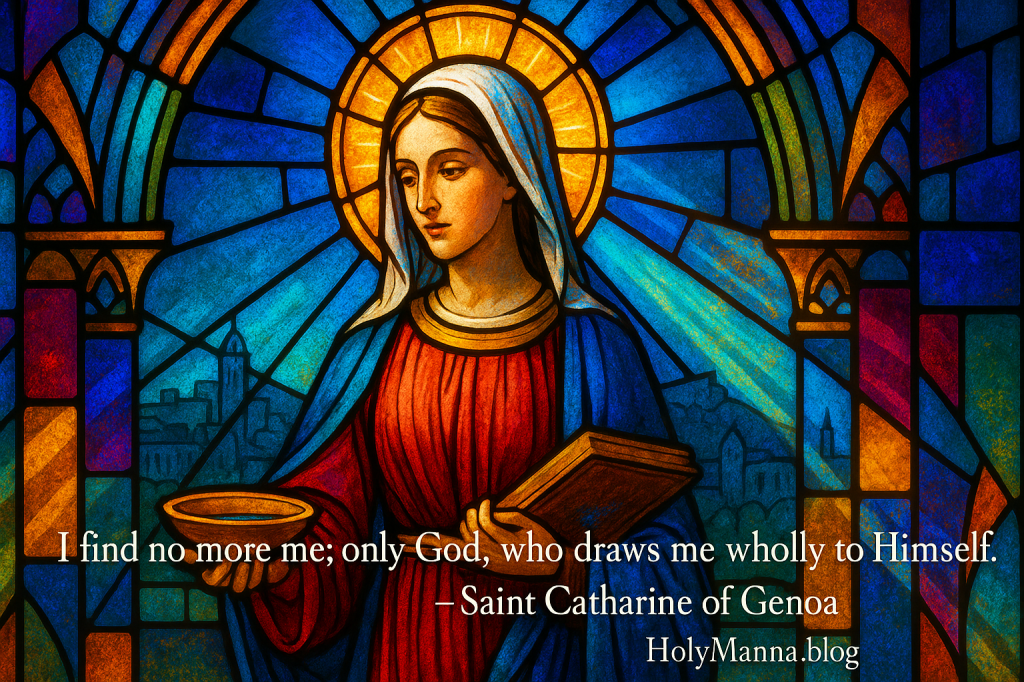
A Wound of Love That Set Genoa Ablaze
Saint Catherine of Genoa (1447–1510) stands at the crossroads of mysticism and mercy. She is renowned for her spiritual classic Treatise on Purgatory and for her luminous leadership at Genoa’s great civic hospital, Pammatone. Her life reveals how deep prayer and frequent Communion can kindle a love that heals cities. She did not withdraw from the world. She carried God’s presence into fever wards, financial ledgers, and conversations with the wounded of every class. Her most famous confession of identity captures her total surrender to divine love: “My me is God, nor do I recognize any other me except my God Himself.”
From Noble House to Holy Fire
Born Caterina Fieschi into a prominent Genoese family related to two popes, she grew up amid wealth, politics, and expectations. At sixteen she entered an arranged marriage with Giuliano Adorno, a union shadowed for years by his gambling and worldliness. Catherine herself endured a decade of inner dryness and discouragement. Everything changed on March 20, 1473, when she went to confession seeking light. There the Lord pierced her with a grace she called a wound of love. She left the confessional resolved to live for God alone, repeating the cry that summed up her turning point: “No longer the world, no longer sin.” From that day she began daily Communion, unusual then for the laity, and adopted a rhythm of prayer, penance, and service that would transform her home and her city. Over time her husband experienced conversion, became a Franciscan tertiary, and joined her works of mercy. Catherine is best known for her profound teaching on purifying love and for her tireless care of the sick poor.
A Hospital Made Into a Chapel of Mercy
Catherine’s conversion quickly became concrete at Pammatone, Genoa’s principal hospital. She started at the bedsides of the abandoned, washing wounds and comforting plague victims with the gentleness she learned in prayer. She organized linens, medicines, and schedules; she reconciled feuds among staff; and she brought integrity to financial accounts in an age when charity could easily be diverted. Eventually she served as director and treasurer, guiding the institution with competence and a mother’s heart. Her leadership attracted a circle of disciples who learned to see Christ in the most disfigured faces. People came to the hospital not only for cures but for counsel, and many left with their faith rekindled by Catherine’s clarity and compassion. Although she is not remembered for spectacular public miracles, those who worked with her testified that her presence often brought sudden peace, reconciled marriages, and unexpected recoveries that fostered conversion. Her “ordinary” charity became an extraordinary sign of God at work in a city often torn by faction and fear.
The Interior Fire
Catherine’s writings, especially the Treatise on Purgatory and the Dialogue of the Soul and Body, unfold a vision in which God’s love is a fire that heals. Purgatory, for her, is not primarily a place but the merciful action of divine love purifying the soul so that it can see God without the least attachment to sin. She insists that the souls who are being purified are filled with certainty and peace because they now want only what God wants. In language both daring and serene she writes of the soul seized by love: “I find no more me; only God, who draws me wholly to Himself.” Her teaching harmonizes with the heart of the Church’s doctrine: “All who die in God’s grace and friendship, but still imperfectly purified, are indeed assured of their eternal salvation; but after death they undergo purification.” (Catechism of the Catholic Church 1030). This vision shaped the way she lived. Frequent Communion fed her love for the Lord and for the sick, and she experienced ecstasies and locutions that never distracted her from work. For Catherine, contemplation and service were one act of love.
Signs of Grace in Daily Life
If you search Catherine’s story for sensational wonders, you will mostly find a quiet blaze. Her gifts were discernment, wise counsel, and a contagious joy that drew others to repentance. The “miracles” most often reported in her lifetime were moral and spiritual: hardened men became gentle, estranged spouses reconciled, and those on the brink of despair found hope. Her husband’s conversion stands as a living sign of grace radiating from her fidelity. Those who accompanied her at Pammatone also recorded instances of sudden improvement among patients after Catherine’s prayer, though she refused attention and deflected praise to God. She desired that all credit go to the divine Physician, preferring to remain hidden while love did its purifying work.
Trials That Tempered Charity
Catherine’s sanctity was refined in real fire. She endured a difficult marriage, years of inner purgation, misunderstanding from those who questioned her fervor, and the exhaustion of serving during epidemics. She embraced austerity without harshness, combining fasting with a cheerful availability that gave courage to the sick and the poor. As her union with God deepened, she suffered physical pains that accompanied her prayer and service, yet she pressed on, anchored in the love that had seized her. She died in Genoa on September 15, 1510, worn out in body but radiant in soul, after a long path of letting God be God in every corner of her life.
After The Sunset
Catherine’s memory continued to generate life long after her death. Disciples such as Ettore Vernazza and his daughter, the mystic Battista Vernazza, helped preserve her teaching and extend her works of mercy. The Company or Oratory of Divine Love that took shape in her circle helped spark concrete reform by uniting prayer, catechesis, and service to the poor. Reports of favors and healings through her intercession spread among the people of Genoa, contributing to the Church’s formal recognition of her holiness. She was beatified in 1675 and canonized in 1737. Her relics are venerated in Genoa, where the faithful continue to seek her prayer for purification of heart, healing of relationships, and steadfast charity. Pilgrims who follow her footsteps in the city discover how a hospital corridor can become a cloister and how a ledger can become a school of honesty and trust in Providence.
Let Love Do What We Cannot
Catherine teaches that holiness is not an escape from the world but the transformation of everything by divine love. Begin where you are. Receive the Eucharist with faith and ask for the grace to serve the most vulnerable people God places in your path. Invite the Lord to purify your desires and reorder your days, trusting that His love will burn away fear and self will. Pray for the dead with confident hope, remembering the Church’s enduring practice: “From the beginning the Church has honored the memory of the dead and offered prayers in suffrage for them.” (Catechism of the Catholic Church 1032). Let Catherine’s words become a simple aspiration you can repeat during the day: “My me is God.” How is the Lord inviting you to let His love purify your desires and reorder your daily life?
Engage with Us!
We’d love to hear how Saint Catherine’s story resonates with you—share your reflections and intentions in the comments.
- Where do you sense God inviting you to say, like Catherine, “no longer the world, no longer sin”?
- How might daily or more frequent reception of the Eucharist reshape your love for those who suffer?
- What “hospital” is God asking you to serve today, whether a home, workplace, parish, or city need?
- How does Catherine’s vision of purgatory as healing love change the way you pray for the faithful departed?
- Which attachment most needs the purifying fire of charity in your life this week?
Go in confidence. Live your faith out loud. Do everything with the love and mercy Jesus taught us.
Saint Catherine of Genoa, pray for us!
Follow us on Instagram and Facebook for more insights and reflections on living a faith-filled life.

 Holy Manna!
Leave a comment