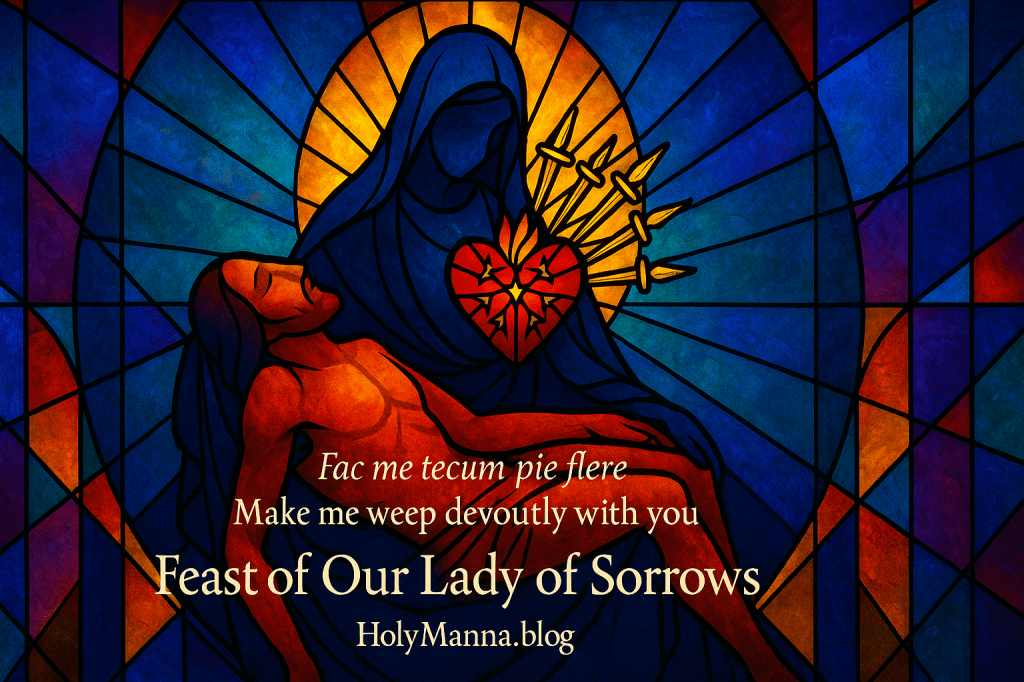
A Mother at the Cross, A Feast for the Whole Church
The Feast of Our Lady of Sorrows is kept on September 15, the day after the Exaltation of the Holy Cross. The Church pauses to contemplate Mary’s share in the Passion of Jesus and her maternal closeness to every disciple who stands beneath the Cross. Sacred Scripture anchors the day in two luminous scenes. At the Presentation, Simeon prophesies to Mary, “and you yourself a sword will pierce” (Luke 2:35). At Calvary, Jesus entrusts Mary and the beloved disciple to one another, “Woman, behold, your son”, and “Behold, your mother” (John 19:26–27). The Catechism of the Catholic Church gathers these threads and teaches that “The Church’s devotion to the Blessed Virgin is intrinsic to Christian worship” (CCC 971) and that “This motherhood of Mary in the order of grace continues uninterruptedly” (CCC 969). The feast is therefore not a mere memory of sorrow. It is a liturgical confession that the Mother of the Lord remains a mother to us, especially where suffering seeks the face of hope.
From Medieval Compassion to the Universal Calendar
The story of this feast winds through centuries of prayer. Medieval Christians loved to ponder the Dolors of Mary, a contemplative gaze crystallized in the Servite Order, founded in thirteenth century Florence. Their spirituality gave enduring shape to the Seven Sorrows, a biblical pathway that follows Mary from the prophecy of Simeon to the burial of Christ. Liturgical history eventually set two observances. A Lenten commemoration known as the Friday of Sorrows entered wider use in the eighteenth century, while a September celebration after the Holy Cross was added to the general calendar in the nineteenth century and fixed to September 15 in the early twentieth century. In the modern Roman Calendar, the September memorial remains, drawing the faithful to stand with Mary in the Paschal Mystery. The feast also carries a hymn that has consoled hearts for centuries. The sequence Stabat Mater opens with the haunting line, “Stabat Mater dolorosa juxta crucem lacrimosa”. The Church often sings or meditates upon this text on September 15, allowing its poetry to train the heart in a love that does not flee.
Where the Sorrowful Mother Draws Near
Under this title, Mary’s maternal nearness shines in the life of the Church. In Rwanda at Kibeho, where the apparitions were later judged worthy of belief, Mary called the faithful to conversion and asked anew for the Rosary of the Seven Sorrows. That request helped reawaken a traditional Servite devotion and formed many hearts to pray with Mary for a wounded world. In Slovakia, Our Lady of Seven Sorrows is honored as the national patroness, and the country marks September 15 with a solemn day of prayer and pilgrimage. In Chicago, the Basilica of Our Lady of Sorrows has long been a Servite center of preaching, reconciliation, and healing. Across these places, the same pattern is visible. Mary stands beside those who suffer in body and spirit. She intercedes as a mother, she points unfailingly to her Son, and she teaches the Church to persevere in love. The biblical testimony remains our guide. The Gospel shows that the Mother of Jesus did not abandon Him. The Lord then entrusted her to the disciple so that no disciple would ever feel alone in the shadow of the Cross.
The Sword and the Gift
The theological heart of this feast is Mary’s unique participation in the redemptive work of Christ. The Church does not set Mary alongside the Redeemer as an equal cause. Rather, she acknowledges a singular maternal cooperation born of grace. The Catechism of the Catholic Church receives the teaching of the Council and affirms that Mary, united with her Son in the work of salvation, “is mother to us in the order of grace” (CCC 969). In the same vision the Church confesses with confidence that “The Church’s devotion to the Blessed Virgin is intrinsic to Christian worship” (CCC 971). The Cross reveals why. At Calvary, the Son offers Himself for the life of the world, and the Mother consents to the Father’s plan with a faith that does not falter. Many saints have contemplated this mystery. The ancient hymn puts it simply. “Fac me tecum pie flere”, which means “make me weep devoutly with you”. In Mary’s school, sorrow is not sterile. It becomes a place of communion, a participation in the charity by which Christ loved us to the end. To keep this feast is to welcome again the gift Christ made when He said, “Behold, your mother”. The fruit is a Church more Marian and therefore more Christlike.
Praying the Seven Sorrows
Devotion on this day naturally turns to the Servite Rosary of the Seven Sorrows. The chaplet is prayed by contemplating seven Gospel moments. The first is the prophecy of Simeon. The second is the flight into Egypt. The third is the loss of the Child Jesus in the Temple. The fourth is Mary meeting Jesus on the way to Calvary. The fifth is the crucifixion and death of the Lord. The sixth is the piercing of His side and the placing of His body in the arms of His Mother. The seventh is the burial of Jesus. The method is simple and powerful. One begins with an Act of Contrition, then for each sorrow prays an Our Father and seven Hail Marys while pondering the mystery. In this way the heart learns to keep company with Mary where the Gospel is most costly and most alive. Pilgrims throughout the world take up this path in concrete places. The Servite sanctuary of Monte Senario rises above Florence and preserves a living memory of the order that carried this devotion across centuries. The Basilica of Our Lady of Sorrows in Chicago witnesses to the consoling presence of the Sorrowful Mother in an American city. In Šaštín, Slovakia, a national shrine gathers families each September to entrust their wounds and hopes to the Mother who understands. These journeys shape disciples who know how to pray when words run out.
A Culture Evangelized by Compassion
The feast has formed Christian culture in striking ways. In many Spanish speaking lands, the Friday of Sorrows that precedes Holy Week features solemn processions that accompany an image of Our Lady of Sorrows through city streets. The faithful move slowly, often in silence or with the hymn Stabat Mater, and learn the patience of love. In the Philippines and Mexico, households erect small altars with a Pietà or a sorrowful image of Mary and gather for Scripture, lament and the Rosary. In Slovakia, September 15 is honored with national prayer and family pilgrimages. Christian art has carried the feast into the imagination. The Pietà has become one of the most recognized depictions of the Mother’s sorrow, a visual catechesis on the sixth and seventh sorrows. These customs are not mere sentiment. They are a school of compassion. To celebrate Our Lady of Sorrows is to allow the Gospel to evangelize our way of grieving, our way of accompanying the suffering, and our way of hoping for the dawn.
Let Mary Teach Your Heart How to Suffer
The feast offers a deeply practical lesson for every disciple. Mary’s presence beneath the Cross shows that faith does not erase pain, yet it transfigures it with meaning. Her steadfast gaze teaches us to remain, to listen, and to love when solutions are not obvious. If a sword pierced her soul, then no wound in our lives is unknown to her maternal heart. The gift Jesus offered from the Cross can be received again today by a simple prayer. “Mother, stay with me where it hurts the most.” The Catechism of the Catholic Church reminds us that this maternal care does not cease. “This motherhood of Mary in the order of grace continues uninterruptedly” (CCC 969). Receive that promise and take a concrete step. Pray one sorrow each day this week with the Gospel open before you. Offer a small hidden sacrifice for someone who is grieving. Read John 19:25–27 and Luke 2:25–35 slowly and invite Mary to interpret your life in the light of her Son. In this school of the Sorrowful Mother, sorrow becomes compassion, and compassion becomes mission.
Engage with Us!
We’d love to hear your thoughts—share your reflections below so we can pray and grow together under Mary’s mantle.
Reflection Questions
- Which of the Seven Sorrows speaks most to your current season, and why?
- How does Mary’s presence beneath the Cross change the way you face suffering?
- What small, concrete act of compassion can you offer this week in union with Our Lady of Sorrows?
- Where might Jesus be saying to you today: “Behold, your mother”?
- How can your family (or small group) pray the Seven Sorrows Rosary together this month?
Take courage, let’s walk with the Sorrowful Mother, learn love at the Cross, and grow together in the heart of the Church.
Our Lady of Sorrows, pray for us!
Follow us on Instagram and Facebook for more insights and reflections on living a faith-filled life.

 Holy Manna!
Leave a comment