Memorial of Our Lady of Sorrows – Lectionary: 443/639
Praying With Mary at the Cross
If your heart feels the world’s weight today, come stand beneath the Cross and learn how to pray. In 1 Timothy 2:1-8, the Apostle summons the Church to “supplications, prayers, petitions, and thanksgivings…for everyone”, even for rulers, so that believers may live “quiet and tranquil” lives rooted in the truth of “one mediator between God and the human race, Christ Jesus” who “gave himself as ransom for all.” The Psalm gives us the posture of this intercession, as we lift our hands toward God’s holy place and confess, “The Lord is my strength and my shield” (Psalm 28). At Calvary, the Gospel shows Mary steadfast at her Son’s side, receiving from Him a new maternal mission for every disciple: “Woman, behold, your son… Behold, your mother.” From that hour, the beloved disciple took her into his home, which is to say, into the heart of the Church (John 19:25-27). The Memorial of Our Lady of Sorrows develops this scene in the Church’s memory and devotion. It follows the Feast of the Exaltation of the Holy Cross in order to contemplate the inseparable union of the Son’s sacrifice and the Mother’s sorrow, celebrated for centuries in the Stabat Mater and in the tradition of the Seven Sorrows. Mary’s compassion is not a rival to Christ’s unique mediation, but its most luminous witness in the order of grace, since she cooperates with her Son as a mother who intercedes for her children (CCC 618; CCC 964; CCC 969; CCC 2634). Together, today’s readings and memorial teach us that authentic Christian prayer is universal, priestly, and Marian. We pray for all people, including those in authority, we lift holy hands without anger, and we let our hearts be schooled by the Mother who stood beneath the Cross and never stopped believing in the triumph of her Son. Where is God inviting you to lift your hands in intercession with a heart that stands firm beneath the Cross today?
First Reading: 1 Timothy 2:1-8
Universal Intercession under the One Mediator
Paul writes to Timothy as his trusted delegate in the bustling, pluralistic city of Ephesus, where civic order, imperial power, and devotion to Artemis shaped daily life. Into this world, the apostle forms a distinctly Christian posture toward society and authority. The Church does not withdraw into resentment or rage. She raises her hands in prayer. In 1 Timothy 2:1-8, Paul commands a wide horizon of intercession for all people, including rulers, because God desires all to be saved and because Christ alone is the one Mediator who gave himself as a ransom for all. This is not a private spirituality. It is the priestly breathing of the Body of Christ for the life of the world. On the Memorial of Our Lady of Sorrows, we contemplate this intercession under the Cross, where Mary stands with a pierced heart, completely united to her Son’s saving will. The Church learns universal prayer from Christ the Mediator and receives Marian tenderness as the shape of that prayer. In a world marked by polarization, the Scriptures call us to lift holy hands without anger, to pray for leaders, and to trust the single Mediator whose sacrifice embraces everyone.
1 Timothy 2:1-8
New American Bible (Revised Edition)
Prayer and Conduct. 1 First of all, then, I ask that supplications, prayers, petitions, and thanksgivings be offered for everyone, 2 for kings and for all in authority, that we may lead a quiet and tranquil life in all devotion and dignity. 3 This is good and pleasing to God our savior, 4 who wills everyone to be saved and to come to knowledge of the truth.
5 For there is one God.
There is also one mediator between God and the human race,
Christ Jesus, himself human,
6 who gave himself as ransom for all.
This was the testimony at the proper time. 7 For this I was appointed preacher and apostle (I am speaking the truth, I am not lying), teacher of the Gentiles in faith and truth.
8 It is my wish, then, that in every place the men should pray, lifting up holy hands, without anger or argument.
Detailed Exegesis
Verse 1: “First of all, then, I ask that supplications, prayers, petitions, and thanksgivings be offered for everyone,”
Paul’s “first of all” signals priority. Christian worship includes a full range of intercession, from pleading to gratitude, and it is offered for everyone. The breadth reflects God’s universal salvific will. Intercession forms the Church into a people whose love looks outward.
Verse 2: “for kings and for all in authority, that we may lead a quiet and tranquil life in all devotion and dignity.”
Even when authorities are indifferent or hostile, believers pray for them. The aim is not political domination but the possibility of peaceful, dignified devotion. Praying for rulers purifies our hearts of resentment and seeks the common good where the Gospel can flourish.
Verse 3: “This is good and pleasing to God our savior,”
Intercession aligns the Church with what delights God. Prayer for all mirrors the largeness of His mercy. It is an act of worship that pleases the Lord and conforms us to His heart.
Verse 4: “who wills everyone to be saved and to come to knowledge of the truth.”
Here is the theological engine of universal prayer. God’s will is salvific and universal. The Church’s intercession cooperates with this will, asking that all be drawn into truth, which ultimately is Christ Himself.
Verse 5: “For there is one God. There is also one mediator between God and the human race, Christ Jesus, himself human,”
Monotheism grounds mediation. Because there is one God, there is one Mediator, Jesus Christ, true God and true man. His true humanity unites Him to us, and His divinity unites us to the Father. All Christian prayer moves through Him.
Verse 6: “who gave himself as ransom for all. This was the testimony at the proper time.”
Christ’s mediation is sacrificial. He ransoms us by offering His life. The Gospel is a concrete historical testimony revealed at the proper time, culminating at Calvary where love is poured out for all.
Verse 7: “For this I was appointed preacher and apostle (I am speaking the truth, I am not lying), teacher of the Gentiles in faith and truth.”
Paul’s mission flows from Christ’s universal ransom. If Christ died for all, then the Gospel must go to all, including the Gentiles. Apostolic ministry is the public service of the one Mediator’s saving reach.
Verse 8: “It is my wish, then, that in every place the men should pray, lifting up holy hands, without anger or argument.”
The proper posture of worship is purity of heart and unity of love. Raised hands symbolize priestly intercession. Absence of anger and quarrel shows that prayer reforms the community from the inside, making space for God’s peace.
Teachings
The Catechism names this outward-looking prayer “intercession.” “Intercession is a prayer of petition which leads us to pray as Jesus did.” (CCC 2634). Christ’s saving work explains why He alone is the Mediator who draws all to the Father. “The cross is the unique sacrifice of Christ, the ‘one mediator between God and men’.” (CCC 618). On Our Lady of Sorrows, the Church remembers that Mary’s maternal role serves, and never competes with, Christ’s unique mediation. The Catechism affirms, “Therefore the Blessed Virgin is invoked in the Church under the titles of Advocate, Helper, Benefactress, and Mediatrix.” (CCC 969). To safeguard Christ’s primacy, The Catechism also states, “Mary’s function as mother of men in no way obscures or diminishes this unique mediation of Christ, but rather shows its power.” (CCC 970). Under the Cross, Mary’s pierced heart shares the intentions of her Son for the whole world. The Church learns from her to pray with universal charity that is entirely dependent on Christ’s sacrifice.
Reflection
This reading trains our hearts to widen our prayer beyond familiar circles and preferred causes. Begin your day by naming people and leaders you find difficult to love, and ask Jesus the Mediator to bless them with wisdom, justice, and peace. Choose one concrete act this week that embodies intercession, such as offering a Rosary for local officials, writing a note of encouragement to a public servant, or fasting for unity in your parish. Let your posture in prayer reflect your interior intention. Lift your hands, and ask for a heart free of anger or argument. Invite Mary into your intercession, especially when sorrow is near, and allow her steadfast trust at Calvary to steady you. Whom is the Lord inviting you to carry to Him in prayer today? Where do you need the grace to release anger and raise holy hands instead? How can you make intercession for leaders a regular part of your spiritual life this week?
Responsorial Psalm – Psalm 28:2, 7-9
Lifted Hands, Trusting Hearts
Composed in the voice of Davidic prayer, Psalm 28 emerges from Israel’s liturgical life where worshipers approached the sanctuary with uplifted hands, a bodily sign of dependence and hope. The “holy place” evokes the Temple, the locus of God’s presence and covenant mercy. In today’s context, the Psalm becomes the Church’s language of intercession shaped by the Cross. We learn to cry out with confidence, to name God as strength and shield, and to ask not only for personal rescue but for the blessing of the whole people. On the Memorial of Our Lady of Sorrows, this prayer is illuminated at Calvary, where Mary’s steadfast trust stands beneath her Son’s saving sacrifice. Joined to the theme of universal intercession in 1 Timothy 2:1-8, the Psalm teaches us the posture and tone of Christian prayer. We lift holy hands without anger, we entrust the anointed King and His people to the Father, and we beg that He pasture and carry His inheritance forever.
Psalm 28:2, 7-9
New American Bible (Revised Edition)
2 Hear the sound of my pleading when I cry to you for help
when I lift up my hands toward your holy place.
7 The Lord is my strength and my shield,
in whom my heart trusts.
I am helped, so my heart rejoices;
with my song I praise him.
8 Lord, you are a strength for your people,
the saving refuge of your anointed.
9 Save your people, bless your inheritance;
pasture and carry them forever!
Detailed Exegesis
Verse 2: “Hear the sound of my pleading when I cry to you for help when I lift up my hands toward your holy place.”
The Psalmist weds voice and gesture. Crying out and lifting hands form a single act of faith directed toward the sanctuary. Prayer engages the whole person. The movement toward the “holy place” expresses the desire to draw near to God’s presence and mercy. The phrase signals liturgical confidence. God hears.
Verse 7: “The Lord is my strength and my shield, in whom my heart trusts. I am helped, so my heart rejoices; with my song I praise him.”
Confession follows petition. The Psalmist names God as strength and shield, then narrates help received. Trust ripens into joy, and joy flowers into praise. This is the arc of Christian prayer. We ask. We trust. We receive. We sing. In the light of the Cross, Jesus is our shield, and in union with Him our hearts learn resilient praise even in sorrow.
Verse 8: “Lord, you are a strength for your people, the saving refuge of your anointed.”
The prayer widens from “my” to “your people.” God’s saving work embraces the community and touches the “anointed”, a royal term fulfilled in Christ the Messiah. Under the Cross, Mary’s sorrowful fidelity accompanies the Anointed One. The Church learns to pray for the whole Body, trusting the Father to be its refuge.
Verse 9: “Save your people, bless your inheritance; pasture and carry them forever!”
The closing petitions gather the shepherd imagery of Israel’s Scriptures. To be saved is to be pastured and carried. The plea is comprehensive and enduring. It asks for protection, blessing, guidance, and perseverance. In Our Lady of Sorrows we see the maternal face of this petition, as she entrusts the Church to the Shepherd who never ceases to carry His flock.
Teachings
The Catechism sets the Psalms at the heart of Christian prayer: “The Psalms constitute the masterwork of prayer in the Old Testament.” (CCC 2586). Praise crowns the Psalmist’s trust and becomes our own liturgical song: “Praise is the form of prayer which recognizes most immediately that God is God.” (CCC 2639). The Psalm’s lifted hands point to the integration of body and soul in prayer: “The need to involve the senses in interior prayer corresponds to a requirement of our human nature.” (CCC 2702). Finally, the Psalm’s communal petitions harmonize with the Church’s intercession for all, echoing the day’s first reading: “Intercession is a prayer of petition which leads us to pray as Jesus did. He is the one intercessor with the Father on behalf of all men, especially sinners.” (CCC 2634). In the mystery of the Cross, Mary’s steadfast presence manifests how the Church prays with and in Christ, for the people whom the Father calls His inheritance.
Reflection
Let this Psalm train your posture and your heart. Begin by naming before God the places where you need strength and shielding, then deliberately move from “my” to “your people” by interceding for family, parish, and civic leaders. Sing a simple hymn of thanksgiving after you pray, even if your feelings lag behind your faith, because praise forms trust. Consider praying a decade of the Sorrowful Mysteries, asking to receive Mary into your home so that your intercession may be steady and hopeful. Where do you need to lift your hands again instead of lifting your voice in anger? Whom is God asking you to carry in prayer so that He may pasture and bless them? How can you weave praise into your daily routine so that trust matures into joy?
Holy Gospel – John 19:25-27
At the Cross, A New Family Is Born
The Fourth Gospel brings us to the foot of Calvary, where Roman crucifixion exposes victims to shame and slow death, yet also unveils the glory of the Son who lays down His life in obedient love. In this public place of humiliation, a quiet remnant remains: the Mother of Jesus, her companions, and the beloved disciple. In Jewish familial culture, entrusting a mother to a faithful son safeguarded her future. Jesus transforms that custom into a sacramental moment for the Church. He forms a new family not by blood alone but by grace flowing from the Cross. On the Memorial of Our Lady of Sorrows, the Church lingers here to contemplate Mary’s steadfast presence and to receive anew the Lord’s final gift. This scene gathers today’s theme. The one Mediator, Christ Jesus, ransoms all and from the wood of the Cross He gives His Mother to the disciple, so that the Church’s universal intercession might be Marian in heart and wholly Christocentric in source.
John 19:25-27
New American Bible (Revised Edition)
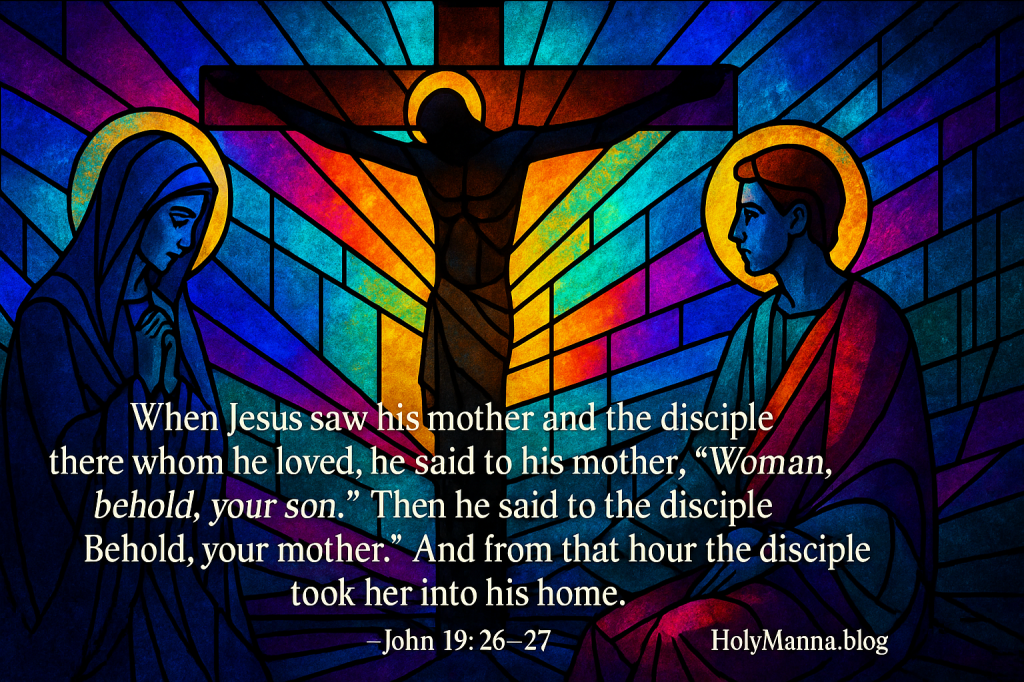
25 Standing by the cross of Jesus were his mother and his mother’s sister, Mary the wife of Clopas, and Mary of Magdala. 26 When Jesus saw his mother and the disciple there whom he loved, he said to his mother, “Woman, behold, your son.” 27 Then he said to the disciple, “Behold, your mother.” And from that hour the disciple took her into his home.
Detailed Exegesis
Verse 25: “Standing by the cross of Jesus were his mother and his mother’s sister, Mary the wife of Clopas, and Mary of Magdala.”
The evangelist names a courageous communion of women who remain when many have fled. Mary’s steadfastness is not stoic resignation. It is faith under trial. Her presence fulfills Simeon’s prophecy of a sword that would pierce her heart and signals that salvation history culminates where she stands with her Son. The beloved disciple’s proximity, implied in the next verse, represents the nascent Church receiving its identity at the Cross.
Verse 26: “When Jesus saw his mother and the disciple there whom he loved, he said to his mother, ‘Woman, behold, your son.’”
Jesus addresses Mary as “Woman,” echoing the new Eve motif in John where Mary’s role is linked to the restoration of creation. His word does not merely console. It effects what it declares. By entrusting Mary to the beloved disciple, He inaugurates a spiritual kinship. The disciple stands in for every Christian who will live from the grace of Calvary. Mary’s sorrow becomes maternal mission. She looks upon the Church with the same love with which she looked upon her Son.
Verse 27: “Then he said to the disciple, ‘Behold, your mother.’ And from that hour the disciple took her into his home.”
The second entrustment completes the new covenant family. The phrase “from that hour” in John signals salvific fulfillment. The disciple receives Mary not as an optional devotion but as a gift bound to the mystery of the Cross. To take her “into his home” means into the sphere of life, prayer, and mission. The Church learns that authentic discipleship includes welcoming Mary’s maternal intercession as part of living under the Lordship of the Crucified.
Teachings
The Catechism articulates Mary’s continuing motherhood that flows from Calvary in the order of grace: “This motherhood of Mary in the order of grace continues uninterruptedly from the consent which she loyally gave at the Annunciation and which she sustained without wavering beneath the cross, until the eternal fulfillment of all the elect. Taken up to heaven she did not lay aside this saving office but by her manifold intercession continues to bring us the gifts of eternal salvation. Therefore the Blessed Virgin is invoked in the Church under the titles of Advocate, Helper, Benefactress, and Mediatrix.” (CCC 969). The same teaching safeguards the primacy of Christ’s sole mediation: “Mary’s function as mother of men in no way obscures or diminishes this unique mediation of Christ, but rather shows its power.” (CCC 970). In the mystery of participation, the Church contemplates how believers share in Christ’s redeeming love while affirming His unique sacrifice: “The cross is the unique sacrifice of Christ, the ‘one mediator between God and men.’” (CCC 618). At the foot of the Cross, Mary stands as the first and most faithful disciple. Her sorrow is evangelizing. Her presence teaches us how to receive and to intercede.
Reflection
Receive this scene personally by obeying the Lord’s word. Invite Mary into your home today with a simple prayer, and ask to share her steadfast faith at the foot of the Cross. Entrust to her the people who weigh on your heart, especially those who suffer or who stand in positions of authority, so that your intercession may be wide and merciful. Consider placing an image of the Pietà or a crucifix in a prominent place and pausing there daily to pray for the Church and the world. Pray a decade of the Rosary meditating on the Crucifixion and ask for the grace to remain with Jesus in trials. Where do you need to stand firm beneath the Cross rather than flee in fear or cynicism? How might you take Mary “into your home” in a concrete way this week, in your prayer, your work, and your relationships? Whom is Jesus asking you to entrust to His Mother so that your home becomes a school of intercession and hope?
Gathered Beneath the Cross
Today’s Word forms one seamless call. In 1 Timothy 2:1-8 we are summoned to offer supplications for everyone, including those in authority, because there is one God and one Mediator who gave Himself as a ransom for all. In Psalm 28 we learn the posture of that intercession as we lift our hands toward the holy place, confess that the Lord is our strength and shield, and ask Him to save, bless, pasture, and carry His people forever. In John 19:25-27 we stand with Mary beneath the Cross and receive the Lord’s final gift to the Church, “Behold, your mother.” On the Memorial of Our Lady of Sorrows, her steadfast love shows us how to remain with Jesus in the hour of suffering and how to pray with hearts enlarged by His sacrifice.
Let these readings reshape your week. Take Mary into your home in a simple, sincere way, and let her teach you to pray with a quiet, courageous charity. Offer intentional prayer for leaders and for those you find hardest to love. Lift your hands in trust, sing praise even when you do not feel like singing, and allow the one Mediator to make your life a channel of mercy for others. Receive the Eucharist with a heart ready to intercede, and consider a decade of the Sorrowful Mysteries for the Church and the world. Where is the Lord inviting you to stand firm beneath the Cross, to pray widely, and to welcome Mary’s maternal care so that your life becomes a beacon of hope?
Engage with Us!
Share your reflections in the comments below so we can pray and grow together.
- First Reading (1 Timothy 2:1-8): Whom in authority will you intentionally intercede for this week, and how will you lift holy hands without anger or argument so that your prayer cooperates with God’s desire that all be saved?
- Responsorial Psalm (Psalm 28:2, 7-9): When you pray today, where do you need to lift your hands toward the holy place and trust the Lord as your strength and shield, moving from “my” needs to prayer for “your people”?
- Holy Gospel (John 19:25-27): How will you take Mary into your home in a concrete way this week so that your intercession at the foot of the Cross becomes more faithful, hopeful, and tender?
Go in peace and live a life of faith that is bold in prayer, steady in hope, and generous in charity, doing everything with the love and mercy Jesus taught us.
Sacred Heart of Jesus, we trust in You!
Immaculate Heart of Mary, pray for us!
Saint Michael the Archangel, defend us in battle!
Follow us on Instagram and Facebook for more insights and reflections on living a faith-filled life.

 Holy Manna!
Leave a comment