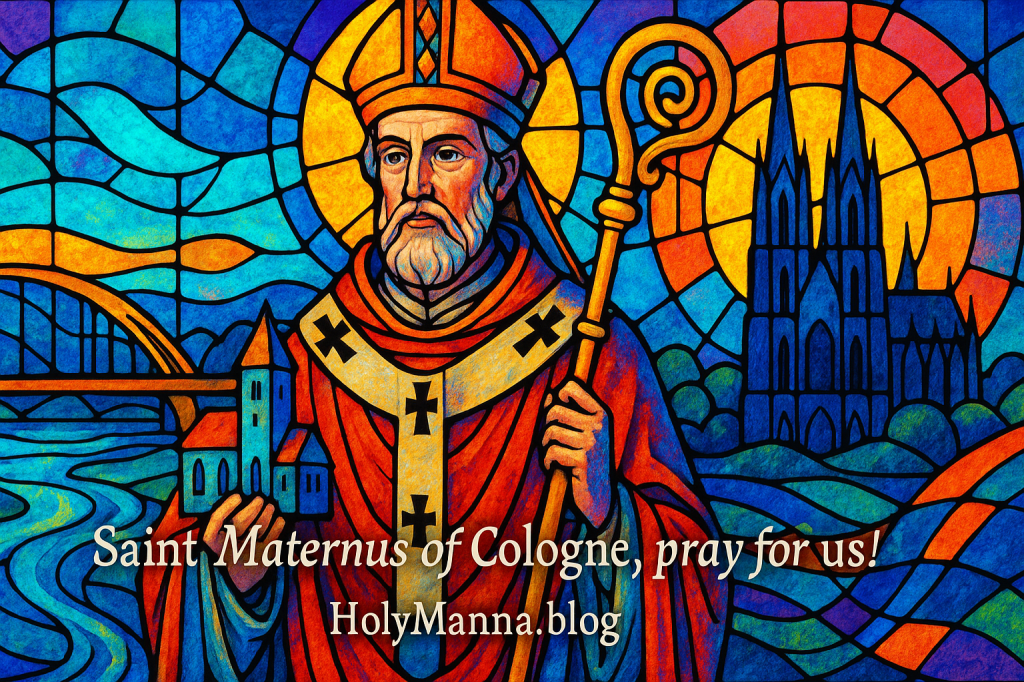
Shepherd of the Rhine and Guardian of Unity
Saint Maternus of Cologne emerges from the dawn of the fourth century as a steadfast bishop who helped the Church move from persecution into public life under Emperor Constantine. He is remembered as a shepherd who defended unity during the Donatist controversy and as a missionary founder whose name is linked with Cologne and, by long tradition, with Trier and Tongeren. Christians in the Rhineland honored him as a father in the faith because he organized the local Church, strengthened communion with Rome, and modeled a pastor’s heart for his people. No authentic writings or direct quotations from Saint Maternus have survived, so the Church preserves his memory chiefly through council records, local tradition, and enduring devotion.
Quiet Beginnings, Apostolic Zeal
Very little is securely known about Maternus’ birthplace or family, which was common for many early bishops outside Rome or Alexandria. What stands clear is his call to serve as bishop during a turning point in Christian history. In 313 he appears at Rome in a synod dealing with the Donatists, and in 314 he signs the acts of the Council of Arles, where bishops from across the West addressed schism and reaffirmed the discipline of the Church. These appearances make him the earliest firmly attested bishop of Cologne. Later legends place him alongside the early evangelizers of Gaul and the Rhineland and sometimes conflate him with a first-century missionary of the same name. Modern historians distinguish the fourth-century bishop from those earlier tales, yet even the legends underline how Christians remembered Maternus as a founder, a catechist, and a traveler for the Gospel. He is most known for steady leadership, loyalty to the apostolic faith, and labor for ecclesial unity.
Councils, Churches, and Charity
Maternus’ life reads like a blueprint for episcopal service at the moment when the Church first breathed freely after the persecutions. He traveled for synods, collaborated with brother bishops, and helped the faithful rebuild communal life as new churches opened their doors. He likely oversaw the formation of catechumens and the reconciliation of the lapsed, tended to widows and the poor, and organized the clergy who served the growing city of Cologne. In all of this, he embodied the apostolic succession described in the Catechism of the Catholic Church: “In order that the full and living Gospel might always be preserved in the Church the apostles left bishops as their successors. They gave them their own position of teaching authority.” CCC 77.
Hagiographic memory surrounding Maternus includes the famous story that, before his episcopate, he died in Alsace and was raised to life by the staff of Saint Peter, brought by his companions Eucharius and Valerius. Whether legendary or not, the tale expresses how early Christians saw his ministry. They regarded Maternus as a man raised up by God to reawaken faith, gather scattered sheep, and found stable communities. His most enduring “miracle” during life was the unity he helped secure. The Catechism captures what he strove to protect: “The individual bishops are the visible source and foundation of unity in their own particular Churches.” CCC 886.
A Confessor’s Burden in an Age of Tolerance
Maternus did not die a martyr. His hardships were the subtler and sometimes heavier trials of leadership in a changing world. The Donatists insisted that sacraments celebrated by clergy who had lapsed under persecution were invalid. Catholic bishops, including Maternus, upheld the Church’s perennial teaching that sacramental grace comes from Christ and not from the personal worthiness of the minister. The Catechism summarizes the principle that undergirded their judgment: “This is the meaning of the Church’s affirmation that the sacraments act ex opere operato, that is, by virtue of the saving work of Christ, accomplished once for all.” CCC 1128.
Beyond theological disputes, pastoral burdens pressed on him daily. He guided a flock now visible to the wider city, navigated new relationships with imperial authorities, cared for the vulnerable, and reconciled the wounded after the long night of persecution. His endurance was quiet but heroic. He shows us how to carry the cross without spectacle, trusting that Christ sanctifies the Church through ordinary fidelity.
Legends, Relics, and the Memory That Heals
After his death, devotion to Maternus spread through the churches that bore his name and through local art and architecture that celebrate his mission. Medieval memory associates him with the founding or early organization of ancient sees in Cologne, Trier, and Tongeren. Pilgrims in parts of present-day Belgium and Germany kept his memory alive, venerating churches dedicated to him and seeking his intercession for steadfastness in the faith. The staff-of-Peter legend continued to inspire prayer for healing and new life in Christ. Although there is no large body of early miracle records tied to his tomb, Maternus’ name became a point of unity for communities that asked God to renew the grace of their baptism and to keep the local Church faithful to the apostolic Gospel. In this we glimpse the communion of saints that the Catechism proclaims: “They do not cease to intercede with the Father for us.” CCC 956.
How Saint Maternus Teaches Us to Love the Church
Maternus’ legacy is a path for every Catholic who longs to be faithful in a distracted age. He teaches patient love for the Church, confidence in the sacraments, and docility to apostolic authority. Support your bishop and priests with prayer and encouragement. Learn the faith so that when confusion arises you can answer with clarity and charity. Seek reconciliation where there has been division, beginning in your own family and parish. Ask for Maternus’ intercession to be a builder of communion. The Catechism reminds us that Christ preserves the Gospel in his Church through the succession of bishops, and he calls each of us to receive that Gospel and hand it on whole and alive. “In order that the full and living Gospel might always be preserved in the Church the apostles left bishops as their successors.” CCC 77.
Engage with Us!
Share your thoughts and graces in the comments.
- Where do you see a need for healing and unity in your family, parish, or workplace, and how could you help build it this week?
- How might you pray for and support your bishop and priests so that they can shepherd with wisdom and courage, as Maternus did?
- What division or grudge can you bring to Jesus today, asking a grace of reconciliation through the intercession of Saint Maternus?
- What concrete step will you take to learn the faith more deeply so you can defend unity with charity?
Go forward with courage. Live the faith with humility, speak truth with love, and do everything with the mercy Jesus taught us.

 Holy Manna!
Leave a comment